Login
 Blog

OEE for High Pressure Die Casting: Shot Cycle, Die Changes and Scrap

Key takeaways
- Set the ideal cycle per die from the designed shot cycle, and count parts as shots times cavities.
- Die change and die heating with no shots are Availability losses; warm-up shots made at cycle are Quality losses.
- Short stops for spray, extraction and ladling hide in Performance unless the cell records them.
- Porosity found at machining or leak test belongs to the cell that cast the part: book it back to the die.
- Price scrap at the lost machine time plus remelt, and agree the pricing rule with your controller.
Cell 4 got its new die on the night shift, and the first shots went straight back into the furnace. The shift report has one line for it: die change. It does not show the spray faults before lunch, the castings the extraction robot dropped, or the housings that leak test will reject tomorrow for porosity. That is why the OEE of a high pressure die casting cell often reads better than the cell runs.
This guide is for plant managers, production managers and process engineers running cold chamber or hot chamber machines. It covers the ideal cycle time, how to split die changes, die heating and warm-up shots between the three OEE factors, the short stops, and how to bring trimming and late porosity rejects into the number.
Where the time goes on a die casting cell
A cell is a loop. The die closes, metal goes into the shot sleeve (cold chamber) or through the gooseneck (hot chamber), the plunger shoots and holds intensification pressure, the casting solidifies, the die opens and the ejector pins push it off. A robot or an operator extracts it, it is quenched and trimmed, and the die is sprayed and blown off before it closes again. Any station in that loop can stop the cell.
| Station | Typical stops and losses | OEE factor |
|---|---|---|
| Furnace and ladle | Low metal level, ladle not pouring, metal temperature out of range | Availability if long, Performance if short |
| Shot end | Plunger tip wear, shot sleeve sticking, tip lubrication fault | Availability |
| Die | Soldering, flash on the parting line, broken ejector pin, cooling line leak | Availability, Quality |
| Spray and blow-off | Clogged nozzles, spray program fault, extra spraying by hand | Performance |
| Extraction | Missed pick, part stuck on the ejector side, gripper fault | Performance |
| Trim press | Part not seated, trim die wear, broken castings | Availability, Quality |
| Die change and heating | Die swap, connections, heat-up before the first shot | Availability |
| Warm-up shots | Cold shuts and misruns until the die is at temperature | Quality |

The shot cycle as the ideal cycle time
Set the ideal per die, not per machine. One machine can run a two-cavity die and a four-cavity die with different shot cycles, and a machine-wide number makes one job look slow and the other impossibly fast.
Take the designed shot cycle from the die's process sheet, or the best stable cycle the die has held over a long run, never a good day's average. The ideal time per part is the shot cycle divided by the number of cavities. Keep it at full cavity count, so a cavity blanked off after damage shows as lost output instead of quietly lowering the target.
Spray and dwell belong to the designed cycle. When a crew lengthens the spray to fight soldering, the cycle stretches and Performance drops, which is the right signal. Our guide to setting the ideal cycle time covers the rules.
Die changes and die heating
A die change is a long internal job: disconnect the cooling and thermal lines, the vacuum and the ejector, swap the die, reconnect, change the shot sleeve and tip if the size differs, load the parameters and heat the die. Each minute with the machine stopped is an Availability loss.
Decide once how to book it. Some plants keep die changes inside planned production time as a loss; others plan a standard die change and treat the minutes over it as unplanned. Both work if the rule stays fixed. Hiding the whole change in planned time lifts OEE and stops anyone from shortening it.
Heating a cold die on the machine is time with no shots at all. Preheating the die before it is mounted turns that internal time into external time, the core idea of SMED, single minute exchange of die. So does staging the next shot sleeve, tip, spray program and gripper fingers before the last shot of the old job.
Warm-up shots are a Quality loss
The first shots on a die still below temperature fill poorly: cold shuts, misruns, flow lines. They run at cycle, so count them as produced and not good. That puts them in Quality, as start-up loss.
The same happens after a long stop mid-shift: the die cools and the restart needs more warm-up shots. So a long stop costs its own minutes plus the scrap after it. Add the warm-up shots to the stop that caused them, or long stops look cheaper than they are. Our article on start-up and shutdown losses covers this pattern.
If the cell has a warm-up mode or a scrap chute signal, count from it; if not, the operator enters the count at restart.
Short stops: spray, extraction and ladling
The losses nobody records are the short halts: a dripping spray nozzle, a casting hanging on the ejector side, a missed ladle, an operator clearing flash from the parting line. Each takes a minute or two, nobody writes them down, and the machine often still shows automatic mode while the cycle waits.
Set one stop threshold for every cell and let shorter halts show as Performance loss with a count and a length. Our guide to micro stops explains how to set it.
Where a camera watches the die area or the extraction, the clip from just before the stop shows what happened. The software suggests the likely reason and the operator confirms it in one tap. The camera cannot see inside the die or the casting, so porosity still comes from inspection.
Trimming and porosity found later
Where the trim press sits inside the cell, a trim stop blocks the cell, so log it as a cell stop with its own reason. Where trimming is separate, give it its own OEE. A casting that breaks in a worn trim die is a trim loss; one that cracks because it was ejected too hot is a casting loss.
Porosity is harder. Gas and shrinkage porosity are usually invisible at the cell and show up at machining, leak test or X-ray, often a shift or more later. If those rejects never come back, the cell's Quality reads high and the machining line takes the blame. Book them against the die and the shift that cast them, using a date stamp or marking where castings have one, and report two Quality figures: at the cell and final.
A worked shift on one cell
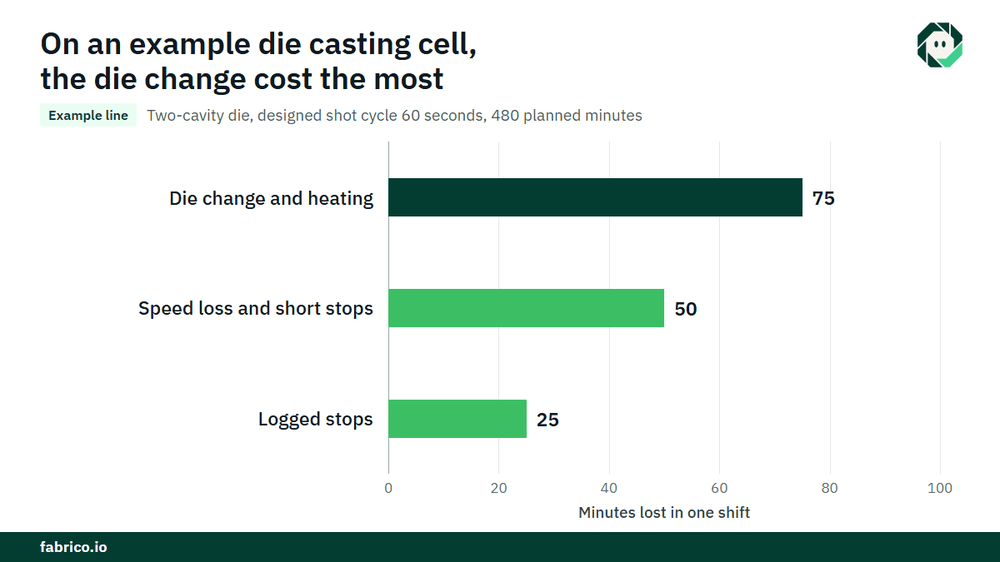
Sample line (illustrative numbers, not a customer): a cold chamber cell runs a two-cavity die with a designed shot cycle of 60 seconds, so the ideal time per part is 30 seconds. Planned production time is 480 minutes.
- Die change and heating took 75 minutes and logged stops 25. Run time is 480 minus 100 = 380 minutes. Availability is 380 / 480 = 79.2%.
- The cell made 330 shots, so 660 castings. At 30 seconds each that is 19,800 seconds, or 330 minutes of ideal time. Performance is 330 / 380 = 86.8%.
- At the cell, 24 castings from 12 warm-up shots and 16 trim and visual rejects were scrapped, leaving 620 good. Quality at the cell is 620 / 660 = 93.9%.
- OEE at the cell is 0.792 x 0.868 x 0.939 = 64.6%. Check: 620 x 30 seconds = 310 minutes, and 310 / 480 = 64.6%.
- Next shift, leak test rejects 30 castings for porosity. Final good is 590, final Quality 590 / 660 = 89.4%, and final OEE 590 x 30 seconds = 295 minutes, 295 / 480 = 61.5%.
- The 50 minutes of Performance loss are 100 castings (3,000 seconds / 30). At a contribution of $6.00 a casting, €6.00 in a euro plant, that is $600 (€600) a shift. The porosity adds 30 x $6.00 = $180 (€180), plus the machining already spent on them.
The die change, 75 minutes or 150 castings, cost $900 (€900), more than both. It becomes cash only if the extra castings sell or save overtime, so agree that rule with your controller.
What each data source sees
| Source | What it tells you | What it misses |
|---|---|---|
| Machine signal | Shot count, time per shot, when the cell stopped | Why it stopped, whether the casting was good |
| Operator input | The reason for a stop, scrap counts and reasons | Short stops nobody halts to enter |
| Camera on the die area | A clip as evidence of what happened at a stop | Anything inside the die or the casting |
| Downstream inspection | Porosity and internal defects | Which die and shift, unless castings are marked |
Mistakes plants make
- One ideal cycle per machine instead of per die.
- Counting shots as parts on a multi-cavity die.
- Folding warm-up shots into the die change.
- Leaving downstream porosity out of the cell's Quality.
- Pricing scrap at the selling price when the metal goes back to the furnace.
Where Fabrico fits
Fabrico is a computer vision enabled Manufacturing Performance Platform. On a die casting cell it starts with OEE and light MES: automatic downtime logging from the machine signal, OEE live by line and shift, and losses priced in money, so the die change, the spray stops and the scrap sit on one list.
- The operator confirms the reason for a stop in one tap.
- A camera clip as evidence for a stop, where a camera watches the die area or the extraction.
- Losses ranked by money, so the costliest die or stop type comes first.
- One view across plants if you cast in more than one.
- When a stop is a breakdown, a work order to the right technician with its cost.
Machines connect through a PLC, a Fabrico IoT device or a camera, so an older machine can still be measured. You start on one line, with a baseline and a decision date agreed in advance. Each plant gets a quote after a review of its lines. See how stops get their cause on our downtime tracking page.
Frequently asked questions
How do you calculate OEE for a die casting machine?
Multiply Availability, Performance and Quality. On a multi-cavity die, parts made is shots times cavities, and the ideal time per part is the shot cycle divided by the cavity count.
Should warm-up shots count as scrap in OEE?
Yes. They are made at cycle and they are not good, so they are a Quality loss. Heating the die with no shots is Availability, part of the die change.
Is a die change planned or unplanned downtime?
That is your plant's rule, and keeping it fixed matters more than the choice. Keep die changes inside planned production time as a loss, or plan a standard and treat the minutes over it as unplanned.
How do you include porosity found at machining in OEE?
Book the rejects back against the die and the shift that cast them, and report Quality at the cell and a final Quality once downstream results arrive.
What is a good OEE for a die casting cell?
There is no fair single benchmark: the die, the alloy, the cavity count and how you book die changes all move it. Compare each cell with its own baseline, die by die.
See your die casting losses in a demo
Bring one cell, one die and your current shift report. We will show where the minutes and the scrap go, and what they cost.
Latest from our blog