


 Login
 Blog

Computer Vision for Genset Manufacturing: Find the Station Holding Back Output

In short: computer vision for genset manufacturing pays off as a counter at the test bay doors, showing which station holds output back.
Vision systems sold to generator plants inspect welds, paint and nameplates; a counting camera only records when a set passes a door, which is the number OEE needs.
Key takeaways
- Tally sets in and out of the load bank test bay every shift, by kVA class, before buying any camera.
- A queue for one class means its test cell holds output; idle cells mean look upstream at coupling, crane and kits.
- Load, insulation and any contract emissions readings stay with the test bench, and weld and paint checks with inspection, outside Fabrico.
- The camera add-on counts sets. For a covered station, the minute of a stop is streamed on request and not stored in Fabrico.
A load bank logs every load step it runs on a set. It says nothing about the sets parked outside its cell, and those parked sets are where a genset order loses its week.
Count once in, once out: the test bay door tally by kVA class
First settle which station holds output back. In a genset plant the answer shows at the test bay doors, because every set, from a 20 kVA open skid to a 2 MVA canopied set, runs on a load bank before it ships. Note three numbers per shift and kVA class: sets in, sets out, and sets standing in front of the cells at shift end.
| Door tally over a week | What it means | Look next at |
|---|---|---|
| In equals out, floor empty, cells idle for part of each shift | The test bay waits for sets | Upstream: coupling bay, crane, kitting cage |
| In beats out for one kVA class, its cell busy all shift | That class's cell holds the queue | Its test plans and cell bookings |
| In beats out for every class | Test capacity as a whole is short | Test durations per type, the cell calendar |
| Sets standing at shift end while a cell sat idle | The cell waits on people or paperwork: a test engineer, the witness, the set's documents | The test bay's own hand-offs and the witness calendar |
| Out beats in for a few shifts, then the floor empties | A queue is being worked off | The station that stopped feeding it |
Count sets, not test runs: a set tested once for the plant and again for a witness passes the doors once each way. Tag each set with its kVA class from the build sheet, so a 1,500 kVA set and a 100 kVA set never share a number.
Sample numbers: two standard cells take sets up to 500 kVA, and a 60-minute standard test in 450 planned minutes allows 14 sets a shift between them. A high-power cell takes the large sets. If the small-set line releases 10 a shift, the standard cells keep up with room to spare. If the large set bay sends two a shift and the high-power cell releases none for a week, ten large sets stand at the doors by Friday.
Explainer presented by Iris, Fabrico's AI-generated presenter: how an add-on camera counts output where a machine has no signal. Book a demo.
Plays from YouTube. Google may set cookies when you press play. Privacy policy.
Why the high-power test cell holds the queue
A plant with a wide range builds two products under one roof: paced small sets and large sets in bays. They share the test bay, and the high-power cell is usually the one resource with no twin. The load bank rating, cooling and cable connection a multi-megawatt set needs are rarely built twice, and its nameplate capacity hides the days one project holds it. Whatever occupies it sets the pace for every large set behind it.
Data centre work fills it. The Engine Technology Forum, an engine industry advocacy group cited here for descriptive facts only, notes that a small data center can require five to 20 megawatts of power, while a larger data center can require 100 or more megawatts. One project can hold the plant's high-power test cell for weeks while the large sets behind it queue at the doors.
Those sets bring their own rules. Data centre generators are specified to meet the exact requirements of the data center operator in terms of electrical generating capacity, emissions performance requirements, fuel storage capacity, and other key parameters, so an order can carry its own test plan and a witness test, the buyer's version of a factory acceptance test. Give each test type its own ideal duration, so a witness day does not read as a slow cell.
Sets for North America add work at the same cell. The UL summary of the third edition of ANSI/CAN/UL/ULC 2200 says it removes the earlier 600 V cap so that medium-voltage generators can be certified, and asks manufacturers to be prepared to provide a safety risk assessment for the stationary generator. Make a listed variant its own item, with its own panel build, test steps and pace.
Because test durations vary from an hour to a whole witness day, book that cell on a calendar, the approach in finite-capacity scheduling without an APS. An hour lost on it is an hour lost for every large set in the plant; an hour lost at a bay that waits for it is mostly free time. Weekend shifts help only if they staff that cell (see the overtime and weekend shift diagnostic).
Load, insulation and any contract emissions readings stay with the test bench and the test engineer; Fabrico counts sets and stop time.
Trusting a camera tally at the doors: what studies show and where it fails
Martinez Rodriguez and colleagues (Automation in Construction, 2021) show that existing security cameras can read whole days: their method examines entire production days recorded by CCTV cameras, while providing the durations of each task, its required resources, and the task efficiency per panel with high accuracy, at floor panel manufacturing stations.
Panahi and colleagues (Sensors, 2023) show where it fails. Watching modular construction stations on CCTV, they traced their errors to false negatives caused by the occlusions commonly caused by walls, bath pods, and other components, and their method misclassified a few frames with a greater number of workers in the image. Their line had no buffers; the floor in front of the cells is one.
Neither study counted sets through a door, so neither gives a figure a genset plant could borrow, and Fabrico has no approved accuracy figure. At the doors the same failures look like a set hidden under a crane load, two sets side by side, or a group of fitters in the exit. Check the tally against the test bench log and a hand count for a week before pricing anything from it (see how accurate a camera part count is).
One example plant, drawn as a flow
Read the tally against the flow: two feeders meet at coupling, two bays share one hook, and everything passes one set of test bay doors.
Upstream suspect: the coupling bay, its alignment check and its kits
When the standard cells stand idle for part of a shift, look upstream, and the first station is coupling. Engines and alternators arrive from their makers and meet on the base frame. A single-bearing alternator is bolted to the engine flywheel housing through an adapter and flexible coupling discs; a two-bearing alternator needs a coupling and an alignment check with a dial gauge.
Alignment is the bay's own gate. When the dial gauge shows a coupling out of tolerance, the set is re-aligned in the bay before release: rework at the coupling bay, booked once there and kept out of the good count. A set the load bank later sends back with high vibration is booked the same way, once, at the bay that caused it.
Each alternator frame size also needs its own adapter kit from the kitting cage, and a missing kit stops the bay. A camera add-on over the coupling exit counts sets out. If the standard cells idle in the hours this count goes flat, coupling holds the small-set range, and its losses are worth pricing.
Upstream suspect: one crane hook for two bays
Engine and alternator go onto the frame by overhead crane. The UK Health and Safety Executive's guidance notes that routine lifting operations which are a little more complex may need to be planned each time they are carried out, and lowering an engine onto its mounts with a slinger guiding it is that kind of lift in a UK plant. A planned lift is a booked resource.
Where the coupling line shares the hook with the large set bay, the line waits each time a 1,500 kVA engine is being lifted next door. Researchers at Chalmers who pooled OEE data from 23 companies reported an average OEE of 65% across 884 machines, with almost half of the recorded losses impossible to classify and 90% of the classified stop time linked to operators' supporting tasks, not to the automatic process. A crew waiting for the hook is that support time.
With a count at the coupling exit, the wait shows within the hour as a gap, and the fitter names it as a crane wait on the tablet. The crane holds output only if the tally agrees: the coupling count drops while the large bay's lifts run, and the standard cells idle soon after. Then the fix is lift planning, not faster fitters, one of the cases in how to identify and eliminate bottlenecks.
The control panel is the last feeder to check. The Engine Technology Forum describes a data centre generating set as an internal combustion engine connected to an alternator, a belly fuel tank, and a controller unit that switches the set on and off and transfers power between the data center, the grid and the generator. In the plant, the controller goes into a panel with a breaker, relays and a harness to the engine sensors, wired in its own area (see OEE for wire harness assembly). A camera add-on over the finished panel rack counts panels ready to fit. Standalone switchgear is covered in computer vision for switchgear and electrical equipment.
Canopy fit-out and container builds: slow lanes, not the constraint
In this example plant, canopied sets get acoustic panels, doors and foam in a fit-out bay after the test; plants that test inside the canopy move fit-out ahead of the doors and count it as an upstream suspect. Panels are cut, bent and coated well ahead (see OEE for press brakes). Here fit-out looks slow, but it sits after the doors: if it ran behind, sets would stand at its entrance, not at the cells.
Data centre sets are a different build: the Engine Technology Forum describes typical data center generator units as a shipping container, a self-contained structure that houses the engine, generator, and fuel storage. For those sets, fuel storage is typically a double-wall, spill containment belly tank integrated underneath the engine, so the welded frame must pass a leak test on the rig before coupling; the rig records that, not the counter. A container fit-out occupies one bay for days, so the fitters book stages as they close them and OEE is read by bay and day.
At crating, a camera add-on counts sets crated; a shortfall against sets tested means a set waits for a part or a document.
A coupling bay shift, read against the queue
Sample numbers, no real plant. The door tally for the 60 to 200 kVA class shows the standard cells idle for part of most shifts, so the coupling bay, with a crew of three fitters, holds that range. The shift runs 06:00 to 14:00; less a 30-minute break, it plans 450 minutes. Ideal pace for this range: 34 minutes from frame on the stand to set lifted out. The camera add-on counts sets out; fitters enter stop reasons on a tablet.
Availability. The crane was tied up for 42 minutes lifting a 1,500 kVA engine in the large set bay, and the flywheel adapter kit for the next alternator frame size was missing from the bay for another 34. The bay ran 374 of 450 minutes: 83.1%.
Performance. At 34 minutes a set, 374 minutes allow 11 sets. The camera add-on counted 10 leaving the bay: 90.9%.
Quality. One set failed the bay's own alignment check before release: the dial gauge showed a two-bearing coupling out of tolerance. Re-aligned in the bay, it is rework: 9 of 10 good first time, 90.0%.
OEE. 374/450 x 10/11 x 9/10 = 68.0% (83.1% x 90.9% x 90.0% on rounded figures). Cross-check: 9 good sets x 34 minutes = 306 of 450 planned minutes, 68.0%.
The 34 slow minutes, one set, came mostly after the switch to an order's two-bearing alternators, uncommon in this range, which need alignment readings. Give them their own item and ideal cycle time, so the bay is not called slow for building what the order specified.
What the lost time costs
Lost: 144 of 450 minutes, of which 76 standing, 34 slow and 34 on the re-aligned set. The shift had room for 13 sets (13 x 34 = 442 minutes) and released 10: standing and slow time cost 3 sets; the re-aligned set still left the bay and cost crew time only.
- Margin, example input: EUR 1,800 contribution margin per canopied set in this range gives 3 x EUR 1,800 = EUR 5,400 per shift, or EUR 1,242,000 across 230 single shifts a year. That figure holds only while orders queue for the line (see the capacity release business case); with spare capacity the minutes cost wages, not sales.
- Labour, sourced rate: three fitters standing or slow for 110 minutes is 5.5 paid hours. At the EU industry average hourly labour cost of EUR 33.9 for 2024 reported by Eurostat, that is EUR 186.45 per shift. The re-aligned set adds 34 minutes of crew time, 1.7 hours or EUR 57.63. Together EUR 244.08 per shift, EUR 56,138.40 over 230 shifts.
The 76 standing minutes alone are 2 sets, EUR 3,600 at the example margin, and neither is the crew's doing: the crane wait comes from lift planning, the adapter from kitting. In Fabrico, losses are priced from each item's own price or margin, entered once per set type.
What to count first, by kVA class
A plant building from 10 kVA to several megawatts does not need the same count everywhere. The first count goes where the tally says each class queues. These bands are an example; rebalance with line balancing once the counts are in.
| kVA class (example bands) | Where the queue usually forms | Count first |
|---|---|---|
| 10 to 100 kVA | At coupling or kitting; the cells keep up | Camera add-on at the coupling exit and the panel rack |
| 100 to 500 kVA | At the crane or the standard cells | Camera add-on at the test bay doors, then the coupling exit |
| 500 kVA to 2 MVA | In front of the high-power cell | Camera add-on at the doors; the test bench log for runs |
| Multi-MW and containers | The high-power cell and the witness calendar | Operator stage sign-off and the test bench log |
Halls that mix paced lines and bays are handled in OEE on manual and hybrid assembly lines. The station card below sorts all fifteen stations by who keeps the count.
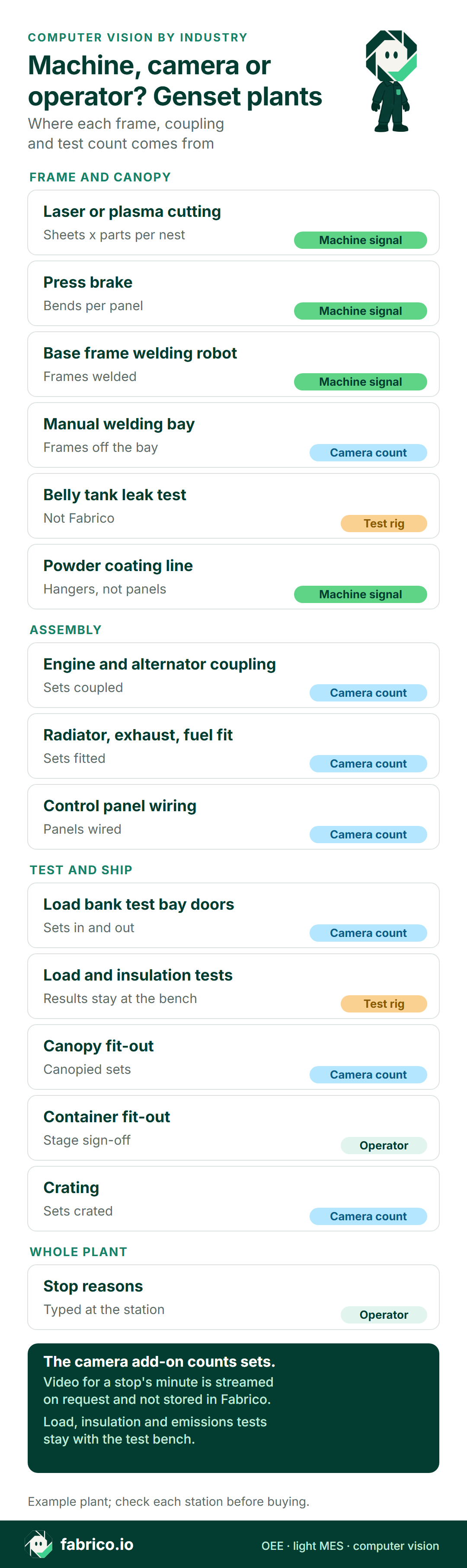
Text version of this infographic
- Frame and canopy: Laser or plasma cutting: machine signal, sheets x parts per nest
- Frame and canopy: Press brake: machine signal, bends per panel
- Frame and canopy: Base frame welding robot: machine signal, frames welded
- Frame and canopy: Manual welding bay: camera count, frames off the bay
- Frame and canopy: Belly tank leak test: test rig, Not Fabrico
- Frame and canopy: Powder coating line: machine signal, hangers, not panels
- Assembly: Engine and alternator coupling: camera count, sets coupled
- Assembly: Radiator, exhaust, fuel fit: camera count, sets fitted
- Assembly: Control panel wiring: camera count, panels wired
- Test and ship: Load bank test bay doors: camera count, sets in and out
- Test and ship: Load and insulation tests: test rig, results stay at the bench
- Test and ship: Canopy fit-out: camera count, canopied sets
- Test and ship: Container fit-out: operator, stage sign-off
- Test and ship: Crating: camera count, sets crated
- Whole plant: Stop reasons: operator, typed at the station
- Footer: the camera add-on counts sets; video for a stop's minute is streamed on request and not stored in Fabrico
- Footer: load, insulation and emissions tests stay with the test bench
This week: compare last week's coupling build sheets with the load bank log, shift by shift; ask the crew how often the large set bay had the hook; agree with the works council which doors a camera may view.
Book a demo to see the test bay doors and coupling bay on one shift view.
Fabrico at the test bay doors and the coupling bay
For a genset maker, Fabrico is cloud OEE with light MES on top:
- Test bay doors, coupling, fit, panel rack, fit-out, crating: the camera add-on counts sets and panels as they pass. If the coupling bay halted at 09:20, the team lead clicks that stop in the shift timeline and the camera add-on streams that minute's video on request, and the video is not stored in Fabrico.
- Cutters, brakes, welding robots: counts are read from the machine control or a sensor.
- Items: kVA class, build type and test plan each carry a pace, so a 60 kVA open skid and a 200 kVA canopied two-bearing set are judged separately.
Fitters, wiremen and test engineers give the stop reason on a phone or tablet. OEE and losses in money appear per station and shift on web, iOS and Android; a REST API, webhooks and Excel or CSV files carry the data out. For the wider choice, see how to evaluate OEE software; for turning counts into a constraint view, real-time OEE for bottleneck analysis.
Roadmap: a camera add-on that notices an idle coupling bay by itself and proposes a likely cause, which the fitter confirms or changes.
Outside Fabrico: weld and paint inspection, tank leak tests, load bank, insulation and emissions results, and the certification file.
Five checks to put to any supplier, Fabrico included, against one week of build sheets and the load bank log:
| Check | A sound reply |
|---|---|
| Can the test bay doors be counted in and out, by kVA class? | Yes, with the class set on the item, so the queue per class is a number. |
| How is a set re-aligned in the bay counted? | Once, under rework at the coupling bay; good sets are not touched. |
| Can a crane wait be told apart from a missing kit? | Yes: the fitter picks the reason, and each has its own code. |
| Who may open bay video, and from where? | A short list of named roles, only by clicking a stop in the shift timeline, agreed in writing with the works council. |
A camera at the doors sees the crews who pass under it. For the EU, the European Data Protection Board's video device guidelines say works agreements and other collective agreements may lay down specific rules for employee data, and add that consent is in most cases the wrong basis for an employer. Tell the crews and the works council what is counted before any bracket goes up; report per bay and shift, never per person. Practical steps: production line cameras without surveillance. The add-on itself is on Fabrico computer vision for OEE.
Genset constraint FAQ
Where should a genset plant put its first camera?
Over the load bank test bay doors, counting sets in and out by kVA class. The tally shows whether the next belongs at the coupling exit.
Should the load bank or a camera count tested sets?
The load bank, wherever its controller can be read: it knows which set ran and for how long. A camera add-on earns its place in front of the bay, counting sets in and out, so the queue that the bench never sees becomes a number.
How is a set counted that fails the alignment check or the load test?
Once. It goes back to the bay that caused the fault, for example coupling for a re-alignment, and is booked there as rework, so no bay is credited twice for it.
Does a camera add-on make sense for multi-megawatt container sets?
Rarely on the build itself, which takes days in one bay and is better tracked by stage sign-offs from the fitters. It still helps at the test bay doors, where a large set that holds a cell for a long run makes the queue behind it grow.
Will a camera at the test bay doors film the crews?
Anyone who walks through its view, yes. Aim it at the floor line of the doors rather than into the cells, report per bay and shift, and settle the framing with the crews and the works council first.
Want to see the test bay queue and the coupling bay counted on one shift timeline? Book a demo.
Related articles






Real Fabrico tiles, sample data.