


 Login
 Blog

Computer Vision for Truck Body Building and Trailers: Find the Bay That Holds the Line

In short: computer vision for truck body building finds the bay that holds a trailer line back, by counting units into and out of each bay against takt.
- The constraint shows as a queue: units wait in front of it, and the bays after it wait for work.
- The usual suspects are a late axle set or chassis, option trailers in the wiring bay, and fit-out on heavily optioned units.
- Fabrico does no inspection. Weld, paint, brake, light, alignment and insulation tests keep their own rigs and records.
- Fabrico's camera add-on counts units leaving a jig or bay; the minute of a stop is streamed on request and not stored in Fabrico.
Computer vision for truck body building finds the slow bay: a camera counts units leaving each bay, and the gaps against takt name the constraint.
Inspection cameras judge welds, paint and lamps; a counting camera only records units leaving a bay, and the hunt below needs nothing more.
Cutting and weld cells in general have their own guide in computer vision for metal fabrication, and car tier suppliers in computer vision for automotive parts. The subject here is one question for body builders and trailer plants: which bay sets the day's output?
Computer vision for truck body and trailer plants: which bay holds the line?
A trailer line builds a handful of units a shift. NTEA, the US work truck association, notes that commercial vehicles are primarily designed and produced individually, on a custom-order basis, in a multi-stage process that runs through chassis makers, body and trailer builders and distributors. Work content changes from unit to unit, and so does the bay that runs out of time.
The cost of not knowing is large. An Iowa State University case study of a side-dump semi-trailer final assembly line, built in two static stations, found a required takt of 761.2 minutes per trailer and a measured one of 891 minutes, 129.8 minutes behind. When one bay overruns by two hours, every bay behind it loses those two hours, and the shift report rarely says where they went.
Plant teams usually have a suspect: the axle supplier, the electricians, fit-out. Counting shows which one is right most days; see bottleneck versus constraint and the theory of constraints for why fixing any other bay leaves output where it was.
Explainer presented by Iris, Fabrico's AI-generated presenter: how an add-on camera counts output where a machine has no signal. Book a demo.
Plays from YouTube. Google may set cookies when you press play. Privacy policy.
The queue test: count once at every bay boundary
A constraint has a simple signature. Units reach it faster than it releases them, so a queue forms in front of it and the bays after it wait for work. Counts at the bay boundaries show both halves.
Where bays touch, the exit of one bay is the entry of the next, so one count at each boundary does both jobs. Where there is a buffer, count into it and out of it: painted frames in the yard, chassis cabs waiting for mounting, reefer boxes curing on their jig. The difference is the queue.
| What the counts show | What it means | Book it as |
|---|---|---|
| Painted frames pile up and the axle bay exits late | The axle bay or its axle sets hold the line | Axle set late, or a slow axle bay |
| The axle bay is on time; the wiring bay exits late on some units | Option content in wiring | An option group with its own ideal time |
| A bay stands empty while the bay before it is full | Starved by the bay upstream, not slow | Waiting for a unit |
| Every bay waits, then all move together | A pulse line held by one bay | The bay that held the move, booked by the line lead |
Read the test over a week. A queue that is there every morning is the constraint; one that empties within the shift is variation. Queues grow faster than intuition says as a bay nears full load, as the Kingman formula for queues shows, so a bay at 90% of takt can still hold the line on a day with three option units in a row.
Pulse line or build bays: where the count goes in each
Pulse lines
On a pulse line every unit moves one bay forward at the same moment, when every bay is done. All bay exits show the same time, so the useful number is the interval between moves against takt. The line lead books the bay that held a late move as the stop reason, and a week of reasons gives the ranking. A camera add-on at the last bay counts the moves.
Static build bays
Many plants build in static bays, where a unit stays for hours. The Iowa State line had two such bays; in the study's words, "the assembly line can hold only two workstations". Counts in and out give time in bay against takt, and the gap between one unit leaving and the next arriving is a loss of its own. There, after a trailer was pulled out, "It usually takes about 45 min for one operator to get all these parts pulled up", and production stopped while the other three waited. A camera add-on at the bay mouth sees that gap; the reason, waiting for kit, comes from the crew, and the changeover time guide covers how to shrink it.
Body builders start from a chassis cab built by a truck maker, and the subframe and body go on in a mounting bay. In the US this is written into the rules for vehicles built in stages: 49 CFR Part 568 lets the chassis maker's incomplete vehicle document incorporate "body builder or other design and engineering guidance", and the final-stage manufacturer must complete the vehicle so that it conforms to the applicable safety standards.
Suspect one: the late axle set or chassis
Axles, air suspension, brake chambers and the brake control module go on in the axle bay, in some plants while the frame is still upside down, before a turnover station flips it. The axle sets are usually bought in, on a supplier schedule the crew does not control.
The queue test separates a late axle set from a slow axle bay. When the set is late, painted frames build up in front of the bay, the crew stands ready, and the floor bay runs out of work: book it as axle set late, an availability loss. When the set was there and the bay still exits late, the loss sits in the bay: a crane wait, a turnover that needs two people.
For a body builder the same test runs on chassis. A mounting bay with a crew and no chassis is a loss, but not slow work: book it as chassis not delivered, so a month of late chassis is never blamed on the crew. Planners can then put real arrival dates into finite capacity scheduling.
Suspect two: option variants in the wiring bay
The wiring bay fits the harness, the lamps and the brake system cabling, and its content swings more than any other bay. A city trailer with standard lamps and a long-haul unit with extra marker lamps, a second rear socket and work lights are not the same job. Conspicuity marking is not optional either: in the US, 49 CFR 393.11 requires trailers 80 inches or wider with a GVWR over 10,000 pounds built since December 1993 to carry retroreflective sheeting, reflex reflectors or a combination of both.
The Iowa State line offered "over 45 different models and 500 different options", and the study found only 38% of the final assembly work value-added. One ideal time per bay then lies twice: it calls the bay slow on every optioned unit and fast on every plain one. Group the options into a few ideal times per bay, as in OEE per SKU, and the counts start to mean something; harness work in depth is in OEE for wire harness assembly.
Late exits only on option units point to the ideal times or the kit; late exits on every unit point to staffing or the work split with fit-out. Both show up as a cycle time deficit, and only the counts tell them apart.
Suspect three: fit-out, the last bay before inspection
Fit-out adds curtains or doors, mudguards, toolboxes, a tail lift, the refrigeration unit on a reefer, and the rear guard: US FMVSS No. 224 requires rear impact guards on trailers and semitrailers with a GVWR of 4,536 kg or more. Every upstream delay lands here, so fit-out looks guilty more often than it is. Use the queue test: if units wait in front of fit-out, it is the constraint; if fit-out waits for units, the cause is upstream.
Reefer boxes are bonded from sandwich panels on a jig that stays occupied while the bond cures, so a count of boxes off the jig shows whether fit-out waited for one. Under the US rules for the ATP agreement, 7 CFR Part 3300 defines an insulated body as "the six-sided structural component of equipment, consisting of insulated doors, sidewalls, roof, floor, and endwall". For an ATP certificate, insulation is proved by a K-coefficient test at an approved testing station, and a tested reference body can serve as the basis for approving serially produced bodies. That test is not Fabrico's job.
The pre-delivery check closes the line: brake test, light check, alignment record, VIN and certification label, kept in their own systems (the split is explained in inspection versus testing). A unit that fails goes back to a bay, and that rework is the quality loss; it is not a first pass, and it counts once, when it leaves the second time. The camera add-on at the fit-out exit counts finished units, the line's output figure.
Cleared before the hunt: machines that already report
Some stations can be cleared without a camera. Laser and plasma cutters, press brakes and roll formers log programs and strokes. Trailer main beams are often welded from flange and web on an automatic beam welding line, and crossmembers on robot weld cells; their controls know run state and cycle counts. Connect that signal and book program changes, wire changes and crane waits by reason, as in OEE for robotic welding cells.
Shot blasting, a cathodic dip (e-coat) line, the paint booth or the powder line run on their own controls, and their PLCs already hold the cycle data. In the US, 29 CFR 1910.107 requires electrical equipment in a spraying area to be explosion-proof, approved for Class I, Division 1 hazardous locations. So any count goes at the booth exit, agreed with the site's safety lead.
The manual frame weld jig is the exception in this group. Welders fit crossmembers, the kingpin plate and landing gear mounts by hand, and the crane lifts the frame out to blasting; only the build sheet records it. A camera add-on above the jig exit counts frames lifted out, not arcs, sparks or people, and shows whether the frame shop ever starves paint.
Worked example: the shift the wiring bay held back
Example numbers, no real plant. A curtainsider semi-trailer line works a nine-hour day shift, 06:00 to 15:30 with half an hour for the break, so it is planned for 540 minutes. The bays work to a 60-minute takt, so the ideal output is 9 trailers. The camera add-on counts trailers leaving the fit-out bay and the moves out of the wiring bay, the team lead types the stop reasons, and the pre-delivery check logs its results.
Availability. The line stood 55 minutes because the axle set for the third trailer arrived late from the supplier, and 20 minutes for a model change at the axle bay, from the standard curtainsider to a shorter city version. Stops were 75 minutes, so run time was 465 of 540: 86.1%.
Performance. Seven trailers left the fit-out bay. Seven times 60 minutes is 420 takt minutes from 465 minutes of running: 90.3%. The 45 slow minutes are in the wiring bay counts: three trailers left it about 15 minutes late each, and all three carried extra marker lamps and a second rear socket.
Quality. One trailer failed the light check at the pre-delivery check on a swapped pin in a lamp plug and went to the rework bay. Its 60 takt minutes leave the good figure: 360 of 420, or 85.7%. On seven units one rework moves quality by 14 points, so judge it over the week.
OEE. 86.1% x 90.3% x 85.7% = 66.7%, worked from the unrounded ratios. Cross-check: 360 good takt minutes of 540 planned minutes is 66.7%.
Which bay held the line. Of the 180 lost minutes, 55 sat with the axle supplier and 20 with the model change. The other 105, the 45 slow minutes and the 60 of rework, both came out of the wiring bay. The wiring bay exit counts show that the three late moves were the option trailers, and the line lead booked the cause: each extra lamp kit came from stores after the trailer reached the bay. The axle wait belongs to the supplier schedule, not the crew, and the lighting option needs its own ideal time.
In money. The 180 minutes between 360 and 540 are three trailers at the 60-minute takt. Take EUR 6,000 of contribution per curtainsider as an example input; a plant puts in its own. While the order book is full, the two unbuilt trailers are EUR 12,000 of contribution for one shift; the reworked one ships, so price its rework at crew time. The 55-minute axle wait alone is EUR 5,500, the figure for the axle supplier. Fabrico values every loss from the plant's own SKU price or margin in the same way.
The fix list follows from that split: lamp kits staged before the trailer enters the wiring bay, an option-group ideal time, a pin check before the unit leaves, and the axle minutes on the next supplier review.
The limits of a bay-exit camera
| Job in a body or trailer plant | Done today by | Bay-exit camera? |
|---|---|---|
| Check the welds on a kingpin plate | Weld inspector, NDT | No |
| Test brakes, lights and axle alignment | Test rigs at the check | No |
| Count frames lifted off a weld jig | Build sheet tick | Yes |
| Count units into and out of a bay | The shift report | Yes |
| Show the fit-out bay during an 11:20 stop | A note from the team lead | Stream the minute of that stop on request |
No published test covers camera counting in a trailer plant, but the closest one is useful. A peer-reviewed study in Sensors (2023) watched a modular construction factory "where modular units move from one station to the next during the production process", much like a trailer line. On 420 hours of video from seven stations, its method gave "96% accuracy in identifying the occupancy of the workstations and an F-1 Score of 89%" in identifying the state of each station.
"The precision is smaller than the recall due to the larger number of false negatives caused by the occlusions". The authors also warn that a station judged busy can be wrong: "This assumption can be violated in cases where workers are present at an occupied workstation but are not working." And "the scope of this study is limited to buffer-less assembly lines", while most trailer plants have a yard of painted frames. It measured occupancy, not unit counts, and Fabrico states no accuracy figure of its own.
So count units crossing a bay exit, not activity inside the bay; occupied is not working, which is why the reason comes from the crew. Mount high over the exit lane, clear of cranes, tail lift pallets and spatter. Price nothing from the camera until a week of its counts matches the build sheet, as set out in how accurate camera OEE is.
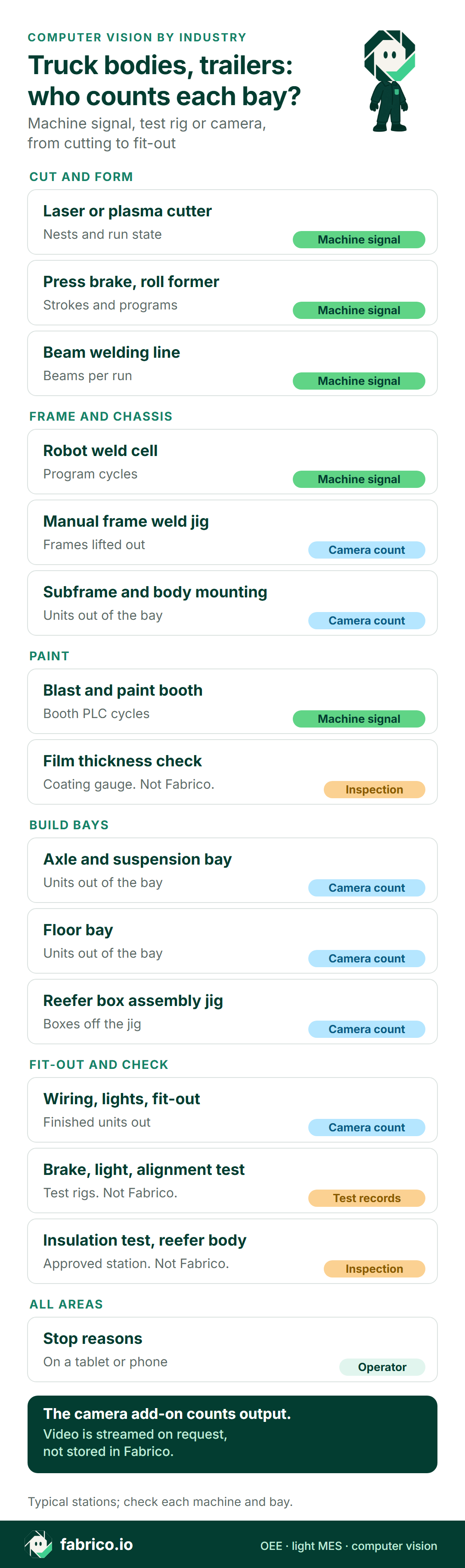
Text version of this infographic
- Cut and form: Laser or plasma cutter: machine signal, nests and run state
- Cut and form: Press brake, roll former: machine signal, strokes and programs
- Cut and form: Beam welding line: machine signal, beams per run
- Frame and chassis: Robot weld cell: machine signal, program cycles
- Frame and chassis: Manual frame weld jig: camera count, frames lifted out
- Frame and chassis: Subframe and body mounting: camera count, units out of the bay
- Paint: Blast and paint booth: machine signal, booth PLC cycles
- Paint: Film thickness check: inspection, not Fabrico
- Build bays: Axle and suspension bay: camera count, units out of the bay
- Build bays: Floor bay: camera count, units out of the bay
- Build bays: Reefer box assembly jig: camera count, boxes off the jig
- Fit-out and check: Wiring, lights, fit-out: camera count, finished units out
- Fit-out and check: Brake, light, alignment test: test records, not Fabrico
- Fit-out and check: Insulation test, reefer body: approved test station, not Fabrico
- All areas: Stop reasons: operator, on a tablet or phone
- Camera add-on: counts output; video is streamed on request, not stored in Fabrico
Book a demo to see frame jigs, build bays and the fit-out exit counted on one shift timeline.
Vendor and works council checks before the first bracket
Ask each shortlisted vendor these questions, with last week's build sheets and the takt plan on the table.
| Ask the vendor | A sound answer |
|---|---|
| Can it count moves out of each bay on a pulse line? | One count of line moves at the last bay, with the line lead booking the bay that held a late move as its stop reason. |
| Can it count into and out of a buffer, such as the frame yard? | Two counts and the difference as the queue, per shift. |
| How does a counted unit earn bay takt? | An ideal cycle time per model or option group, set against the bay. |
| How is a late chassis or axle set booked? | Its own stop reason, kept apart from slow work. |
| Where is the video sent, and who sees it? | A data flow on paper, and counts per bay and shift. |
A camera over a jig or a bay will see people. Explain to the crews, and to the works council where there is one, why the count exists before a single bracket is fixed. German plants have no choice here: the Works Constitution Act, section 87, lists technical devices designed to monitor employee behaviour or performance as a co-determination matter, so the council agrees before the camera goes up. Point the lens at the jig or bay exit, not at the work, and report counts by bay and shift, not by name.
The Fabrico camera add-on counts frames and units, not people.
Where Fabrico fits on a body or trailer line
Fabrico is a cloud OEE platform with light MES functions. In body and trailer plants it covers three jobs today:
- At cutters, press brakes, beam welding lines and robot cells it reads run state and cycle counts through the controls, so program changes and crane waits appear as stop minutes, and the crew adds the reason.
- At frame jigs, build bays and fit-out the camera add-on counts frames lifted out and units leaving each bay. If the fit-out bay stood still at 11:20, the video for the minute of that stop can be opened from the shift timeline, streamed on request from the add-on and not stored in Fabrico.
- Against takt you set each model's ideal cycle time to the bay takt, so a counted unit earns its takt minutes.
Welders, fitters and electricians add stop reasons from a tablet or a phone. OEE and losses appear per bay and per shift, with each loss valued in money, in the browser and the iOS and Android apps. Data leaves through the REST API, webhooks, or Excel and CSV exports. Routings and job tracking for the fabrication side are covered in MES for metal fabrication.
Roadmap, not live today: the camera add-on flagging a bay where a unit sat past takt, with a proposed cause.
Outside Fabrico: weld inspection, film thickness, brake, light and alignment tests, insulation tests on reefer bodies, VIN and certification labels, and the build record of each unit.
For the product, see Fabrico computer vision for OEE; the wider buying guide is OEE software.
Questions trailer and body builders ask next
Which bay usually holds a trailer line back?
On many lines it is the wiring or fit-out bay on heavily optioned units, or the axle bay when axle sets arrive late. Count units into and out of each bay for a week first; the bay with the queue in front of it is the answer.
How do you count a pulse line where every bay moves at once?
Count the moves at the last bay against takt. When a move comes late, the line lead books the bay that held it as the stop reason, so a week of reasons shows which bay holds the line most often.
Where do the first two cameras go?
At the exit of the bay you suspect and at the fit-out exit, which gives the line's output.
Want to see which bay holds your trailer line, counted against takt on one shift timeline? Book a demo.











Real Fabrico tiles, sample data.