


 Login
 Blog

Computer Vision for Gas Cylinder Manufacturing: 9 Ways the Output Count Goes Wrong

In short: computer vision for gas cylinder manufacturing counts cylinders where no machine does: at valve-fitting benches, test-area entry and pallets, so the output number stops drifting.
It counts; it does not inspect. Pressure, leak and weld results stay with the test rigs and inspection, and Fabrico does no inspection (see inspection vs testing).
- Nine miscounts recur on a welded LPG cylinder line; the table names each one, its fix and the station that owns the count.
- Rig cycles are not cylinders: a repeated test or a reheated reject passes the rig twice.
- Lot samples and weld retest cylinders are planned removals with their own code, never scrap.
- Requalified cylinders back for periodic inspection run as their own orders, or they inflate new-build output.
- Fabrico's camera add-on counts cylinders at valve fitting, the test-area entry and palletising, where no machine counts.
- Where a camera add-on covers a station, the video for the minute of a stop is streamed on request and not stored in Fabrico.
This audit covers welded steel cylinders for LPG, propane and refrigerants, from coil to pallet. Seamless high-pressure and composite cylinders are built on other lines and are left out. Which rules apply depends on the market. In Europe, EN 1442:2017, as listed by the Irish standards body NSAI, sets the minimum requirements for the design, construction and testing during manufacture of welded steel LPG cylinders of 0.5 to 150 litres. In the US, DOT 4BA cylinders are built to 49 CFR 178.51, and ISO 4706:2023 covers welded cylinders mainly for industrial gases.
The gas cylinder miscount table: nine errors and their fixes
Each row is a way the shift's cylinder number goes wrong, the station that should own that count, and the fix. The sections below take them in order.
| Miscount | Station that owns the count | Fix |
|---|---|---|
| 1. Rig cycles read as cylinders tested | Pressure test rig | Count cylinders at the test-area entry; keep rig cycles as cycles |
| 2. Reheated rejects counted twice | Test area and furnace | Book the reheat as rework; credit the cylinder once, at first pass |
| 3. Lot samples booked as scrap | Quality, at the pull point | A planned sample code where the cylinder is pulled |
| 4. Weld retest cylinders and held lots | Quality | Held count until the lot decision; then good, sample or scrap |
| 5. Welded shells counted as finished cylinders | Seam welder for shells; leak test for finished | Two counts with the work in progress between them |
| 6. Furnace loads read as cylinders | Seam welder count; furnace gives run state | Never derive cylinders from loads or belt time |
| 7. Requalified cylinders inside new-build output | Requalification intake | A separate order type from intake to pallet |
| 8. Repainted cylinders counted at the bench twice | Valve-fitting bench (camera add-on) | Repaint booked at paint as rework; bench counts arrivals once |
| 9. One tally for 12.5 kg and 45 kg | Valve-fitting bench | Standard minutes per size, earned per cylinder |
Explainer presented by Iris, Fabrico's AI-generated presenter: how an add-on camera counts output where a machine has no signal. Book a demo.
Plays from YouTube. Google may set cookies when you press play. Privacy policy.
Why the welder count and the pallet count never agree
Two numbers should match and do not: shells off the seam welder and cylinders onto pallets. The audit makes the gap add up. Shells welded, minus cylinders palletised, equals cylinders in the test queue, plus held lots, plus samples pulled, plus cylinders in a rework loop, plus scrap. If the five buckets do not close the gap, one of the nine miscounts is in play.
Total and good are different numbers taken at the same station (good count vs total count); a plant that mixes them overstates its real capacity.
Every loop in the flow is a place where a counter sees the same cylinder twice. Codes matter as much as counts: Chalmers researchers looked at OEE records from 884 machines: almost half the recorded losses had no usable loss category. Write the reheat, repaint, refit, sample and hold codes before the first signal is wired.
Run the audit on last week's records in five steps:
- Put the seam welder's shell count next to the pallet count for each shift and write down the gap.
- Ask quality for samples pulled and lots held per shift, and subtract them.
- Ask the test area for rejects sent to reheat and retests run, and check whether they sit in the rig's cycle count.
- Split requalified cylinders out of every count from the test onward.
- Mark, per station, whether a PLC, a rig, a scale, an operator or nothing gives the count.
Miscounts 1 and 2: rig cycles and reheated rejects
A pressure test rig logs cycles, and a cycle is not always a new cylinder. For DOT 4BA cylinders, 49 CFR 178.51 says that if the test pressure cannot be held because of a test apparatus failure or operator error, the test may be repeated. One cylinder, two cycles: read as cylinders tested, the cycle counter credits output the test area did not clear.
Rejects go further round. The same section allows reheat treatment for a rejected cylinder, after which it must pass all prescribed tests to be acceptable, and seam repairs over three inches on cylinders above six inches in diameter require a reheat. Counted at each pass, it is two cylinders of furnace and test output, and the pallet count is one short of both.
The fix is the same for both. Count cylinders as they roll onto the test-area entry conveyor, with a camera add-on where the plant allows a bracket, and keep rig cycles as cycles. A reheated cylinder is credited once, at its first test, with the reheat and retest booked as rework, the rule in does rework count as good in OEE. The Compressed Gas Association notes that pressure testing is required for many newly manufactured cylinders and is also an accepted method for requalification, which is why the same rig can see three kinds of cylinder in one shift.
Miscounts 3 and 4: lot samples, weld retests and held lots
Cylinder plants cut good cylinders up on purpose. Under the US rule, mechanical testing takes two specimens from one cylinder taken at random out of each lot of 200 or fewer, after heat treatment. At 1,200 cylinders a shift and one cylinder per lot of 200, six cylinders a shift leave the line by plan. Booked as scrap, they show the seam welders a loss they did not cause; booked as nothing, they leave the pallet count six short every shift.
Weld tests add a second, unplanned pull. If the weld tensile specimen fails, one additional specimen must be taken from two additional cylinders or test plates from the same lot, and if either fails, the entire lot is rejected. So a bad weld day pulls up to three samples, and a lot of up to 200 stops between test and paint until quality decides.
Give both their own codes at the pull point: planned sample, retest sample and held. A held cylinder is neither good nor scrap until the lot decision, so the count follows the lot as well as the cylinder (lot vs serial tracking). Samples and holds then show per station and shift (quality losses by machine and shift).
Miscounts 5 and 6: shells, finished cylinders and furnace loads
A two-piece welded cylinder is two drawn halves joined by one circumferential seam, with a foot ring, a collar and a threaded boss for the valve. Blanking and double-action drawing presses have stroke counters, so the half count comes from the press (OEE software for stamping and press operations).
The halves are closed on a rotary seam welder; submerged arc is the common process, MIG in some plants. The welder logs a cycle per seam, so it owns the shell count (OEE for robotic welding cells). A shell is not a cylinder: it still lacks heat treatment, test, paint, valve and tare stamp, and on the routing it is a separate item (BOM vs routing). Reporting welder cycles as cylinders made counts every shell in the queue, every held lot and every sample as output. Keep two counts, shells at the welder and finished cylinders after the leak test, with work in progress between.
The furnace is the third trap. For DOT 4BA, heat treatment must be accomplished after all forming and welding operations, so in a DOT 4BA plant the furnace sits behind the last weld; other standards set their own clause. A furnace PLC logs run state, belt speed and loads, which tell you whether it ran, not how many cylinders it treated. Measure it as a batch resource, as in OEE for heat treatment, and take the cylinder count from the welder upstream and the test-area entry downstream.
Miscount 7: requalified cylinders inside new-build output
Many cylinder plants also take cylinders back for periodic inspection. In the US, 49 CFR 180.209 says each specification cylinder that becomes due for periodic requalification must be requalified and marked, and its table lists requalification periods of 5, 7, 10 or 12 years for DOT 4BA, depending on the case. In Europe, BS EN 1440 specifies procedures for the periodic inspection and testing of transportable refillable LPG cylinders of the same 0.5 to 150 litre range. Where a 4BA cylinder is marked on a plate, the US rule reserves space for at least six retest dates.
A requalified cylinder shares the blaster, test rig, paint line and stamping table with new ones, and each of them counts it, so it lifts new-build output and hides a slow weld shop. Run requalification as its own order type from intake to pallet, with its own standard minutes, and report it beside new build.
Miscounts 8 and 9: paint loops and one tally for every size
Cylinders hang on an overhead conveyor for zinc spray and paint. A cylinder rejected for paint goes back round, and the bench sees it twice if arrivals carry no code. The conveyor PLC gives run state, not empty hooks or repaints. Book the repaint at paint as rework, and let the bench count each cylinder it fits once.
Sizes are the last trap. A 45 kg cylinder needs a hoist and more than twice the bench time of a 12.5 kg one, so a tally in cylinders per hour makes a heavy-size shift look slow. Set standard minutes per size, as argued in OEE per SKU, with one ideal cycle time per product, so each cylinder earns its own minutes. Where the bench's tightening tool logs each tightening, that log can count; with a click wrench it cannot, a difference covered in torque monitoring vs cycle monitoring.
Three spots no machine counts, and the camera's limits
Three spots on a welded cylinder line have no machine count: the outfeed of a manual valve-fitting bench, the test-area entry conveyor and the palletising area. A camera add-on counts cylinders there; everywhere else a press, welder, furnace, rig or scale already reports.
Camera counts have limits. A McGill University team counted vegetables on a harvester conveyor with a camera; it detected shallots with a precision of 76%, and the authors found that occasional occlusion and inconsistent lighting conditions were the main factors that hindered performance. That was outdoors on soil-covered crops, so the figure does not transfer to a factory. The lesson does: anything that hides a cylinder or changes the light changes the count.
On a cylinder line, hands and the hoist cross the bench, so aim the lens at the outfeed roller, not the turntable. Fresh paint and zinc reflect lamps, so test the view under the shift's real lighting. Cylinders on a full pallet hide each other, so count them as they are placed. Check every new view against a hand tally first (how accurate camera OEE is; OEE with computer vision).
Zone rating around paint booths and degassing is decided by the plant; the camera add-on belongs outside the test enclosure, looking along the entry conveyor, where the safety engineer allows. To see bench, queue and pallet counts next to the press and welder signals, book a demo.
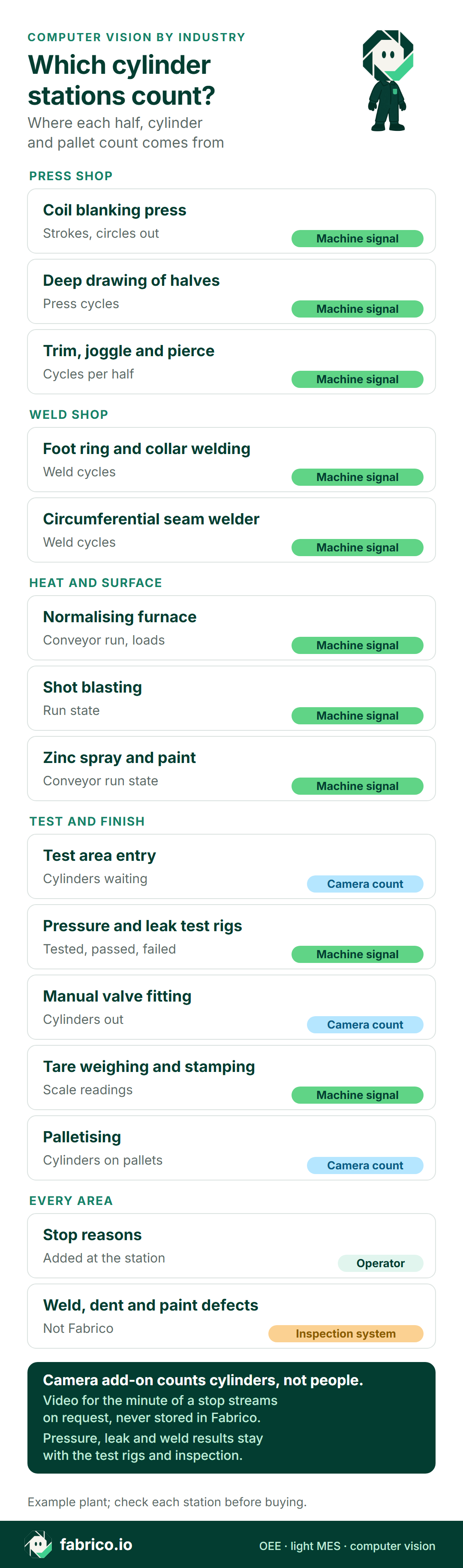
Text version of this infographic
- Press shop: coil blanking press: machine signal, strokes, circles out
- Press shop: deep drawing of halves: machine signal, press cycles
- Press shop: trim, joggle and pierce: machine signal, cycles per half
- Weld shop: foot ring and collar welding: machine signal, weld cycles
- Weld shop: circumferential seam welder: machine signal, weld cycles
- Heat and surface: normalising furnace: machine signal, conveyor run, loads
- Heat and surface: shot blasting: machine signal, run state
- Heat and surface: zinc spray and paint: machine signal, conveyor run state
- Test and finish: test area entry: camera count, cylinders waiting
- Test and finish: pressure and leak test rigs: machine signal, tested, passed, failed
- Test and finish: manual valve fitting: camera count, cylinders out
- Test and finish: tare weighing and stamping: machine signal, scale readings
- Test and finish: palletising: camera count, cylinders on pallets
- Every area: stop reasons: operator, added at the station
- Every area: weld, dent and paint defects: inspection system, not Fabrico
- Footer: the camera add-on counts cylinders, not people; video for the minute of a stop streams on request, never stored in Fabrico
- Footer: pressure, leak and weld results stay with the test rigs and inspection
A valve-fitting shift, audited and priced
Example numbers from no real plant: a manual valve-fitting bench with two operators fits valves on 12.5 kg and 45 kg LPG cylinders. Planned time is the day shift, 06:00 to 14:00, less a 20-minute break: 460 minutes. The standard is 0.5 bench minutes per 12.5 kg cylinder and 1.25 per 45 kg cylinder. A camera add-on counts cylinders leaving the bench, passes and fails come from the leak rig's PLC, and the two operators enter stop reasons.
Availability. The bench stood for 50 minutes: 22 waiting for painted cylinders, 15 changing from 12.5 kg to 45 kg (turntable insert, valve type, hoist), 8 for the torque tool check and 5 with a tool fault. It ran 410 of 460 minutes: 89.1%.
Performance. It fitted 568 cylinders of 12.5 kg, worth 284 standard minutes, and 48 of 45 kg, worth 60. 344 earned minutes against 410 run minutes gives 83.9%; the missing 66 minutes are slow fitting.
Quality. Sixteen 12.5 kg cylinders failed the leak test at the valve thread and came back for a refit. Those 8 standard minutes come off good: 336 of 344, 97.7%.
OEE. 89.1% x 83.9% x 97.7% = 73.0%. Cross-check: 336 first-pass good minutes over 460 planned is also 73.0%, the one-step form in how to calculate OEE.
Now the audit. The bench's tally sheet counted the 16 refits again, 584 cylinders of 12.5 kg, and knew nothing of the leak fails. On the tally, earned minutes are 292 + 60 = 352, performance reads 85.9%, quality reads 100% and OEE reads 76.5%: 3.5 points too high, from the bench version of miscount 2. Had the tally used one rate of 0.5 minutes for every size, the 48 heavy cylinders would earn 24 minutes instead of 60, and the bench would look 36 minutes slower than it was.
Neither the wait nor the slow pace started at the bench. The paint conveyor's PLC said running all morning, yet the bench's camera add-on count went flat from 09:20 to 09:42 and stayed thin: after a colour change, the loader left empty hooks, then hung every second hook.
What the lost minutes cost
No public contribution margin per welded LPG cylinder was found, so these are example inputs a plant replaces with its own: EUR 6 per 12.5 kg cylinder and EUR 15 per 45 kg cylinder, both EUR 12 per standard minute while orders wait. The refit is priced at crew time instead, because refitted cylinders still ship: an example EUR 45 per hour for the two-person bench. Pricing output by size is the idea behind SKU-level output value.
| Loss | Minutes | Example value |
|---|---|---|
| Slow fitting | 66 | EUR 792 |
| Paint line wait | 22 | EUR 264 |
| Size change | 15 | EUR 180 |
| Torque check | 8 | EUR 96 |
| Tool fault | 5 | EUR 60 |
| Valve refit (crew time) | 8 | EUR 6 |
| Total | 124 | EUR 1,398 |
The 116 minutes of stops and slow fitting at EUR 12 are EUR 1,392, and the refit adds EUR 6: EUR 1,398 a shift, or EUR 29,358 over 21 shifts if every shift ran like this one. It is lost margin only while valve fitting limits output; if the welders or the furnace set the pace, a bench minute is worth less. Refit sealant is left out. Ranked by money, slow fitting and the paint wait are EUR 1,056 of the EUR 1,398, and both send the team to the paint loader before anyone touches the bench.
Where Fabrico fits, what to ask a vendor, and the bench team
Fabrico is a cloud OEE system with light MES features. On a cylinder line it covers three groups of stations:
- Press shop, weld shop and furnace: presses, welders, the furnace and the blaster send run state and counts from their PLCs, so die changes, wire changes and furnace gaps land under their own codes.
- Test area entry, valve fitting and palletising: the camera add-on counts cylinders arriving, leaving the bench and going onto pallets. When valve fitting halted at 10:40, the shift lead opens that stop on the timeline; where a camera add-on covers the bench, the video for the minute of a stop is streamed on request and not stored in Fabrico.
- Test rigs and scales: tests, passes, fails and weighings come from the PLC or controller and are measured against the standard minutes for each cylinder size.
Operators enter stop reasons on a tablet or phone at the bench. Each station's losses are shown in money by shift. Fabrico runs in the browser and on iOS and Android; data goes out by REST API, webhooks, Excel or CSV.
Roadmap: the camera add-on flagging a valve bench that has stopped sending cylinders, or a test-area conveyor that keeps filling, and suggesting a stop reason that the operator confirms or replaces.
Outside Fabrico: weld inspection, test results, certificates, approvals and serial traceability. Rejects from those systems reach OEE as counts.
Questions for any OEE or camera vendor:
| Ask | A sound answer |
|---|---|
| Is a repeated pressure test counted as a second cylinder? | No. Cylinders are counted at the entry; rig cycles stay cycles. |
| How is a reheated and retested reject counted? | Once, at its first test, with reheat and retest as rework. |
| How are lot samples and held lots booked? | Planned sample, retest sample and held codes at the pull point, not scrap. |
| How are requalified cylinders kept out of new build? | A separate order type with its own standard minutes per size. |
| How does a cylinder earn standard minutes by size? | A standard per size and valve type, credited when it passes the leak test. |
| How are press, welder and furnace signals read? | Strokes, weld cycles and run state from their PLCs, interface named. |
For the wider checklist, see how to evaluate OEE software and the Fabrico computer vision feature.
Operators stand inside the view of any camera over a valve bench or pallet zone. Settle the purpose of the count, and who may open station video, with the bench team and the works council where one exists, before a bracket goes up. Keep faces out of frame and report per station and shift, not per person; Fabrico's camera add-on counts cylinders, not people.
Questions cylinder plant teams ask
Where should the first camera go in an LPG cylinder plant?
Over the outfeed of a manual valve-fitting bench, where a click wrench leaves no count. Presses, welders, the furnace and the test rigs report counts of their own.
Can a counting camera find weld, dent or paint defects on a cylinder?
No. Weld quality is proven by the plant's tests and inspection, dents and paint by its inspectors. Their reject counts still feed OEE quality.
Does a cylinder that is reheat treated and retested count twice?
It should count once. It is credited at its first pass through the test, and the reheat and the second test are booked as rework, so it never enters good output.
Should requalified cylinders count in the same OEE as new ones?
Not in the same output figure. A requalified cylinder was not built this shift, so run it as its own order type with its own standard minutes.
Want the test queue, valve-fitting benches and pallets counted once each, beside the press and welder signals on one timeline? Book a demo.












Real Fabrico tiles, sample data.