


 Login
 Blog

Used Packaging Machinery Checklist: What to Check Before and After You Buy

In short: this used packaging machinery checklist runs from the seller's floor to week 4 on your line. A used machine is a sound buy when it runs your own format at the speed your line needs in a run-off you watched, the documents and food-contact records come with it, and the purchase terms define a failed acceptance run before you pay.
- Judge speed at your format, not the data plate.
- Count minor stops, rejects and changeover minutes in the run-off, not only output.
- Get drawings, the PLC program backup and the spare parts list before the order.
- Measure the first weeks after installation the same way as the run-off.
The listing shows a flow wrapper, a case packer or a palletiser, a plate speed, a year and a photo of it running. It cannot show how the machine will run your pack, film and crew after a truck ride. A second hand machine can be on your floor sooner than a new build. It can also bring the previous owner's losses with it. The checklist below covers fillers, wrappers, case packers and palletisers for food and FMCG lines: on the seller's floor, in the purchase terms and in the weeks after installation, with all 8 checks on one list near the end.
About us: Fabrico builds OEE and light MES software. Our part starts once a machine runs on your floor; the condition, safety and value of a used machine are for your engineers, the seller and your advisers to judge.
Weighing a hand-pack station against any machine at all? Start with measuring manual packing before you automate. For brand-new equipment, see factory vs site acceptance tests and the OEE clause of a new line contract; a complete new line needs a ramp-up plan.
Used packaging machinery: the plate speed is not your speed
The data plate gives a top speed for the format the machine was built around. Your pack may be longer, heavier or wrapped in a stiffer film, and the real speed drops with it. Read nameplate vs real capacity before you set the plate figure against your plan.
Turn your plan into one number first: the good output per planned minute the line needs from this machine. That number, not the plate, is what the run-off has to beat with some margin.
On the seller's floor: four numbers to record
Ask for a run-off at your format, with your film or cases if you can ship them, and time it yourself:
- Speed at your format: packs per minute while it runs, set against its rated speed for that format.
- Minor stops: count the short halts per hour. Seconds to a minute or two each, they add up; see how minor stops differ from reduced speed.
- Reject rate: rejected packs over packs made, with the reasons: seals, misfeeds, crushed cases.
- Changeover minutes: from the last good pack of one format to the first good pack of the next. Our changeover time guide covers what to include.
Keep availability, performance and quality apart. Machine pages by type: flow wrapper OEE, case packer OEE, palletiser OEE and filler OEE on a bottling line.
Documents to ask the seller for
- Electrical and pneumatic drawings, manuals and the safety-related changes made since it was built.
- A backup of the PLC and HMI program, with access rights, so faults can be traced and settings changed.
- The spare parts list, with any parts no longer made.
- Service records, and the hours run if the machine logs them.
- The change parts that come with it, and the formats each set fits.
- Any conformity paperwork the machine was supplied with.
The work equipment rules put the duty on the employer who puts the machine to use. In the EU, Article 3 of Directive 2009/104/EC (as published on legislation.gov.uk) says the employer shall take the measures necessary to ensure that the work equipment made available to workers is suitable for the work. In Great Britain, under regulation 4 of PUWER 1998, every employer shall ensure that work equipment is so constructed or adapted as to be suitable for its purpose. If the machine comes from outside the EU or Great Britain, or has been rebuilt, ask your safety adviser whether it needs a new conformity assessment before first use.
In Great Britain, HSE's guidance on second-hand products says anyone supplying second-hand equipment for use at work must ensure, so far as reasonably practicable, that it is safe, and "sold as seen" cannot be used to avoid that. In the United States, OSHA 1910.212 says one or more methods of machine guarding shall be provided against hazards such as ingoing nip points and rotating parts. On the seller's floor that means three checks: every guard fitted, every interlock tested with the machine running, and no bypass wired in for the run-off.
Food-contact and hygiene checks on a second hand machine
Belts, guides, seals, hoppers and nozzles may touch product. Regulation (EC) No 1935/2004 requires that food-contact materials, under normal or foreseeable use, do not transfer their constituents to food in quantities which could endanger human health. The quote is from the UK version published on legislation.gov.uk; the EU version is on EUR-Lex. Check the text that applies where you sell with your food safety team.
In the United States, 21 CFR 117.40 says equipment must be designed and of such material and workmanship as to be adequately cleanable. On a used machine, ask what it last ran: an allergen or a non-food product changes the cleaning and part replacement plan.
Buy used, buy new or rebuild: options, costs and who picks which
Four routes answer the same need: 92 good packs a minute from the wrapping step. Start with what the inspection finds, then put a cost on each route.
| What you find | Lean towards | Why |
|---|---|---|
| Your format runs at the needed speed, documents complete | Buy used | Speed and spares are known |
| Run-off only just above the line's need | Negotiate, or buy new | No margin for a new crew |
| Your format sits outside the machine's range | Buy new | Change parts may not exist |
| No PLC program backup or drawings | Walk away, or plan a controls retrofit | Faults cannot be traced |
| Your own machine's losses are mostly worn parts | Rebuild what you have | Known formats, known crew |
| Materials of food-contact parts unknown | Replace those parts first | Food-contact rules apply |
| Run-off only passes with the seller's engineer at the controls | Walk away, or write crew training into the terms | Your crew will run it |
Book a demo to see how availability, performance and quality are kept apart once a machine is connected to Fabrico.
What each route costs, before the purchase price. Machine prices come from quotes, so none is named here. The other costs can be put on the same scale. Labour is priced at the euro-area industry rate from Eurostat hourly labour costs: EUR 40.3 an hour in 2025, with EU averages from EUR 12.0 in Bulgaria to EUR 56.8 in Luxembourg. Output is priced at EUR 0.072 a pack, worked out in the example below from a sample price and a sourced food processing margin. All other figures are sample figures.
| Route | Cost or effort beyond the price (sample) | Choose it if |
|---|---|---|
| Buy used | Run-off visit: 2 engineers for 2 days of 8 hours, 32 hours x EUR 40.3 = EUR 1,289.60, before travel. First weeks: the sample falls 146,474 packs short in weeks 1 to 3, EUR 10,546 | The run-off at your format clears the line's need with room to spare, and drawings, PLC backup and spares come with it |
| Buy new | Factory and site acceptance tests and a ramp-up of its own; not modelled on this page | Your format sits outside the used machine's range, or the run-off only just clears the need |
| Rebuild what you have | Parts and engineer hours per quote; each week the line stands without cover costs up to 432,400 packs, EUR 31,133 | Your machine already runs your formats and its losses come from worn parts; the work fits a planned shutdown or stock covers it |
| Renew change parts only | Parts per quote; in the sample, worn change parts cost EUR 796 a week, EUR 36,611 a year | Changeovers run long but speed, minor stops and rejects at your format are fine |
Questions to put to sellers, makers and your own team
- Seller of the used machine: can the run-off use our film and product, with one timed changeover, and can we have the machine's own fault log?
- Same seller: which parts are no longer made, and who supplies them now?
- Maker of a new machine: what output at our format will they write into the contract, and how is it measured? See the OEE clause of a new line contract.
- Your maintenance team: what share of the current machine's lost minutes comes from worn parts, and what share from settings or crew?
- Finance: which contribution per pack do we use, and does it sit near the food processing margin range?
- Your safety adviser: does this machine need a new conformity assessment before first use?
What to write into the purchase terms
Questions to settle with the seller before you sign. This is not legal advice: have your lawyer word the terms.
- Is there an acceptance run after installation at your site, at your format, and how long does it last?
- What counts as a failed run: good output per planned minute below a set figure, rejects above a set rate, a changeover over a set time?
- Who measures, at which counting point, and whose figures count if they differ?
- After a failed run, does the seller fix and re-run, and by when? Is part of the payment held until the run passes?
- How many engineer days on site come with installation and commissioning?
- Which documents and change parts transfer, and when?
Worked example: a used flow wrapper for a cereal bar line
Sample figures for illustration only. A cereal bar plant looks at a used flow wrapper. The plate says 160 packs a minute; at the plant's bar size and film it is rated 120. The bar line feeds 92 packs a minute on average over planned time, so the wrapper needs 92 / 120 = 76.7% OEE at that rating. Against the plate, the need would look like 57.5%, a margin that is not there.
Run-off on the seller's floor, 120 minutes at the plant's format:
- Availability: one jam (6 minutes) leaves 114 minutes of run time: 114 / 120 = 95.0%.
- Performance: 11,856 packs against 114 x 120 = 13,680 possible: 86.7%. The 9 minor stops, 10 minutes in all, sit here with slow running.
- Quality: 237 rejects, 11,619 good packs: 98.0%.
- OEE: 0.950 x 0.867 x 0.980 = 80.7%. Check: 11,619 / (120 x 120) = 80.7%. One changeover, timed after the two-hour run, took 35 minutes.
The terms set an acceptance test over weeks 3 and 4 after installation: average OEE of at least 76.7% at the plant's format. A week has 4,700 planned minutes (2 shifts of 470 minutes, 5 days), so at most 564,000 packs, and the line needs 432,400 good packs.
Week 1 after installation: run time 3,384 minutes, availability 72.0%. 357,350 packs against 406,080 possible, performance 88.0%. 14,294 rejects leave 343,056 good packs, quality 96.0%. OEE 0.720 x 0.880 x 0.960 = 60.8%.
| Period | A x P x Q | OEE | Good packs vs need |
|---|---|---|---|
| Run-off, 2 hours | 95.0% x 86.7% x 98.0% | 80.7% | Above |
| Week 1 | 72.0% x 88.0% x 96.0% | 60.8% | 89,344 short |
| Week 2 | 78.0% x 91.0% x 97.0% | 68.9% | 44,083 short |
| Week 3 | 82.0% x 93.0% x 97.5% | 74.4% | 13,047 short |
| Week 4 | 85.0% x 94.0% x 98.0% | 78.3% | 9,223 over |
Weeks 3 and 4 made 860,976 good packs against 864,800 needed: average OEE 76.3%, so the test fails by 3,824 packs. The week logs show most of the gap in minor stops at the infeed, a setting item for the seller's engineer, so the plant holds the retained payment and books a re-run.
How thin the margin is
Sample figures for illustration only. A run-off 5 points lower, at 75.7%, would sit a point under the 76.7% need before any truck ride or new crew. One point of OEE here is 5,640 packs a week (1% of 564,000), so a run-off under the need is a reason to hold the order until the seller finds the loss and repeats the run-off.
Now say worn change parts add 20 minutes to each of the plant's 5 weekly changeovers. That is 100 of 4,700 planned minutes: week 4's availability falls from 85.0% to 82.9% and its OEE from 78.3% to 76.3%. The lost time costs 100 x 120 x 0.94 x 0.98 = 11,054 good packs, so week 4's surplus of 9,223 turns into a shortfall of 1,831. Week 3 loses the same 100 minutes, or 10,881 good packs at its own rates, so the weeks 3 and 4 shortfall grows from 3,824 to 25,759 packs.
In money. The plant sells a bar pack at EUR 0.31 ex works, a sample price. The margin comes from a sourced range: the NYU Stern margin dataset by industry (Aswath Damodaran, January 2026 data, 78 US food processing firms) shows a gross margin of 23.23% and a pre-tax operating margin of 10.63%. Gross margin still carries the plant's fixed costs, so it understates what one more pack adds, which keeps the sample on the safe side: EUR 0.31 x 23.23% = about EUR 0.072 a pack. Weeks 1 to 3 fall short by 146,474 packs, EUR 10,546 of contribution. The slower changeovers alone cost 11,054 packs, EUR 796 a week, about EUR 36,611 over a 46-week year: the figure to weigh against new change parts.
Where a used machine loses output in the first weeks
Each loss shows in stops and rejects by cause, hour and shift before the weekly total:
| What goes wrong | Early sign in the data | Fix |
|---|---|---|
| Worn seal jaws or drifting heater control | Seal rejects climb through the shift, low at start-up | Replace jaws and sensors |
| Infeed timing set for the seller's product | Minor stops cluster at the infeed, worst on your longest format | Seller's engineer resets timing before the re-run |
| Change parts missing or worn | Changeovers run well past the 35 minutes of the run-off | Count change parts against the list on delivery |
| Film or cases differ from the run-off | Misfeed and tracking rejects jump with a new reel or case batch | Run off on your own film |
| Crew new to the machine | One shift shows more and longer stops on the same product | Seller trains every shift |
| The line around it stops the wrapper | Wrapper ready but idle, reason "no product" or "outfeed full" | Code starved and blocked time apart from wrapper stops |
Settle the last row before week 1: if the terms say "OEE of the wrapper", state whether starved and blocked time counts against it.
Used packaging equipment checklist: from run-off to week 4
For your engineers, quality team and the seller:
- Speed at your format: Was the speed timed in a run-off at your pack size and film, not read off the data plate?
- Minor stops: How many short stops per hour did the run-off show, and what caused them?
- Reject rate: What share of packs was rejected, counted on your own film and product?
- Changeover minutes: How long from the last good pack of one format to the first good pack of the next?
- Documents in hand: Do drawings, the PLC program backup, manuals and the spare parts list come with the machine?
- Food-contact parts: Which parts touch product, and what material records exist for each?
- Failed run in writing: Do the terms say what a failed acceptance run is, and what happens next?
- First weeks measured: Will output after installation be counted at the same point and the same way as in the run-off?
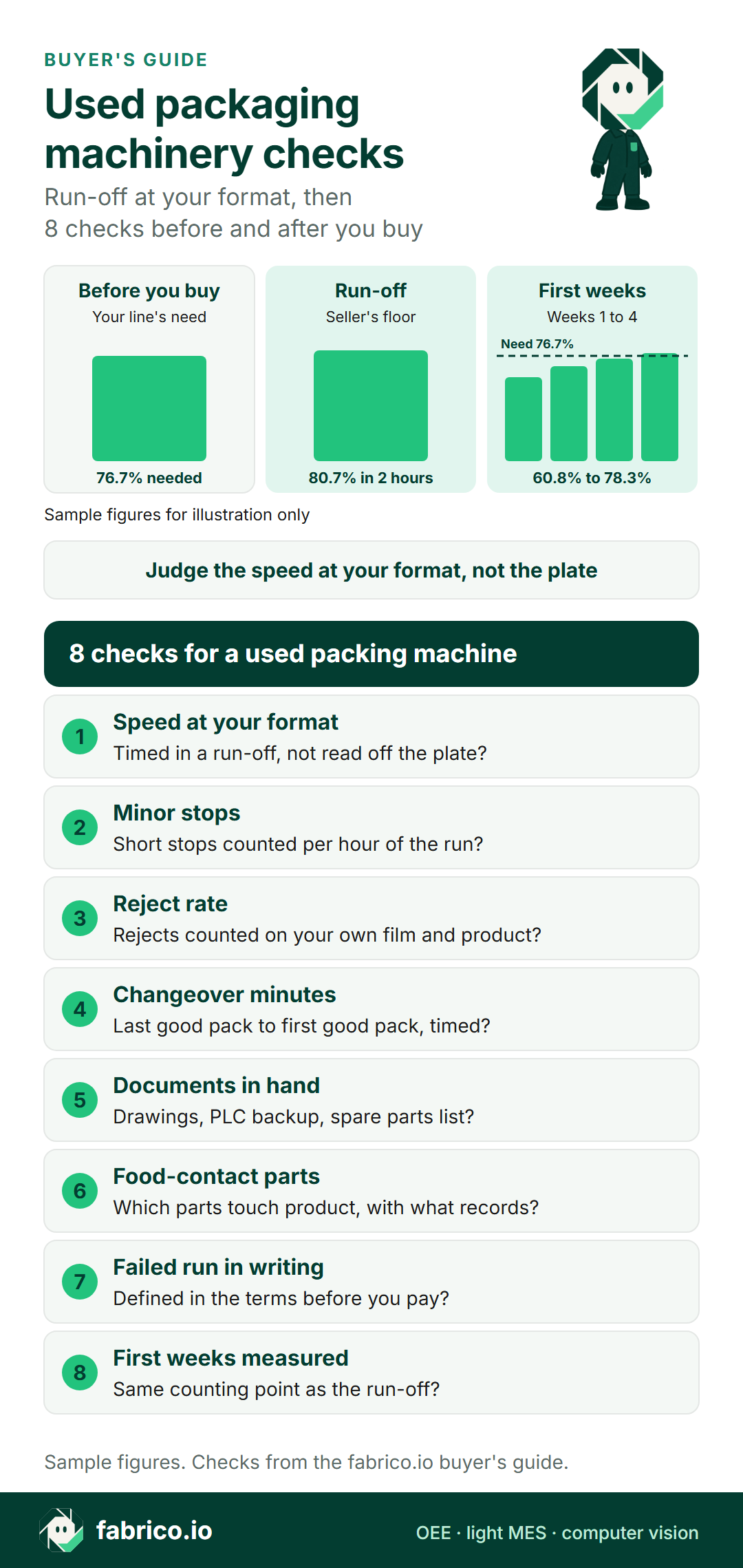
Text version of this infographic
- Card title: used packaging machinery checks.
- Before you buy: the line needs 76.7% OEE from the wrapper (sample).
- Run-off: 80.7% over 2 hours on the seller's floor at the buyer's format.
- First weeks: 60.8% in week 1, rising to 78.3% in week 4, against a dashed 76.7% need line.
- 8 checks: speed at your format, minor stops, reject rate, changeover minutes, documents in hand, food-contact parts, failed run in writing, first weeks measured.
Before you visit a seller: five steps for this week
- Turn the plan into one figure. Good packs per planned minute, divided by the rated speed at your format: 92 / 120 = 76.7% in the sample.
- Book the run-off on your materials. Ship film, cases or product for two hours of running plus one timed changeover.
- Get the documents before the visit. Drawings, PLC and HMI backup, spare parts list and change parts inventory first.
- Draft the failed-run clause. Figure, counting point, weeks covered, starved and blocked time; your safety adviser adds guards and conformity.
- Set up the first-weeks count. The run-off's counting point, stop reasons coded from the first shift, and one named person who signs off each week.
How Fabrico measures the machine once it runs
Fabrico measures the machine once it is installed and connected, so weeks 1 to 4 read in the same three factors as your run-off notes.
- Older machines too: where a used machine's PLC is hard to read, Fabrico fits an IoT device with external sensors to collect the production signal.
- The same three factors as your run-off notes: each machine shows OEE split into availability, performance and quality, so you can set the first weeks beside the run-off figures you wrote down.
- Short stops a run-off hides: micro-stops are detected from the machine signal, including stops too short for anyone to write down, and the operator picks the stop cause on a tablet or phone.
- Evidence for a re-run: OEE tracking shows when a drop began, downtime splits by cause, machine and shift, and any list exports to Excel or CSV for the talk with the seller.
- A machine with no usable signal: if an older machine gives no clean signal, the camera add-on counts its output instead. The camera add-on's video for a stop is streamed on request and not stored in Fabrico.
Next reads: the OEE and MES solution overview, what to look for in OEE software, light MES in plain terms, the camera add-on for counting and cameras on food lines.
Second hand packing machines: questions before the order
What should you check before buying used packaging machinery?
Watch a run-off at your own format and record four numbers: speed, minor stops, reject rate and changeover minutes. Then ask for drawings, the PLC program backup, the spare parts list and records for the parts that touch product, and write a failed acceptance run into the purchase terms.
How long should a run-off on a used packing machine last?
Long enough to show the short stops and at least one changeover, not just a few good minutes. The sample on this page used two hours plus one timed changeover; a full shift tells you more if the seller can run it.
Can second hand packaging equipment be used with food?
It can, if the parts that touch food meet the food-contact rules where you sell. Under Article 3 of Regulation (EC) No 1935/2004, as published on legislation.gov.uk, materials must not transfer constituents to food in quantities that could endanger health. Replace parts with unknown materials. This is not legal advice.
What counts as a failed acceptance run on a used machine?
Whatever the purchase terms say, so define it before you pay: for example good output per planned minute below the line's need, rejects above a set rate, or a changeover over a set time, measured at your format and your site.
Why does a used machine run slower after installation than in the run-off?
The run-off is short and tuned by the seller's engineer. On your floor the crew is new to the machine, the film and product differ, and upstream and downstream machines interrupt it. In the sample, week 1 reached 60.8% against 80.7% in the run-off.
When is rebuilding your current machine better than buying used?
When your current machine already runs your formats and its losses come from worn parts you can replace. A rebuild keeps known change parts and a known crew.
Want the first weeks after installation measured in the same three factors as your run-off? Book a demo to see the three factors tracked shift by shift.
Related articles



Latest from our blog
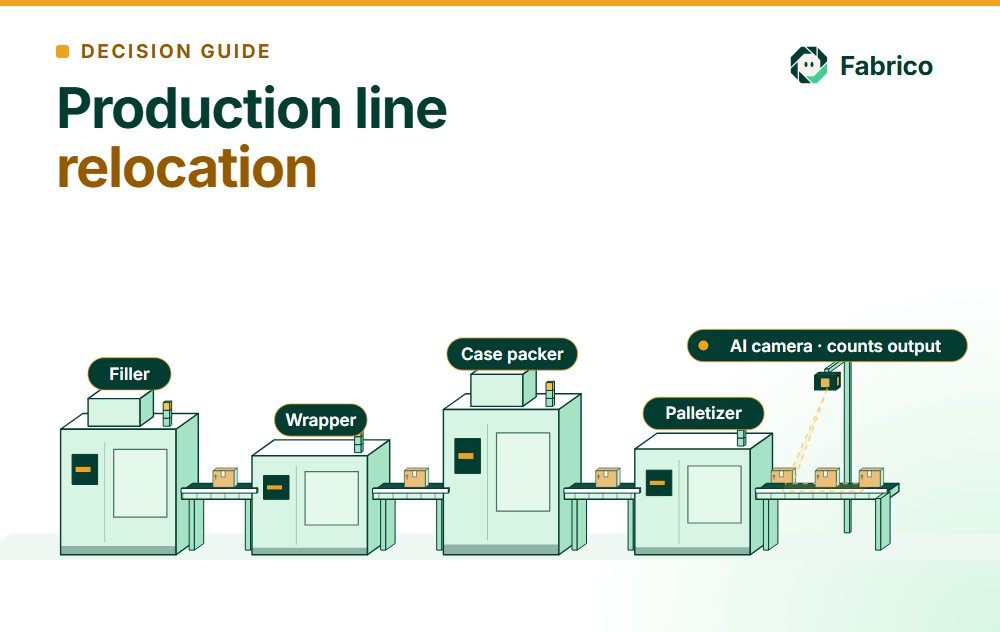





Real Fabrico tiles, sample data.