


 Login
 Blog
OEE Guarantees for a New Line: What to Put in the Contract

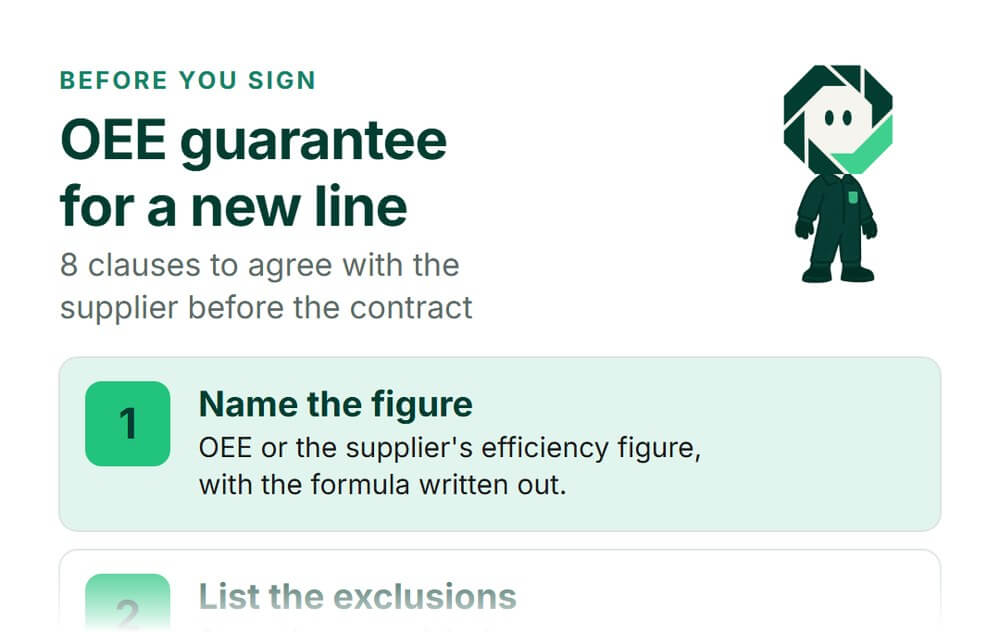
In short: An OEE performance guarantee for a new packaging line is only worth something if the contract defines the figure, the ideal rate, the exclusions, the test and the data source before the test runs.
- Ask which figure is promised: line OEE, or the supplier's efficiency figure that counts only their losses.
- Read the exclusion list closely. Starvation, material and changeovers can move the result by several points.
- Fix the test: length, formats, shifts, crew and the ideal rate per format.
- Measure from one agreed source, with a stop log both sides sign.
- Write down what happens on a miss: fix, retest, limits, then the commercial step.
The supplier's proposal says the new line will run at 85%. Before you sign, ask: 85% of what, measured how, over which hours, and with which losses left out? Two people can read the same test and get two different numbers. This guide helps you agree the number before the test, not argue about it after.
It sits between two pages we already have. For what each test checks, see FAT vs SAT. For whether to buy the line at all, see new line cost vs recovering capacity. This page covers the guarantee clause.
We sell Fabrico, OEE and light MES software. Test what we say here like any vendor's claims. This is not legal advice: check with your lawyer for contract wording.
OEE performance guarantee for a new packaging line: what is really promised
A supplier's "line efficiency" and your OEE often use the same word for different things. OEE counts all lost time against planned production time: stops, slow running and rejects, whatever caused them. A supplier's efficiency figure usually counts only the losses their equipment caused, and sets the rest aside.
Published standards cover these figures. Germany's DIN 8743 (2014, now withdrawn) set key figures for packaging machines and lines and the "requirements for the collection of technical key figures in acceptance tests". It says it "serves to promote mutual understanding between manufacturers and users of packaging machines and packaging lines". A later European standard, DIN EN 415-11 (edition 2021-12), covers the determination of efficiency and availability of packaging machines. Both are paid documents. If a supplier cites one, ask which edition and which key figure, and attach the definition to the contract.
| Figure | What it counts | What it leaves out |
|---|---|---|
| Line OEE | Stop time, slow running and rejects | Only time you did not plan to run |
| Supplier efficiency | Losses caused by the delivered equipment | Starvation, material, crew, utilities, as listed |
| Rated speed | Top speed in a short run | Stops, rejects and changeovers |
| Availability only | Stop time | Slow running and rejects |
Rated speed or availability alone is not a performance guarantee. Ask for one figure that combines time, speed and quality. For the formula, see our OEE calculation guide.
Which figure to write in: a decision framework
Pick the supplier's efficiency figure if they deliver one machine and you run everything around it. It is fair to judge them only on what they control.
Pick line OEE if they deliver the whole line and run it during the test with their crew, materials checked by them, and upstream supply in their scope.
Write both if they deliver a turnkey line but your crew and your materials run the test. Their efficiency figure is the pass mark; OEE is reported next to it, so you see what the line will really give you.
| Write in | Pick it if | Watch out for |
|---|---|---|
| Supplier efficiency | One machine, you run the rest | Long exclusion lists that hide real losses |
| Line OEE | They run the whole line in the test | Your losses count against them; expect pushback |
| Both | Turnkey line, your crew and materials | Two numbers to sign; keep one stop log |
| Not yet | Rates, formats or count points unclear | Signing a number nobody can measure |
Who delivers what also shapes the clause. If a machine builder and a systems integrator share the scope, see machine builders vs systems integrators before you split the guarantee between them.
Want a second view on the figure and the test plan? Book a demo and bring the supplier's proposal.
Exclusions: the clause where guarantees are won or lost
An exclusion is a loss that does not count against the supplier. Each one is reasonable on its own. A long list, loosely worded, can turn a weak line into a pass. Write each exclusion with the reason it is fair and how it will be logged.
| Loss | Fair to exclude when | Write down |
|---|---|---|
| Starvation or blocking | The cause sits outside their scope | Which machines are in scope; how a starved minute is logged |
| Material out of spec | It fails your agreed spec | The spec, who checks it, how its rejects count |
| Changeovers | Run to the agreed method | A target per changeover; time above it counts |
| Crew | Your crew is short | Crew size and training done before the test |
| Utilities | Air, power or steam out of limits | The limits and who logs them |
| Micro-stops, slow running | Never: they belong to the line | Ideal rate per format; the minor stop threshold |
Watch the last row. Short stops and slow running are easy to miss in a short test, and they are the supplier's to fix. See micro-stops for why they hide. Also fix the ideal rate per format at the machine that sets the line's pace, not the fastest machine's nameplate. On a bottling line that is often the filler; see filler OEE on a bottling line.
Test length, formats and conditions
A short run at top speed with the supplier's best technician proves the machine can run. It does not prove the line will run on a Tuesday night shift. Agree these points in writing:
- When: after site acceptance, once your crew is trained, within an agreed window.
- How long: long enough to cover each shift, at least one changeover and the formats that matter. A short test can miss the stops that only show up over several shifts.
- Formats: name them. A test on the easiest format says little about the hardest.
- Crew: whose people run the line, and how many.
- Materials: production materials from your normal suppliers, checked against the agreed spec.
- Planned time: breaks and cleaning fixed in the test plan, so they are set aside before the test, not argued about after.
Worked example: one test, two results
Illustrative, sample data, not a customer. A new packaging line runs a 24-hour test: three 8-hour shifts, 1,440 planned minutes. The ideal rate at the filler is 200 packs a minute. The contract guarantees 80%.
- Stops: 216 minutes in total. Machine faults 96, starvation from the process upstream 72, a bad reel of film 30, a changeover 18, inside its agreed target.
- Output: 220,320 packs counted, 216,000 good. Rejects 4,320: 2,880 from seal faults, 1,440 from the bad film.
Line OEE. Run time = 1,440 minus 216 = 1,224 minutes. Availability = 1,224 / 1,440 = 85%. Performance = 220,320 / (1,224 x 200 = 244,800) = 90%. Quality = 216,000 / 220,320 = 98.0%. OEE = 85% x 90% x 98.0% = 75.0%. Check: 216,000 good packs / (1,440 x 200 = 288,000) = 75.0%.
Supplier's figure. The contract excludes starvation, out-of-spec material and the changeover: 72 + 30 + 18 = 120 minutes, so the time base is 1,440 minus 120 = 1,320 minutes. The 1,440 film rejects are excluded too, so only the 2,880 seal rejects count: 220,320 minus 2,880 = 217,440 packs. Figure = 217,440 / (1,320 x 200 = 264,000) = 82.4%.
The same 24 hours passes at 82.4% and fails at 75.0%. That is a 7.4-point gap from the exclusions alone. Neither number is wrong. Each loss is counted once, and the difference is exactly the exclusion list. That is why the list, the formula and the ideal rate belong in the contract, not in a meeting after the test.
Who measures: one data source, one stop log
Disputes after a test are rarely about the arithmetic. They are about counts and stop reasons. Settle both first.
- Counts: agree which PLC tags or sensors count packs in and good packs out, and check them against a hand tally at full speed before the test. See HMI data collection for OEE for what the machine screen can and cannot give you.
- Machine states: if the line follows PackML, the OPC UA for PackML specification (OPC 30050) lists "Overall Equipment Effectiveness (OEE) data" among what PackML provides, and aims to "provide consistent tag structure for connection to plant MES and enterprise systems". Ask the supplier to expose those tags to your systems. Our PackML state model guide has the detail.
- Beverage lines: the Weihenstephan Standards define "a communication interface for the standardized transmission of machine data", with a domain for beverage filling and packaging machines. If the supplier offers it, write it into the scope.
- Stop reasons: keep one stop log during the test. A supplier's engineer and your team leader code the stops together, and both sign after each shift.
- Stations with no signal: at a hand-pack table or an older machine, a camera that counts output gives both sides the same count, and video of a disputed minute helps settle what happened.
The aim is a plant-side record that does not depend on the supplier's own screen. Share it with them.
When the line misses the guarantee
Write the sequence into the contract before the test, while both sides still want the deal:
- Joint review: both sides go through the stop log and the losses, and agree which ones count.
- Fix: the supplier fixes what is theirs, and you fix what is yours.
- Retest: within an agreed window, under the same test plan.
- Limit: a fixed number of retests, so the test does not run for ever.
- Commercial step: what happens after the last retest. Payments held back until the test passes and other remedies are legal terms: check with your lawyer.
Then keep measuring. A line that passes a 24-hour test can still drift once the commissioning team leaves. Track the same OEE, with the same definitions, from handover on, and compare it with the test result. If the gap grows inside the warranty period, you have the data to raise it.
Checklist: questions before you sign
Put these to the supplier and to your own team. They apply to any line and any supplier.
| Check | Question to answer in writing |
|---|---|
| 1. Figure | Is the formula written out, with each term defined? |
| 2. Ideal rate | What rate per format, at which machine? |
| 3. Exclusions | Is each excluded loss named, with how it is logged? |
| 4. Test | How long, which formats, which shifts, whose crew? |
| 5. Timing | When does the test run, and how long is the window to pass? |
| 6. Data source | Which PLC tags or sensors count, checked against a hand tally? |
| 7. Stop log | Who codes the stop reasons, and who signs after each shift? |
| 8. Miss | How many retests, and what happens after the last one? |
| 9. After handover | Who keeps measuring, and against which baseline? |
If you are still choosing the system that will measure the line, our guides to OEE software, machine monitoring software and MES for mid-size FMCG plants list what to compare.
Where Fabrico fits
Fabrico is a cloud OEE and light MES platform. It is not a party to your contract. It can be the plant-side record both sides read during the test and after handover.
- Data source: on automated lines, Fabrico reads cycles, stops and output from the line's PLC. On older or semi-automated machines, a Fabrico IoT device with external sensors collects the production signal.
- Stops: micro-stops are detected from the machine signal, and operators tag stop causes on a tablet or phone.
- OEE: each machine shows OEE split into availability, performance and quality, updated while the line runs, with losses shown in money.
- Test report: any list exports to Excel or CSV, and a REST API and webhooks feed other systems.
- Camera add-on: where there is no machine signal, the AI camera add-on counts output. From the shift timeline you can open the camera video for that minute. In the standard setup, video is streamed when someone opens it and is not stored in Fabrico.
- Timing: Devices connected in about a month; full rollout in 3 to 4 months.
Roadmap, not live today: a camera proposing a likely stop cause for the operator to confirm.
Fabrico does not sell quality inspection.
Ask in the demo: how to report a test window with the agreed exclusions shown as their own loss categories, and how the camera video for a disputed minute is opened during the joint review.
See light MES and OEE in Fabrico, Fabrico computer vision for OEE and computer vision for FMCG manufacturing. The nine checks above apply to us too.
What people ask next
What is an OEE guarantee for a new line?
It is a clause in the purchase contract that says the new line will reach an agreed OEE, or an agreed efficiency figure, in a defined performance test. It only works if the formula, the ideal rate, the exclusions, the test and the data source are written down before the test.
Should the guarantee be OEE or the supplier's efficiency figure?
If the supplier delivers one machine and you run the rest, a machine efficiency figure that counts only the supplier's losses is fair. If the supplier delivers and runs the whole line in the test, line OEE with a short exclusion list is closer to what you pay for. You can also write both: one as the pass mark, one reported next to it.
Which losses are fair to exclude from the test?
Losses whose cause sits outside the supplier's scope: starvation or blocking from machines they did not deliver, material that fails your agreed spec, crew shortages and utilities outside agreed limits. Micro-stops and slow running belong to the line, so they should count.
How long should the performance test run?
Long enough to see normal running on each shift, at least one changeover and the formats that matter. The right length depends on the line and the product mix, so agree it in writing with the supplier before the test.
Who should measure OEE during the test?
Both sides, from one agreed data source: PLC tags or sensors on the line, checked against a hand tally at the start. A shared stop log that both sides sign after each shift settles most arguments before they start.
What happens if the line misses the guarantee?
The contract should say: a joint review of the losses, a fix, a retest within an agreed window, a limit on the number of retests, and the commercial step after the last one. The wording of that step is a legal matter, so check with your lawyer.
Want to see how a performance test would look in Fabrico on a line like yours? Book a demo and bring the supplier's test plan.
Related articles








Real Fabrico tiles, sample data.