


 Login
 Blog
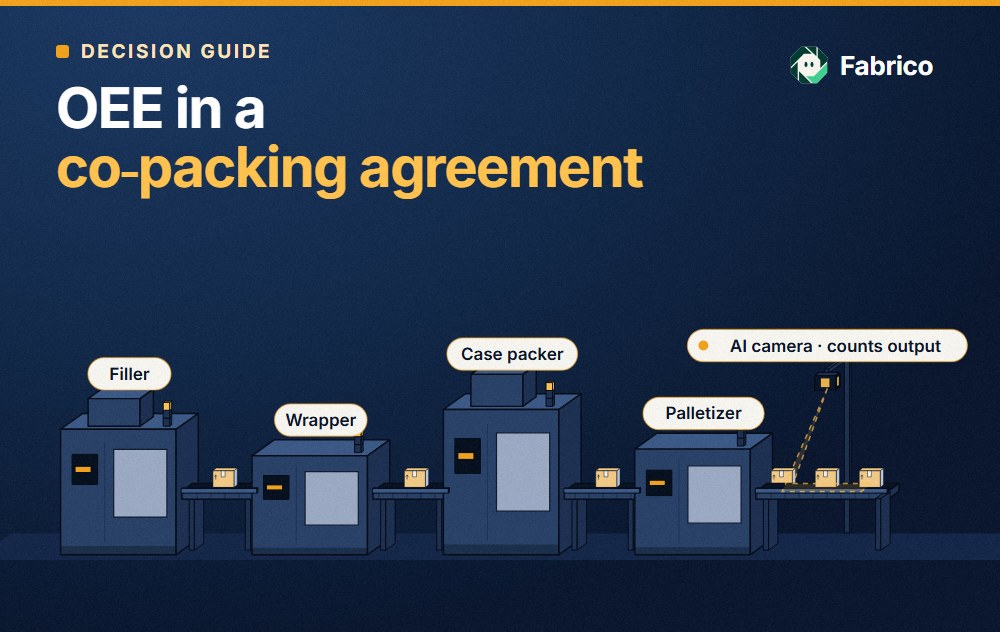
OEE in a Co-Packing Agreement: The Performance Clauses to Agree

In short: A co-packing agreement can carry OEE only if brand owner and co-packer first agree planned time, the ideal rate per SKU, the count point and who owns each loss, then report from one record.
- OEE is good for reporting and improvement targets. On its own it is a weak basis for money terms.
- Write loss owners down: agree who carries late brand materials, artwork changes and runs below the agreed minimum before the first run.
- Agree who measures, what the brand can see, and how long records are kept.
- Set a reporting rhythm and a dispute route before the first run.
- This is not legal advice. Your lawyer writes the clauses.
A co-packing agreement sets price, volumes, specifications and quality. When a performance clause is added, OEE comes up. This guide lists the OEE topics brand owner and co-packer should agree, with a worked sample.
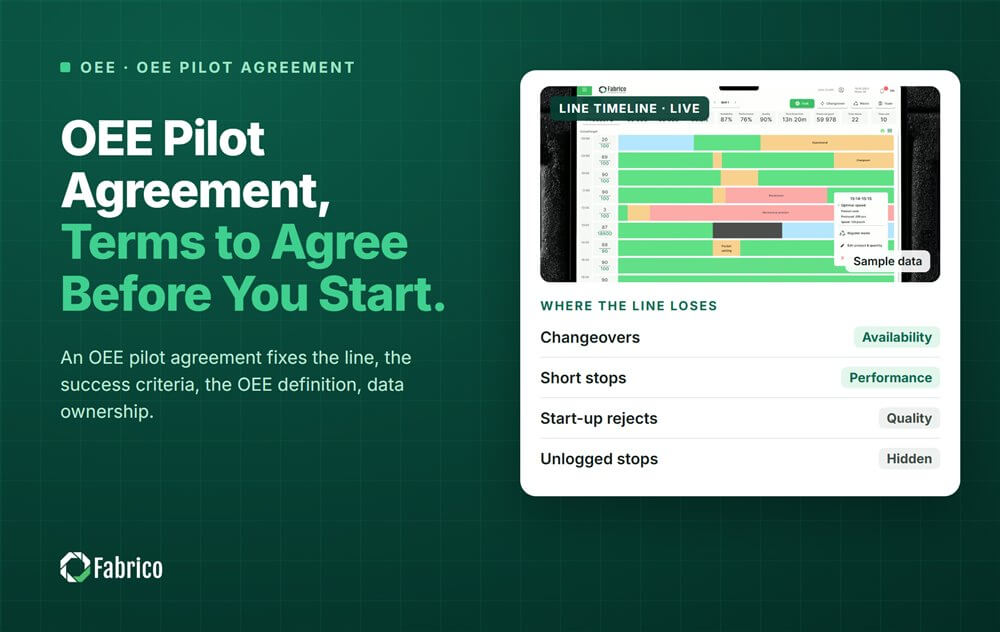
It is not a contract template and not legal advice. It names the topics a clause has to settle, not the clause. Use your lawyer for the wording. To measure each customer job inside a co-packing plant, read line-level OEE for co-packers and MES for contract manufacturers. For counting kits, displays and hand work, see computer vision for co-packers. For a new line bought from a line builder, read OEE terms in a new line contract; for a software trial, read OEE pilot agreement terms.
Co-packing agreement performance clauses: what OEE can and cannot carry
OEE is a fair view of how well the line ran. It does not say whether the order arrived on time or what each unit cost, and some losses it counts sit on the brand's side of the table.
Short runs are a good example. In a 2024 report by PMMI, the packaging machinery trade association, 48% is the figure given for brand owners hiring a contract packager or manufacturer "to offer a customized product/package, especially for short or limited runs". Short runs mean more changeovers, which lower OEE. In the same report, 53% of the contract firms planning new equipment want it to expedite changeover. A raw OEE target can punish the co-packer for the brand's order pattern.
| Use | OEE fits? | Why |
|---|---|---|
| Weekly performance report | Yes | Shows where time and output went |
| Improvement target | Yes, with loss owners | Both sides see which losses are theirs |
| On-time delivery | No | Use on-time in full; OEE ignores dates |
| Cost per unit | Partly | OEE drives cost, but price terms are separate |
| Product quality | No | Specs and the quality agreement govern it |
| Money terms on its own | Rarely | Brand-caused losses sit inside the number |
Keep quality where it belongs. For contract drug manufacturing only, the US FDA's guidance on quality agreements says quality agreements "should not cover general business terms and conditions such as confidentiality, pricing or cost issues, delivery terms, or limits on liability or damages". It does not cover food or other products, but the same split is a sensible default: performance terms sit next to the quality document, not inside it.
Where OEE goes in the agreement: a decision framework
Pick report-only if the relationship is new, runs are short or irregular, or the ideal rates are not agreed yet. Nobody is judged on OEE until the data is trusted.
Pick an improvement target with a joint review if the brand has regular volume on a set line, the definitions are signed, and the stop log carries a loss owner. Misses lead to a joint action plan.
Put it next to commercial terms only if you have weeks of agreed data and clean loss owners. A 2024 contract manufacturing primer from a US law firm advises against exclusivity unless the term is short or the co-man "has agreed to minimum performance and quantity requirements". The link to volume, exclusivity or price is for your lawyers.
| Where OEE sits | Pick it if | Watch out for |
|---|---|---|
| Report only | New partner, short runs, rates not agreed | Reports nobody reads |
| Target, joint review | Regular volume, signed definitions | Targets set before the baseline |
| Next to commercial terms | Weeks of agreed data, clean loss owners | Brand losses inside the number |
| Not yet | No count point or stop log | Signing a number nobody can measure |
Want a second view on where OEE should sit in your next agreement? Book a demo and bring the SKU list.
Definitions to fix before the first run
Most OEE disputes are really about one of these terms. Write each down in a schedule both sides sign. See OEE and ISO 22400 and the OEE calculation guide.
| Term | Agree in writing |
|---|---|
| Planned time | The shifts booked for the brand, minus agreed breaks and planned cleaning |
| Ideal rate | One rate per SKU or format, at the pacing machine, in a signed schedule |
| Count point | Which sensor or station counts units, checked against a hand tally |
| Good unit | Which rejects, reworks and samples count as not good |
| Changeover | A standard time per changeover type; time above it is a loss |
| Minor stops | The threshold below which a stop is logged as a minor stop |
Set the ideal rate at the pacing machine, not from a nameplate; a low rate hides speed losses. Agree whether micro-stops are the co-packer's to fix.
Whose loss is it? The co-packer's and the brand owner's
This clause makes OEE fair in a co-packing deal. Each loss gets one owner in the stop log, and nothing is counted twice. The table is a starting point for the conversation, not a market standard: each row is a question to agree.
| Loss | Often proposed owner | Write down |
|---|---|---|
| Late materials the brand supplies | Brand owner | Lead time, and how a starved minute is logged |
| Artwork or spec change | Brand owner | Notice period and who logs the change time |
| Run below agreed minimum | Brand owner | The minimum run per SKU, and who carries the extra changeovers |
| Brand QA hold | Brand owner | How long a hold may last, and how its minutes are coded |
| Materials out of spec | The party that sourced them | The spec and who checks it on arrival |
| Faults, minor stops, slow running | Co-packer | Nothing to exclude: they belong to the line |
| Standard changeovers, crew | Co-packer | Standard times and crew size |
Tie each brand-owned loss to the specs and order rules, so a late film reel has a code in the log, not an argument in the review.
Worked example: one week, two figures
Illustrative, sample data, not a customer. A co-packer runs one brand's two SKUs on one line for a week: 4,800 booked minutes, minus 400 minutes of agreed breaks and planned cleaning, gives 4,400 minutes of planned time. Ideal rates: SKU A 120 packs a minute, SKU B 80 packs a minute.
- Stops, 680 minutes: late film from the brand 180, an artwork change 60, four changeovers at the 40-minute standard 160 (two of them caused by runs below the agreed minimum), changeover overrun 40, faults and minor stops 240.
- Run time: 4,400 minus 680 = 3,720 minutes. SKU A ran 2,000 minutes, SKU B 1,720.
- Output: SKU A 216,000 packs with 5,400 rejects (2,000 of them from brand-supplied labels). SKU B 123,840 packs with 3,096 rejects.
Line OEE. Availability = 3,720 / 4,400 = 84.5%. Ideal minutes for the output = 216,000 / 120 + 123,840 / 80 = 1,800 + 1,548 = 3,348. Performance = 3,348 / 3,720 = 90.0%. Good packs = 210,600 + 120,744 = 331,344 of 339,840, so quality = 97.5%. OEE = 84.5% x 90.0% x 97.5% = 74.2%. Check: good packs at ideal rate = 210,600 / 120 + 120,744 / 80 = 1,755 + 1,509.3 = 3,264.3 minutes, and 3,264.3 / 4,400 = 74.2%.
Brand-owned losses. 180 + 60 + 80 (two extra changeovers) = 320 minutes, plus 2,000 label rejects worth 2,000 / 120 = 16.7 ideal minutes: 336.7 in all.
Co-packer's figure. Time base = 4,400 minus 320 = 4,080 minutes. Good output plus the brand's rejects = 3,264.3 + 16.7 = 3,281.0 ideal minutes. Figure = 3,281.0 / 4,080 = 80.4%. Check: the co-packer's own losses are 360 minutes of stops, 372 minutes of slow running (3,720 minus 3,348) and 67.0 minutes of its rejects, 799.0 in all, and 1 minus 799.0 / 4,080 = 80.4%.
The parts add up: 3,264.3 + 799.0 + 336.7 = 4,400 minutes. Against a sample review threshold of 78%, line OEE says miss and the co-packer's figure says pass. Both are right. That is why the agreement should name both figures and the loss owners.
Data access: who measures, who sees what
The clause is only as good as the record behind it. Agree:
- System of record: often the co-packer's, since the line is theirs. Name it.
- Counts: the count point per SKU, checked against a hand tally when a new SKU starts.
- Stop reasons: one reason list with an owner field, coded at the line during the run.
- Hand work: at kitting stations with no machine signal, a counting camera gives both sides one count. See AI visual counting and line cameras without surveillance.
- What the brand sees: reports for its jobs only. The line runs other brands too.
- Format, retention, audit: the export format, how long records are kept, and whether the brand may check counts on site.
Reporting cadence and dispute handling
| When | What | Who |
|---|---|---|
| Each shift | Stop log with owner codes | Co-packer, brand rep if on site |
| Weekly | OEE and co-packer's figure per SKU | Co-packer sends, brand reads |
| Monthly | Losses by owner, actions on both sides | Both, in one meeting |
| Quarterly | Targets, ideal rates, minimum runs | Both, with sign-off |
For disputes, agree a short route before the first run:
- Raise it in time: a disputed code or count is flagged within an agreed number of working days.
- Joint review: both sides look at the stop log and the counts. At a camera station, agree how the camera video for that minute is opened during the joint review.
- Recode or keep: the result is written into the record, with who agreed it.
- Escalate: unresolved items go to named managers, then to the step the contract sets. That step is a legal matter, so use your lawyer.
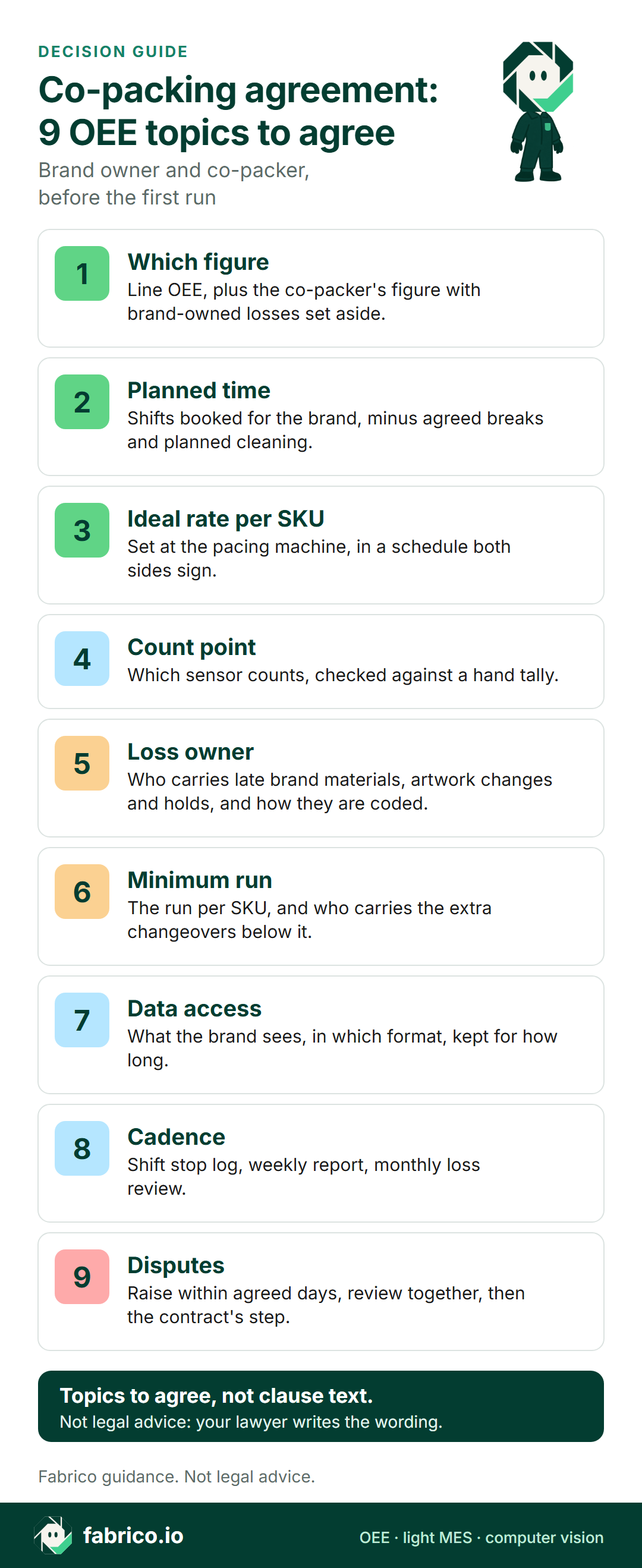
Checklist: performance topics to agree
These are topics, not clause text. Put them to your partner and to your own team.
| Topic | Question to answer in writing |
|---|---|
| 1. Figure | Line OEE, the co-packer's figure, or both? |
| 2. Planned time | Which shifts, breaks and cleaning are set aside? |
| 3. Ideal rate | What rate per SKU, at which machine, and how is it changed? |
| 4. Count point | Which sensor counts, checked how? |
| 5. Loss owners | Which losses are the brand's, and how are they coded? |
| 6. Minimum run | What run per SKU, and who carries extra changeovers? |
| 7. Data access | What does the brand see, in which format, kept how long? |
| 8. Cadence | Which reports, how often, who signs? |
| 9. Disputes | How fast is a code raised, and who settles it? |
Still choosing how to measure? Our guides to OEE software, the best OEE software and MES for mid-size FMCG plants list what to compare.
Where Fabrico fits
Fabrico is a cloud OEE and light MES platform. It is not a party to your agreement. A co-packer can use it as the record both sides read.
- One record for the monthly review: on automated lines, Fabrico reads cycles, stops and output from the line's PLC, and on older machines an IoT device with external sensors collects the signal. The OEE both sides discuss comes from the machine, not from two spreadsheets.
- Brand-owned and co-packer-owned stops: each stop on a connected machine is recorded with start and duration, and operators tag the cause on a tablet or phone from your list of reason codes. Late brand materials or an artwork change can carry their own code, as agreed in the contract.
- What the brand owner sees: role-based access control sets who can see and change what, and an audit log records changes. Lists export to Excel or CSV, and a REST API and webhooks feed other systems, with losses shown in money.
- Hand-pack and rework stations: where there is no machine signal, the camera add-on counts output. With the camera add-on, the video for a disputed stop is streamed when someone opens it and, in the standard setup, is not stored in Fabrico.
- Not included: Fabrico does not sell quality inspection. Ask in the demo how an inspection system's rejects reach the quality part of OEE.
Roadmap, not live today: the camera add-on proposing a likely stop cause for the operator to confirm.
Ask in the demo: how to report OEE per brand and SKU, how to code brand-owned losses as their own category, and what a brand owner's read-only view can look like.
See light MES and OEE in Fabrico, Fabrico computer vision for OEE and computer vision for FMCG manufacturing. Test these claims in the demo like any vendor's.
What people ask next
Should OEE be a KPI in a co-packing agreement?
It can be, if both sides agree the definitions first: planned time, the ideal rate per SKU, the count point and who owns each loss. Many agreements start with OEE in the reporting schedule only, and move it into a target once a few weeks of agreed data exist.
What is the difference between line OEE and the co-packer's figure?
Line OEE counts every loss on the line during the brand's planned time. The co-packer's figure sets aside the losses the agreement assigns to the brand owner, such as late materials it supplies, artwork changes and runs below the agreed minimum. Report both from the same record.
Who should own the OEE data in a co-packing deal?
Often the co-packer runs the system of record, because the line is theirs. The agreement then sets what the brand owner can see, in which format, how often, and how long records are kept. Confidentiality matters, because the same line runs other brands.
How should ideal rates be set for each SKU?
Agree one rate per SKU or pack format at the machine that sets the line's pace, in a schedule both sides sign. A rate set too low hides speed losses; a rate set too high makes every week look like a miss.
How often should a brand owner and co-packer review OEE?
A common rhythm is a daily stop log, a weekly report per SKU, a monthly review of losses by owner and a quarterly look at targets. The right cadence depends on volume and run length, so agree it with your partner.
Is there a standard co-packing agreement template with OEE clauses?
Templates exist, but performance terms depend on the line, the products and the law that applies. Use this page as a list of topics, and have your lawyer write the clauses. This is not legal advice.
Want one co-packed week split by loss owner? Book a demo with your SKU list and last month's stop log.
Related articles



Real Fabrico tiles, sample data.