


 Login
 Blog
New Product Introduction in Manufacturing: A New SKU on a Food Line

In short: new product introduction in manufacturing, when a food or FMCG plant adds a new SKU to a line it already runs, comes down to five steps: readiness sign-offs, trial runs at the planned speed, a signed first-off approval, a locked record of format parts and settings, and four weeks in which the new SKU's availability, performance and quality are measured on their own.
- Give the new SKU its own rated speed before the first trial.
- Run one trial for a full planned length, not a tuned half hour.
- Call it done on written criteria, set beside the line's other SKUs.
The recipe worked in the pilot plant, the customer has a listing date and the line already runs a dozen SKUs. This page covers the stretch from the first trial on the real line to the week the new SKU runs like the rest.
A whole new line needs a new line ramp-up plan instead. The format swap itself is in the changeover checklist, and the quality wait after it in first-off approval after changeover.
Where the line work sits in NPI
Most NPI guides describe a stage-gate process from idea to launch. Robert Cooper set the model out in Stage-gate systems: a new tool for managing new products (Business Horizons, 1990), and a 2020 review in the Journal of Business Chemistry sums up how it works: after each stage, a go or kill decision, the gate, decides on the project's progress. A generic version for a food plant has five gates, each closed by a signed go or no-go:
| Gate | Owner | Proof to close it |
|---|---|---|
| 1. Concept and business case | Marketing and finance | Volume, price and margin target |
| 2. Recipe and pack development | R&D and packaging | Pilot-plant batches to spec |
| 3. Supplier, material and label approval | Purchasing, quality, regulatory | Approved specs, label proof |
| 4. Line trials and first-off approval | Production and quality | Full-shift trial, signed first off |
| 5. Launch and first weeks | Operations | Four weeks measured against written criteria |
Gate names and owners vary by company; read the table as roles. This page covers gates 4 and 5, the ones on the production line, where a recipe that worked in the pilot plant meets the real line speed, crew and changeovers.
What a new SKU changes on a line that already runs
Line, crew and other SKUs stay. What changes:
- New recipe: a different viscosity, piece size or bake time. It moves the speed the slowest machine can hold, and may bring a new allergen.
- New format or pack: a larger pouch, a new tray, a different film. Change parts, settings and the reject pattern at the sealer all differ.
- New customer spec: a tighter fill weight, a new code date format or case count: new limits for quality to sign against.
Set the new SKU's rated speed at its own format, at the machine that limits the line. Reuse the old SKU's rate and the new one carries a performance loss it never had, or hides one it has. The arithmetic is on the OEE per SKU page.
Food safety and label checks before the first trial
A new recipe can change the hazards the food safety plan covers. The EU and UK texts below are quoted from the UK versions on legislation.gov.uk; for EU markets, read the EU's own texts. In the United States, for facilities covered by the FDA's preventive controls rule for human food, 21 CFR 117.170(b)(1) says the plan must be reanalysed whenever a significant change in the activities conducted at your facility creates a reasonable potential for a new hazard. Where a new preventive control is needed, 21 CFR 117.160(a) says you must validate that the preventive controls identified and implemented under § 117.135 are adequate to control the hazard; paragraph (c) of the same section lists controls that need no validation, among them food allergen and sanitation controls.
The EU and UK rules point the same way. Article 5(2) of Regulation (EC) No 852/2004 on food hygiene says that when any modification is made in the product, process, or any step, food business operators shall review the HACCP procedure and make the necessary changes. For a chilled ready-to-eat recipe, Article 3(2) of Regulation (EC) No 2073/2005 adds that, as necessary, the manufacturer shall conduct studies in accordance with Annex II to check the microbiological criteria hold throughout the shelf-life, in particular where the food can support the growth of Listeria monocytogenes. If your team needs a shelf-life study, book it early: it takes longer than the trials.
The label has to match the recipe that will run. Article 21(1)(b) of Regulation (EU) No 1169/2011 on food information says the name of an allergen listed in Annex II shall be emphasised through a typeset that clearly distinguishes it from the rest of the list of ingredients. In the United States, the FDA lists nine major food allergens identified by law: milk, eggs, fish, Crustacean shellfish, tree nuts, peanuts, wheat, soybeans and sesame. A new allergen on the line also moves the SKU's place in the run order; see the allergen changeover matrix. Your food safety team reads these rules for the markets you sell in; this is not legal advice.
The NPI process on the line: five steps to steady output
- Readiness: rated speed, counting point, reject reasons and the food safety and label sign-offs, agreed before trial material is ordered.
- Trial runs: a short run to prove the product can be made, then one at full planned length and target speed, with a changeover in and out. Record availability, performance and quality for each run.
- First-off approval: quality checks the first saleable units against the spec and signs. Time the wait from first unit to signature.
- Format parts and settings record: change parts, temperatures, fill targets, speeds and materials, with a version number. The version that passed the trial is the one crews run.
- Weeks 1 to 4 measured per SKU: availability, performance, quality and the top three losses for the new SKU alone, reviewed weekly against the other SKUs.
Short halts at the infeed count under performance, as reduced speed loss vs minor stops explains. Scrap while the line settles after a start is a quality loss; see startup loss vs reduced yield loss.
Sign-offs for a new SKU, and the proof each needs
Titles vary by plant; read the middle column as a role.
| Sign-off | Signed by | Evidence |
|---|---|---|
| Food safety plan review | Food safety lead | Hazard review for the new recipe |
| Label and allergens | Technical or regulatory lead | Label proof against the final recipe |
| Rated speed and counting point | CI or line engineer | Speed at the limiting machine, this format |
| Trial run result | Production manager | A, P and Q from the full-length trial |
| First-off approval | Quality at the line | Units checked against the spec, timed |
| Settings record | Line engineer | Versioned parts and settings list |
| Introduction done | Operations manager, with quality | Week 4 review against the criteria |
First-run checklist for a new SKU
Copy it into the launch plan and give each line a name and a date:
- Rated speed for this SKU: Ideal rate set at the limiting machine for this format, not copied from another SKU?
- Food safety and label sign-off: Both signatures on file before trial material is ordered?
- Final materials for the trial: Film, trays, cases and labels at the final spec, not samples?
- Full trial at planned speed: Booked in the plan as a full shift, with the changeover crew rostered for both changes?
- First-off approval timed: Time from first unit to quality signature recorded, as well as the result?
- Settings record locked: The version at the line matches the one that passed the trial?
- Same counting point and reject reasons: Output counted where the other SKUs are counted, with the same reject reasons?
- Four weeks reviewed per SKU: Four review dates in the diary, with one owner who brings the numbers?
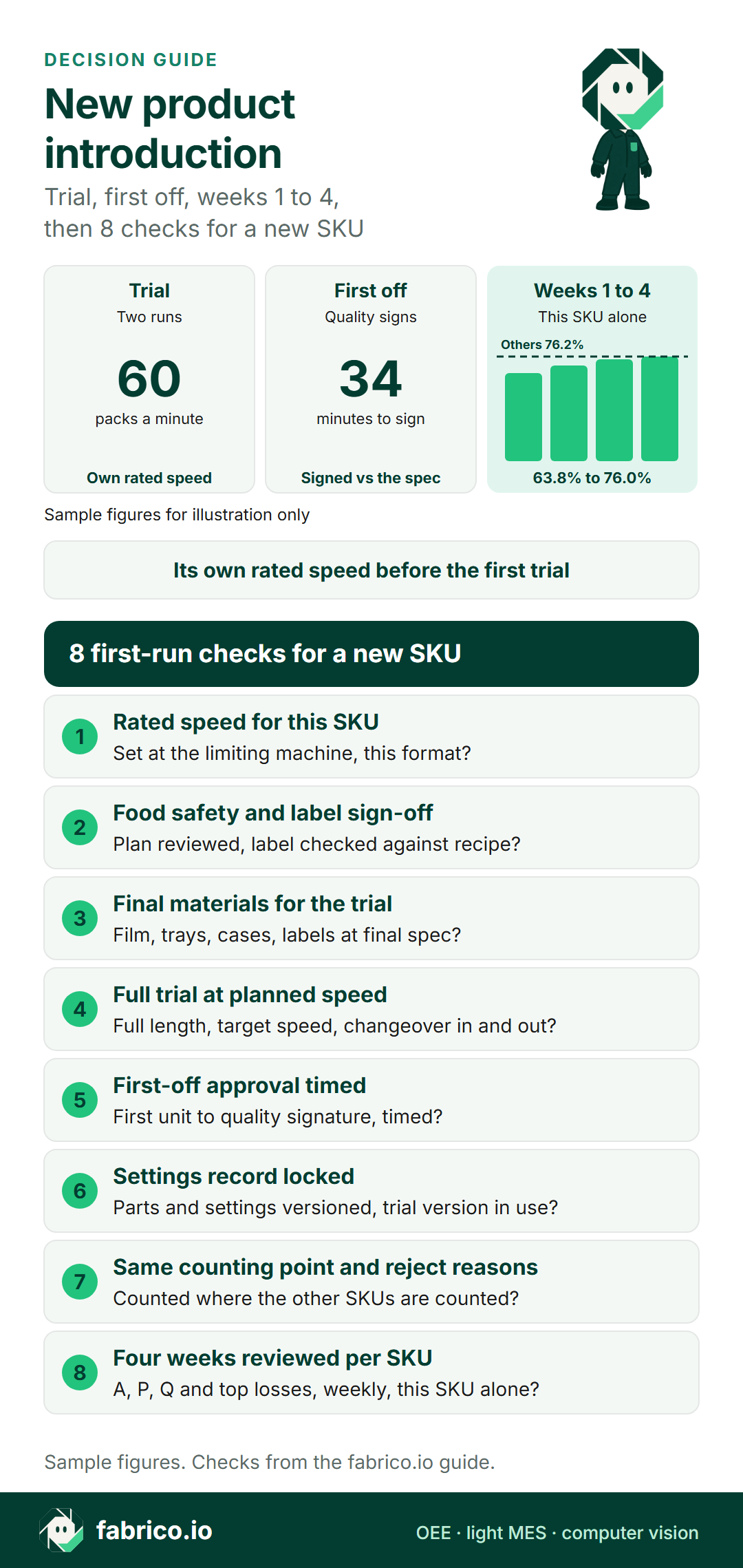
Text version of this infographic
- Title: new product introduction on a food line.
- Sample figures for illustration only.
- Trial: two runs at the new SKU's own rated speed of 60 packs a minute (sample).
- First off: 34 minutes from first unit to signature (sample); quality signs the first saleable units against the spec.
- Weeks 1 to 4: OEE 63.8%, 69.7%, 74.0% and 76.0%, against 76.2% for the line's other SKUs.
- Its own rated speed before the first trial.
- 8 checks: rated speed for this SKU, food safety and label sign-off, final materials for the trial, full trial at planned speed, first-off approval timed, settings record locked, same counting point and reject reasons, four weeks reviewed per SKU.
Worked example: a new snack pouch on a running pack line
Sample figures for illustration only. A snack plant adds a 300 g sharing pouch to a line that packs smaller pouches. At the new format the form-fill-seal machine limits the line to 60 packs a minute, against 80 for the range. Over the last eight weeks the other SKUs averaged availability 86.0%, performance 90.0% and quality 98.5%: 0.860 x 0.900 x 0.985 = 76.2% OEE.
Criteria, set before the first trial: OEE of 73.2% or more (within 3 points) for two weeks in a row, quality at or above 98.5%, settings unchanged for two weeks. The new SKU runs 2,700 planned minutes a week.
Trials and first off: trial 1 ran 45 minutes with an engineer tuning the sealer; trial 2 ran a full 450-minute shift with a changeover in and out. Of trial 2's 126 minutes of stops, 70 were the two changeovers and 34 were the wait from first unit to the quality signature: about 2,040 packs at 60 a minute. Quality now brings the spec sheet to the line before each start.
| Run | Planned, stopped | A x P x Q | OEE |
|---|---|---|---|
| Trial 1, tuned | 45 min, 3 min | 93.3% x 87.0% x 97.0% | 78.8% |
| Trial 2, full shift | 450 min, 126 min | 72.0% x 82.0% x 94.0% | 55.5% |
The short run proved the pouch; the full shift set the starting point.
Week 1:
- Availability: 540 minutes of stops (310 for seal jaw temperature changes, 230 for film splices and jams) leave 2,160 minutes of run time: 2,160 / 2,700 = 80.0%.
- Performance: 108,864 packs against 2,160 x 60 = 129,600 possible: 84.0%.
- Quality: 5,443 rejects leave 103,421 good packs: 95.0%.
- OEE: 0.800 x 0.840 x 0.950 = 63.8%. Check: 103,421 / (2,700 x 60) = 63.8%.
| Week | A x P x Q | OEE | Top loss |
|---|---|---|---|
| Other SKUs | 86.0% x 90.0% x 98.5% | 76.2% | Reference |
| Week 1 | 80.0% x 84.0% x 95.0% | 63.8% | Seal jaw settings |
| Week 2 | 83.0% x 87.0% x 96.5% | 69.7% | Infeed minor stops |
| Week 3 | 85.0% x 89.0% x 97.8% | 74.0% | Start-up rejects |
| Week 4 | 86.0% x 90.0% x 98.2% | 76.0% | Start-up rejects |
Week 4 made 123,131 good packs from 125,388: quality 98.2%. OEE clears 73.2% in weeks 3 and 4 and the settings record has not changed since week 2, but quality is short of 98.5%, so the review says hold. Most rejects come in the first minutes after a start, so one engineer takes the start-up routine and one more review week is booked.
Measured at the old 80 packs a minute, week 4 performance would read 125,388 / (2,322 x 80) = 67.5% and OEE 0.860 x 0.675 x 0.982 = 57.0%: a speed loss the format never had.
If trial 2 had been skipped and the plan had used trial 1's tuned 78.8%, the line would have been booked for 127,598 good packs a week. Week 1 would have missed that by 24,177 packs, 18.9%, and the shortfall would have reached the customer before anyone saw the cause.
What the ramp-up cost in money. Sample figures for illustration only. Take a sample factory price of EUR 2.00 for the 300 g pouch and a sample contribution margin of 16%, or EUR 0.32 a pouch. The 16% is a cautious pick against two published figures for 78 US food processing firms in NYU Stern's margin dataset (January 2026 data, accessed 15.11.2026). One is a pre-tax operating margin of 10.63%, struck after all fixed costs, so contribution sits above it. The other is a gross margin of 23.23%, which contribution can exceed where much of the plant's cost is fixed. Swap in your own price and margin.
- The reference: at the other SKUs' 76.2%, 2,700 planned minutes at 60 packs a minute give 123,507 good packs a week.
- The shortfall: weeks 1 to 4 made 103,421, 112,886, 119,857 and 123,131 good packs, so they fell 20,086, 10,621, 3,650 and 376 packs short: 34,733 packs in total.
- In euros: 34,733 x EUR 0.32 = EUR 11,114.56 of contribution over the launch month, about EUR 2,779 a week on average. Week 1 alone is EUR 6,427.52, nearly 58% of it, which is why the seal jaw settings need an owner before trial 1.
- The skipped trial: the 24,177 packs that week 1 would have missed against a plan built on trial 1 are EUR 7,736.64 of contribution, and a missed delivery on top.
- The hold week: at the week 4 gap of 376 packs, one more review week costs EUR 120.32 of output. That is why the review below holds rather than re-trials.
Book a demo to see how a connected line splits a trial run into availability, performance and quality.
Launch, hold or re-trial: the week 4 decision
The week 4 review has four possible calls. The costs below are sample figures for the pouch above: output valued at EUR 0.32 a pouch, and people's time at the euro area industry labour cost of EUR 40.3 an hour (Eurostat, 2025, accessed 15.11.2026). Put your own crew size, hours and margin in.
| Call | Choose it if the review shows | Cost or effort (sample) | Next step |
|---|---|---|---|
| Launch done | All three criteria met for two weeks in a row | No extra cost; the remaining gap moves into the normal loss reviews | Close the launch file, keep the settings version |
| Hold one more week | OEE passes but one criterion is short, or the gap is still closing | 4 to 8 h of engineer time, EUR 161 to 322, plus the week's gap: EUR 120.32 at week 4 levels, EUR 1,168 at week 3 levels. EUR 281 to 1,490 in all | One loss, one owner, one more review date |
| Re-trial | Gap flat for two weeks with the loss in settings or materials, or the customer spec or recipe changed | A full-shift trial: crew of 4 for 7.5 h, EUR 1,209, plus 6 to 10 h of quality and engineering, EUR 242 to 403, plus up to 5,600 packs short at trial 2 levels, EUR 1,792. EUR 1,451 to 3,404 in all | Change it, new trial, new first off, new settings version |
| Line issue | The other SKUs dropped in the same weeks | 4 to 8 h of CI time, EUR 161 to 322; the lost output is priced in the line's own review, not the launch | Review the line, not the SKU |
The cheapest call is not always right. A hold that drags on for a flat gap costs more each week than one re-trial, and a re-trial for a gap that is still closing throws away a week of learning. In the sample the gap fell from 20,086 to 376 packs a week, so a hold is the call. Keep the trial and weekly figures: the next launch starts from them.
Questions to settle with your own team, or to put to any vendor of line software, before the next launch:
- Which rated speed does the system use for this SKU, and can each SKU on the line carry its own?
- How do we see the new SKU's weeks apart from the other SKUs on the same line: by date and shift, by run, or by export?
- Is the wait for the first-off signature recorded as its own stop reason, with a start and an end time?
- Who signs the week 4 call, and were the criteria written down before trial 1?
- Does the settings record carry a version number, and who may change it between shifts?
Where new SKU launches slip, and the early sign
| What goes wrong | Early sign in the line data | Fix |
|---|---|---|
| Rated speed copied from another SKU | Performance stuck low with no stops to explain it | Set the rate at the limiting machine for this format |
| Seal settings found during the run | Week 1 top loss is seal jaw temperature changes | Pre-heat off the line where a spare sealer is free: in the peer-reviewed 2022 ready-meal changeover study, pre-heating sealing heads on a spare line saved 310 seconds per changeover, its biggest single gain. That plant ran tray sealers for chilled meals, not a form-fill-seal pouch, and the gain depended on the spare sealer, so trial the idea on your own jaws before counting on the seconds |
| First-off wait with no owner | A long wait for quality after every start | Spec sheet and signer at the line before the start |
| Fill target raised to be safe | Few underweight rejects, material use above plan | Set the target from the measured spread. In Great Britain the packers' rules require the batch average to be at least the nominal quantity and no pack to fall short by more than twice the tolerable negative error; for a 300 g pouch the tolerable negative error table gives 9 g, so 18 g |
| Settings changed shift by shift | Quality swings from one shift to the next | Run only the locked, versioned record |
What Fabrico measures on the line while a new SKU settles in
Fabrico makes OEE and light MES software. Every step above works with whatever counting your line uses today. During a launch, a line system adds the counts and stop times nobody has to write down; recipes, specs and signatures stay in the systems your teams already use.
What you see: a shift timeline, unclassified time waiting for a reason, and the operator's line-down screen, on sample lines.
Plays from YouTube. Google may set cookies when you press play. Privacy policy.
What Fabrico adds during the launch weeks:
- Trial figures straight from the line: Fabrico reads automated machines from the PLC and fits older ones with an IoT device with external sensors, so trial counts are not copied from a clipboard.
- Week by week in three factors: Fabrico shows OEE by machine, line and shift, split into availability, performance and quality, for the current shift or a past period. The line also runs other SKUs, so the team reads the new SKU's weeks by picking the dates and shifts it ran from its own run log, or exports those periods to Excel or CSV and sets them beside earlier weeks.
- Losses for the weekly review: the crew picks why the line halted on a tablet or phone, downtime breaks down by cause, machine and shift, and the machine signal catches micro-stops nobody would note.
- A hand-finished pack: at a packing table with no machine signal, output at that table is counted by the camera add-on. To look back at a halt, the team clicks it on the shift timeline and opens the camera add-on video for that minute; the video is streamed on request and not stored in Fabrico.
Losses carry a money value, and the figures also go out through the REST API and webhooks. More in the OEE and MES solution overview and how to judge OEE software; for food plants, see MES for food manufacturing and the camera add-on on food lines.
Questions from new product launch reviews
What is new product introduction in manufacturing?
On a running food or FMCG line, it is the work of taking a new recipe, format, pack or customer spec from its first trial to steady output: trial runs, a signed first-off approval, a locked settings record and a few weeks measured for the new SKU alone. Concept and design reviews come earlier and sit outside it.
What are the stages of new product introduction?
A generic stage-gate process for a food plant has five gates, each closed by a signed go or no-go: concept and business case, recipe and pack development, supplier, material and label approval, line trials and first-off approval, and launch with the first weeks measured. On a line that already runs, the production work sits in the last two.
How long should trial runs for a new SKU be?
At least one trial should run a full planned length at the target speed, with a changeover into and out of the new SKU. A short run tuned by an engineer proves the product, not the shift.
Who signs the first-off approval for a new product?
Quality at the line, checking against the approved spec, with one name agreed before the trial. Time the wait from first unit to signature too: in the sample it took 34 minutes, about 2,040 packs.
When is a new product introduction finished?
When criteria written before the first trial hold for two weeks in a row. The sample uses OEE within 3 points of the line's other SKUs, quality at or above theirs and an unchanged settings record.
Should a new SKU get its own rated speed in OEE?
Yes, if its format runs slower or faster at the slowest machine. In the sample, measuring the new pouch against the old rate would show week 4 OEE at 57.0% instead of 76.0%.
Does a new recipe need a new food safety review?
Often. In the United States, for facilities covered by the FDA's preventive controls rule, 21 CFR 117.170 requires a reanalysis of the food safety plan when a significant change creates a reasonable potential for a new hazard. A new allergen also changes the label. Check the rules where you sell with your food safety team; this is not legal advice.
Want to see a past trial week on a connected machine split into availability, performance and quality, with downtime by cause? Book a demo.
Related articles

Latest from our blog





Real Fabrico tiles, sample data.