


 Login
 Blog
Palletizer OEE: Why the End of the Line Can Stop the Whole Line

Key takeaways
- The palletizer is fast by design, so its own OEE says little; the minutes it blocks the filler say a lot.
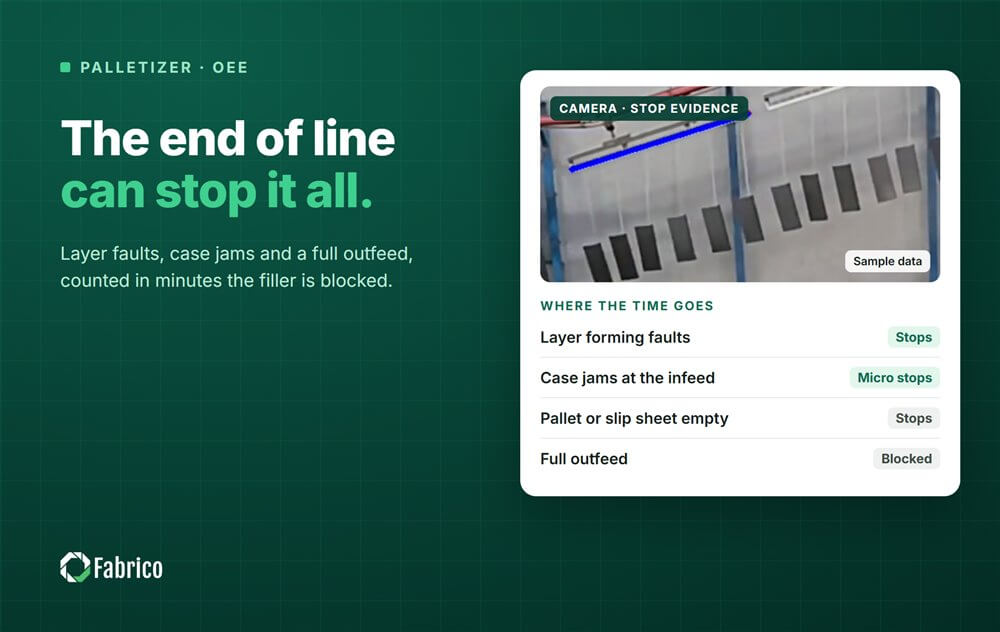
- Typical stops: layer forming faults, case jams, empty pallet and slip sheet magazines, and a full outfeed.
- The stretch wrapper and pallet removal sit on the palletizer's path: a full outfeed blocks it as surely as a fault.
- Protection time is buffer size divided by the rate feeding it.
- A buffer that never drains protects nothing, so check drain time against the time between stops.
A full pallet sits at the palletizer outfeed because the stretch wrapper has a film break. The palletizer cannot discharge, the case conveyor fills, the case packer stops, and a few minutes later the filler is blocked. The line's OEE drops for a fault that started at the wrapper, and the filler crew sees only a blocked state.
The palletizer is rarely the slowest machine, yet its stops travel upstream through each buffer on the line. This guide covers its typical stops, how to measure its OEE, how accumulation decides which stops reach the filler, and how to charge the minutes to the right place.
Why the end of the line can block the whole line
Blocking travels backwards. When the palletizer stops, cases build up on the conveyor from the case packer. When that conveyor is full, the packer stops, product builds up in front of it, and so on until the filler has nowhere to put bottles. Each buffer buys time; once they are all full, a palletizer fault is a filler stop.
On a V-curve line the palletizer sits at the outer end and gets the most spare speed. An example layout runs the filler at 30,000 bottles an hour, the labeller at 33,000, the case packer at 36,000 and the palletizer at 39,000 in recovery speed. That spare speed lets the palletizer catch up after a stop. It is also why its own OEE, measured against its rated speed, looks low on a perfect day. The number that matters is how many minutes it blocked the filler, as our guide to starvation and blocking explains.

Where the palletizer's time goes
| Area | Typical stops | OEE factor | Reaches the filler? |
|---|---|---|---|
| Case infeed | Case jams, tipped or crushed cases | Short stop | Only if long or frequent |
| Layer forming | Case turner misses, cases out of pattern, layer not squared, gripper or pusher fault | Short stop or Availability | Only if long |
| Pallet dispenser | Pallet magazine empty, broken or wrong pallet, dispenser fault | Availability | Often, if the magazine was not refilled in time |
| Slip sheets | Magazine empty, double sheet, sheet not placed | Short stop or Availability | Sometimes |
| Full pallet outfeed | Stretch wrapper down, film break, pallet not collected | Blocked | Yes, once the outfeed positions are full |
| Pattern change | New pattern, layer count or pallet type | Availability, minutes over standard | Depends on the buffer |
Robot palletizers and conventional layer palletizers stop for different reasons. A robot is more likely to stop on gripper and pick faults, a layer machine on case turning and layer forming. Both stop on empty magazines and a full outfeed.
The stretch wrapper and the pallet outfeed
Many plants measure the stretch wrapper as a separate machine and forget that it sits on the palletizer's path. A film break, a film reel change or a top sheet fault at the wrapper stops pallets leaving. The palletizer keeps building only while it has outfeed positions free.
Pallet removal works the same way. If a forklift or the conveyor to the warehouse does not take full pallets away, the outfeed fills and the palletizer is blocked. That stop has nothing to do with the machine, so give it its own code: blocked, pallet not removed.
Little's law gives the outfeed's protection: with 3 full pallet positions and a pallet built every 6 minutes, the outfeed absorbs 18 minutes of wrapper or forklift delay before the palletizer stops.
How to measure Availability, Performance and Quality on a palletizer
- Availability = run time / planned production time. Own faults, empty magazines and changeover overruns reduce it; in the full view, so do starved and blocked time.
- Performance = cases palletized / (run time x rated cases a minute) for the pattern that ran. Count in cases or layers, not pallets, so a half-built pallet still counts.
- Quality = good cases / cases palletized. Pallets rebuilt because of a collapsed layer, a wrong pattern or a bad wrap count against it.
Set the rated speed per pattern, from the nameplate or the maximum demonstrated rate. A pattern with many turned cases forms layers more slowly than one with none.
Then add one number the classic formula does not give: minutes the palletizer blocked the filler. That is its real cost to the line, and it belongs next to the palletizer's Availability figure, not hidden inside the filler's.
Accumulation and buffers: what reaches the filler
Two numbers decide whether a palletizer stop costs output. Protection time is how long the buffers upstream absorb a stop: buffer size divided by the rate feeding it. Drain time is how long the palletizer needs to empty the buffer after a stop: the backlog divided by its spare speed.
If stops come more often than the drain time, the buffers never empty. The next stop then starts with full conveyors, and even a short one blocks the filler. That is why adding conveyor without checking drain time often changes nothing. Our guide to line balancing covers how rates and buffers fit together.
A worked shift at the palletizer
Sample line (illustrative numbers, not a customer): a filler at 360 bottles a minute packing 12-bottle cases, so 30 cases a minute reach the palletizer. The palletizer has a recovery speed of 36 cases a minute.
- The case conveyor in front of the palletizer holds 150 cases: 150 / 30 = 5 minutes of protection. Tables further upstream add 3 minutes, so 8 minutes in total before the filler is blocked.
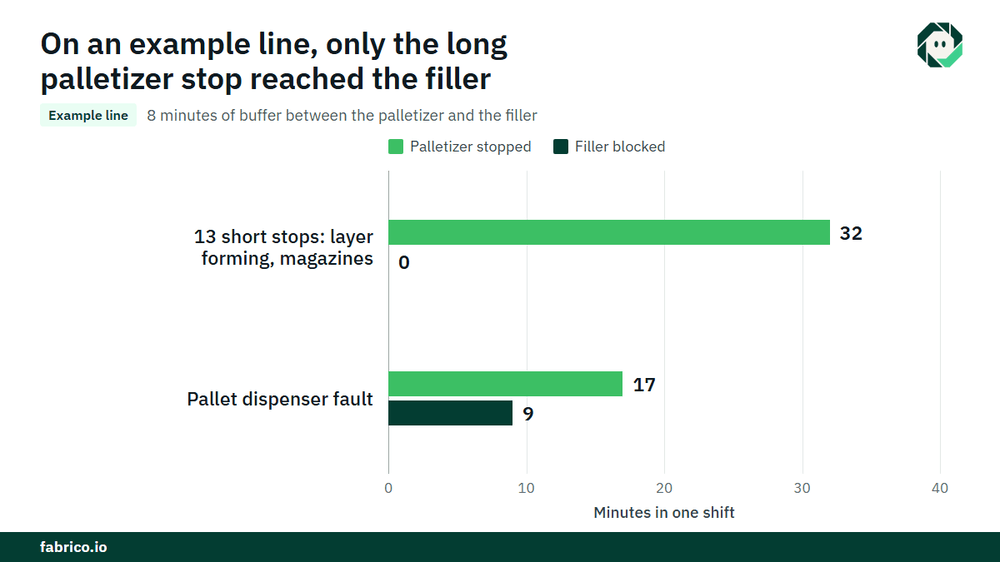
- Short stops: 10 layer forming faults of 2 minutes and 3 magazine stops of 4 minutes, 32 minutes in total. Each ends inside the 8 minutes, so none reaches the filler.
- Drain time after a 4 minute stop: 4 x 30 = 120 cases of backlog, cleared at 36 minus 30 = 6 cases a minute, so 120 / 6 = 20 minutes. With 13 short stops over a 450 minute shift, about one every 35 minutes, the buffer drains in time.
- One long stop: a pallet dispenser fault of 17 minutes. The filler is blocked for 17 minus 8 = 9 minutes: 9 x 360 = 3,240 bottles, or 270 cases.
- At a contribution of $1.50 a case: 270 x $1.50 = $405 per event, or €405 in a euro plant at €1.50 a case.
- If a stop like that happens on one shift in three, 750 shifts a year give 250 events: 250 x $405 = $101,250, or €101,250.
On the palletizer's own report, the 32 minutes of short stops look bigger than the one dispenser fault. Priced at the filler, the short stops cost nothing on this shift and the dispenser fault costs the line. If short stops start coming every 15 minutes, that changes, because the buffer no longer drains between them. Our article on the true cost of downtime covers how to price a stop beyond the minutes.
What the PLC says and what a camera adds
The palletizer PLC knows its own faults, its magazine sensors and its outfeed sensors, but it often reports a layer forming problem as a generic stop. Where a camera watches the layer forming table or the case infeed, the clip shows a tipped case, a case turned the wrong way or a gap in the pattern. The operator confirms the reason in one tap. The PLC stays the clock, and the clip is the evidence.
Mistakes plants make with palletizer OEE
- Judging the palletizer by its own OEE instead of by the minutes it blocked the filler.
- Coding a full outfeed as a palletizer fault when the wrapper or the forklift caused it.
- Adding buffer without checking drain time.
- Letting pallet and slip sheet magazines run empty because refilling is nobody's job.
- Counting pallets instead of cases, so half-built pallets vanish from the count.
Where Fabrico fits
Fabrico is a computer vision enabled Manufacturing Performance Platform. OEE and light MES come first: automatic downtime logging at the palletizer and the machines upstream, so a blocked filler can be traced to the stop that caused it, and OEE live by line and shift.
- The operator confirms the reason in one tap, including blocked, pallet not removed.
- A camera clip as evidence for a stop, where a camera watches the layer forming table.
- Losses priced in money and ranked, so the stop that reached the filler outranks the ones the buffer absorbed.
- One view across plants for end-of-line areas on different sites.
- A work order with its cost to the right technician when a stop is a breakdown.
You start on one line, with a baseline and a decision date agreed in advance. Each plant gets a quote after a review of its lines. See how a stop gets its evidence on our computer vision for OEE page.
Frequently asked questions
How do you calculate palletizer OEE?
Availability is run time over planned production time, Performance is cases palletized over what the palletizer could handle at its rated speed for that pattern, and Quality is good cases over cases palletized. Multiply the three, and track the minutes it blocked the filler next to it.
Why does the palletizer stop the filler?
Because blocking travels upstream. Once the case conveyor and the tables in front of the packer are full, a palletizer stop leaves the filler nowhere to put bottles.
How big should the buffer before a palletizer be?
Size it from the rate feeding it, the length of the stops you want to absorb and the time between stops. Protection time is buffer size divided by the feed rate; then check that the palletizer's spare speed drains it before the next stop.
Should stretch wrapper stops count against the palletizer?
Log them at the wrapper, and charge the palletizer's blocked minutes to the wrapper when a full outfeed was the cause. That keeps each machine's record honest.
What are the most common palletizer stops?
Layer forming faults, case jams at the infeed, empty pallet or slip sheet magazines and a full outfeed waiting for the wrapper or a forklift.
See your end of line in a demo
Bring one line and its current downtime log. We will show which palletizer stops reached the filler and what each one cost.








Real Fabrico tiles, sample data.