


 Login
 Blog

Computer Vision for Lawn Mower Manufacturing: Find the Station Holding Output Back

In short: the station holding a mower line back shows in its queues. Count units into and out of each buffer, then put a camera add-on where no machine counts.
- A queue that keeps growing sits in front of the constraint; an empty buffer means the loss belongs upstream.
- On an indexed line no queue forms, so the station that finishes last on most cycles sets the pace.
- Count first at the boxing table, the handle station exit and the queue in front of the run test booth.
- Fabrico does no inspection. Blade stop, run test, noise label and code checks stay with their rigs and scanners.
Computer vision in lawn mower manufacturing counts mowers in and out of each queue, so the station holding output back shows on the shift timeline.
It does not inspect: blade brake rigs, run test booths and label scanners judge the mower, while the camera add-on only counts units leaving manual stations.
In scope: walk-behind and ride-on mowers, lawn tractors, trimmers, hedge cutters, chainsaws, leaf blowers and robotic mower assembly. Cameras that steer robotic mowers are a product feature, not this page's subject. Battery packs have their own page, computer vision for battery manufacturing, and so do washers and fridges: computer vision for household appliances.
The queue test on a lawn mower line
A mower plant is a chain of buffers: decks after paint, engines at the dock, mowers in front of the run test booth. The queue test asks each buffer one thing: over an hour, did more units go in than came out?
If the queue grows, the station after it cannot keep up or is blocked further down. If the buffer runs empty and the next station stands, it is starved and the loss belongs upstream. That is the method of a bottleneck analysis, and it is why starved and blocked stops must be booked to the station that caused them, not the one that showed them.
An indexed main line lets no queue form. A 2016 Modern Materials Handling report on a US commercial mower plant describes the classic index and dwell line: operators control the system’s pace, and the line indexes forward only when all of them signal that they are done. On a line like that the constraint is the station that finishes last, cycle after cycle, and the queue test moves to the done signals: log which station signals last on each index.
| Buffer reading | Likely cause | Loss owner |
|---|---|---|
| Painted decks pile up, engine fit busy | Assembly is slower than paint | Main line |
| Painted deck buffer empty, engine fit waits | Press, weld or powder line is behind | Upstream area |
| Decks waiting, engine dock empty | Bought-in engines or packs late | Supplier reason |
| Run test queue grows | Booth slower than the line, or down | Run test booth |
| Indexed line, handle station last to finish | Handle station paces the line | Handle station, slow running |
| Fewer boxes than mowers out of test | Fails sitting in rework, or boxing short of crew | Rework bay or boxing table |
A run test that takes two minutes on one mower and six on the next builds a queue even when its average keeps up; that is Kingman's formula for queue time. Count queues every hour, not once a shift.
Explainer presented by Iris, Fabrico's AI-generated presenter: how an add-on camera counts output where a machine has no signal. Book a demo.
Plays from YouTube. Google may set cookies when you press play. Privacy policy.
Where the queues sit in a mower plant
One example plant: shared fabrication and paint, two side feeders, one main line and three queues worth counting.
Feeders matter because they hide behind the main line. Assembly magazine's account of the Ariens plant in Brillion, Wisconsin, notes that subassembly lines build components such as control arms and transmissions, and feed them to the main assembly line. A feeder that falls behind looks like a slow main line station unless its output is counted on its own.
Layout can be the constraint too. At the same plant, the old U-shaped cell gave way to a straight line of seven workstations because the inside of the U caused a bottleneck because space got tight. In a cell like that, units bunch at the stations sharing the cramped inside.
Upstream: presses and weld robots already count, the powder line does not
Steel decks are drawn and trimmed on presses that count their own strokes; see OEE software for stamping and press operations. Polymer decks and housings come off moulding cells, covered in computer vision for plastics injection molding. Ride-on and zero-turn frames are welded in robot cells that log program cycles; see OEE for robotic welding cells. None of these needs a camera to count.
What they share is capacity. The plant in the Modern Materials Handling report operates three shifts for welding, fabrication and painting to support the single shift mower assembly. Upstream runs three times the hours of assembly, so the painted deck buffer is the upstream queue to watch: a bad night in the weld shop is tomorrow's empty buffer.
The powder line PLC knows chain speed, not how many hooks carried a deck. A camera add-on at unload counts decks lifted off; against the decks engine fit takes, that is the painted deck queue by the hour. Book a colour change as a powder line changeover, so starved minutes at assembly land where they started.
Run this test before buying hours. If assembly waits on decks, an extra assembly shift adds wages and no mowers; the overtime and weekend shift diagnostic belongs upstream.
The engine dock: petrol and battery variants arrive from outside
Most mower plants buy their engines in. The US emissions rules for small spark-ignition engines assume it: under 40 CFR 1054.130, if you sell an engine for someone else to install in a piece of equipment, you must give the installer instructions that keep the engine in its certified configuration. So the engine dock is a queue the plant does not control: a late truck shows as decks waiting in front of engine fit while the dock is empty.
The mix at the dock is moving. In California, the Air Resources Board approved a rule requiring most newly manufactured small off-road engines, such as those in lawn mowers and leaf blowers, to be zero emission from model year 2024, for engines in its small off-road engine programme, spark-ignition engines rated at or below 19 kilowatts. In Europe, the garden machinery federation EGMF reports in its 2026 activity report that adoption of battery-powered equipment, handheld products and robotic solutions continues to grow, while petrol-powered categories face challenges and riding machines hold stable volumes.
So two kinds of unit pass one engine fit station. A petrol engine is bolted through the deck and the blade bolt torqued from below by a DC nutrunner that logs each tightening, so that station already counts. A battery mower gets a motor, controller and battery tray, less work with its own ideal time. Book an empty dock as a supplier reason, never as slow running.
The handle station and the pace of an indexed line
On a walk-behind line the handle station is the fiddly one: lower and upper handle, the bail the user holds to keep the blade turning, the blade control cable, the drive cable on self-propelled models and the throttle on petrol ones, each routed and clipped. Nothing there gives a signal. On an indexed line, a slow handle station does not build a queue; it holds every station on the line in its dwell.
Where operators press done, the line controller can log each press; the cycles where the handle station pressed last are the queue test for a line without queues. A camera add-on at the station exit counts mowers out; new operators show as fewer mowers per hour.
Model mix changes the station times. At the Ariens plant, all mowers share the same basic tubular steel frame, although many components (engines, front axles, footrests, seats, tires) are unique to different models, and eight zero-turn series run on one line. Give each model family its own ideal time, or the station building long-cycle models looks slow when it is not. See OEE on manual and hybrid assembly lines.
Trimmers, hedge cutters, chainsaws and blowers are built in small hand cells with a run-in stand; count each cell's exit, with an ideal time per product.
Run test, label and box: inspection stays on the rigs
Petrol mowers are fuelled, started and run in a ventilated booth, and the blade brake is checked on a rig; battery mowers get a function test. In the US, the CPSC safety standard for walk-behind rotary mowers says the blade control must stop the blade completely within 3.0 seconds after release of the control (16 CFR 1205.5); the proof stays with the rig's records.
When the booth stops, the run test queue fills within minutes and the line blocks. Count mowers into the queue (out of the last main line station) and out of it (the rig's pass and fail log). A mower that fails goes to rework and back through the test; count it once, as a fail; see how to track quality losses inside OEE.
Labels are a station of their own. In the US, for a testing programme the mowers shall be divided into production lots, and the certification label names the lot and the month and year of manufacture; boxes counted by shift and model put a production figure next to each lot. In the EU, lawnmowers are listed in Article 12 of the outdoor noise directive 2000/14/EC as equipment subject to noise limits, and Article 11 puts the CE marking and the indicated sound power level on each item of equipment. A label printer that stops holds every box behind it.
Then the handle is folded, catcher and manual go in, and the box is closed. A closed box is finished output that nothing upstream can count, so the boxing table takes the first camera add-on. See the OEE camera at a manual packing station.
Where to start counting in a mower plant
Start where the count is missing and a queue is likely; machines that already count keep their own signal.
| Count point | Source | What it proves |
|---|---|---|
| 1. Boxing table exit | Camera add-on | The line's output, by hour and model |
| 2. Handle station exit | Done log, camera add-on | Whether it is last to finish on the index |
| 3. Run test queue, in and out | Last station count in, rig log out | Whether the booth blocks the line |
| 4. Powder line unload | Camera add-on | The painted deck queue against engine fit |
| 5. Engine fit | Nutrunner tool controller | Mowers started, against decks and dock stock |
With those five, every queue in the diagram has a number in and out. Write the reason list with the team leads first: engines late, packs late, decks short, colour change, booth down, label printer down. The wider method is in how to find and remove a manufacturing bottleneck.
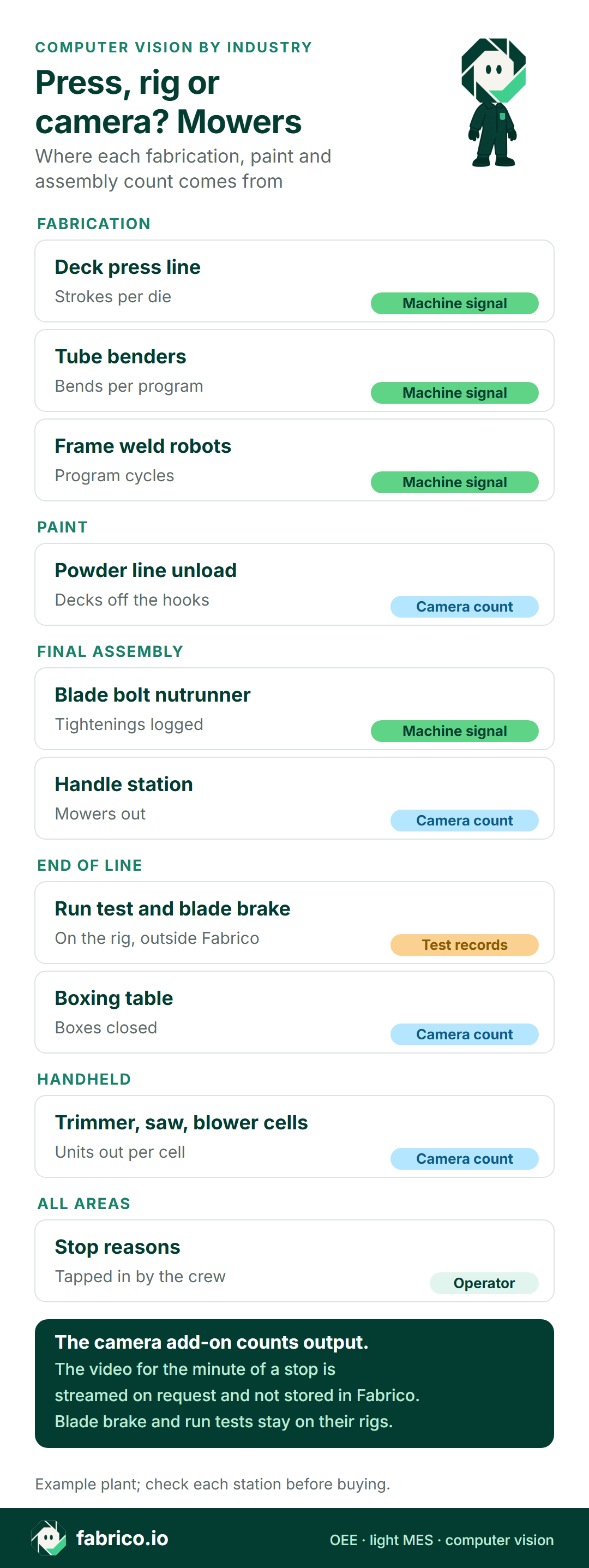
Text version of this infographic
- Fabrication: Deck press line: machine signal, Strokes per die
- Fabrication: Tube benders: machine signal, Bends per program
- Fabrication: Frame weld robots: machine signal, Program cycles
- Paint: Powder line unload: camera count, Decks off the hooks
- Final assembly: Blade bolt nutrunner: machine signal, Tightenings logged
- Final assembly: Handle station: camera count, Mowers out
- End of line: Run test and blade brake: test records, On the rig, outside Fabrico
- End of line: Boxing table: camera count, Boxes closed
- Handheld: Trimmer, saw, blower cells: camera count, Units out per cell
- All areas: Stop reasons: operator, Tapped in by the crew
- AI cameras (an add-on) count output. The video for the minute of a stop can be opened from the shift timeline; it is streamed on request and not stored.
- Blade brake and run tests stay on their rigs.
Book a demo to see engine fit, the handle station and the boxing table counted on one timeline.
Worked example: one shift where the handle station held the line
Example numbers, no real plant: an indexed line builds petrol and battery walk-behind mowers. The ideal cycle is 60 seconds for a petrol mower and 45 seconds for a battery one. The shift is 05:30 to 13:30 less a 30-minute break, so 450 minutes are planned. Camera add-ons count closed boxes and mowers leaving the handle station, the nutrunner counts engine fit, the run test rig logs pass and fail, and the team lead types in stop reasons.
Availability. The queues explained the three stops. For 35 minutes decks stood at engine fit with the engine dock empty: supplier reason. For 15 minutes the painted deck buffer was empty after a colour change from red to green: powder line changeover. For 10 minutes the run test queue was full behind an extraction fault: booth reason. Run time: 450 minus 60 = 390 minutes, an availability of 86.7%.
Performance. The boxing table closed 200 petrol and 180 battery mowers: 200 x 60 s + 180 x 45 s = 20,100 seconds, or 335 minutes of ideal work, from 390 minutes of running: 85.9%. The line's done log showed where the other 55 minutes went: the handle station pressed last on most index cycles, with two operators in their second week.
Quality. Eight petrol mowers failed the run test first time. Good first-pass output was 192 petrol and 180 battery mowers: 11,520 + 8,100 = 19,620 seconds, or 327 minutes. Quality was 327 of 335: 97.6%.
OEE. 86.7% x 85.9% x 97.6% = 72.7%. Cross-check: 327 good minutes of 450 planned minutes is 72.7%. The bars add up too: 327 + 55 + 35 + 15 + 10 + 8 = 450. The arithmetic from count to OEE is set out in OEE with computer vision.
Where a camera add-on covers the station, the video for the minute of a stop can be opened from the shift timeline, streamed on request and not stored in Fabrico. For the first engine stop, the handle station video showed no mowers arriving from upstream; the team lead checked the engine rack and booked the supplier reason.
The shift in euros
Example inputs, to be swapped for the plant's figures: 24 people from first station to boxing, each costing EUR 40 an hour with employer charges, and EUR 60 contribution margin per mower. The rate is close to the euro area figure: Eurostat's 2025 labour cost statistics put industry at EUR 40.3 an hour, the highest paying sector. No public margin figure for a walk-behind mower was found, so the EUR 60 is an example input. Wages run whether the line moves or not: one lost minute is 24 x 40 / 60 = EUR 16. At the 60-second petrol ideal, each lost minute is also at least one mower not built, worth EUR 60 of margin only if orders are waiting and it cannot be built later.
| Loss this shift | Minutes | Crew cost | With lost margin |
|---|---|---|---|
| Slow running at the handle station | 55 | EUR 880 | EUR 4,180 |
| Engines late from the supplier | 35 | EUR 560 | EUR 2,660 |
| Colour change starved the line of decks | 15 | EUR 240 | EUR 1,140 |
| Run test booth fault | 10 | EUR 160 | EUR 760 |
| Run test fails, line time used | 8 | EUR 128 | EUR 128 |
| Total lost time | 123 | EUR 1,968 | EUR 8,868 |
That is EUR 1,968 of crew time and EUR 6,900 of margin: EUR 8,868 for one shift, or EUR 88,680 over a week of ten shifts like it. The 8 run test fails count at crew time only, because those mowers were reworked and boxed the same shift; rework labour comes on top.
The handle station is 47% of the money, more than the late engines and the booth together. It is the constraint for this shift, so the first fix to test is there: pair each new operator with an experienced one, or put a second operator at handles until the times settle. A fix at the powder line would have saved 15 minutes; handles cost 55. Prove the fix with the same counts next shift, as in real-time OEE for bottleneck analysis.
What a camera can and cannot see at a mower station
Hands get in the way. Researchers at Hamburg University of Technology who built a camera system to recognise manual assembly steps found, for hand joints, that due to the increased occlusion of the hands by holding a tool, these were not continuously usable. They also note that judging progress by watching the product is not always applicable if the product is multi-variant with small lot sizes or if the work is affected by occlusions, and that robustness has to account for changes in the application environment, such as backgrounds and lighting. Their study recognised steps and tools in a lab, not output on a mower line, so treat it as a list of limits rather than a benchmark.
For a mower plant that sets three rules. Point the camera add-on at the mower or box leaving the station, not at the hands, so the count never depends on seeing a cable clipped. Give the powder unload even light; glossy paint under one lamp is a hard scene. This page states no accuracy figure; test the count against a hand tally at your own stations.
Tell operators and the works council what the camera counts before drilling any bracket, keep faces out of frame, and show results per station and shift with no names. Positions near the fuelled run test booth need the safety lead's sign-off.
Mower plant FAQ: the queue test
How do I find the station holding back a mower line?
Count units into and out of each buffer: painted decks, the engine dock and the run test queue. The queue that keeps growing sits in front of the constraint.
Can an OEE camera check blade stop time or whether an engine starts?
No. Blade brake and run tests stay on their rigs, and label and code checks stay with the plant's inspection system. Fabrico does no inspection. A failed run test still lowers OEE quality once it reaches the count.
What if our mower line is indexed and no queue forms inside it?
Log when each station signals done on every index. The station that is last to finish sets the pace.
Should petrol and battery mowers share one ideal cycle time?
No. Give each model family its own ideal time, or battery mowers read as fast work and petrol mowers as slow.
Should we add a shift before running the queue test?
Run the test first. If assembly waits on an empty painted deck buffer, the extra shift belongs upstream, not in assembly.
Where Fabrico fits in a mower constraint hunt
Fabrico is cloud OEE software with light MES functions. In a mower and garden equipment plant it does three things now:
- Presses, benders, weld robots and the powder line: it reads run state and counts from their controllers or PLCs, so a die change or booth stop becomes stop time, with the reason from the crew.
- Powder unload, assembly stations, handheld cells and boxing: the camera add-on counts decks, mowers, boxes and handheld units. Where a camera add-on covers the station, the video for the minute of a stop can be opened from the shift timeline, streamed on request and not stored in Fabrico.
- Model mix: each model family gets its own ideal cycle time, and each loss gets a euro value from the price or margin set per model.
Reasons are tapped in at the station on a tablet or phone. Managers follow the same figures on the web or in the iOS and Android apps, and data can be exported via a REST API, webhooks, Excel or CSV. Camera add-on details sit on the computer vision for OEE feature page, and the wider platform on the OEE and MES solution overview.
Roadmap: a camera add-on that marks the station holding the line and offers a probable cause, which the team lead accepts or corrects; not available today.
Outside Fabrico: blade brake and run tests, weld and coating checks, label and code inspection, safety certification and its records, noise and emissions certification.
Four checks for any camera vendor:
| Question | Good answer |
|---|---|
| Can it show a queue, not only a count? | Counts in and out of the same buffer on one timeline. |
| How does it handle an indexed line? | Each station's done signal per index, plus counts at the exit. |
| Where do the rig's pass and fail go? | Into quality, each fail counted once. |
| How are starved and blocked minutes booked? | To the station that caused them, with the crew's reason. |
Want the run test queue, the handle station and the boxing table on one shift timeline? Book a demo.
Related articles





Latest from our blog




Real Fabrico tiles, sample data.