


 Login
 Blog

User Requirement Specification for Equipment: Speed, OEE and Data

In short: a user requirement specification (URS) for equipment is the buyer's document that states what a new machine must do, in terms that can be tested, before any supplier proposes a design. For packaging and production equipment, the clauses that decide whether the machine earns its money are the ones most templates leave vague: sustained speed and OEE at acceptance, the data the machine must send out, changeover time and reject handling, each with a named way to measure it.
- Write rated speed and sustained speed as two numbers, and define OEE at acceptance: formula, ideal rate, excluded states and test window.
- Require state, count, reject, stop reason, speed and format signals over OPC UA, using PackML or Weihenstephan, with a read-only user for monitoring.
- Time changeovers from the last good unit to the first good unit at rate, and name who holds the stopwatch.
- In the worked example, three vague clauses on a rice cartoner cost EUR 126,435 in the first year. Writing them properly takes about two engineer days.
A plant usually writes a URS in a hurry. The project has a budget, the supplier shortlist is ready and the template from the last project is on the shared drive. That template covers formats, utilities, hygiene, guarding and documentation well. It is weak where the money is: how fast the machine really runs, how much of its time it runs, and whether anyone can prove either after the final payment.
This guide is for the engineering, production or project manager writing a URS for a new cartoner, case packer, flow wrapper, filler or similar machine. It gives the clauses to add, with sample wording, the reasons behind each, a worked example on a rice cartoner priced in euros, and a decision block on which document should carry which requirement.
User requirement specification for equipment: what it is and where it sits
The term comes from regulated industry. The European Commission's GMP guide for medicinal products, EudraLex Volume 4, Annex 15 on qualification and validation (2015), says the specification for equipment, facilities, utilities or systems should be defined in a URS and/or a functional specification, and that the URS should be a point of reference throughout the validation life cycle. Its glossary defines the URS as the set of owner, user and engineering requirements necessary and sufficient to create a feasible design meeting the intended purpose of the system. The same annex has the design checked against the URS, and has the equipment confirmed against the URS or functional specification at the vendor's site before installation.
Food, beverage, household and personal care plants are not bound by that annex, and most pharma URS templates carry clauses they do not need, such as qualification protocols and GMP risk assessments. The structure still helps. The plant writes down what the machine must do and how each point will be checked. The supplier answers with an offer, and later with a functional specification. Every test after that, at the builder's works, on site and at handover, checks the machine against the same list. A requirement that is not in the URS tends to become a change order.
This page stays on what to require. What each acceptance test covers is in FAT vs SAT. The stages and sign-offs from installation to handover are in the equipment commissioning checklist. Turning a performance figure into a contract guarantee with exclusions and remedies is covered in OEE guarantees for a new line. For software rather than machines, see the light MES requirements template.
What a typical template already covers
Most URS templates have sound sections for scope and intended use, product and pack formats, materials of construction and cleaning, utilities, layout and footprint, safety and CE marking, documentation, training and spare parts. Keep them. The gaps sit in three places, and they share one cause: the clause names a feature or a number without saying how it will be measured, by whom, over what period.
| Topic | Typical template line | What it leaves open |
|---|---|---|
| Output | Speed: 140 packs a minute | Top speed or average? Which format? Over how long? With whose crew and materials? |
| Effectiveness | Efficiency of 85% or more | Which formula, which losses count, which ideal rate, who calculates |
| Data | Machine to be prepared for MES connection | Which signals, which protocol, which states, who may write to the machine |
| Changeover | Quick, tool-less format change | Where the clock starts and stops, for which formats, with how many people |
| Rejects | Reject station included | Which faults it must catch, where rejects go, how they are counted |
Performance clauses: rated speed, sustained speed and OEE at acceptance
A packaging machine has at least three speeds, and a URS that names one of them invites the supplier to answer with the most flattering. Write all three, per format, and say which one the acceptance is judged on.
Rated speed is the speed the machine is designed to run for a given format in your plant. The OPC Foundation's PackML companion specification, OPC 30050 has a tag for it, MachDesignSpeed, and is precise about what it means: the maximum design speed in primary packages per minute for the package configuration being run, which is not the maximum speed specified by the manufacturer but the speed the machine is designed to run in its installed environment. That distinction belongs in the URS. A brochure maximum on the easiest format is not a rated speed for your 500 g carton with a leaflet insert.
Sustained speed is good output divided by running time over a long window: how fast the machine goes when it goes, including the speed operators actually choose to avoid jams. It is the number that sets your weekly capacity, and it is the one most often missing. A machine rated at 140 cartons a minute that operators run at 118 because the carton erector jams above 120 has a sustained speed of 118, whatever the FAT showed.
OEE at acceptance combines the time the machine ran, the speed it ran at and the good output it made into one figure, availability x performance x quality, with the rated speed as the ideal rate. It is the only one of the three that shows short stops and slow running together. Write the definition into the URS rather than a bare percentage. There is a published European standard on the subject, EN 415-11 (2021), on determining the efficiency and availability of packaging machines; it is a paid document. If a supplier quotes a figure under it, ask for the edition and the clause, and copy that definition into an annex. For the general formula, see the OEE calculation guide.
| Figure | What it proves | What it hides | Write it as |
|---|---|---|---|
| Rated speed | The mechanism can run that fast on that format | Stops, slow running, rejects | Packs a minute, per format, in the installed setup |
| Sustained speed | The speed operators can hold | Stops and rejects | Good output over running time, whole test window |
| Availability | How much of the time it runs | Slow running, rejects | Running time over planned time, by machine state |
| OEE at acceptance | Time, speed and quality together | Losses outside the machine, if excluded | Formula, ideal rate, excluded states, window |
Sample wording for the performance section
Adapt the numbers; keep the structure. Each clause states the figure, the measure, the window and the owner.
- P1, rated speed: "The machine shall be designed to run at a rated speed of 140 cartons a minute for each format in Annex A, in the installed layout, with the materials in Annex B."
- P2, sustained speed: "Over the acceptance window, the average speed while in the Execute state shall be at least 128 cartons a minute for each format, calculated as the processed count divided by time in Execute."
- P3, OEE at acceptance: "Machine OEE shall be at least 84%, calculated as availability x performance x quality, with the rated speed in P1 as the ideal rate. Planned time is the acceptance window minus time the machine reports as starved or blocked. Quality counts cartons rejected by the machine and by the downstream checkweigher as not good."
- P4, window: "The acceptance window is at least 24 hours of planned production with the plant's crew and production materials, covering the formats that make 80% of planned volume and at least two format changes."
The starved and blocked exclusion is where a machine clause differs from a line clause. The machine supplier cannot be judged on a filler upstream that runs dry. The PackML model carries flags for exactly this, Equipment Starved and Equipment Blocked, so the exclusion can come from the machine's own signals rather than from a debate. Line-level exclusions, crew rules and remedies are contract terms; the OEE guarantee page covers them.
Choosing the ideal rate is the decision that moves the result most. Use the rated speed per format from P1, not the fastest format's nameplate and not last month's average. The ideal cycle time guide explains why, and nameplate vs real capacity shows how far apart the two can drift.
Data and connectivity clauses: signals out, states and read-only access
The cheapest time to get data out of a machine is before it is built. At order time a signal is a line in the PLC program. After handover it is a visit from the builder's software engineer, a change to validated code and a stop on a running line. A URS that says "prepared for MES connection" buys none of this, because it names no signal, no protocol and no behaviour.
Ask for the signals an OEE calculation needs, named, with their meaning. The table maps each to its PackML tag; if the plant has standardised on the Weihenstephan Standards instead, the same list maps to their data points for the machine class.
| Signal | PackML tag | Why monitoring needs it |
|---|---|---|
| Machine state | CurrentState | Running, held, suspended, stopped: the clock for availability |
| Starved or blocked | Equipment Starved, Equipment Blocked | Separates the machine's own stops from line effects |
| Processed count | ProdProcessedCount | Units made, good and rejected: performance |
| Reject count | ProdDefectiveCount | Units marked not good: quality |
| First-out stop reason | StopReason | What stopped it first, before the cascade of alarms |
| Speed | CurMachSpeed, MachDesignSpeed | Actual vs rated speed, so slow running is visible |
| Format or product | Product | The right ideal rate for each format |
The standards behind the tags are worth naming in the URS, because they settle arguments about meaning before they start. PackML began at OMAC, the packaging automation group, and was adopted by ISA as TR88.00.02; OMAC presents PackML as a way to move consistent machine data between machines and systems, so that machines from different builders look and behave alike. The current edition is listed by ISA as ISA-TR88.00.02-2022, Machine and Unit States, a technical report on defining and managing machine and unit states. The OPC UA companion specification states that PackML provides standard defined machine states and operational flow, and OEE data. It also defines the counters precisely: the processed count includes all good and defective products, and the processed count minus the defective count is the number of non-defective products made by the machine. Writing those two tags into the URS removes the usual dispute over what "output" means.
Food and beverage plants in German-speaking markets often specify the Weihenstephan Standards instead. They define a communication interface for the standardised transmission of machine data to higher-level IT systems, cover over 150 machine classes, and publish machine profiles that show which data points must be provided and which are optional. Either standard works. Pick one for the plant, name it with its edition, and require the machine class profile or the PackML tag list as an annex the supplier confirms line by line.
OPC UA is the usual transport for both. If your plant also runs older machines on native PLC protocols, OPC UA for OEE explains what changes and what does not; the PackML state model page explains the states themselves.
Read-only access for monitoring
Monitoring needs to read the machine, never to write to it. Say so in the URS: a separate OPC UA user or endpoint for monitoring, with read rights on the listed tags and no write rights to setpoints, recipes or commands, documented ports, and a test at SAT where that user tries to write and is refused. This keeps a reporting system from becoming a control path, and it gives IT or OT security a clear line to sign. NIST's guide to operational technology security, SP 800-82 Rev. 3 is a sound reference for the wider design, since it addresses OT's own performance, reliability and safety requirements. Ask the supplier to state which user roles exist on the machine, who holds the passwords after handover, and how a firmware update affects the tag list.
With these signals in place, OEE software reads state, counts and speed from the PLC from the first shift after handover. Availability, performance and quality per shift are then calculated on the same rules as the acceptance window, and the operator adds a stop reason at the line where the machine's first-out code is not enough. The walkthrough below shows the line screen those signals feed, from the shift timeline to the operator's reason prompt.
What you see: a shift timeline, unclassified time waiting for a reason, and the operator's line-down screen, on sample lines. Book a demo.
Plays from YouTube. Google may set cookies when you press play. Privacy policy.
Reject handling and who measures
A reject station is not a requirement. A reject requirement says which faults the machine must catch, what happens to the rejected pack, and how it is counted. Write three things:
- What it rejects: list the faults, such as a missing inner bag, an open or crushed flap, a missing leaflet, an unreadable code or a carton outside weight limits. For each, name the sensor or the downstream device that catches it.
- Where rejects go: a lockable bin per reject point, so a rejected carton cannot find its way back onto the line, plus a confirm sensor that stops the machine if the reject does not leave.
- How they are counted: a reject count by cause, sent out with the other signals, and kept out of the good count. If a checkweigher or code reader sits downstream, say which count is final for quality, so the same carton is not counted twice or not at all.
Verify it with seeded faults. During FAT and again at SAT, feed a known number of faulty cartons of each type through at rated speed. Every one must land in the right bin and in the right counter. A reject system that catches most faults most of the time will pass a demonstration and fail an audit. Checkweigher rejects have their own subtleties; checkweigher rejects in OEE quality covers them.
Name who measures, and with what
Every performance clause needs a measurement clause beside it, or the result depends on who brought the stopwatch. Four points settle most disputes:
- The count point: cartons are counted at the machine's discharge, after the last reject point, from the processed and reject counters listed in the data section.
- The clock: time in each state comes from the machine's state signal, logged with a timestamp, not from a hand-written log.
- The tool: the plant's own monitoring system reads the signals during the acceptance window, and a manual count of sampled periods checks the counters against reality.
- The signatures: the plant's engineering lead and the supplier's site lead both sign the result, with the raw data attached.
Putting the plant's system in charge of the measurement has a second benefit. The acceptance figure and the first months of production are then calculated the same way, so a drop after handover shows up as a drop, not as a change of method.
Want to see machine states, counts and stop reasons from a packaging line on one screen? Book a demo.
Changeover clauses: define the clock before the supplier quotes it
"Quick, tool-less format change" describes a feature. It does not set a time, and so it cannot fail. The changeover clause needs a start, an end, the format pairs, the crew and the target. A workable definition is the plant's: from the last good carton of the old format to the first good carton of the new format, with the machine then running at 90% of rated speed or more for 10 minutes without a stop. The definitions behind that are in changeover time.
Ask the supplier where their changeover clock starts and stops, and write your own into the URS. Then add the design features that make the target reachable and visible: numbered change parts, digital position indicators on adjustment points, format recipes stored in the PLC and sent out with the product signal, and a changeover state the monitoring system can see. A sample clause:
- C1: "A format change between any two formats in Annex A shall take no more than 26 minutes, from the last good carton of the old format to the first good carton of the new format, followed by 10 minutes at 90% of rated speed or more without a stop, done by one trained operator without tools beyond those supplied with the machine. Time is taken from the machine's state and count signals."
Name the format pairs that matter. A change between two carton sizes on the same erector is not the same job as a change that swaps the leaflet feeder, and an average across all pairs can hide the one that eats an hour every week.
Worked example: what three vague clauses cost on a rice cartoner
Sample figures for illustration only. A food plant buys a cartoner for 500 g cartons of boil-in-bag rice. It is the slowest machine on the line, so it sets the pace. The URS came from a template: "Speed: 140 cartons a minute", "tool-less format change", "prepared for MES connection". The FAT was a short run at 140 a minute on the main format, which passed, and the final payment followed.
The line runs two shifts a day, five days a week. Each shift is 480 paid minutes less 24 minutes of breaks: 456 planned minutes, so the ideal output at the rated speed is 456 x 140 = 63,840 cartons a shift. Five people run the end of the line. Labour is priced at the Eurostat euro area industry labour cost for 2025, EUR 40.3 an hour, within a whole-economy range of EUR 12.0 in Bulgaria to EUR 56.8 in Luxembourg, so an hour of the crew costs 5 x 40.3 = EUR 201.50.
What the machine did. Once the plant fitted its own counter and state signal, four months in, an average shift looked like this. Stops at the cartoner: 47 minutes, so run time is 456 minus 47 = 409 minutes and availability 409 / 456 = 89.69%. Operators held the speed at 118 a minute because the erector jams above 120: 409 x 118 = 48,262 cartons, performance 118 / 140 = 84.29%. Rejects: 527, so 47,735 good, quality 98.91%. OEE: 89.69% x 84.29% x 98.91% = 74.77%, the same as 47,735 / 63,840.
What clauses P1 to P4 would have forced. With sustained speed and OEE in the URS, the FAT result would not have been enough. The supplier would have had to fix the erector before final payment. The sample assumes it then reaches the pass marks with a little room: 29 minutes of stops, run time 427, availability 93.64%; 129 a minute, performance 92.14%; 55,083 cartons with 330 rejects, 54,753 good, quality 99.40%. OEE 85.77%, above the 84% in P3.
| Per shift | Vague URS | Specified URS |
|---|---|---|
| Stops at the cartoner | 47 min | 29 min |
| Availability | 89.69% | 93.64% |
| Running speed | 118 a minute | 129 a minute |
| Performance | 84.29% | 92.14% |
| Quality | 98.91% | 99.40% |
| OEE | 74.77% | 85.77% |
| Good cartons | 47,735 | 54,753 |
| Shifts for 503,000 a week | 10.54 | 9.19 |
Clause 1, speed: EUR 100,105.20 a year. Demand is fixed at 503,000 cartons a week. The vague machine needs 503,000 / 47,735 = 10.54 shifts to make it, which means Saturday overtime. The specified machine would need 503,000 / 54,753 = 9.19. The gap is 1.35 shifts a week, or 1.35 x 8 hours x EUR 201.50 = EUR 2,176.20 a week. Over 46 working weeks: EUR 100,105.20.
Clause 2, changeover: EUR 22,863.53 a year. The line changes format 4 times a week. Timed from last good to first good at rate, the tool-less change takes 63 minutes, because the leaflet feeder has no position indicators and every change ends in trial and error. A clause like C1, with indicators and change parts specified, would have held it to 26. The difference is 37 x 4 = 148 minutes a week, and 148 / 60 x EUR 201.50 = EUR 497.03 a week, EUR 22,863.53 a year.
Clause 3, data: EUR 3,465.80 once, and the claim it cost. "Prepared for MES connection" turned out to mean a spare network port. Adding the state, count and reject signals took 36 hours of the plant's controls engineer (EUR 1,450.80), a 6-hour stop to load and test the changed program, made up with crew overtime (EUR 1,209.00), and eight weeks of hand tallies while the change waited for a slot, a quarter of an hour a shift (EUR 806.00). The builder's own charge for the program change comes on top and is not priced here. The larger cost is indirect: without data, nobody could show the speed shortfall until month four, after the final payment, and with a URS that only said 140 a minute the supplier had met the specification.
Reading it. The three vague clauses cost EUR 126,434.53 in the first year, and the speed and changeover losses repeat every year after. Writing the three clauses properly, on top of a URS the plant writes anyway, takes about two engineer days, 16 hours at EUR 40.3: EUR 644.80. That is a ratio of roughly 196 to one, before any argument about whether the crew hours could have been used elsewhere.
If the line were sold out, the gap would be lost sales, not crew hours. The specified machine makes 7,018 more good cartons a shift. At a sample ex-works price of EUR 1.64 and the food processing gross margin of 23.23% from the NYU Stern margin dataset by industry (January 2026, 78 US firms), each carton contributes about EUR 0.381; gross margin still carries fixed costs, so this understates a unit's true contribution. That is EUR 2,673.86 a shift, or EUR 1,229,974.68 over 460 shifts a year. The fixed-demand figure is the cautious one; use the one that matches your order book.
The clause set: must, should, and how each is verified
These eight clauses sit on top of a normal URS. Each row names the requirement, whether it is a must or a should, and the evidence that closes it. A must that cannot be verified is a wish; if you cannot write the last column, rewrite the clause.
| Clause | Must or should | What it states | Verified by |
|---|---|---|---|
| Rated speed | Must | Design speed per format, cartons a minute | Run at the builder, each format |
| Sustained speed | Must | Average over the test window, at discharge | Count over running time, from the state log |
| OEE at acceptance | Must | Formula, ideal rate, exclusions, window | Plant calculates from the signals |
| Changeover | Must | Last good unit to first good at rate | Timed by the plant, named format pairs |
| Rejects | Must | By cause, kept out of the good count | Seeded faulty packs, all rejected |
| Signals out | Must | State, counts, stop reason, speed, format | Tag list read live at SAT |
| Open protocol | Should | OPC UA with PackML or Weihenstephan | Interface document, tested at SAT |
| Read-only access | Must | Monitoring user that cannot write | Write attempt refused at SAT |
The open protocol is a should rather than a must for one reason: a single machine joining an old line may be better served by the protocol the rest of the line already speaks. For a new line with several suppliers, make it a must, or the integrator will spend the commissioning weeks writing translators between machines.
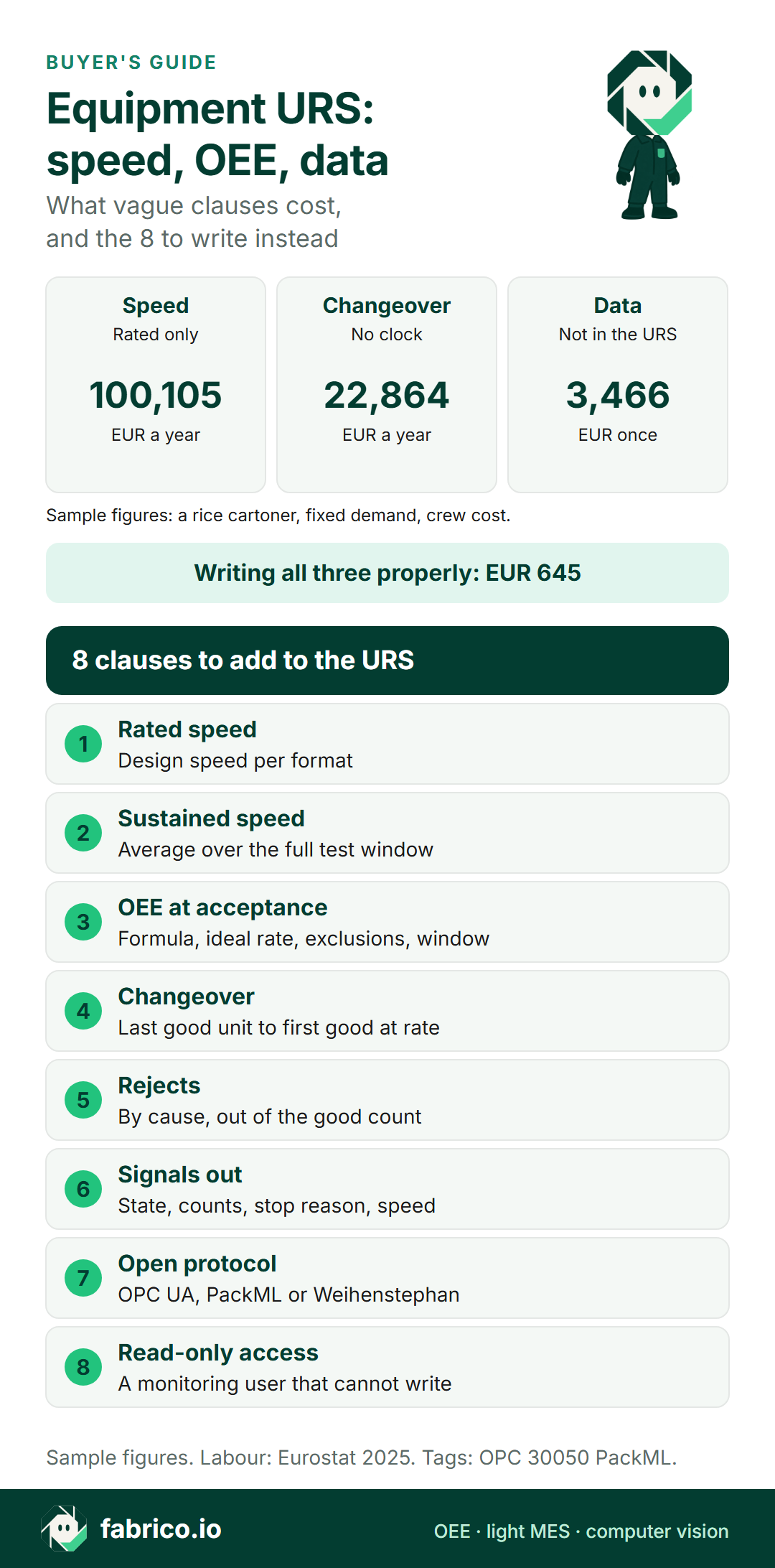
Text version of this infographic
- Speed clause with rated speed only: EUR 100,105 a year.
- Changeover clause with no clock: EUR 22,864 a year.
- Missing data clause: EUR 3,466 once.
- Writing all three properly: EUR 645.
- Clause 1, Rated speed: Design speed per format
- Clause 2, Sustained speed: Average over the full test window
- Clause 3, OEE at acceptance: Formula, ideal rate, exclusions, window
- Clause 4, Changeover: Last good unit to first good at rate
- Clause 5, Rejects: By cause, out of the good count
- Clause 6, Signals out: State, counts, stop reason, speed
- Clause 7, Open protocol: OPC UA, PackML or Weihenstephan
- Clause 8, Read-only access: A monitoring user that cannot write
- Sample figures. Labour: Eurostat 2025.
Template URS, functional spec or supplier spec: options, effort and who writes which
Four documents can end up carrying the requirements. They are not alternatives in the full sense, because the functional specification answers a URS, but plants do choose how much weight each one carries. The effort ranges below are sample estimates in engineer days, priced over an 8-hour day at the Eurostat range of EUR 12.0 to 56.8 an hour.
| Option | Who writes | Effort, sample | Choose it if |
|---|---|---|---|
| Template URS, filled in | Plant engineer | 1.5 to 3 days, EUR 144.00 to 1,363.20 | A like-for-like replacement of a machine you already measure, same formats |
| Plant URS with performance and data annex | Plant engineering, with production, quality and OT | 2.5 to 5 days, EUR 240.00 to 2,272.00 | A new machine type, a new line, or any machine that will set the line's pace |
| Supplier's specification as the requirement | Supplier; plant reviews | 3 hours to 1 day of review, EUR 36.00 to 454.40 | A standard catalogue machine, low cost, not the line's constraint |
| Functional specification | Supplier; plant approves | 2 to 4 days of review, EUR 192.00 to 1,817.60 | Always after the URS for custom machines; it answers the URS, clause by clause |
Who should pick which. A plant replacing a case packer with the same model on the same formats can live with a filled-in template, as long as it copies the performance and data annex from the last project. A plant buying the machine that will set a new line's pace should write its own URS with the annex, whatever the price of the machine, because that machine decides the line's capacity for the next ten years. Accepting the supplier's specification as the requirement fits small standard machines only: it hands the definition of "good enough" to the party being paid. The functional specification is never a substitute; if a supplier proposes to skip the URS and go straight to their functional specification, the plant loses the yardstick that specification should be checked against.
Questions to put to suppliers before you sign:
- What is the rated speed for each of our formats in our layout, and what sustained speed have you measured on comparable installations over a full shift?
- Which states, counts and stop reasons will the machine send out, over which protocol, and will you confirm our PackML tag list or Weihenstephan profile line by line?
- How is a read-only monitoring user set up, and what happens to the tag list after a software update?
- Where does your changeover clock start and stop, and what did your last three customers' format changes take on that clock?
- Which faults does the reject system catch, where do rejects go, and how will you prove it with seeded faults at FAT?
- Will you accept the acceptance figure as calculated by our monitoring system from the machine's own signals?
Before the request for quotation goes out: a two-week plan
The URS is cheapest to fix before suppliers price it. A two-week sprint is enough for most machines.
Week one: measure and draft.
- Pull a month of data from the machine being replaced, or the nearest similar one: running speed, stops by reason, rejects and changeover times. It sets realistic pass marks.
- List the formats by volume and mark those that make 80% of planned output. They go in the acceptance window.
- Draft P1 to P4 and C1, with numbers from step one, and the reject list with production and quality.
- Ask IT or OT security for the protocol, the standard (PackML or Weihenstephan) and the read-only access rules.
Week two: test the clauses.
- For every must, fill in the verified-by column. Rewrite any clause you cannot verify.
- Have finance check the volume and the price per unit used for the business case, so the speed clause matches the plan.
- Walk the draft through the FAT and SAT structure: each clause should map to a test.
- Send the URS with the request for quotation, and ask each supplier to answer it clause by clause in their offer.
For the software that will read the machine, use the same discipline. The OEE software for high-speed packaging lines guide compares options against the same signals, and machine monitoring software covers the wider field.
Where Fabrico fits once the machine is on the floor
Fabrico is OEE software and light MES for the plant floor. It does not write the URS or test the machine; it measures what the machine does from the day it starts, on the same rules the acceptance window should use:
- Fabrico reads automated lines from the PLC, and fits an IoT device with external sensors to older machines that have no usable signal. Stops and counts come from there, and the operator chooses the stop reason at the line, on a tablet or a phone. Screens and modules are on the OEE and light MES solution page.
- Reports give OEE, downtime and losses for each machine, line and shift, and price the losses with the plant's own unit prices and margins, so a speed or changeover shortfall reads in euros, not adjectives.
- Where a station is manual and has no machine signal, the camera add-on counts its output; MES and OEE with computer vision explains how. With the camera add-on, the video for the minute of a stop is streamed on request, not kept in Fabrico.
- Acceptance and production figures can leave through the REST API, webhooks or Excel and CSV files, so they reach the project file and the supplier.
Which protocols and machine signals a given machine needs is a question to settle machine by machine; the data clauses above give you the list to bring to that conversation.
Sources, accessed 16.11.2026: EU GMP Annex 15; OPC 30050 PackML; OMAC PackML; ISA-88 standards; Weihenstephan Standards; DIN EN 415-11; NIST SP 800-82 Rev. 3; Eurostat, labour cost per hour 2025; NYU Stern, margins by industry.
Questions engineers ask about an equipment URS
What is a user requirement specification for equipment?
It is the buyer's document that states what a new machine must do, in terms that can be tested, before any supplier proposes a design. It covers the product and formats, output, quality, utilities, hygiene, safety, documentation and data, and every later document, from the supplier's offer to the acceptance run, is checked against it.
Who writes the URS, the buyer or the supplier?
The buyer. The plant's engineering lead usually drafts it with production, quality, maintenance and IT or OT, and signs it before the request for quotation goes out. The supplier answers it with an offer and later a functional specification, which the plant approves.
What is the difference between a URS and a functional specification?
The URS says what the machine must achieve and how that will be checked. The functional specification is written by the supplier and says how their machine will do it: sequences, interlocks, screens, alarms and interfaces. The functional specification answers the URS clause by clause; it does not replace it.
Should a URS include an OEE target?
Yes, if it also defines it: the formula, the ideal rate per format, which states count as excluded time, the test window and who calculates the result. An OEE target with no definition is a number both sides will read differently. Contract terms and remedies for a miss are a separate step.
Which data signals should a packaging machine URS ask for?
At least the machine state, a processed count and a reject count, a first-out stop reason, the current speed and the design speed, and the format or product running. Ask for them over OPC UA using the PackML tags or the Weihenstephan data points for the machine class, with a read-only user for monitoring.
Is a URS only for pharma equipment?
No. EU GMP Annex 15 makes the URS a formal step for medicinal products, and the pharma templates come from there. Food, beverage and FMCG plants have no such rule, but the same document protects them in the same way: it fixes what the machine must do before price and delivery date take over the talks.
Want to see machine states, counts and losses in money from a packaging line? Book a demo.
Related articles



Latest from our blog



Real Fabrico tiles, sample data.