


 Login
 Blog
iAuditor vs Pervidi: Choose by Where a Failed Check Must Go

In short: iAuditor vs Pervidi is decided by where a failed check has to go. If you need fast checklists across sites and hazard reports from anyone on site, look at iAuditor (now Mitti) first; if checks hang off tagged assets, a failed item must become an SAP or JD Edwards work order, or IT wants it on premise, look at Pervidi first. Both apps digitise checklists, take photo evidence, run offline and raise an action from a failed item.
- Price, as published on 15.11.2026: Mitti lists a free plan and Premium at $24 a seat a month billed annually; Pervidi shows no public price, quote on request.
- Rules set the rhythm: OSHA wants forklifts examined at least daily, PUWER wants inspection results kept until the next one.
- Sample powder coating shift: moving one check and tightening another is worth 400 good parts, about EUR 684.
The plant, quality or EHS manager who searches this pair is usually past the "should we go digital" stage. Forklift checks sit on a clipboard at the charging bay, the booth checks are on a laminated sheet, and corrective actions live in an inbox. The real question is what happens in the minute after a tick box says "fail": who hears about it, which system the follow-up lands in, and who proves it was fixed. That is the frame for everything below.
Key takeaways
- Route the fail first: a corrective action inside the inspection app points to Mitti; a work order in SAP or JD Edwards points to Pervidi.
- Checks tied to serial-numbered trucks, hoists or extinguishers favour Pervidi's barcode and RFID capture at the point of work.
- Reports from contractors and visitors favour Mitti's issue QR codes that need no login.
- Mitti publishes per-seat prices; Pervidi builds a quote and says cloud is typically per user per month, on-premise a one-time licence.
- In the coating example, the check's timing, not its result, cost the shift 24 minutes.
A word on names. Mitti's iAuditor page is headed "iAuditor is now Mitti" and calls the product "Mitti, formerly iAuditor"; its SafetyCulture page says "SafetyCulture is now Mitti". IT Brief Australia reported on 12.08.2026 that "SafetyCulture has rebranded as Mitti" (IT Brief, accessed 14.11.2026). This page uses iAuditor where the search does and Mitti where the vendor's pages do. Fabrico, which makes cloud OEE software and a light MES, comes in once, where a failed check meets the line's stop log. For a longer list, see SafetyCulture alternatives for manufacturing.
Pick by where a failed check has to go
Mitti's home page calls it "The operations system for every site, shift and standard". Pervidi's home page says "Any industry. Any inspection. Configured to yours." and its Why Pervidi page opens with "The checklist was never the hard part." Read side by side (features on 14.11.2026, prices on 15.11.2026):
| After the tick box | iAuditor (now Mitti) | Pervidi |
|---|---|---|
| A check fails | Corrective action created and assigned automatically | Corrective work assigned, reminded, escalated, then verified |
| Where follow-up lands | Tasks linked to inspections; custom action types | Inspection-triggered work orders; native SAP and JD Edwards |
| What ties a check to equipment | Templates, sites and assets in one platform | Barcode or RFID data at the point of work |
| Who can raise a problem | Anyone with a phone, via issue QR codes, no login | Operators photograph issues; actions go to a technician's device |
| Building the form | Drag-and-drop; AI turns a photo or PDF into a checklist | Conditional logic, required fields, role permissions, no code |
| Hosting | Cloud, online or offline on any device | Cloud or on-premise; designed to run fully offline |
| Price, as published (checked 15.11.2026) | Free plan; Premium $24 a seat a month billed annually, $29 monthly; Enterprise custom (pricing page) | No public price, quote on request; tiers by team size, 1 to 20, 20 to 100 and 100+ users (Pervidi pricing) |
Use the decision matrix with the fail in mind. Each row names the vendor whose page leads with that job.
| If this is you | Look first at | Why (vendor page) | Prove it in the pilot by |
|---|---|---|---|
| Safety walks and 5S audits across six sites, rolled out by one EHS lead | iAuditor (Mitti) | New processes rolled out across sites "with a click" | Publishing one template to two sites and comparing completion |
| Contractors at goods-in must be able to flag a hazard | iAuditor (Mitti) | Issue QR codes, "no login required" | A QR code at the gate for a fortnight |
| Checks belong to forty serial-numbered trucks and hoists | Pervidi | Barcode or RFID at the point of work | Scanning twenty tagged assets on one round |
| A failed guard check must open a maintenance order in SAP | Pervidi | Inspection-triggered work orders; native SAP and JDE | Failing one item and finding the order in the ERP |
| IT will not approve a cloud-only tool | Pervidi | "Cloud or on-premise. Offline or online." | Written hosting terms from both vendors |
| Old checklists are phone photos and PDFs | iAuditor (Mitti) | AI turns a photo or PDF into a checklist | Converting your three worst sheets and timing it |
| A fix is not closed until someone verifies it | Pervidi | Assignment, completion and verification | Timing one fail from flag to verified close |
| Ten users want to start free and grow | iAuditor (Mitti) | Free plan for teams up to 10 | Checking which limits bite: five active templates, basic analytics |
Price in this decision. Mitti publishes a free plan for teams of up to 10 with five active inspection templates, Premium at $24 a seat a month billed annually or $29 billed monthly, excluding taxes, and a custom-priced Enterprise tier; Pervidi publishes no price and quotes on request, describing cloud as "typically per user per month" and on-premise as "one-time licensing with optional annual support and maintenance" (both checked 15.11.2026). Add the internal hours as well: someone builds the templates, someone owns the ERP link, and someone closes and verifies the actions.
If most of your inspections are line-side process audits, structure them first with the layered process audits guide; tools aimed at the audit programme itself are in audit management software for manufacturing.
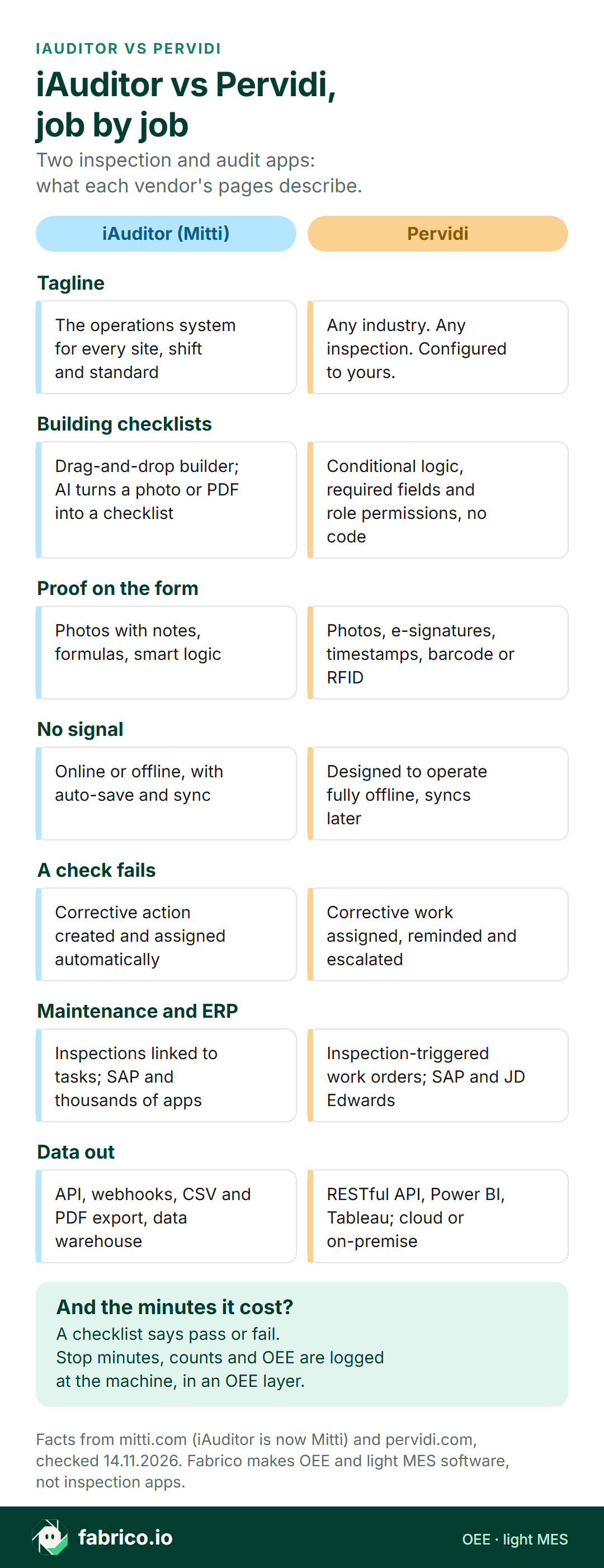
Text version of this infographic
- Tagline. iAuditor (Mitti): the operations system for every site, shift and standard. Pervidi: any industry, any inspection, configured to yours.
- Building checklists. iAuditor (Mitti): drag-and-drop builder; AI turns a photo or PDF into a checklist. Pervidi: conditional logic, required fields and role permissions, no code.
- Proof on the form. iAuditor (Mitti): photos with notes, formulas, smart logic. Pervidi: photos, e-signatures, timestamps, barcode or RFID.
- No signal. iAuditor (Mitti): online or offline, with auto-save and sync. Pervidi: designed to operate fully offline, syncs later.
- A check fails. iAuditor (Mitti): corrective action created and assigned automatically. Pervidi: corrective work assigned, reminded and escalated.
- Maintenance and ERP. iAuditor (Mitti): inspections linked to tasks; SAP and thousands of apps. Pervidi: inspection-triggered work orders; SAP and JD Edwards.
- Data out. iAuditor (Mitti): API, webhooks, CSV and PDF export, data warehouse. Pervidi: RESTful API, Power BI, Tableau; cloud or on-premise.
- And the minutes it cost? A checklist says pass or fail. Stop minutes, counts and OEE are logged at the machine, in an OEE layer.
Tagged assets and RFID rounds
Many plant checks are not about a place but about a thing with a serial number: a reach truck, a chain hoist, an extinguisher, a ladder. For those, the record has to follow the asset, and the inspector has to prove they stood next to it.
Pervidi's digital inspection page is written for that case. It lists "barcode or RFID data at the point of work", "Electronic signatures and automatic timestamps", and annotated photos, and says "Pervidi is designed to operate fully offline", which matters in a steel-framed warehouse or a cold store. Its home page describes "Inspections, asset management, and field workflows in one platform".
Mitti approaches equipment from the platform side: its home page says Mitti brings "inspections, training, incident reporting, asset management, and more under one platform", and its iAuditor page mentions connecting "sensors and weather feeds" to monitor conditions. Its inspection pages lead with building and scheduling checklists rather than with tag scanning.
The pilot test is blunt. Tag twenty assets, walk one round with each app, then search one truck's full history. Count the taps, check that the timestamp and the asset ID cannot be edited afterwards, and see whether the round still works with the phone in flight mode. The forklift pre-use inspection guide covers what the truck check itself should contain.
From a failed item to an SAP or JDE work order
This is where the two pages diverge most. Pervidi's CMMS and work order page describes "inspection-triggered work orders (automatically created when an inspection identifies a defect)" and states "Pervidi integrates natively with SAP and JD Edwards (JDE)." Technicians "can raise, update, and close work orders from their iOS or Android device in the field." The compliance page follows the action "through assignment, completion, and verification."
Mitti keeps the follow-up inside its own platform first. The quality management page says "If something fails during a check, a corrective action is created and assigned automatically", and the tasks and actions page says "Link inspections to tasks so teams know exactly what work needs to be done." For other systems, the integrations page is headed "Connect to thousands of apps, from SAP to SmartSheet", and the developer portal offers webhooks for "near real-time inspection event notifications".
Ask both vendors to fail one item on a test asset during the pilot, live, with your ERP or maintenance system on the screen. If the order appears with the asset, the photo and the inspector's note, the route works. If someone has to retype it, it does not.
How often the rules say to check: OSHA 1910.178(q)(7) and PUWER regulation 6
The schedule is not a matter of taste. For powered industrial trucks, OSHA 29 CFR 1910.178(q)(7) says "Such examination shall be made at least daily", and "Where industrial trucks are used on a round-the-clock basis, they shall be examined after each shift" (accessed 14.11.2026). In Great Britain, regulation 6 of PUWER 1998 requires equipment exposed to deterioration to be inspected "at suitable intervals", with each result "recorded and kept until the next inspection under this regulation is recorded" (accessed 14.11.2026).
The stakes behind the rules are measured. Eurostat's accidents at work statistics count "2.78 million non-fatal accidents at work that resulted in at least 4 calendar days of absence" in the EU in 2024 and 3 367 fatal ones, with manufacturing at 18.3% of the non-fatal total (accessed 14.11.2026). The International Labour Organization puts worldwide deaths from work-related accidents and diseases at nearly three million a year, with 395 million non-fatal work injuries (accessed 14.11.2026).
Translated into app requirements: a schedule that raises a flag when a daily or after-shift check is missed, a record that cannot be lost before the next inspection, and an audit trail of who checked what, when. Ask both vendors to show a missed check, not a completed one. For where routine rounds end and formal inspections start, see operator rounds vs inspection.
A coating line where check timing cost the shift
Everything in this section is sample data written for this page: an invented plant, with no product screen shown. A metal storage maker powder coats steel shelving uprights on an overhead conveyor: wash, dry-off oven, spray booth, cure oven. Take a 9 hour shift less a 40 minute break: 500 planned minutes. The line can hang 12 parts a minute, so 6,000 parts are possible.
Two inspection habits shape the shift. The booth filter check sits on the pre-start list. Today it fails on pressure drop at start-up, the photo and action go in correctly, and the conveyor waits 24 minutes for new filters. Dry film thickness is checked every two hours; after a colour change one gun drifts low, and 190 parts are coated too thin before the next check catches it. Another 88 parts are rejected for ordinary reasons.
| Sample coating shift | Minutes or parts |
|---|---|
| Colour change, white to anthracite | 29 min |
| Booth filter change after the pre-start check failed | 24 min |
| Cure oven slow to reach temperature | 16 min |
| Hanger jam at loading | 10 min |
| Chain lubrication | 7 min |
| Line stopped | 86 min |
| Parts coated | 4,570 |
| Rejected: coating too thin | 190 |
| Rejected: other causes | 88 |
The shift's OEE. Of 500 planned minutes the line ran 414, so availability is 414 / 500 = 82.8%. Those 414 minutes allow 4,968 parts at 12 a minute; 4,570 were coated, so performance is 4,570 / 4,968 = 92.0%. Taking away 278 rejects leaves 4,292 good parts, so quality is 4,292 / 4,570 = 93.9%. The product, 82.8% x 92.0% x 93.9%, is 71.5%, which is 4,292 good of 6,000 possible.
The check was right; its timing was wrong. Read as compliance, the record is spotless: the filter failed, a photo was taken, the action closed. Read against the clock, the check ran at the one moment when a fail stops a ready line. Schedule it at the end of the previous shift, with the action due before handover, and the 24 minutes come back.
What both changes are worth. 24 more minutes at the shift's performance coat 24 x 12 x 92.0% = 265 more parts. They are not all good: the shift's other-cause reject rate is 88 of 4,570, about 1.9%, so about 260 of them pass. Checking film thickness hourly, with an out-of-limit reading raising an action at once, is assumed to save 140 of the 190 thin parts. Together that is 400 more good parts, 4,692 in all, and an OEE of about 78.2%, up 6.7 points.
The margin per upright. Take a sample selling price of EUR 9.50 per coated upright and value lost output at 18% of it, EUR 1.71. That rate sits between the 6.59% pre-tax operating margin and the 30.28% gross margin reported for 27 US Furniture and Home Furnishings firms in NYU Stern's January 2026 margins by industry table (accessed 15.11.2026). The 400 parts are worth 400 x 1.71 = EUR 684.00 on this shift. If five shifts a month carry the same pattern, typically the colour-heavy days, that is EUR 3,420 a month and EUR 41,040 over 60 shifts a year. Both apps describe scheduled checks and actions raised from a failed item; the pilot shows which one your crews keep to.
Matching a failed check to the stop it caused
The inspection app knows the filter failed at start-up. It cannot know the conveyor then stood for 24 minutes. That number comes from the line, and it is the one that decides when the check should run. Fabrico measures that side with OEE software and a light MES; its MES and OEE solution overview lists what each module records. Fabrico reads run, stop and count from the machine's PLC; see the OPC UA and OEE guide. A stop reason such as "waiting: failed pre-start check", with the asset name spelled the same in both systems, lets you pull every wait that a check caused and price it.
A work order opens from a logged stop in one tap, and you can set chosen stop reasons to create that work order automatically as soon as the reason is logged. At the hand-loading station, where no machine signal exists, the camera add-on counts output; asking that camera to propose a stop reason is a Roadmap idea. Where a camera covers the line, the video for the minute of a stop can be opened from the shift timeline; it is streamed on request and not stored. See computer vision for OEE. Mitti offers inspection webhooks and Pervidi a RESTful API, but Fabrico claims no ready connector to either, so match the two records by asset and clock time in a pilot. To see waits caused by checks priced by line and shift, book a demo.
Six things to do before either vendor calls back
- Pick three checklists: one asset check (truck or hoist), one quality check, and the audit people complain about most.
- Write down where each fail goes today, who closes it and who verifies the fix.
- Count serial-numbered assets. If most checks hang off one, weight the RFID and work-order rows.
- Count seats. Mitti prices per seat; Pervidi quotes by team size. Inspectors, approvers and viewers may be priced differently.
- Find one check that stopped a line in last month's stop log and price it with the method above.
- Agree one asset list and one clock with IT so the inspection record and the line record can be joined later.
Questions for Mitti and Pervidi
- Show a missed daily check, not a completed one: who is told, and when?
- Fail one item on a tagged asset and show where the follow-up lands in our maintenance system.
- Who verifies a fix, and does the trail show the verification separately from the completion?
- What does the inspector see if the network drops mid-form, and what reaches the server later?
- What would our seat count cost in year one and year three, with the ERP link included?
- Can a fail that stopped the line be matched to the stop record by asset and time?
Operator checks inside a TPM routine: digital CIL operator checklist software. Mitti against a maintenance-first tool: MaintainX vs SafetyCulture.
iAuditor and Pervidi: what buyers ask
Is iAuditor the same product as Mitti?
Yes, according to the vendor. Mitti's iAuditor page is headed "iAuditor is now Mitti" and calls the product Mitti, formerly iAuditor. Its SafetyCulture page says "SafetyCulture is now Mitti", and IT Brief Australia reported the rebrand on 12.08.2026.
What do iAuditor and Pervidi cost?
On 15.11.2026 Mitti's pricing page listed a free plan for teams up to 10, Premium at $24 a seat a month billed annually or $29 monthly, and a custom Enterprise tier. Pervidi's pricing page showed no figures: it builds a quote, with cloud typically priced per user per month and on-premise as a one-time licence with optional support.
Which one can raise a work order in SAP?
Pervidi's CMMS page describes inspection-triggered work orders and native SAP and JD Edwards integration. Mitti creates corrective actions automatically, links inspections to tasks and lists SAP among thousands of connectable apps. Ask each to show the order landing in your system during the pilot.
Do both work without a signal?
Both vendors say so. Mitti says it works on any device, online or offline. Pervidi says it is designed to operate fully offline and syncs when connectivity returns. Test a full round in the plant area with the weakest coverage.
Can Fabrico run beside iAuditor or Pervidi?
Yes, on the line side. The machine supplies run time, stops and the count, the operator names the cause, and a wait caused by a check gets its own reason and minutes in Fabrico. Results leave by webhook, REST API or spreadsheet download. No ready connector to Mitti or Pervidi is claimed, so trial the match on one line.
Want to see what a badly timed check costs in minutes and euros? Book a demo.
Related articles







Real Fabrico tiles, sample data.