


 Login
 Blog

Computer Vision for Cookware Manufacturing: Find the Station Holding Output Back

In short: computer vision for cookware manufacturing counts pans and sets in and out of each hand-station queue, so the station holding output back shows.
It counts output; coating thickness, scratches and rivet checks stay with inspection, and Fabrico inspects nothing.
- Count the racks in front of and behind the spindle coating line first; a rack that keeps filling sits before the constraint.
- Presses count strokes, so take the pan count at the last draw: a body drawn twice is one pan, not two.
- On a chained spindle line, the PLC stop log names the booth that stopped; a camera at the exit cannot.
- Where the camera add-on covers a station, the video for the minute of a stop is streamed on request and not stored in Fabrico.
A draw press logs its strokes and a spindle line logs its chain. Neither says where blasted bodies piled up while a booth was down. That is a queue question.
The queue test for a cookware plant
Every rack, trolley or roller table between two stations is a queue. Count what goes in and what comes out, hour by hour. A queue that keeps growing sits in front of a station that cannot keep up. A queue that runs empty starves the station after it, and that lost time belongs upstream. The station with a full queue in front and a hungry one behind is the constraint: an hour lost there is lost for the whole plant. The method is in bottleneck analysis, and the Kingman formula explains why a queue grows much faster than the load once a station runs close to full.
| Rack | In count from | Out count from | Keeps filling: look at | Runs empty: look at |
|---|---|---|---|---|
| Drawn bodies before blasting | Last draw press, strokes | Blast booth out rack, camera add-on | The blast booth | The press shop: die or coil change |
| Q1: blasted bodies before the spindle line | Blast booth out rack, camera add-on | Load station, pans placed, camera add-on | The spindle line | The blast booth |
| Q2: cured pans before riveting | Spindle line unload | Riveting tables, pans handled, camera add-on | The riveting tables | The spindle line or the coating check |
| Q3: pans and lids at packing | Riveting tables and the lid bench | Gift boxes closed, camera add-on | The packing table | The feeder whose count stopped |
This is an example layout; a plant that buys circles or sends coating out has other racks. Most racks here run first in, first out, the FIFO lane case, so the in and out counts are enough.
Explainer presented by Iris, Fabrico's AI-generated presenter: how an add-on camera counts output where a machine has no signal. Book a demo.
Plays from YouTube. Google may set cookies when you press play. Privacy policy.
Which station holds output back, and how do the racks show it?
A planner usually has a candidate in mind; the racks confirm or overturn it. Read them by the hour: a rack that ran empty from 11:05 to 11:50 and refilled by lunch leaves no trace in a shift total, yet those 45 minutes were lost at the constraint.
Three readings cover most days. Full in front and low behind: that station is the constraint, and its stops and slow running are worth money. Empty in front while the station is ready to run: starvation, with the cause upstream. Full behind until the station has nowhere to put its output: blocking, with the cause downstream. Book the lost time to the station that caused it, not the one that showed it; the logic is set out in theory of constraints.
A tally sheet gives totals; timed in and out counts give the hour a rack ran dry. That is where the camera add-on earns a place: at hand stations that feed or empty a rack, not where a press or the line controller already counts.
An example cookware plant: two branches and one chained line
Stainless bodies get a bonded base and go to buffing; aluminium bodies for non-stick take the blast booth and the spindle line; cast iron takes the enamel furnace. A lid bench feeds packing in parallel.
A 2023 study of an Indian pressure cooker plant follows the same backbone, from circle cutting and deep drawing through trimming, handles, buffing and polishing to testing and packing, and its authors calculated OEE per machine over a month. It found the main cause of scratches was two cookers touching on the conveyor belt. Touching pans are also hard to count apart, so the camera add-on counts them where they sit apart, on a rack or a spindle.
Every branch meets at packing, so packing shows that something ran short, not which station caused it: a poor place to start the hunt.
Press shop and bonding: where the count already exists
Circles are blanked from coil or bought in cut, drawn on a hydraulic or mechanical press, often in a first draw and a redraw, then trimmed and curled at the rim. Spun aluminium and copper bodies come off spinning lathes: a CNC lathe counts its own cycles, while a hand spinner's lathe usually counts nothing, so the count goes at its out rack. Die-cast or forged aluminium bodies skip the draw: the casting cell or forging press counts its own shots, and the count goes at the trim or machining step that finishes the body.
A press knows its strokes. OSHA's machinery definitions describe a press as a machine that shears, punches, forms or assembles metal with dies attached to slides, and a single stroke as one full cycle of the slide down and back up. Take the count at the last step: a body drawn twice passes two presses, so summing strokes counts it twice. More on OEE software for stamping and press operations.
Many stainless pans get an aluminium disc bonded to the base. One cookware patent describes the process: the pan and the aluminium plate are heated by induction to about 400 C and an impact bonding machine presses the two metals together at around 5,000 psi. The bonding press reports one base per stroke, so a camera add-on adds little there.
In the queue test the press shop supplies the first in count. Give a die change its own stop code, so a day of short runs does not read as slow presses and a low drawn-body rack traces to the change that caused it.
The spindle line: why an exit camera cannot name the slow booth
Non-stick bodies are blasted inside, sprayed with a primer and one or more top coats, and cured. The two common chemistries cure differently: a ceramic coating patent notes that PTFE coatings require a thermal sintering process at 350 to 400 C, while its sol-gel coating is sprayed and heated at 120 to 300 C for 10 to 30 minutes. Running both on one line changes the oven profile, not only the paint.
On a spindle line, pans ride through the booths and the oven on spindles that a loader fills, all on one chain. On a synchronous line like this, a camera at the unload sees pans leave at chain pace whichever booth is in trouble, and a booth fault stops the whole chain. The exit camera cannot say which station finished last, because every station finishes at the same moment. The plant sees the slow booth elsewhere:
- The line PLC stop log says which booth or stop button halted the chain, and for how long.
- The chain speed setpoint and oven zone temperatures show the pace the line was set to and whether a coating change slowed it.
- The camera add-on over the load station counts pans placed. Against spindles passed, from the PLC or a sensor on the chain, the gap is empty spindles.
An empty spindle takes the same oven time as a full one, so empty spindles are speed loss at the constraint. With Q1 full, the loss sits with the loader or the load layout; with Q1 empty, it belongs upstream. Pans roller coated as flat discs before drawing are counted by the coater and the press instead.
Each coating gets its own item and ideal pace; if the ceramic cure needs a slower chain, that coating is judged at that pace. A coating change gets its own stop code, read as downtime by SKU, changeover sequence decides how often the line pays for one, and the first pans after it pass first-off approval. A coating reject is stripped and recoated, never buffed.
Rules are splitting item lists: since 1 January 2025, Minnesota law bars the sale of cookware that contains intentionally added PFAS. A plant shipping into such a US market may run PFAS-free coatings beside fluoropolymer ones on one line, so coating changes multiply.
Buffing benches, enamel furnaces and riveting tables
Buffing benches. Mirror finishes and short runs go to a bench where a polisher holds the pan against a cloth wheel; automatic polishers report their own cycles. OSHA's ventilation standard for grinding, polishing and buffing requires hoods connected to exhaust systems where buffing dust calls for local exhaust. The camera add-on therefore goes above the out rack, out of the wheel's throw and clear of the hood, and counts pans set down finished. A pan buffed on two benches is one piece, counted at the bench that finishes it; a pan sent back after a surface check is rework, counted once.
Polished stainless is hard on any camera. A 2022 Sensors study of shiny metal parts states that surface inspection systems are especially difficult to automatize when surfaces are highly reflective or specular, and that reflections produce very bright regions and very deep shadows. Its limits matter: it is an inspection study with a purpose-built light rig on nickel-plated parts, its scores are for finding defects, not counting, and it is not a Fabrico figure. For a count: frame the pan's outline against a matte background, use diffuse light, keep hands and stacked pans out of the count zone, and test against a hand tally first. See the camera placement and lighting guide.
Enamel furnaces. Enamelled cast iron often takes a ground coat and a cover coat, each fired. A 1919 Bureau of Standards paper on enamelled cast iron ware describes the dry process: a coat is dusted on the hot casting, which is returned to the furnace for a couple of minutes while the cover coat fuses. Modern lines differ, but the point holds: count pieces into and out of the furnace, because a furnace taking the same piece twice looks busy while output stands still. Batch furnaces behave like heat treatment.
Riveting tables. A pneumatic riveter worked by a foot pedal often has no counter, and a pan with a long handle and a helper handle takes several rivets, so rivet strokes would count pans several times over. The camera add-on above the table counts pans handled.
Lid bench and packing. An 8-piece set might be four bodies and four lids made on different days. A gift box closes only when every piece is there, so one short lid size stops sets. The camera add-on counts closed gift boxes, and a count at the lid bench shows whether lids are the cause.
One early shift on the spindle line, priced
Sample numbers, no real plant. The spindle line runs 06:00 to 14:00 less two 20-minute breaks: 440 planned minutes. The example chain carries one pan every 20 seconds, an ideal pace of 3 pans a minute for both coatings today. The camera add-on counts pans placed, the PLC gives spindles passed and the stop log, and the team lead adds stop reasons on a tablet.
Availability. At 10:00 the line changed from a PTFE top coat to a ceramic one, guns flushed and oven brought down: 40 minutes. A gun clog cost 18 more. Run time was 382 of 440 minutes: 86.8%.
Performance. 382 minutes at 3 a minute pass 1,146 spindles; the camera add-on counted 1,029 pans placed: 89.8%. The 117 empty spindles are 39 minutes of speed loss.
Quality. The coating check rejected 27 pans for thin coat and blisters, sent to stripping and recoating. 1,002 of 1,029 were good first time: 97.4%.
OEE. 86.8% x 89.8% x 97.4% = 75.9%. The quick check: 1,002 good pans at 3 a minute take 334 of 440 planned minutes, or 75.9%. The bars sum to the shift: 334 + 40 + 18 + 39 + 9 = 440.
The queue reading. Q1 held blasted bodies all morning, so the line was the constraint. Between 11:05 and 11:50 Q1 ran empty after the blast booth stopped for a media change: 84 of the 117 empty spindles fall in those 45 minutes, 28 minutes of loss that belongs to the blast booth, not the loader. The other 33 are spread across the shift. Q2 never held more than a trolley and the riveting tables waited for pans twice, so riveting was not holding output back.
Money. Stops and empty spindles cost 58 + 39 = 97 minutes at the constraint, or 291 pans never coated. Take EUR 5 a pan as an example contribution margin, which the plant swaps for its own. For a margin band, NYU Stern's January 2026 margin data (accessed 16.11.2026) lists 27 US home furnishings firms at a gross margin of 30.28% and a pre-tax operating margin of 6.59%; at those margins, EUR 5 fits a pan selling for about EUR 17 to EUR 76. While orders for those pans wait, the shift gave up EUR 1,455: EUR 600 for the coating change, EUR 270 for the gun clog, EUR 420 for the blast booth gap and EUR 165 for scattered empty spindles. The 27 rejects ship after recoating, so they are priced at crew time: at an example 5 crew minutes a pan, 135 minutes at EUR 40 an hour is EUR 90. Fabrico values every loss like this, using the plant's own SKU price or margin.
The fixes follow the counts: move the blast booth media change into a break or cover it with a fuller Q1, and schedule coatings so the line pays for one change a day.
Where to start counting: four racks in order
Finding the constraint takes the racks around the likely one, counted with the time, not every station.
- Q1 in and out: the camera add-on at the blast booth out rack and at the spindle load station shows whether the line is starved.
- Spindles passed against pans placed: spindle pulses from the PLC or a sensor give empty spindles by the hour.
- Q2 and the riveting tables: pans handled per table show whether riveting keeps up or blocks the line.
- Packing and the lid bench: gift boxes closed per set design and lids built per size show whether a lid size stops sets.
Keep the rules plain from day one: rework is never good count, and a recoat or a second buffing pass is rework, not scrap, as in scrap versus rework.
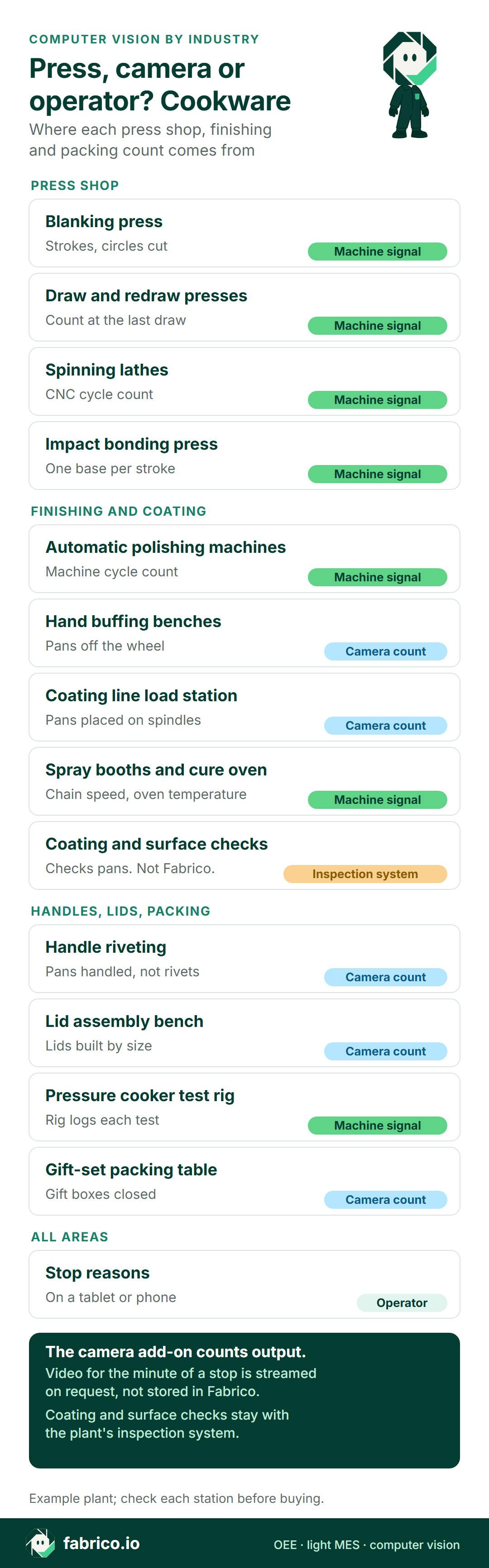
Text version of this infographic
- Press shop: blanking press: machine signal, strokes and circles cut
- Press shop: draw and redraw presses: machine signal, count at the last draw
- Press shop: spinning lathes: machine signal, CNC cycle count
- Press shop: impact bonding press: machine signal, one base per stroke
- Finishing and coating: automatic polishing machines: machine signal, machine cycle count
- Finishing and coating: hand buffing benches: camera count, pans off the wheel
- Finishing and coating: coating line load station: camera count, pans placed on spindles
- Finishing and coating: spray booths and cure oven: machine signal, chain speed and oven temperature
- Finishing and coating: coating and surface checks: inspection system, not Fabrico
- Handles, lids, packing: handle riveting: camera count, pans handled, not rivets
- Handles, lids, packing: lid assembly bench: camera count, lids built by size
- Handles, lids, packing: pressure cooker test rig: machine signal, the rig logs each test
- Handles, lids, packing: gift-set packing table: camera count, gift boxes closed
- All areas: stop reasons: operator, tablet or phone
- Bottom panel: the camera add-on counts output; video for the minute of a stop is streamed on request, not stored in Fabrico
- Bottom panel: coating and surface checks stay with the plant's inspection system
Book a demo to see the racks around a spindle line, the riveting tables and gift-set packing counted on one shift timeline beside the press strokes.
Loaders, polishers and packers will be in the frame. Before a bracket is fixed, explain to them, and to the works council if there is one, what the count is for. Point the lens at the rack, spindle or gift box, not the person, and report by station and shift. If polishers are paid by the piece, settle first whether the count feeds the pay sheet. See running production line cameras without watching people.
Inspection and food-contact rules stay outside the count
Camera systems offered to cookware plants often check surfaces or coatings. A counting camera gives the output figure OEE needs; rejects reach OEE quality through the inspection station's own count. Thickness gauges, inspectors, surface vision and lid test rigs keep their jobs, and their own rulebooks. In the US, the Cookware & Bakeware Alliance, the industry trade association, publishes engineering standards covering manufacturing design, tolerances, materials, testing and finishes. In the EU, kitchenware is a food contact material that must comply with Regulation (EC) No 1935/2004 and be made under good manufacturing practice, Regulation (EC) No 2023/2006. Those records stay with quality and the ERP; the count only says how many left a station, and when.
Fabrico on a cookware floor, and what to ask any supplier
Fabrico is a cloud OEE platform with light MES functions. For a cookware plant that means:
- Press shop and spindle line: strokes, run state and stops come from the presses and the line PLC, through the control or a sensor, so die changes, coating changes and gun clogs appear as stop time that someone gives a reason.
- Racks and hand stations: the camera add-on counts bodies into Q1, pans placed, pans buffed, pans riveted, lids built and sets closed. If the load station stops, the team lead can open the video for the minute of that stop from the shift timeline; the camera add-on streams it on request, and Fabrico does not keep it.
- Per item: each diameter, coating and set design gets its own ideal pace.
The reason for a stop is typed by the loader, polisher, packer or press operator, on a phone or tablet beside the station. OEE and losses appear per station and per shift, each loss valued in money, in the web app and the iOS and Android apps. Data goes out by REST API, by webhook or as an Excel or CSV file.
Roadmap: the camera add-on spotting by itself that a load station has gone idle and proposing a probable cause, which the loader then confirms or changes.
Outside Fabrico: coating thickness and adhesion checks, surface inspection, handle and rivet checks, the pressure cooker test rig's results, and coating recipes and oven profiles.
Questions for any camera or OEE supplier:
| Ask | A sound reply |
|---|---|
| Can a rack be counted in and out with the time? | Yes, an in count and an out count per rack, by the hour, on one timeline. |
| How are empty spindles found? | Pans placed, counted at the load station, set against spindle pulses from the PLC or a sensor. |
| Which booth stopped the chain? | From the line PLC stop log, not from a camera at the exit. |
| How is a coating reject counted? | Once, out of the good count, with the recoat priced at crew time. |
| Can PTFE and ceramic runs have their own ideal pace? | One item per coating, diameter and set, each with its own pace and changeover code. |
| How does the lens cope with polished pans and buffing compound? | Diffuse light, a matte background, a housing clear of the wheel and hood, and a cleaning routine. |
| Who can open the bench video, and from where? | Named roles only, from the shift timeline, with the data flow on paper and reviewed by the works council before mounting. |
Details of the add-on are on Fabrico computer vision for OEE, the wider platform on the Fabrico OEE and MES overview, and manufacturing vision systems for OEE shows how camera add-on counts turn into availability, performance and quality.
Cookware plant questions
Where should a cookware plant put its first camera?
At the spindle line load station, counting pans placed, with a second count where blasted bodies enter the rack in front of it. Together they show whether the line is the constraint or starved.
Can a counting camera find the slow booth on a chained coating line?
No. Every spindle moves at chain pace, so the exit looks the same whichever booth caused trouble. The line PLC stop log names the booth.
How is a pan that fails the coating check counted?
Once, as a reject, and it leaves the good count. It is stripped and recoated, never buffed, and the strip and recoat work is priced at crew time.
Does a camera help at the gift-set packing table?
Yes. It counts closed gift boxes per set design. A second count at the lid bench shows whether a short lid size, not the packers, stopped the sets.
Want to see a coating line's racks counted hour by hour? Book a demo to see pans placed, pans riveted and gift sets closed on one shift timeline beside the press strokes.
Related articles










Real Fabrico tiles, sample data.