


 Login
 Blog

Computer Vision for Chemical Filling: Fair OEE When Pails, Drums and IBCs Share a Line

In short: set an ideal rate per pack format and grade; a camera add-on counts packs where people close, label and stack them.
- One line rate lies: on the example shift, 100 litres a minute shows 55.4% OEE, while rates per format show 72.4%.
- Pails, drums and IBCs differ in fill time, label size, closing work and empties, so each station absorbs a different variant.
- Fabrico does no inspection: check scales, leak tests and label checks keep their jobs, and their reject counts feed quality.
- Where the camera add-on covers a station, the video for the minute of a stop is streamed on request and not stored in Fabrico.
- In a classified hazardous zone, camera hardware must be rated for that zone, and the site safety team signs it off.
Computer vision for chemical filling counts drums, IBCs and pails where people close and stack them, giving OEE a true count per pack format.
It is not inspection or bung-finding: the check scale, leak test and label checker keep those jobs, and a robotic filler's own vision finds the bung (see why a label checker is not an output counter).
The harder question is the rate: one ideal rate for a scale that fills 20 litre pails and 1,000 litre IBCs turns pack size into a fake performance loss. Reactors and blending upstream are left out on purpose.
Computer vision for chemical filling: what changes per pack and order
Each row is something that changes between orders; each column is a station in a drum, pail and IBC filling hall.
| What changes | Empties in | Fill on the scale | Close | Label | Pallet or exit |
|---|---|---|---|---|---|
| Pack format: pail, drum, IBC | IBCs need a valid test date | Own ideal time per format | Hand lid, bung, or IBC lid and seal | Three CLP label sizes | Pails layered, four drums a pallet, IBCs by forklift |
| Product grade | No change | Thick grades fill slower | No change | New product text | No change |
| Flammable product | UN-marked packs for transport | Container bonded to the fill stem (US rule) | No change | CLP and ADR elements together | No change |
| Market | No change | No change | No change | Label language, reel change | No change |
| Order and product change | Empties staged for the next pack | Flush between products | New closure if the pack changes | New label run | New pallet pattern |
The scale absorbs the format, the grade and the flush. The label station absorbs the market. The empties yard absorbs the IBC test date. One ideal rate per line hides all of that inside a single performance number; MES for chemical manufacturing covers the system choice for the packing end.
Explainer presented by Iris, Fabrico's AI-generated presenter: how an add-on camera counts output where a machine has no signal. Book a demo.
Plays from YouTube. Google may set cookies when you press play. Privacy policy.
Why one ideal rate per filling line lies
Example inputs, not a real plant. Line 2 is one net-weight filling station with an adjustable platform, planned for 450 minutes on an early shift (06:00 to 14:00, 30-minute break). It runs three packs for open orders, each with an ideal time from the plant's best clean run:
- 20 litre pails of ISO VG 46 hydraulic oil, lidded by hand: 0.5 minutes a pail.
- 200 litre drums of ISO VG 320 gear oil, bunged by hand: 2.0 minutes a drum.
- 1,000 litre IBCs of the same gear oil, lid and seal fitted on the scale: 10 minutes an IBC.
The weighing terminal prints tickets and sends nothing, so a camera add-on counts packs leaving each exit; the check scale and the leak test log their own rework.
Stops. A label reel change from German to Polish text on the pails took 6 minutes, the flush from VG 46 to VG 320 with the platform change to drums 45, the lance change to IBCs 12, and a wait for an IBC bottle inside its test date 18. That is 81 minutes, so the station ran 369 of 450: availability 82.0%.
Counts. Pails: 262 in 140 minutes, worth 131 ideal minutes. Drums: 61 in 135 minutes, 122 ideal minutes. IBCs: 8 in 94 minutes, 80 ideal minutes. Ideal time is 333 of 369 running minutes: performance 90.2%.
Rework. Six pails were topped up after the check scale and two drums re-bunged after the leak test. They ship later but were not right first time, so 3 + 4 = 7 ideal minutes leave quality: 326 of 333, or 97.9%.
OEE. 82.0% x 90.2% x 97.9% = 72.4%. The quick check: 326 good minutes of 450 is 72.4%.
Here are the same counts through one rate per line, as many plants set it:
| Ideal rate set as | Performance | OEE | What the crew hears |
|---|---|---|---|
| One pack every 2 minutes (the drum rate) | 179.4% | 143.6% | Nothing: the number is impossible |
| 100 litres a minute (the drum rate in litres) | 68.9% | 55.4% | The pail table lost 88 minutes |
| Per pack and grade: 0.5, 2.0 and 10 minutes | 90.2% | 72.4% | The flush and the IBC wait cost most |
The pack rate gives 662 ideal minutes from 369 running, so nobody believes it. The litre rate is worse because it looks believable: 24,920 good litres at 100 litres a minute is 249.2 minutes, 55.4% of 450. All of the gap is the pail run: 5,240 litres earn 52.4 ideal minutes against 140 running (37.4%), at a table that worked at 93.6% of its real pace, because a pail cycle is handling, not flow. The grade matters too: held to the VG 46 drum rate of 1.5 minutes, the VG 320 drum run would read 67.8% instead of 90.4%.
The fix is a rate per product and pack, which is what OEE per SKU means here; reporting in packs, litres or pallets is a separate choice (OEE units: bottles, cases or pallets).
Want to see pails, drums and IBCs on one shift timeline, each at its own rate? Book a demo.
Pack format variants: pails, drums and IBCs on one scale
Each format has its own limit. A 20 litre pail fills in seconds, but its cycle is handling: place, tare, fill, lid, lift off. A 200 litre drum is limited by flow through the lance, then a bung by hand. A 1,000 litre IBC is limited by volume and by the forklift at both ends of the fill.
The IBC also brings a check no other format has. The UK Department for Transport's guidance note on IBC testing opens with it: "Intermediate bulk containers (IBCs) intended for the carriage of dangerous goods are required to undergo initial inspections and subsequent periodic inspections at 2½ and 5-year intervals." The operator reads the plate before filling and sets aside a tote past its date. Book that wait as its own stop reason, so it lands on the empties yard and not on the filling crew.
The label grows with the pack too. The Health and Safety Authority (Ireland), the national CLP authority, lists minimum CLP label sizes by pack capacity: at least 74 x 105 mm above 3 and up to 50 litres, 105 x 148 mm above 50 and up to 500 litres, and 148 x 210 mm above 500 litres. Pail, drum and IBC each sit in a different band, so a format change is also a label stock change. Plan each format on its demonstrated rate, not the filler's brochure figure.
Product variants: thick, thin and flammable fills
Lubricant plants sell by viscosity grade. The abstract of ISO 3448 reads: "Establishes a system of viscosity classification for industrial liquid lubricants and related fluids." A hall that fills ISO VG 46 hydraulic oil in the morning and ISO VG 320 gear oil in the afternoon moves two very different liquids through one lance. Thick grades fill slower, cold product slower again, and foaming grades need a gentler valve setting. None of that is a slow crew. Group grades into three or four families per pack, take the best clean run in each, and give a new product its family's rate until it has its own.
Flammable products add steps at the scale. The US rule for container filling, OSHA 1910.106, says: "Category 1 or 2 flammable liquids, or Category 3 flammable liquids with a flashpoint below 100 °F (37.8 °C), shall not be dispensed into containers unless the nozzle and container are electrically interconnected." In practice that is a bond wire on the container, or a floor plate connected to the fill stem, which the rule also accepts. A solvent run therefore carries steps an oil run may not, and needs its own ideal time.
Market variants: CLP labels and transport marks
The market changes the label. Ireland's CLP sheet asks for a label that is visible, legible and readable in English, with each language's hazard and precautionary statements grouped together where more than one is used. A plant shipping the same pail to Germany and Poland either changes the reel between orders, as the example shift did for 6 minutes, or prints one multi-language label that needs more room.
Dangerous goods add a second set of marks. HSA's labelling page is plain: "Single packages must carry both the CLP and the ADR label elements." A flammable solvent in a drum gets a combined label; a lubricant that is not dangerous for transport may need the CLP elements only. Book label changes as their own stop reason, split by market, product and pack size. A camera that counts drums out does not read the label; label checking stays with the label and code system or the operator, and the labeller's own losses are covered in labeller OEE.
Order variants: flushes and small batches
A product change means draining the lines, flushing or pigging them, and often a lance change. The time depends on the pair: thin to thick, light colour to dark, one additive pack to an incompatible one. Give the flush a stop reason per product family, so a week of small batches does not read as a slow crew.
A four-IBC order carries the same 45-minute flush as a 300-pail order. Where the products allow it, many halls sequence thin to thick to shorten flushes; whether that pays depends on run length, worked through in production run length versus changeovers. Waiting for lab release belongs to the batch, not the filling crew, so give it a batch-level reason.
The hall as a flow: where packs queue and no machine counts
Drawn as a flow, the example hall has one scale feeding three exits and two queues: empties waiting for a tested tote, and full IBCs waiting for the forklift.
The blue exits are where people finish the pack and nothing reports. A field study that included three US paint plants, in the Journal of Occupational and Environmental Hygiene, describes the task: "The filling operators (Plants E, F, and G) filled containers with final product from an automated dispenser and placed lids." The dispenser can report its fills; the lids, bungs, labels and pallets after it often leave no count. Coatings plants have their own loss pattern (OEE for paint and coatings manufacturing).
Count each pack at its exit, not at the scale or on the finished pallet. The hourly gap between fills and exits is packs waiting for a lid, a bung, a label or a forklift (more in a camera on a filling line). Where an automatic pail line's filler, capper and palletiser already report through PLCs, a camera adds little; see palletiser OEE.
The same shift in money, per pack format
Price stopped and slow minutes at margin only because orders were waiting for all three packs; on a day the hall runs ahead of orders, those minutes cost crew time only. The example contributions are EUR 15 a pail, EUR 120 a drum and EUR 520 an IBC. For a margin band, NYU Stern's January 2026 margin data (accessed 16.11.2026) lists 59 US specialty chemical firms at a gross margin of 35.12% and a pre-tax operating margin of 12.17%; at those margins, EUR 15 fits a pail selling for about EUR 43 to EUR 123, EUR 120 a drum at about EUR 342 to EUR 986, and EUR 520 an IBC at about EUR 1,481 to EUR 4,273.
| Pack | Lost minutes (stops + slow) | Ideal minutes a pack | Lost packs | Example contribution | Margin lost |
|---|---|---|---|---|---|
| 20 litre pails | 6 + 9 = 15 | 0.5 | 30 | EUR 15 | EUR 450 |
| 200 litre drums | 45 + 13 = 58 | 2.0 | 29 | EUR 120 | EUR 3,480 |
| 1,000 litre IBCs | 12 + 18 + 14 = 44 | 10 | 4.4 | EUR 520 | EUR 2,288 |
| Shift | 117 | EUR 6,218 |
The shift lost EUR 6,218 of margin. The flush alone is EUR 2,700 (22.5 drums), the IBC change and wait EUR 1,560 (3 IBCs) and the label change EUR 180 (12 pails). A drum minute is worth EUR 60 here and a pail minute EUR 30, so run order matters in money; downtime by SKU ranks losses that way.
Rework is priced at crew time, because those packs ship later: about 2 minutes per pail top-up and 15 per drum re-bung and retest, 42 minutes of one operator. At Eurostat's EU average of EUR 33.9 per hour of labour cost in industry in 2024, that is 0.7 hours x 33.9 = EUR 23.73, about EUR 24 (see rework and the good count).
The litre view would book 87.6 slow minutes on the pail table: 8,760 litres, 438 pails, EUR 6,570. That is more than the whole real loss, against a station that cannot fill 100 litres a minute in 20 litre packs.
What a camera can and cannot count at a filling station
A 2025 ICCV paper on counting stacked objects found that "existing methods struggle to handle the challenge of stacked 3D objects in which most objects are hidden by those above them." Its method needs several views and was tested on stacks of identical objects, not a filling hall. So do not count pails off a finished pallet three layers high; count each pail as it leaves the lidding table.
A 2022 study of automatic checkout, where people move items past a camera by hand, names problems a hand station shares: "Several problems stem from real-world scenarios such as object occlusion, blurring from scanning motion, and similarity in scanned items." Checkout is harder, with many product types, but the lessons carry over: count after hands and forklift tines release the pack, where it rests or rolls, and remember that a pail of VG 46 looks like a pail of VG 320, so the grade comes from the order the crew started. Glare off steel drums and mounting height matter too. Ask vendors for a side-by-side hand count at the station rather than a brochure figure (how accurate camera OEE is).
Solvent filling areas are often classified as hazardous. In Great Britain, DSEAR requires employers to identify and classify areas where explosive atmospheres may occur and to keep ignition sources, such as unprotected equipment, out of them. The international standard for classifying gas and vapour zones, IEC 60079-10-1, covers the classification of areas where flammable gas or vapour hazards may arise. Camera hardware inside a classified zone must be rated for that zone, and the site safety team signs off position, housing and cable route. Fabrico makes no ATEX or hazardous-area compliance claim. Often the simplest answer is a camera outside the zone, looking in at the pallet build or the IBC exit.
How to count each station: options, costs and vendor questions
Most halls mix three ways to count, chosen station by station.
| Option | Fits | What it costs the plant | Weak spot |
|---|---|---|---|
| Tally sheet and scale tickets | A first baseline, very low volumes | Crew minutes every shift, typing later | Short stops and the fill-to-exit gap never show |
| Scale terminal or PLC connection | Automatic pail lines, connected drum fillers | Controls and IT work per machine | Counts fills, not closed packs |
| Camera add-on at the station exit | Hand lidding, bunging, the IBC exit, hand palletising | A mount, power and network at each station | Needs a clear view of each pack leaving |
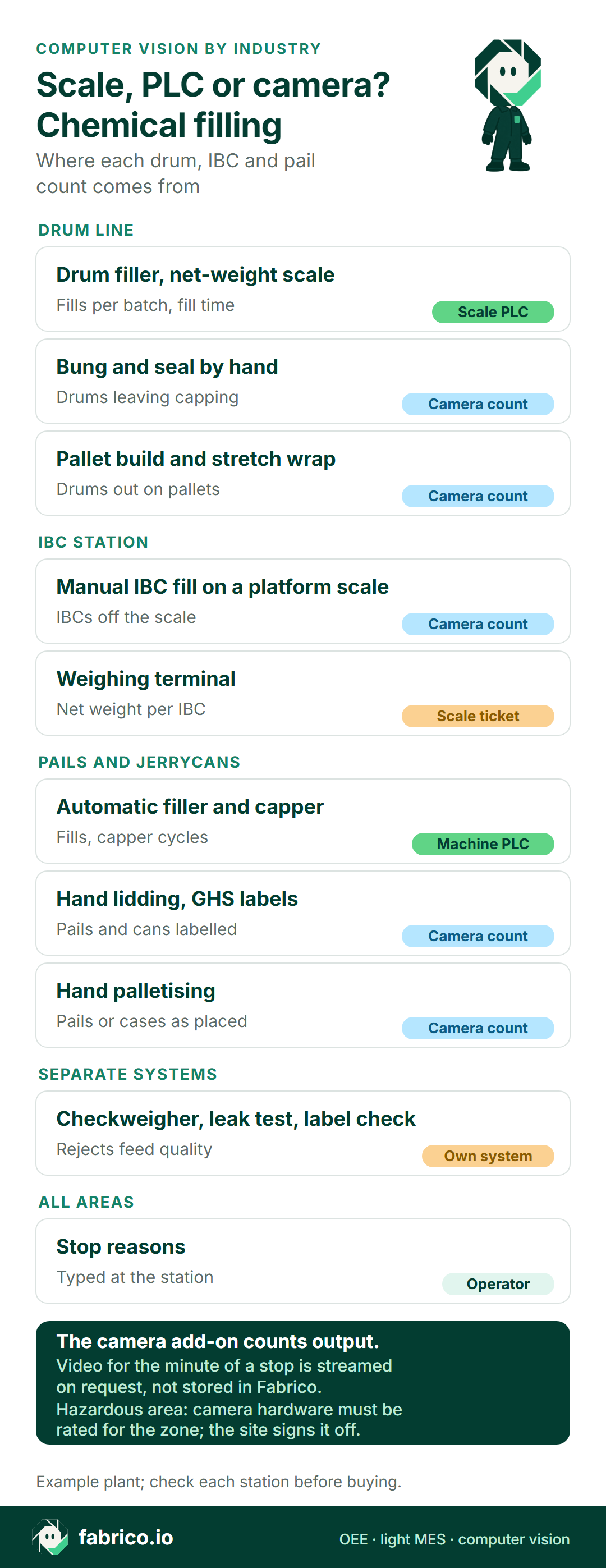
Text version of this infographic
- Drum line: Drum filler, net-weight scale: scale plc, fills per batch, fill time
- Drum line: Bung and seal by hand: camera count, drums leaving capping
- Drum line: Pallet build and stretch wrap: camera count, drums out on pallets
- Ibc station: Manual IBC fill on a platform scale: camera count, ibcs off the scale
- Ibc station: Weighing terminal: scale ticket, net weight per ibc
- Pails and jerrycans: Automatic filler and capper: machine plc, fills, capper cycles
- Pails and jerrycans: Hand lidding, GHS labels: camera count, pails and cans labelled
- Pails and jerrycans: Hand palletising: camera count, pails or cases as they are placed
- Separate systems: Checkweigher, leak test, label check: own system, rejects feed quality
- All areas: Stop reasons: operator, typed at the station
- Camera add-on: counts output. Video for the minute of a stop is streamed on request, not stored in Fabrico.
- Hazardous area: camera hardware must be rated for the zone; the site signs it off.
Five questions that separate vendors for a mixed-format hall:
- Can each pack and grade carry its own ideal rate, picked from the running order?
- Are flush, format change, label change and waiting for a tested IBC separate stop reasons?
- Where exactly does the camera count, and what happens when a forklift blocks the view?
- How do check scale and leak test results reach quality, with rework kept apart from scrap?
- Can lost minutes be priced per pack, and only while orders wait?
Five steps for this quarter:
- Take the best clean run per pack and grade family from a month of batch records.
- Split stop reasons: flush, format change, label change, tested IBC wait, lab release.
- Mark the exits that leave no count.
- Put the first camera add-on at the busiest of them.
- Read OEE per pack format per week.
For tools in this industry, see OEE software for chemical manufacturing; for the buying side in general, OEE software.
Where Fabrico fits in a mixed-format filling hall
Fabrico works as cloud OEE with light MES functions:
- Per product and pack: each pail, drum and IBC of each grade has its own ideal rate, so OEE reads fairly per format and shift.
- At automatic lines and connected scales: run state and counts come from the PLC or scale terminal, so a flush or a wait for empties shows as stopped minutes the crew can name.
- At hand stations: the camera add-on counts packs leaving the pail table, the drum exit and the IBC exit. Where the camera add-on covers a station, the video for the minute of a stop, such as the IBC exit going quiet while the forklift fetched a tested tote, can be opened from the shift timeline, streamed on request and not stored in Fabrico.
The crew types stop reasons on a phone or tablet. Fabrico prices each loss from the plant's own price or margin per product, on the web, iOS and Android, and passes data to the ERP through the REST API, webhooks, or an Excel or CSV export.
Outside Fabrico: fill weight control, check weighing, leak testing, label checks, hazardous-area certification, the batch record and lot traceability.
Operators will be in the frame at any hand station. Tell the crew, and the works council where one exists, what the numbers are for before a bracket is fixed; point the lens at the pack, not the person, and report by station and shift, never by name (works council approval guide). More on the product: Fabrico computer vision for OEE, and on how camera add-on counts become availability, performance and quality, OEE with computer vision.
Questions chemical packing managers ask
Can one ideal rate cover pails, drums and IBCs on the same filler?
Not fairly. A pail cycle is mostly handling and an IBC cycle mostly flow, so one rate flatters one format and blames another. Set an ideal time per pack and grade from a clean run of each.
Where should a mixed-format filling hall put its first camera?
At the busiest exit with no count, usually the hand lidding table or the IBC exit. Automatic pail lines and connected scale terminals already report, so a camera adds little there.
Can an OEE camera check fill weight, leaks or CLP labels?
No. Fill weight stays with the scale or a check scale, leaks with a leak test and labels with a label checker or a person. Fabrico does no inspection. Their reject and rework totals can feed OEE quality.
Can a camera go into an ATEX or hazardous zone?
Only with hardware rated for that zone, after the site's safety team signs off position, housing and cable route. Fabrico makes no ATEX or hazardous-area compliance claim. A camera outside the zone, looking in, is often simpler.
Want to see a pail run, a drum run and an IBC run each measured at its own rate? Book a demo.
Related articles











Real Fabrico tiles, sample data.