


 Login
 Blog
Computer Vision for Hospital Bed and Wheelchair Manufacturing: Find the Bottleneck

In short: computer vision in hospital bed manufacturing counts beds into and out of each queue, so the station holding output back shows up.
A counting camera says how many beds or frames left a station; weld, coating and electrical safety checks stay with inspectors and test rigs.
- If beds pile up in front of a station while it runs flat out, that station is the constraint.
- In a published New Zealand bed case, welding held output back; once welding keeps up, check the end-of-line test.
- Price only the constraint's lost minutes, and only while orders wait; repairs are priced at crew time.
- The camera add-on counts output only; video for the minute of a stop is streamed on request, not stored.
The queue test: which station holds bed output back?
One station in a bed plant sets the pace for everything after it: the constraint. The cheapest way to find it is to count what waits in front of each station, every hour: units into the queue, units out of it, and the difference.
| What the hourly counts show | What it means | Look next at |
|---|---|---|
| Queue grows, the next station never waits | The next station is the constraint | Its stops, changeovers and retests |
| Queue empty, the next station waits | For now, something upstream holds it back | The station or parts feeding the queue |
| Queue full, the station before it waits | The next station is down or too slow | Why the next station stopped |
A station that runs flat out with nothing waiting in front of it is busy, not the constraint, and the constraint can move inside one shift, as the worked example below shows. Counting queues is work-in-process tracking at its simplest; WIP tracking software compares tools for it. Once you have found the constraint, real-time OEE for bottleneck analysis covers proving the fix.
Explainer presented by Iris, Fabrico's AI-generated presenter: how an add-on camera counts output where a machine has no signal. Book a demo.
Plays from YouTube. Google may set cookies when you press play. Privacy policy.
Counting in and out of a queue with a camera add-on
Machines already count many queue edges: a tube laser, a CNC bender and a robot weld cell log their cycles, and a test rig's controller logs each run. The gaps are hand stations: weld jigs, powder unload, the harness bench, a bed line exit without a PLC, chair cells and the wrap station. A camera add-on over one of those points counts units crossing it; with the next station's machine count, you have both sides of the queue. It does not judge a weld, a coat of powder or a bed's electrical safety.
A peer-reviewed study of manual assembly names the limits. Pierleoni and colleagues, writing in the Journal of Imaging in 2020, found that "the motion phases are the main source of error for counting algorithms": hands placing or picking up a piece. Their counter could not handle two operators placing and picking up in view at once, and mixed daylight made them add a light ring. On recorded video the improved counter reached 96.6% accuracy, and the same authors wrote that it "is not yet absolutely reliable". They counted small steel lighting parts on one table, not beds, so treat the study as a checklist: frame a point where units move one way, keep two people out of the same view, and light it evenly.
At a station with a camera add-on, the line lead can also call up the video for the minute of a stop, streamed on request and not stored in Fabrico.
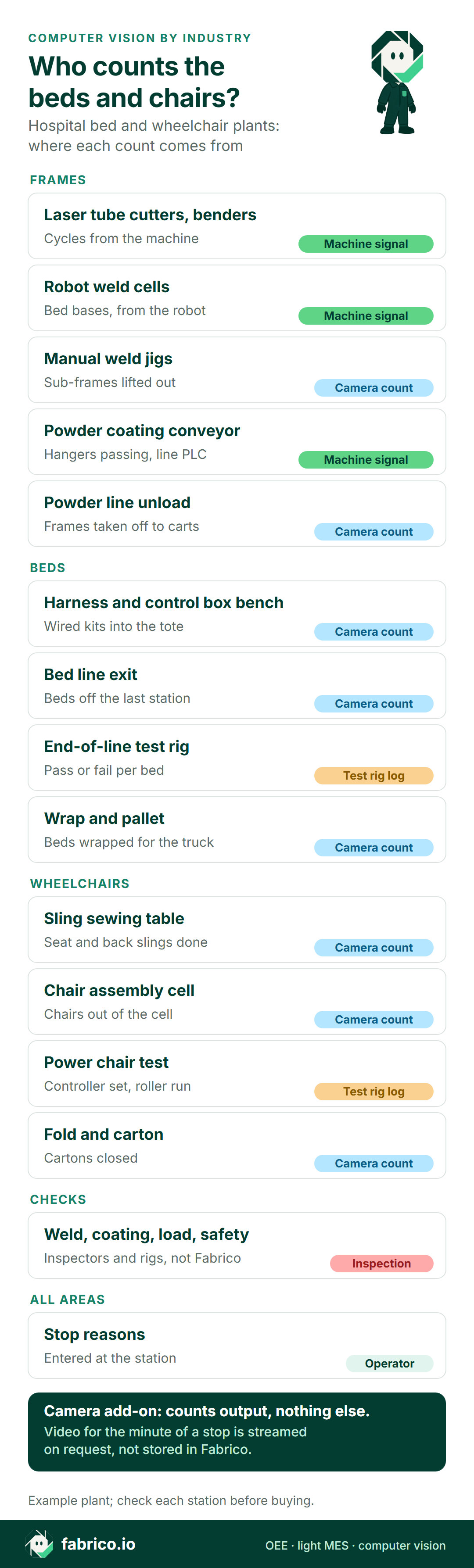
Text version of this infographic
- Frames: laser tube cutters and benders: machine signal, cycles from the machine
- Frames: robot weld cells: machine signal, bed bases from the robot
- Frames: manual weld jigs: camera count, sub-frames lifted out
- Frames: powder coating conveyor: machine signal, hangers passing from the line PLC
- Frames: powder line unload: camera count, frames taken off to carts
- Beds: harness and control box bench: camera count, wired kits into the tote
- Beds: bed line exit: camera count, beds off the last station
- Beds: end-of-line test rig: test rig log, pass or fail per bed
- Beds: wrap and pallet: camera count, beds wrapped for the truck
- Wheelchairs: sling sewing table: camera count, seat and back slings done
- Wheelchairs: chair assembly cell: camera count, chairs out of the cell
- Wheelchairs: power chair test: test rig log, controller set and roller run
- Wheelchairs: fold and carton: camera count, cartons closed
- Checks: weld, coating, load and safety: inspectors and rigs, not Fabrico
- All areas: stop reasons from the operator, entered at the station
- Camera add-on: counts output, nothing else. Video for the minute of a stop is streamed on request, not stored in Fabrico
Frame welding: where a published case names the bed bottleneck
Bed bases, lifting arms and stretcher chassis start as steel tube, and a published case puts the bed constraint right there. The EMA case study on Howard Wright, a New Zealand maker of medical beds and stretchers, states: "The bottleneck process for Howard Wright historically has been welding." The same EMA study names changeovers as the main downtime: fixing cut tubes to a jig, then a visual check before the robot program starts. EMA also writes that defects requiring rework "absorbed further capacity at the bottleneck", and that new jigs reached "12 units a day with no overtime", against a previous maximum of 11: a 9% productivity gain through the whole operation with no added labour.
So count both queues around welding: cut tube kits in front of the weld cell, laser cycles in and robot cycles out, and welded frames waiting for powder. A hand jig counts nothing; a camera add-on above its unload point tallies sub-frames as they are lifted out. If kits pile up before welding while the powder line runs with empty hooks, welding is the constraint. Cell losses are in OEE for robotic welding cells, system choice in OEE software for metal fabrication and welding, and general weld bays in computer vision for metal fabrication.
Powder coating: why the hanger count is the wrong count
Where a plant builds both, bed and wheelchair frames can share one overhead conveyor through pretreatment, the booth and the cure oven. Its PLC counts hangers passing, including empty hooks, test panels and recoats; a camera add-on over unload counts frames lifted onto carts. The gap is the powder line's queue signal. Hangers far ahead of frames means empty hooks and a shortage upstream, in welding; frames piling up on carts means assembly is not taking them. Coating rejects go back for stripping or recoating: book them from the coating record, not the camera add-on.
Electric bed assembly: actuators, control boxes and mattress platforms
An electric hospital bed carries linear actuators for the backrest, knee section, height and tilt, a control box, a hand pendant and a battery. The plant buys actuators and control boxes, fits them and routes the cables. Where cable sets are pre-wired on a bench, a camera add-on over the outgoing tote counts kits, so a harness shortage shows before the line waits; see OEE for wire harness assembly.
Final assembly builds the base and castors, the lifting mechanism and the mattress support platform, then fits actuators, side rails and boards. A camera add-on at the line exit counts beds into the test queue. Set an ideal cycle time per model family, so low care hours do not look slow.
The end-of-line test: where beds wait once welding keeps up
In the example plant, the rig runs each actuator through its stroke, checks the end stops and CPR release, and runs the electrical safety check where the test plan calls for one. A failed bed goes to the repair bay and back for a second run; like the touch-up welds in the EMA case, retests spend time at a station that may set the pace.
IEC 80601-2-52:2026, published by the IEC in May 2026, sets particular requirements for the basic safety and essential performance of medical beds for adults. Its scope covers electrical and manual medical beds, the bed lift and the detachable mattress support platform, and leaves out stretchers and examination tables; beds for children fall under IEC 80601-2-89. A plant building stretchers and adult beds on one floor may run different test plans, so count the test queue per product family. Which tests run on every bed and which on a type sample is the plant's test plan; Fabrico has no part in it.
Count the rig's queue from both sides, beds in from the line exit and runs out from the rig's controller, and keep a few beds waiting on purpose: in drum-buffer-rope terms, that buffer protects the station that sets the pace.
Wheelchairs: every chair a variant, so the bottleneck moves
A manual wheelchair can be ordered by seat width and depth, back height, frame angle and wheel size, and WHO's wheelchair provision guidelines say the best outcomes come when selection follows "an individual process of assessment, fitting, training and follow up". Two chairs in a row can differ, and so can their build times.
That variation broke one published chair line's numbers. A 2025 IEOM conference case study of a wheelchair assembly process reports a "deviation of 53% from the current production capacity", because the capacity formula ignored the parts that vary by model. Benchmarking one model that shared 80% of its components with the others, the authors cut the cycle time at Workstation 4 from 100.53 to 60.41 seconds, and capacity rose from 35 to 46 wheelchairs an hour. At 46 an hour a chair leaves about every 78 seconds, longer than Workstation 4's new 60.41, so something other than Workstation 4 now set the pace: fix one constraint and the next one shows.
Count chairs out of the cell with a camera add-on, slings off the sewing table and cartons closed, and set an ideal time per chair family; takt time vs cycle time covers the balancing. Upholstered home furniture has its own page: computer vision for furniture manufacturing.
Worked example: one shift at the bed test rig
Example inputs, not a real plant. Welding keeps up; one test rig follows the bed line. Planned time is 450 minutes, 06:00 to 14:00 less a 30-minute break at 10:00. The rig's ideal is 12 minutes per test run, the line's 10 minutes a bed. Four bed places sit in front of the rig, and three beds wait from yesterday. A camera add-on above the line exit, framing the last station and the four places, counts beds into the queue; the rig's controller gives runs and its own record first-pass results. Stop reasons come from the plant's list, including "no bed in queue" and "queue full".
| Hour | Beds into the queue (camera add-on) | Beds onto the rig (rig controller) | Waiting at the end | What the queue says |
|---|---|---|---|---|
| 06:00 to 07:00 | 6 | 5 | 4 | The line outruns the rig |
| 07:00 to 08:00 | 4 | 5 | 3 | Line model change from 07:36 |
| 08:00 to 09:00 | 3 | 3, plus 1 retest | 3 | Line out of height actuators from 08:30; rig model change 08:48 to 09:06 |
| 09:00 to 10:00 | 0 | 3 | 0 | No beds in; the rig runs 3 and waits from 09:42 |
| 10:30 to 11:00 | 2 | 2 | 0 | Rig waits until 10:45, then runs at once |
| 11:00 to 12:00 | 6 | 5 | 1 | Both running |
| 12:00 to 13:00 | 4 | 1, plus 1 retest | 4 | Rig trip 12:09 to 12:33, at the end of a run; queue full, line waits from 12:35 |
| 13:00 to 14:00 | 5 | 5 | 4 | The line releases a bed only when the rig takes one |
| Shift | 30 | 29, plus 2 retests | 4 |
Read it as the queue test. Whenever both were running, beds were waiting and the rig never waited for one: the rig set the pace. From 09:42 the queue was empty and the rig waited 33 minutes in all, 09:42 to 10:00 and 10:30 to 10:45 after the break, because the line ran out of height actuators at 08:30; for that stretch the actuator supply was the constraint. After the rig tripped at 12:09, at the end of a run, the places filled and the line lead logged "queue full" from 12:35. The video for the minute of that stop, streamed on request from the camera add-on at the line exit and not stored in Fabrico, showed a finished bed on the last station and no free place in front of the rig.
Availability. The rig stood for 75 minutes: 18 changing to the low care test program and cable adapter (08:48 to 09:06), 33 with no bed in the queue, and 24 after the trip (12:09 to 12:33) until an electrician reset it. Run time was 375 of 450 minutes: 83.3%.
Performance. 31 test runs at 12 minutes is 372 ideal minutes against 375 run: 99.2%. The missing 3 minutes are one 15-minute test after the restart, 12:33 to 12:48, when the tester re-seated an adapter plug.
Quality. 26 of the 31 runs gave a first-pass good bed: 83.9%. Three beds failed their first test: a hand pendant in the wrong port of the control box, a CPR release that did not drop the backrest, and a backrest actuator cable pinched under the deck. The first two were repaired and passed on retest; the third waits for a new actuator. A retest is a run, never a new good bed.
OEE. 83.3% x 99.2% x 83.9% = 69.3%. Cross-check: 26 good beds x 12 minutes = 312 minutes, and 312 / 450 = 69.3%. The wrap station counted 28 beds, the 26 first-pass beds plus the two repaired ones: dispatch sees 28, OEE quality stays at 26.
From rig minutes to money
Example input: a contribution margin of EUR 400 a bed. For a margin band, NYU Stern's January 2026 margin data (accessed 16.11.2026) lists 204 US healthcare products firms at a gross margin of 54.00% and a pre-tax operating margin of 15.34%; at those margins, EUR 400 fits a bed selling for about EUR 740 to EUR 2,610. The same table puts 27 home furnishings firms at 30.28% and 6.59%, which fits EUR 400 to a bed selling for about EUR 1,320 to EUR 6,070.
The rig is the constraint, so its lost minutes are the plant's lost beds, but only while orders wait. Price the rig minutes that gave no shipped bed: 450 minus 28 shipped beds x 12 minutes = 114 minutes.
| Rig loss (sample data) | Minutes | Beds | At EUR 400 |
|---|---|---|---|
| Model change at the rig | 18 | 1.5 | EUR 600 |
| No bed in queue (actuator shortage) | 33 | 2.75 | EUR 1,100 |
| Rig trip | 24 | 2.0 | EUR 800 |
| Slow test after the restart | 3 | 0.25 | EUR 100 |
| Retests of the two repaired beds | 24 | 2.0 | EUR 800 |
| First test of the bed still waiting | 12 | 1.0 | EUR 400 |
| Total | 114 | 9.5 | EUR 3,800 |
OEE books 138 lost minutes, but the first tests of the two repaired beds, 24 minutes, ended in shipped beds, so they are not lost sales. The repairs are priced at crew time: two beds at 45 minutes each is 1.5 hours, or EUR 52.35 at the EU average hourly labour cost of EUR 34.9 in 2025 reported by Eurostat, used only as an example rate, plus the new actuator at the plant's own part cost. If the order book is short and a later shift could catch up, the stops cost paid time instead: an example crew of 2 standing for 75 minutes is 2.5 hours, or EUR 87.25.
Now price the same morning the wrong way. The line stood 90 minutes for actuators; at its 10-minute pace that is 9 beds, or EUR 3,600. The plant lost only the 33 minutes the rig waited, EUR 1,100: the queue, a retest and the rig's own model change filled the rest. The line's 18-minute model change at 07:36 cost nothing, with three beds waiting. In the EMA case, one more unit a day at the constraint, 12 against 11, was the whole 9% gain. The method is throughput accounting.
Book a demo to see beds into the test queue and runs out of the rig on one shift timeline.
Where to start counting, and where a camera adds little
Start around the likeliest constraint: beds into the test queue against rig runs, then kits into welding against frames out, then hangers against frames at unload, then wrapped beds and boxed chairs.
| Station | Count it from | What a camera add-on adds |
|---|---|---|
| Tube laser, CNC bender, automatic saw | Machine cycles | Little |
| Robot weld cell | Robot program cycles | Little |
| Hand weld jig | A paper tally | Sub-frames out |
| Powder conveyor | Hangers passing, from the PLC | Little |
| Powder unload, harness bench | Nothing | Frames off the hooks, wired kits |
| Bed line exit | Nothing, if it has no PLC | Beds into the test queue |
| Test rig | Its controller and pass and fail record | Little; count the queue in front |
| Wrap, chair cell, carton | A dispatch sheet | Beds and chairs out |
Questions to put to a camera counting vendor
| Question | What a good answer sounds like |
|---|---|
| How do you count units into a queue and out of it? | Two counts per queue, by station and hour. |
| Can a retest stay apart from a first test? | Yes, from the rig's own record; a retest is never first-pass good. |
| What if two people load and unload in view at once? | The vendor names the limit and mounts over a one-way point. |
| How is ideal time set per bed model or chair family? | One per family, from the build order. |
| Which signals come from the tube laser, robot cell and powder PLC? | Cycle count and run state, interface named in the offer. |
| Who can open video from a weld jig or the line exit? | Roles agreed with the workforce, and a written data flow. |
Cameras over jigs and benches see welders and fitters, and people notice: EU-OSHA's OSH Pulse 2025 survey found that one in four workers (25%) mention digital technologies used for "supervision or monitoring of their work and behaviour". Explain the count before anything is mounted, agree it with the works council or employee representatives where they exist, frame the unload point rather than the person, and report per station and shift.
Where Fabrico fits in a bed and wheelchair plant
Fabrico is OEE software in the cloud, with light MES features. In a bed and wheelchair plant:
- Tube shop, robot cells, powder conveyor and test rig: Fabrico reads run state and cycles from the controllers; stops wait on the timeline for a reason.
- Weld jigs, powder unload, harness bench, line exit, chair cells, wrap and carton: the camera add-on counts the units. Where a camera add-on covers a station, the line lead can open the video for the minute of a stop, streamed on request and not stored in Fabrico.
- Bed models and chair families: each gets its own ideal cycle time.
Testers, fitters and line leads enter stop reasons on a tablet or phone, from the plant's own list. Counts per station share one shift timeline, so a queue is the difference of two counts. OEE and losses show on web, iOS and Android dashboards, each loss priced from the plant's margin per product, and data leaves through the REST API, webhooks, or Excel and CSV files.
Roadmap only: a camera add-on that spots an idle jig or an empty queue place unprompted and proposes a probable cause.
Outside Fabrico: weld, coating, load, function and electrical safety testing, test certificates, serial numbers, device records and the plant's quality system. The product page is Fabrico computer vision for OEE; the step from counts to an OEE number is in OEE with computer vision, and the buying view in OEE software.
Bed and wheelchair plant questions on bottlenecks
Which station is usually the bottleneck in a hospital bed plant?
It depends on the plant, and the queue test decides. In the published New Zealand case from EMA, welding was. In the worked example below, once welding keeps up the end-of-line test becomes the constraint, because a failed bed comes back for a second run.
Can a counting camera check welds, powder coat or a bed's electrical safety?
No. Weld inspectors and fixture gauges check welds, a coating gauge measures powder film, and the test rig runs the function and electrical safety tests in the plant's test plan. Fabrico inspects and tests nothing; the fails those checks record still reach OEE quality. The quality system side is in OEE for medical device manufacturing.
Does a bed that passes its retest count as good?
Not for OEE quality: it failed its first run, so it counts as a fail, as improving first pass yield explains. It still appears in the wrap count as shipped output; its cost is the retest time at the rig plus the repair time.
Is this the same as cameras that watch patients in hospital beds?
No. Patient room cameras, fall detection and bed exit alarms are care products for wards. The camera add-ons here hang in the factory over jigs, benches and the line exit, and count frames, beds and chairs. Bench-built devices have their own page: computer vision for medical device manufacturing.
Want to find the station that holds your beds back? Book a demo to see queue counts, rig runs and wrapped beds on one shift timeline.
Related articles










Real Fabrico tiles, sample data.