


 Login
 Blog

Computer Vision for Stroller Manufacturing: Count Every Pushchair Exactly Once

In short: computer vision for stroller manufacturing counts finished pushchairs at hand stations, so OEE stops counting frames, fabric sets and carrycots as strollers.
A counting camera reports what left a station; fold, brake and stitch inspection stays with the test lab and the checker.
- Name one output station, the carton line, and treat frames, wheel sets and fabric sets as feeder counts.
- A travel system is one stroller, however many cartons it ships in; a bought-in car seat is not counted.
- Book lab samples for EN 1888 in the EU or 16 CFR 1227 in the US under a sample code.
- A stroller that fails the fold or brake check and is fixed counts once, never as first-pass good.
- Fabrico's camera add-on counts frames, dressed frames and cartons; the video for the minute of a stop is streamed on request, not stored in Fabrico.
Ask a pushchair plant how many strollers the early shift built and three people give three numbers: the rivet bench tally, the fold check sheet and the dispatch count. This page audits where those numbers part ways and which station should own the one that goes into OEE.
It covers pushchairs, prams and travel systems, the products in the scope of EN 1888-1, which covers pushchairs and prams carrying children up to 15 kg each. Motor driven pushchairs, child car seats and cameras built into strollers are not covered here.
Stroller output miscounts, from rivet bench to carton
Each row is a way a stroller plant books more or fewer good strollers than it shipped. The fix is a counting rule; the last column names the station that owns the count, so there is one place to look when the number is wrong.
| Miscount | What the number shows | Fix | Owning station |
|---|---|---|---|
| 1. Rivet bench frames added to carton output | Output up to double | Frames off the rivet bench are work in progress | Carton line |
| 2. Fabric sets counted when the sewing hall finishes them | Kit waits vanish from the line record | Count sets as they reach the kit rack, as a feeder count | Kit rack at soft goods fitting |
| 3. A travel system counted once per carton | One sale shows as three or four strollers | One frame, one unit; carrycot and adaptors are feeder counts | Carton line |
| 4. Accessory kits boxed as units | Output too high on bundle orders | Accessory packs are a pack count, never output | Accessory pack bench |
| 5. One ideal time for every model, or one per colourway | Performance swings with the mix | Ideal time per frame family; a colourway change is a changeover | Line lead |
| 6. Lab samples written off as scrap | Quality too low | A sample code, outside scrap and shipped output | Quality office |
| 7. A fold or brake fail counted again after rework | Quality too good | Log the fail once; rework time goes to the rework bench | Fold and brake check |
| 8. A carton reopened for a missing US card counted again | Output too high on US orders | Count cartons per market SKU; a repack is rework | Carton line |
Two rules come first: what one stroller is, and that the carton line is the only output station.
Explainer presented by Iris, Fabrico's AI-generated presenter: how an add-on camera counts output where a machine has no signal. Book a demo.
Plays from YouTube. Google may set cookies when you press play. Privacy policy.
What one stroller means: frame, pushchair or travel system
Every product has exactly one frame. A compact pushchair adds a seat unit and hood; a pram adds a carrycot. A travel system pairs the frame with a seat unit, in some sets a carrycot, and adaptors for an infant car seat that comes from a car seat line or a supplier. The order may leave as one carton or as several that meet on one pallet.
In the US, the CPSC list of durable infant products names strollers and includes products that are combinations of the listed categories; it sets no counting unit, so the plant does. Output is the frame, counted once when its carton closes. Seat units, carrycots, wheel sets and adaptors are feeder or pack counts, and a bought-in car seat is not counted at all.
BDKH, the German nursery products association, counts small owner-managed firms, large international groups and start-ups among its members, so plants differ. A brand that buys in frames and covers counts at fitting and at the carton; a plant with its own tube shop, moulding and sewing hall has feeders to keep apart, as below.
Every arrow ends at the carton line, so upstream counts are feeder counts; the kit rack is the one queue, the rework bench the one loop. The gap between a plain counter at a feeder and OEE software is set out in production counter vs OEE software.
Frames and wheel sets: what machines already report, and where the count belongs
Tube saws, benders, punch presses and the coating line keep their own records, and the moulding machines that make hinges, hubs and brake pedals count every shot; see OEE for injection moulding. None of these is a stroller count. Their gap is the reason behind a stop. Across 884 machines at 23 companies, Chalmers researchers could not classify almost half of the recorded OEE losses, as loss categories were lacking or vague. Agree codes for die changes, tube shortages and hinge colour swaps first.
At the rivet bench the assembler joins tubes to the fold hinges in a jig and fits the fold mechanism: lock pawls, springs, the handlebar release and the brake bar. A riveter counts shots, but twenty shots are not a frame. A camera add-on over the outfeed trolley counts frames as they leave, so the line lead sees whether frames or fabric sets ran short; the method for benches like this is in OEE on manual and hybrid assembly lines. The wheel bench supplies one wheel set per frame: count sets, not wheels, and keep them out of output.
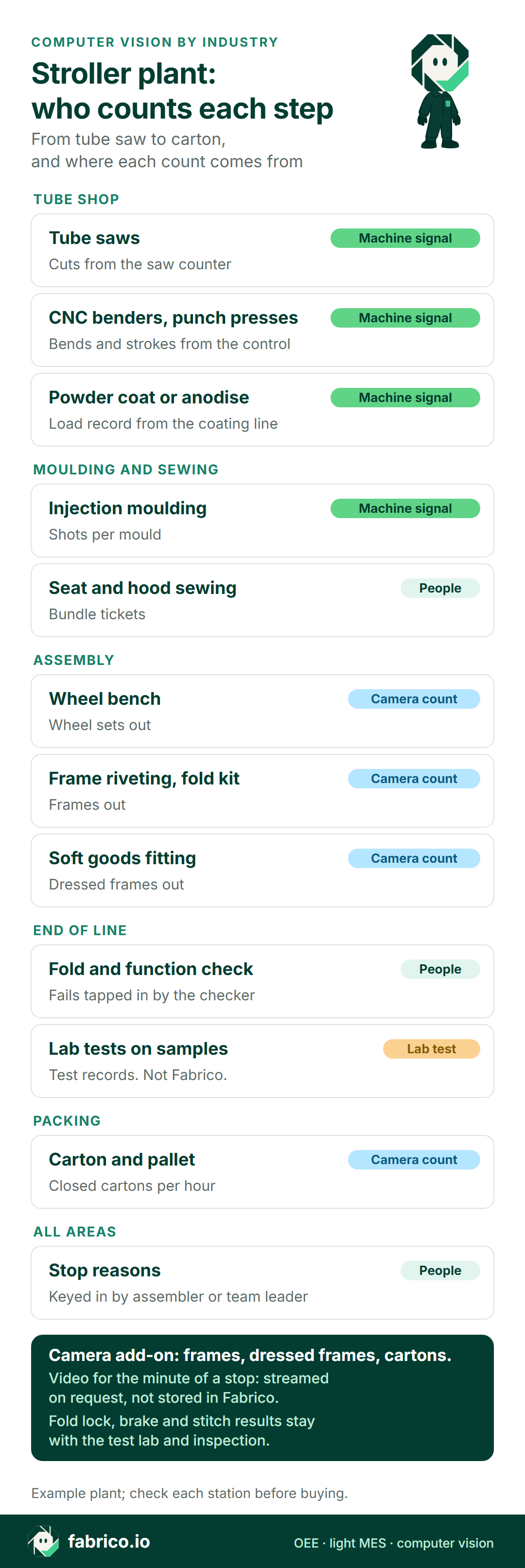
Text version of this infographic
- Tube shop: tube saws: machine signal, cuts from the saw counter
- Tube shop: CNC benders and punch presses: machine signal, bends and strokes from the control
- Tube shop: powder coat or anodise: machine signal, load record from the coating line
- Moulding and sewing: injection moulding: machine signal, shots per mould
- Moulding and sewing: seat and hood sewing: people, bundle tickets
- Assembly: wheel bench: camera count, wheel sets out
- Assembly: frame riveting and fold kit: camera count, frames out
- Assembly: soft goods fitting: camera count, dressed frames out
- End of line: fold and function check: people, fails tapped in by the checker
- End of line: lab tests on samples: lab test, test records, not Fabrico
- Packing: carton and pallet: camera count, closed cartons per hour
- All areas: stop reasons: people, keyed in by the assembler or team leader
- Footer: the camera add-on counts wheel sets, frames, dressed frames and cartons. Video for the minute of a stop: streamed on request, not stored in Fabrico
- Fold lock, brake and stitch results stay with the test lab and inspection
Fabric sets sewn in another hall
Seat covers, hoods, aprons, baskets and carrycot bodies are cut and sewn in a separate hall; sewing at volume has its own page, computer vision for textile manufacturing, and upholstered goods are on computer vision for furniture manufacturing. For the line, the sewing hall is a feeder that delivers one fabric set per frame, by colourway.
The miscount sits at the hand-off. If the sewing hall books a set as done when it leaves the last machine, the record shows sets that are still on a trolley in the corridor, or in the wrong colour. The line stands with bare frames on the outfeed trolley, and the wait is booked to the line as a whole.
Count fabric sets when they reach the kit rack beside soft goods fitting, by colourway, as a feeder count on the same timeline. A gap between frames arriving and dressed frames leaving then shows which side ran short. The kit rack works as a small supermarket; FIFO lane vs supermarket compares the two ways to feed a line. At fitting, where covers, harness and hood go on, a camera add-on counts dressed frames.
Bundles, accessory kits and colourways
A bundle may add a rain cover, a footmuff or car seat adaptors. If the accessory pack bench closes a carton per kit and dispatch credits it, bundles inflate output. Accessory packs are a pack count, never OEE output.
Colourways are the opposite trap. Black, grey and navy versions of one compact share the frame and the build minutes, so they share one ideal time; a tandem or a jogger is a frame family with its own. One ideal time for the line makes tandem days look slow; one per colourway hides that the frame work is identical (OEE per SKU). What a colourway changes is the kit at fitting, so book the swap as a changeover with its own code, and check the first stroller in the new colour before the run goes on, as in first-off approval after changeover.
Safety-test samples: EN 1888 in the EU, 16 CFR 1227 in the US
Strollers pulled for testing are built and boxed, then never shipped. Booked as scrap they drag quality down; left in shipped output, dispatch never reconciles. The region decides how many leave.
In the EU, EN 1888-1 covers children up to 15 kg, and EN 1888-2 adds requirements for pushchairs rated above 15 kg up to 22 kg, used only together with EN 1888-1, so a pushchair rated above 15 kg is tested against both parts. In Intertek's description of EN 1888 testing, parking and locking devices are activated and deactivated 200 times and the wheels run on a rolling road at 5 km/h over obstacles 72,000 times. Intertek adds that in the UK, EN 1888 testing is the recommended way to show compliance with the Wheeled Child Conveyances (Safety) Regulations 1997.
In the US, 16 CFR 1227 requires each carriage and stroller to comply with ASTM F833-21, and 16 CFR 1107.21 requires periodic testing at least once a year, unless the maker qualifies for a longer interval, on representative samples sent to a third party lab. The route card rule: samples count as built and good at the line, then leave shipped quantity under a sample code that quality owns. Inspection vs testing sets out how the two jobs differ.
Fold and brake check fails: count once, rework apart
The checker folds and unfolds each stroller, sets the parking brake, locks the front swivels and closes the harness buckle. One side not latching, or a brake bar not holding both rear wheels, is a fail and goes to the rework bench.
The double count comes next: the fixed stroller passes on its second visit, and if passes are the good count it becomes first-pass good, so the fold kit station never sees its own error. A fixed stroller is rework, not scrap and not good (scrap vs rework). On a stroller line: log the fail once, count the stroller once at the carton, and book the minutes spent opening fold joints and resetting brake bars to the rework bench. First-pass yield at the check then points at the fold kit, and final yield shows what ships; yield vs first-pass yield covers the difference.
Export cartons: no double count at packing
For the US, the durable infant product rule requires the maker or importer to provide a postage-paid consumer registration form with each product and to mark each product permanently with the maker, a US contact, model name and number, and date of manufacture. EU cartons carry the manuals, warnings and markings in the languages that the compliance file sets for each country.
A US carton closed without its card is reopened, and a count taken from the tape machine then counts it twice. Count cartons per market SKU at the carton line and book a reopened carton as rework time at packing. Carrycot cartons and accessory packs join the same pallet, which is why a pallet count is never the output count.
Book a demo to see the rivet bench, soft goods fitting and the carton line counted on one shift timeline.
Where a camera add-on counts on a stroller line, and where it misses
Four stations have no count of their own, and a camera add-on counts there, within limits. PerfCam, a KTH and AstraZeneca study of camera tracking on a conveyor test line, states: "In situations where cameras cannot be installed optimally or where the environment poses challenges like poor lighting or occlusions, the accuracy of the system may decrease." It adds: "For example, in areas with intense glare or shadows, the object detection algorithms might fail to recognize and track items accurately." Its test line was a drug maker's conveyor, not a pushchair bench: its accuracy figures do not apply, its failure causes do.
On a stroller line, anodised and chrome tube throws glare, an assembler leaning over the outfeed hides the frame, folded strollers stacked on a trolley overlap, and black covers on black frames give little contrast. So the camera goes where one unit crosses one line on its own: the rivet bench outfeed rail, the exit of soft goods fitting, the carton conveyor after the tape machine. Run it beside a hand count for a full shift at each station before trusting it. No accuracy figure is promised here.
The early shift on a pushchair line: tally against audit, in euros
The figures are invented for illustration. Four assemblers and a checker build a compact pushchair at 1.5 line minutes and a travel system pushchair, frame plus seat unit, at 2.0. Forty travel system orders also take a carrycot, boxed at the carrycot bench; the car seat is bought in. The shift runs from 05:45 to 14:15 with a 30-minute break: 480 planned minutes, with OEE taken at the carton line.
Availability. The carton line stood for 62 minutes: 30 waiting for grey fabric sets, 20 changing from black to grey kits, and 12 after the riveter lost air pressure. 418/480 = 87.1%.
Performance. 120 compacts earned 180 line minutes and 90 travel system pushchairs 180 more: 360 in 418 running minutes is 86.1%. The 58 slow minutes came while a new assembler learned the fold kit station.
Quality. Ten strollers failed the check: six compacts with one side not latching and four travel system pushchairs whose brake bar did not hold. Their 17 line minutes (6 x 1.5 plus 4 x 2.0) drop out of first-pass good: 343/360 = 95.3%.
OEE. 87.1% x 86.1% x 95.3% = 71.5%, the same as 343 good minutes over 480 planned.
The whiteboard counted every closed carton on the pallet at one rate, and the reworked strollers as good:
| Count | Whiteboard tally | Audited |
|---|---|---|
| Units counted | 250 (210 stroller cartons plus 40 carrycot cartons) | 210 strollers |
| Earned line minutes | 375 (1.5 for every carton) | 360 (1.5 per compact, 2.0 per travel system) |
| Good units | 250 (reworked strollers booked as good) | 200 first-pass (343 line minutes) |
| Performance | 375 / 418 = 89.7% | 360 / 418 = 86.1% |
| Quality | 100% | 343 / 360 = 95.3% |
| OEE | 375 / 480 = 78.1% | 343 / 480 = 71.5% |
The tally ran 6.6 points high. Forty carrycot cartons became strollers (miscount 3), one rate hid the travel system build minutes (miscount 5) and the reworked strollers counted as first-pass good (miscount 7). One rate alone gives 210 x 1.5 = 315 minutes, 45 short; the carrycots added 60.
The fabric set wait did not start at the line. The dressed frame count stopped at 09:10 while the frame count kept climbing, and by 09:40 seventeen bare frames stood on the trolley. The team leader opened the video for the minute of a stop at soft goods fitting from the timeline: an empty grey slot on the kit rack. The sewing hall had booked the grey sets as done (miscount 2).
What the shift cost
No public margin per stroller model turned up, so the margins are example inputs: EUR 30 for a compact and EUR 40 for a travel system pushchair, EUR 20 per line minute for both. A plant enters its own margin per model, and Fabrico prices lost minutes from it.
| Loss | Minutes | Example value |
|---|---|---|
| Slow running at the fold kit | 58 | EUR 1,160 |
| Grey fabric set wait | 30 | EUR 600 |
| Colourway change | 20 | EUR 400 |
| Riveter air pressure | 12 | EUR 240 |
| Fold and brake rework | 45 at the rework bench | EUR 30 (crew time) |
| Total | 120 line, 45 rework | EUR 2,430 |
480 planned minus 360 earned leaves 120 lost line minutes, and 120 x EUR 20 = EUR 2,400 of contribution, but only while this line is the constraint and orders wait. The ten fails were fixed and still ship, so they cost crew time, not margin: 45 rework operator minutes at an example EUR 40 an hour is EUR 30. As a sense check on that rate, Eurostat puts euro area industry at EUR 40.3 per hour in 2025.
If demand limits output instead, lost minutes are worth crew time only: five people were paid 40 hours for 30 hours of build standard, so 10 hours, EUR 400, plus EUR 30 of rework. The shift cost EUR 430 to EUR 2,430, up to EUR 12,150 over five shifts. Slow running and the fabric set wait make EUR 1,760 of it: training at the fold kit, and the hand-off from the sewing hall.
Fabrico on a stroller floor, with vendor checks and the works council
Fabrico is cloud software for OEE, with light MES functions on top. On a stroller floor:
- Saws, benders, punch presses and moulding machines: run state and counts come from the counters or controls, and die changes, mould swaps and tube shortages get codes on the timeline.
- Wheel bench, rivet bench, soft goods fitting and the carton line: the camera add-on counts wheel sets, frames, dressed frames and cartons. For a station a camera add-on covers, the video for the minute of a stop can be opened from the shift timeline, streamed on request and not stored in Fabrico.
- Fold and brake check: the checker logs fails on a tablet, and they become the quality figure against build minutes per frame family.
Assemblers or the team leader add stop reasons from a tablet or phone, and lost minutes show in euros by station and shift.
Roadmap: a camera add-on that flags bare frames piling up ahead of soft goods fitting and proposes a stop reason that the team leader confirms or changes.
Outside Fabrico: EN 1888 and ASTM F833 test results, stitch and rivet inspection, lab records and certificates. Fabrico does no inspection or testing; OEE takes only the fail tally.
Before a stroller pilot, put these miscount questions to any OEE or camera vendor:
| Question | A good answer |
|---|---|
| How is a travel system with a carrycot counted? | Once, as the frame; carrycot cartons as a pack count. |
| How are lab samples booked? | A sample code, outside scrap and shipped output. |
| How is a fold check fail that is fixed handled? | Logged once at the check; rework time at the rework bench. |
| Can ideal time differ by frame family, not by colour? | Yes: compact, travel system, tandem and jogger each get one. |
| Can fabric set arrivals be counted apart from dressed frames? | Yes, on one timeline, so a kit wait shows where it began. |
A camera above a rivet bench has people in view as well as frames. Settle the purpose with the team before a bracket goes up, involve the works council where the plant has one, and write down which roles may open footage and why. Report by station and shift, never by name; the camera add-on counts frames and cartons, not people. For the product itself, see camera-based OEE software, OEE with computer vision and the MES and OEE solution overview.
Questions stroller plants ask
Which station on a stroller line should own the output count?
The carton line, because a closed carton is the count that matches what ships. Frames, wheel sets and fabric sets are feeder counts at their own stations, and a camera add-on can count them where no machine does.
How is a travel system counted?
Once, as one frame at the carton line. The seat unit, carrycot and adaptors are feeder or pack counts, and a bought-in infant car seat is not counted at all.
Do strollers pulled for EN 1888 or US periodic tests count as scrap?
No. They were built and passed the line, so they count as built, then leave shipped quantity under a sample code. Booking them as scrap makes quality look worse than it was.
Want riveted frames, dressed frames and cartons counted once, on one shift timeline? Book a demo.
Related articles









Real Fabrico tiles, sample data.