


 Login
 Blog
ThingWorx vs Ignition: Model First or Tag First for Plant Apps?

In short: If group IT wants one model of assets and enterprise systems across plants, with a vendor OEE app on top, look at ThingWorx first; if controls engineers will build operator screens on PLC tags at each site, look at Ignition first. ThingWorx, an industrial IoT platform now sold by Velotic, starts from Things built on templates; Ignition starts from tags on a plant server. Velotic shows no price for ThingWorx and routes buyers to Contact sales; Inductive Automation, by contrast, prices an Ignition platform licence at USD 1,200 (both read 15.11.2026).
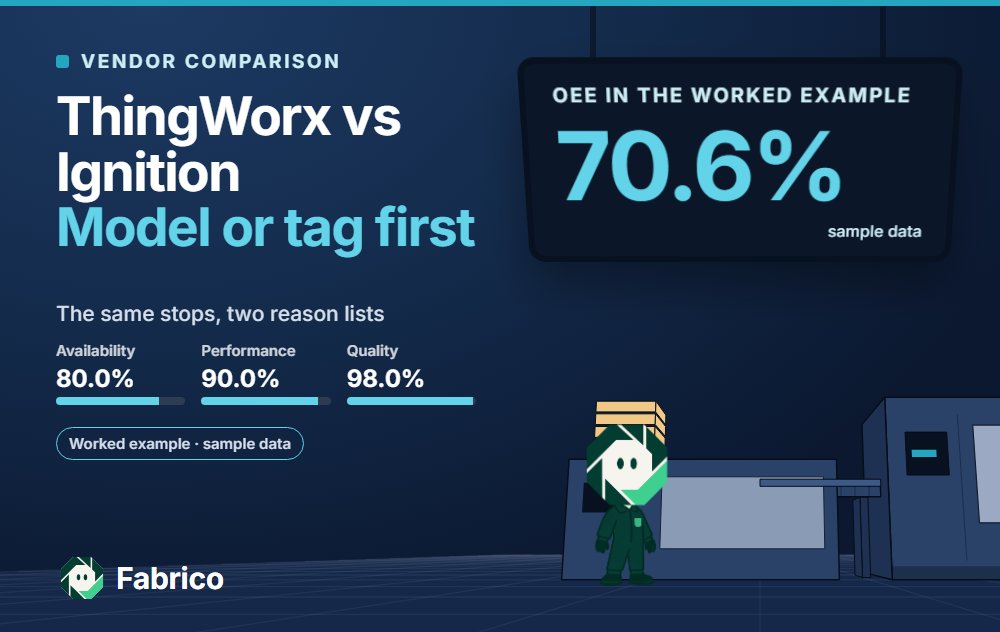
- Worked example: the same 98 stopped minutes coded with two reason lists, where the unclassified share falls from 41.8% to 9.2%.
Key takeaways
- ThingWorx builds from a model of Things and templates; Ignition builds from tags read off controllers.
- There are three routes to OEE: RTPPM on ThingWorx, Sepasoft's module on Ignition (USD 22,700 list), or your team's own build.
- In the sample below, a two-level reason list puts an owner on EUR 89.60 of stopped time a shift, EUR 44,800 a year, with OEE unchanged.
- The reason list decides how much downtime gets a name on either platform; review it as early as the connection plan.
This pair lands on one shortlist when a group IT team wants a platform for plant apps and the controls engineers at the sites already know Ignition. Fabrico makes cloud OEE software and a light MES that can run beside either platform. ThingWorx facts come from velotic.com and the ThingWorx 10.2 help center on support.ptc.com; Ignition facts from inductiveautomation.com and its docs, read 13.11 to 15.11.2026. For a wider field, see ThingWorx alternatives.
Model first or tag first
Each cell condenses a vendor page, linked further down.
| Question | ThingWorx | Ignition |
|---|---|---|
| Self-description | Industrial IoT platform that puts machine data in context | Server software at the centre of plant-floor systems |
| The build starts from | Things created from Thing Templates | Tags, and UDTs whose instances follow the type |
| Screens are built in | Mashup Builder, from the model | Ignition Designer, with Perspective and Vision |
| Reaching machines | Kepware, Velotic's connectivity product | OPC UA module, MQTT modules, SQL Bridge |
| Where it runs | ThingWorx Cloud Services or on premises | Windows, Linux or macOS servers; Ignition Edge on devices |
| Route to OEE | RTPPM: prebuilt dashboards and reason trees | Sepasoft OEE Downtime module, from a technology partner |
| Price, as published (checked 15.11.2026) | No public price; quote on request (Contact sales) | USD 1,200 platform licence plus USD 11,225 for Perspective, at list |
In ThingWorx the model leads: a team defines Thing Templates for a filler or a labeller, creates Things from them, and builds mashups that read from the model. In Ignition the tag leads: a controls engineer reads tags off a PLC, groups them into UDTs and binds them in Designer. Both end with a screen on a phone, but the first decision differs, and so does the person who makes it. A fair first test for both vendors: one downtime screen for two similar machines, then one template edit that reaches both.
Explainer presented by Iris, Fabrico's AI-generated presenter: a neutral concept video, no product shown. Book a demo.
Plays from YouTube. Google may set cookies when you press play. Privacy policy.
What Velotic and Inductive Automation put on their pages
ThingWorx. Per Velotic's home page, Velotic is an independent industrial software company formed by combining ThingWorx and Kepware, from PTC, with Proficy, from GE Vernova; TPG's launch release of 17 March 2026 says the same and describes Velotic as "Backed by TPG" (read 15.11.2026). Velotic's ThingWorx page (read 15.11.2026) presents a platform for connecting and contextualizing industrial data and scaling AI-ready insights, and its FAQ says ThingWorx wraps and extends existing systems instead of replacing them. In the help center, each Thing starts from a Thing Template holding properties, services, events and subscriptions, and an edit to a template reaches the Things built from it. Mashups are made in the Mashup Builder, which the help center calls a 100% configuration, zero code environment. Kepware mixes drivers and protocols in one server, and its page says ThingWorx uses that connected data for applications.
Ignition. The Ignition page presents server software at the centre of plant-floor equipment and data, resting on SQL, Python, OPC UA and MQTT, with browser clients served from a server on site or in the cloud and Ignition Designer included. The Perspective module page covers HTML apps for phones, tablets, touch panels and desktops. Per the tags documentation, a tag is a point of data, and UDTs build tags in an object-oriented way so that editing the type carries through to its instances. The modules page lists an OPC UA module for most major PLCs, MQTT modules for two-way traffic with edge devices, and SQL Bridge (all read 13.11.2026).
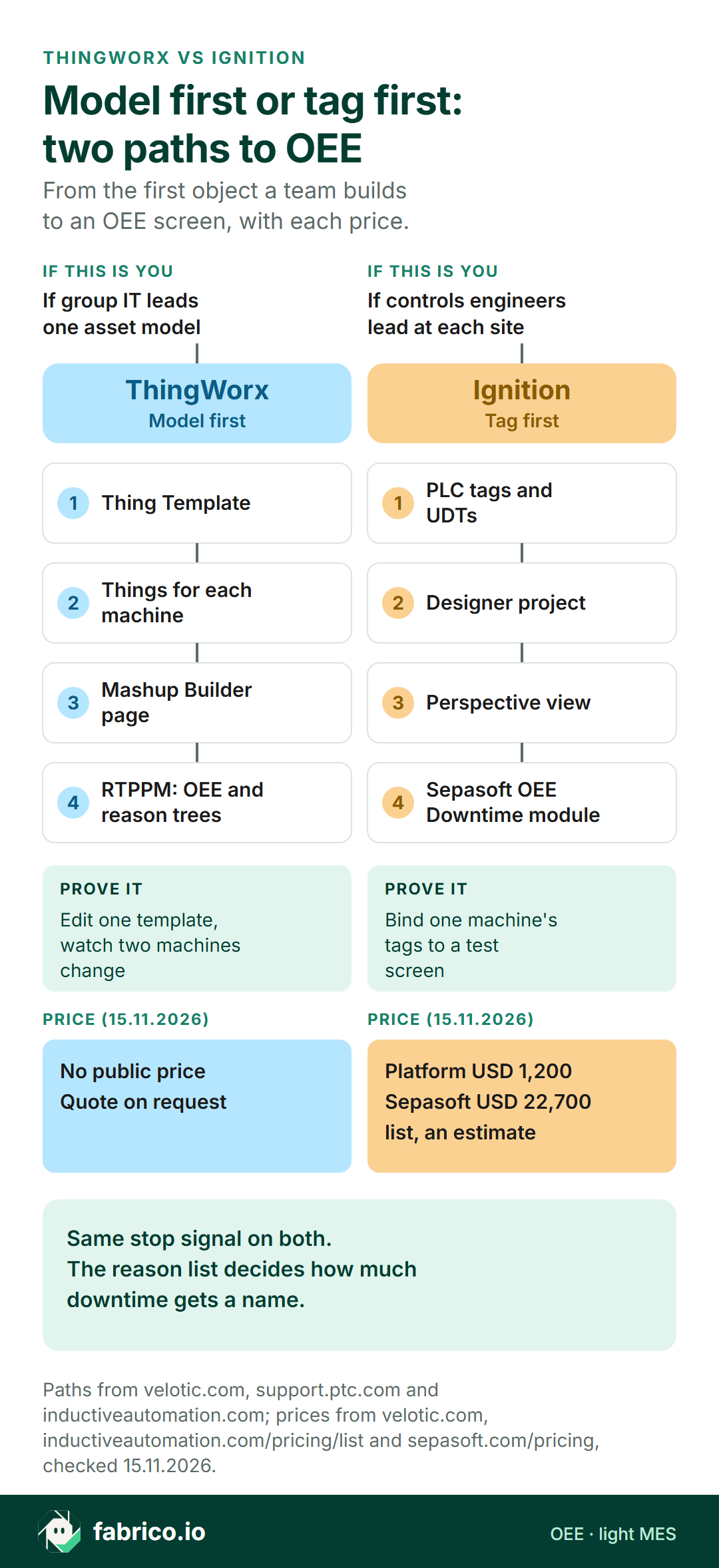
Text version of this infographic
- Model first or tag first: two paths to OEE.
- If group IT leads one asset model: look first at ThingWorx, model first: Thing Template, then Things for each machine, then Mashup Builder page, then RTPPM: OEE and reason trees. Prove it: edit one template, watch two machines change. Price (15.11.2026): No public price; Quote on request.
- If controls engineers lead at each site: look first at Ignition, tag first: PLC tags and UDTs, then Designer project, then Perspective view, then Sepasoft OEE Downtime module. Prove it: bind one machine's tags to a test screen. Price (15.11.2026): Platform USD 1,200; Sepasoft USD 22,700; list, an estimate.
- Same stop signal on both. The reason list decides how much downtime gets a name.
Two routes to OEE: RTPPM, Sepasoft or your own build
Both platforms carry the run and stop signal. What differs is how much of the OEE application arrives ready, and what it costs as published.
| Route | What the vendor page offers | Price, as published (checked 15.11.2026) | What your team still builds |
|---|---|---|---|
| ThingWorx RTPPM | Prebuilt dashboards for OEE, MTBF and MTTR, drill-downs and reason trees, with Kepware linking brownfield machines | No public price; the RTPPM page offers Contact us | Reason lists, line models, any screens beyond the prebuilt ones |
| Ignition with Sepasoft OEE Downtime | OEE calculation joined with downtime tracking, as an Ignition module | USD 22,700 perpetual site licence, on top of the Ignition Platform | Line configuration, reason lists, operator screens |
| Your own build, on either | Platform tools: mashups or Perspective views, scripting, history | Platform licence plus your team's hours | Everything: the OEE rule, planned time, reasons, reports, upkeep |
Velotic's RTPPM page (read 15.11.2026) describes prebuilt KPI dashboards, drill-down dashboards and reason trees, and says Kepware gives RTPPM access to production data from brownfield equipment. Digital Performance Management joins manual and automated data and tracks corrective actions. On the Ignition side, Inductive Automation lists Sepasoft as a technology provider building MES modules on the Ignition module SDK, and Sepasoft's pricing page gives the OEE Downtime Module at USD 22,700, a perpetual site licence covering unlimited lines, machines and users per site, with annual support from 16% to 24% (checked 15.11.2026). The third route looks free and rarely is: an OEE app that a platform team builds is an OEE app that team maintains, which is the core trade-off in MES vs IIoT platform.
Designing the reason list
A run bit and a counter tell either platform that a labeller stopped at 10:42 for six minutes. They do not say why. The why comes from a person choosing from a list, so the list design decides how much stopped time ends up unclassified, and that design lands with whoever builds the downtime app, on RTPPM, Sepasoft or a home-made screen alike.
What tends to decide the unclassified share, on any platform:
- Depth and size. Seven groups of three to six causes fit one phone screen and are quick to pick under pressure; forty-odd flat items are not.
- Where Other sits. At the top of the list it becomes the default answer. Inside a group it still tells you which area the minutes belong to.
- When the prompt appears. Asking as the machine restarts catches the operator while the cause is fresh.
- Who changes the list. Shift leads hear of new causes first, so give one named person the right to add them.
More on list design in downtime reason code design and on the operator's side in operator downtime reason entry.
Worked example: the same stops, two reason lists
Labelled sample figures for an invented bottling plant, with no real site or Fabrico screen behind them. A group IT team builds a downtime app for one labelling line. Release one gives operators a flat list of 42 reasons with Other at the top. Four weeks later the team rebuilds it as seven groups on two levels, three to six causes each, with no top-level Other.
The shift is 525 minutes with 35 minutes of breaks, so planned time is 490 minutes. The signal records 98 minutes stopped, so run time is 392 minutes and availability is 392 / 490 = 80.0%. At an ideal 40 bottles a minute, 392 x 40 = 15,680; the line labels 14,112, so performance is 90.0%. The reject signal removes 282, leaving 13,830 good, so quality is 98.0%. OEE is 80.0% x 90.0% x 98.0% = 70.6%, the same as 13,830 good of 490 x 40 = 19,600 possible. For a clean comparison, both releases are shown on a shift with these figures.
List 1, flat. Changeover 30 minutes, label web break 14, waiting for bottles 13, unclassified 41: 41 / 98 = 41.8% of stopped time. The biggest bar in the morning report has no owner.
List 2, two levels. Changeover 34, label web break 22, waiting for bottles 18, infeed starved 15, unclassified 9: 9 / 98 = 9.2%. Infeed starvation, hidden before, is now a named 15 minute loss.
OEE did not move: 70.6% in both. What moved is that 32 more minutes now carry a cause someone can act on. The screen design did that, so the reason list belongs in the first build review next to the connection plan. A filling line's typical causes are listed in beverage filling line downtime codes, and why unnamed minutes pile up in unclassified downtime.
Putting the unclassified minutes in EUR
Use a sample contribution margin of EUR 0.07 per labelled bottle on a sample factory price of EUR 0.30, 23.3% of the price. Soft drinks margins bound it: the January 2026 margin file from NYU Stern (accessed 15.11.2026) lists 27 US soft beverage firms at a pre-tax operating margin of 20.53% and a gross margin of 54.74%, and contribution margin sits between the two. A stopped minute is valued at the ideal rate, as OEE values it: 40 bottles, or EUR 2.80. Calendar, also a sample: two shifts a day, so 42 shifts a month and 500 a year.
| Stopped time on the sample shift | Minutes | EUR, shift | EUR, month | EUR, year |
|---|---|---|---|---|
| All stopped time | 98 | 274.40 | 11,524.80 | 137,200 |
| Unclassified, flat list | 41 | 114.80 | 4,821.60 | 57,400 |
| Unclassified, two-level list | 9 | 25.20 | 1,058.40 | 12,600 |
| Infeed starved, named only by list 2 | 15 | 42.00 | 1,764.00 | 21,000 |
The rebuild made no extra bottles on the day, so on its own it saved nothing. The whole OEE gap, 19,600 minus 13,830 bottles, is still 5,770 bottles or EUR 403.90 a shift. What changed is how much of the stopped time someone can be asked about: unnamed minutes fall from EUR 114.80 to EUR 25.20 a shift, so EUR 89.60 a shift, EUR 44,800 a year, moves from nobody's problem to a cause with an owner. The infeed alone is EUR 21,000 a year that the first release hid. Set those figures against the hours the rebuild takes, whichever platform carries it, and against what the team does next with the newly named causes.
Where each runs and what happens when the link drops
The ThingWorx deployment architectures page names ThingWorx Cloud Services and on-premise deployment, from small development systems up to multi-node clusters. Ignition's installation docs cover Windows, Linux and macOS, and Ignition Edge goes onto devices at the machine and passes data up over the Gateway Network or MQTT, with store and forward and 35 days of internal data storage for history and events.
The question that settles the design is what an operator sees on the line screen when the link to the application server drops at 03:00. Ask both vendors to show it, not describe it. Where MQTT carries the counts, the OASIS MQTT 5.0 standard describes "At least once" delivery, where messages arrive "but duplicates can occur" (accessed 14.11.2026). Publish running counter totals, not increments, so a duplicate message cannot add bottles. The unified namespace guide covers how plants organise those topics across sites.
Decision matrix: ThingWorx or Ignition for your plant
Price: Velotic quotes ThingWorx and RTPPM on request; an Ignition platform licence is USD 1,200 at list and Sepasoft's OEE Downtime module USD 22,700 (all checked 15.11.2026). Budget too for the build hours on either. Every row points at the product whose own page or help center covers that job; a mixed answer is common.
| If this is you | Look first at | Why (vendor page) | Prove it in the pilot by |
|---|---|---|---|
| Group IT wants one asset model for all plants | ThingWorx | Every Thing is created from a Thing Template | Editing one template and watching two machines change |
| Existing systems must stay, with apps on top | ThingWorx | Wraps and extends existing systems | Showing one existing system's data in a new app, untouched |
| A vendor OEE app with reason trees, ready made | ThingWorx RTPPM | Prebuilt dashboards, drill-downs and reason trees | Loading one line's stops and drilling into a reason tree |
| Machine property history kept in the platform | ThingWorx | Value streams store properties as time series | Logging a counter for a week and querying it back |
| Controls engineers build screens on PLC tags | Ignition | OPC UA module for most major PLCs | Binding one machine's tags to a test screen |
| Operators use phones and touch panels at the line | Ignition Perspective | HTML apps for phones, tablets and panels | Picking a stop cause on a phone with gloves on |
| OEE as a priced module on the plant server | Ignition with Sepasoft | OEE Downtime Module, perpetual site licence | Booking a week of stops and comparing with the shift log |
| Devices at the machine must ride out outages | Ignition Edge | 35 days of internal data storage for history and events | Cutting the uplink for a shift and checking what arrives |
| Many controller brands through one server | Both | Kepware combines drivers in one server; Ignition OPC UA module | Connecting the two oldest controllers on site |
If the shortlist also holds a frontline app platform, compare Ignition vs Tulip.
Fabrico as the ready OEE app beside a platform
On a platform team, build time is the scarce resource: a week spent on a downtime screen is a week taken from apps nobody else can build. Fabrico is the downtime and OEE app already built, OEE software in the cloud plus a light MES. Operators pick a cause from a two-level reason list on a handheld, and the cost of lost time, downtime and OEE show per line and shift, as the MES and OEE solution overview lays out. Fabrico reads run, stop and count from the machine's PLC; see the OPC UA and OEE guide. Coded downtime goes back through webhooks, the REST API or CSV exports, so a mashup or a Perspective view can show it; Fabrico names no ready connector for either platform, so test the route on one line.
At a manual step, or an older machine with no signal worth reading, output is counted by the camera add-on, which does no more than count; stop-reason suggestions from a camera stay a Roadmap item for that add-on. Where a camera covers the line, the video for the minute of a stop can be opened from the shift timeline; it is streamed on request and not stored. See the camera add-on page and computer vision for beverage lines. To see a two-level reason list at the machine, book a demo.
Send both vendors the same brief
Give Velotic and the Ignition integrator the same two machines, a sample reason list and your OEE rule, then ask:
- Can you build one downtime screen for two similar machines, and show a template change reaching both?
- Which parts of the link to our controllers come from your product, and which from another product or module?
- What does the line screen show when the link to the application server drops?
- How does an operator pick a stop cause on a phone, and who can change the list later?
- From what length does the app ask for a cause, and how are shorter stops booked?
- What is the quote, or the list total, for the platform, the OEE route and a year of support on that scope?
Background reading: the OEE software guide and OEE calculation, so both vendors work to one formula.
Before the brief goes out
- Measure today's unclassified share. Take last month's stops on one line and divide the unnamed minutes by all stopped minutes. That number is the baseline for any new app.
- Draft the reason list with the shift leads. Two levels, a handful of groups, no Other at the top. An hour with the people who live with the list beats a week of screen design.
- Write a one-page build brief. Two similar machines, the reason list, the OEE rule, the devices operators will hold, and what must happen when the network drops.
- Price the three routes. RTPPM by quote, Sepasoft and Ignition from the published lists, and your own build in team hours, all for the same scope.
- Name the owner of the list and the OEE rule. ISA's ISA-95 page puts MES at Level 3 and "monitoring and supervising" at Level 2 (accessed 14.11.2026); the reason list is Level 3 work, so give it an owner outside the platform team, then send the brief.
FAQ: ThingWorx and Ignition
Who sells ThingWorx now?
Velotic, per its home page, which says the company was formed by combining ThingWorx and Kepware, from PTC, with Proficy, from GE Vernova. The ThingWorx 10.2 help center is on support.ptc.com.
How much do ThingWorx and Ignition cost?
Velotic shows no price for ThingWorx or RTPPM and routes buyers to Contact sales (checked 15.11.2026). Inductive Automation's price list shows the Ignition Platform at USD 1,200 and the Perspective Module at USD 11,225, and Sepasoft charges USD 22,700 for its OEE Downtime Module for Ignition.
How do ThingWorx and Ignition connect to PLCs?
Velotic pairs ThingWorx with Kepware, its connectivity product, which mixes drivers and protocols in one server. For Ignition, Inductive Automation lists an OPC UA module that reaches most major PLCs, plus MQTT modules for edge devices.
Can either one calculate OEE?
Yes, per their pages. Velotic's RTPPM on ThingWorx has prebuilt dashboards for OEE, MTBF and MTTR with reason trees. For Ignition, Inductive Automation lists Sepasoft's OEE Downtime module. A team can also build its own screens on either.
Why is so much of our downtime unclassified?
Often the reason list, not the connection. A long flat list with Other at the top collects minutes nobody names. In the sample on this page, a two-level list cut the unclassified share of stopped time from 41.8% to 9.2%, with OEE unchanged at 70.6%.
Want named downtime without a platform build? Book a demo.
Related articles



Real Fabrico tiles, sample data.