







 Login
 Blog
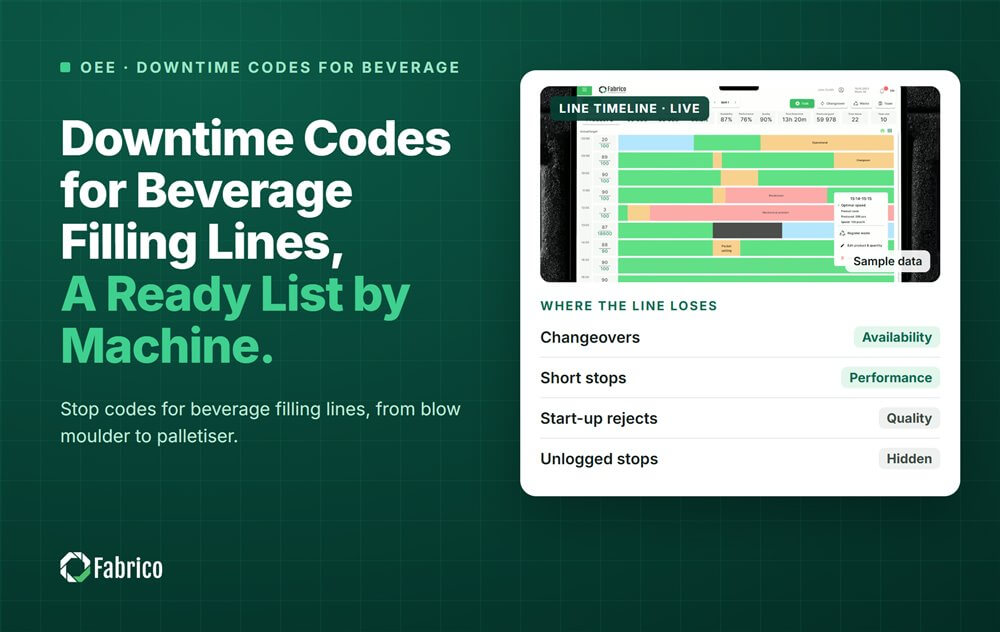
Downtime Codes for Beverage Filling Lines: A Ready List by Machine

Key takeaways
- The filler is the bottleneck on most beverage lines, so its codes need the most care.
- "Product low" from the syrup room or process side is starved time, not a filler fault.
- Flavour changes, size changes and CIP are three different things; code them apart.
- Never treat a validated CIP as a loss to shorten; code it as planned and measure it.
- Fewer than 10 reasons per machine keeps operators using the list.
Code beverage line stops by machine and by group, with fewer than 10 reasons per machine. Give the filler and capper the most detail, because they set the pace of the whole line, and keep product supply, CIP and changeovers in codes of their own.
Fabrico, an OEE and light MES platform, logs each stop from the machine signal and asks the operator to confirm the reason in one tap. Below is a code list for a typical beverage line, from blow moulder to palletiser, with the stops that most often get mixed up and a worked week you can compare with your own.
Why do beverage lines need their own downtime codes?
A beverage line looks like any packaging line, but three things make its stops different:
- The filler sets the pace. It is the slowest and costliest machine by design; the machines around it run faster so the line can recover after short stops. A filler minute costs line output; many other minutes do not.
- The product comes from a process. Syrup room, mixer or tank: when product runs low, the filler stops even though nothing is wrong with it.
- Changes are frequent. Flavour changes, bottle size changes and cleaning all stop the line, for very different lengths of time.
A craft brewer packaging benchmark by OFS found lines filling only 54% of the time, with a stop every 11 minutes 48 seconds. Numbers like that only become useful when each stop has the right code.
What should each machine on a beverage line code?
| Machine | Own stop reasons to code |
|---|---|
| Blow moulder or depalletiser | Preform jam, oven temperature fault, mould change, empty bottle supply out |
| Rinser | Rinse pressure low, gripper fault |
| Filler | Bottle jam at infeed, fill level out, filling valve fault, CO2 pressure low, product low in buffer tank |
| Capper | Caps out, cap feed jam, torque fault, crooked caps |
| Labeller | Label web break, glue skip, label roll change, wrong label loaded |
| Coder and inspection | Missing or wrong date code, fill level reject stop, cap inspection reject stop |
| Shrink wrapper or case packer | Film break, pattern jam, blank misfeed, glue nozzle clog |
| Palletiser | Pallet supply out, layer pattern fault, stretch film out |
Then add the shared groups that apply to every machine: breakdown, changeover, material, quality, starved or blocked, short stop, planned and utilities. Keep the words the operators use. Our guide to operator friendly reason codes shows how to word them.
Which beverage stops should never share a code?
- Product low vs filler fault. If the buffer tank runs low because the syrup room is behind, that is starved time charged to the process side. Our guide to starvation and blocking at the bulk to pack handoff covers this case.
- Flavour change vs size change. A flavour change is mostly flushing and rinsing. A size change means format parts and settings. They have different standard times and different fixes.
- CIP vs extra cleaning. A scheduled, validated CIP is planned time. Extra cleaning after a spill or a contamination is unplanned and needs its own code.
- CO2 and utilities vs the filler. Low CO2 or air pressure stops the filler, but the fix is elsewhere.
- Caps out vs cap feed jam. One is material supply, the other is the capper. Same machine, different owner.
How do you code changeovers and CIP on a beverage line?
Treat each type of change as its own planned activity with a standard time:
- Flavour change: from the last good bottle of one product to the first good bottle of the next, including flush and rinse.
- Size change: format parts, guide rails, star wheels, filler and capper settings, labeller adjustments.
- CIP: the validated cleaning cycle. Code it, measure it, and never shorten it to improve OEE; it is a food safety step.
The standard time is planned. The minutes over the standard are a loss and get the code "changeover over standard", with the type attached. That way overruns stay visible instead of disappearing into planned time. The same OFS benchmark measured an average changeover of just over 49 minutes. Our guide to changeover standards on FMCG lines shows how to set the standards, and planned vs unplanned downtime explains where the line between them goes.
What does a week of beverage line codes show?
Sample line (illustrative numbers, not a customer): a carbonated soft drink line with the filler as the bottleneck at 400 bottles a minute. Before the new list, most of these stops were logged as "filler stopped". One week with the new codes:
| Code | Group | Stops | Minutes | Owner |
|---|---|---|---|---|
| Bottle jam at filler infeed | Short stop | 64 | 96 | Line crew |
| Product low in buffer tank | Starved by process | 5 | 55 | Syrup room |
| Label web break | Labeller | 9 | 45 | Line crew |
| Caps out | Material | 4 | 36 | Material supply |
| Flavour change over standard | Changeover | 3 | 36 | Shift lead |
| Fill level reject stop | Quality | 22 | 33 | Quality and crew |
| Total | 107 | 301 |
- The 55 minutes of "product low" were never a filler problem. With their own code, the syrup room can see them and plan batches ahead.
- The infeed jams are frequent and short: 64 stops at 1.5 minutes on average. That points to guide rails and bottle handling, not to maintenance.
- Three flavour changes ran 12 minutes over standard each. The shift lead now has a number to work on.
- At 400 bottles a minute, the 96 minutes of filler jams alone are 38,400 bottles not filled.
How do you start using the list on your line?
- Take last month's stops and sort them into the machines and groups above.
- Cut any reason that never happened; add the ones that did.
- Pilot the list on one line, on every shift.
- Ask the operators which codes they could not find, and rename them.
- Review the list every two weeks, then every quarter.
- Copy the same groups to every beverage line in the group, so a stop means the same thing in every plant.
Where Fabrico fits
Fabrico is a computer vision enabled Manufacturing Performance Platform. OEE and light MES come first, with computer vision on stops.
- Automatic downtime logging from the filler and the machines around it.
- The operator confirms the reason in one tap from the short list for that machine.
- A camera clip as evidence for a stop, where a camera watches the infeed or the capper.
- Every loss priced in money and ranked, so a filler minute and a palletiser minute are not treated the same.
- One view across plants with the same codes on every line.
You start with a pilot on one line, with a baseline and a decision date agreed in advance. There is no free plan and there are no tiers: each plant gets a quote. Read how a light MES starts on one line in our light MES guide.
Frequently asked questions
What are downtime codes on a filling line?
They are the reasons recorded for each stop, such as "caps out" or "bottle jam at infeed". Each belongs to a machine and a group, and maps to one OEE loss.
How many downtime codes does a filler need?
Usually fewer than 10 of its own reasons, plus the shared groups. If the operator cannot find a code in a few seconds, there are too many.
Is CIP counted as downtime?
A scheduled, validated CIP is usually planned time. Extra or unplanned cleaning is a loss and needs its own code. Never shorten a validated CIP to improve OEE.
Should a flavour change and a size change have different codes?
Yes. They take different times and need different fixes, so each needs its own standard and its own overrun code.
What does "starved by process" mean on a beverage line?
The filler is ready but has no product, because the syrup room, mixer or tank is behind. The minutes belong to the process side, not to the filler.
Try the codes on one line
Bring one beverage line and last month's stop log. We will show your stops by machine, by code and by cost.
Latest from our blog


Real Fabrico tiles, sample data.