


 Login
 Blog
Dozuki vs GembaDocs: Pick by Your SOP Gap, Then Test It

In short: Dozuki vs GembaDocs comes down to the gap you have today. If your gap is getting undocumented changeovers written at the machine fast, look at GembaDocs first; if it is training paths, measured checks and many languages, look at Dozuki first. Both keep revision history and a skills matrix, so the tie-breakers are capture speed, depth of training, hosting and price.
- Price, as published on 15.11.2026: GembaDocs lists five plans from EUR 49 a month (2 users) to EUR 499 a month (100 users), on-premise on request; Dozuki shows no public price, quote on request.
- Three tests settle most of it: one changeover clip, one mid-shift revision, one expiring certificate.
- Sample night shift on a corrugated die-cutter: one changeover with no usable SOP cost 27 minutes and 1,420 rejected sheets, about EUR 379.
The search usually comes from a CI lead at a box plant with two problems on the same night shift. The setup sheet for a job last run months ago is a page of numbers with no pictures, and the operator on that machine has never been signed off on it. Dozuki and GembaDocs both claim that ground. Rather than walk through two feature lists, this page sorts the choice by your gap, then runs the three tests that separate the tools in a pilot, then prices one slow changeover on a rotary die-cutter in euros.
Key takeaways
- Authoring backlog first (SOPs live in people's heads): GembaDocs' pages put capture from a phone at the machine up front.
- Readiness first (quizzes, observed practice, trainer sign-off across sites): Dozuki's pages put the learning path up front.
- GembaDocs publishes plan prices in euros; Dozuki quotes on request. Ask both for a five-year total with your user count.
- The die-cutter example: 64.4% OEE on the night shift, about 72.6% with a usable setup SOP, at a margin anchored to the packaging industry's published range.
- Stop minutes and counts come from the machine, so whichever tool wins, measure the changeover at the line.
Fabrico, maker of cloud OEE software and a light MES, appears once, near the end, where the lost changeover minutes feed back into the SOP queue. Plants already on Dozuki that want a wider field can start from the Dozuki alternatives review.
Dozuki or GembaDocs: pick by the gap you have today
The two vendors overlap on the basics: approval before publishing, revision history with rollback, a QR code at the station and a skills matrix. Where they part is the starting point. GembaDocs' home page leads with "SOPs made easy" and "Capture any task on your phone, or any process on your screen." Dozuki's home page leads with "Scale performance. Empower the people who make it possible." One begins at the blank page, the other at the workforce. The table below is a condensed record of their own pages (vendor features read 14.11.2026, prices 15.11.2026).
| Topic | Dozuki | GembaDocs |
|---|---|---|
| Starting point | Frontline platform: knowledge, training, workflows, analytics | SOP builder with a skills matrix and Kanban cards |
| First draft | CreatorPro AI drafts from demonstrations and documents | Phone photos with spoken captions, or a recording cut into steps |
| Change control | Multi-step review, revision history, acknowledgement before access | Sign-off before publishing, change log, PDF of each approved version |
| Training | Quizzes, assessments, trainer verification, auto re-enrolment | Matrix linked to SOPs, live signatures, certificate expiry in red |
| Checks in the job | Forms, checkpoints, second check at critical steps | OK/Not OK images, critical step flags, pass/fail logging |
| Hosting | Cloud; open APIs and webhooks | Cloud, or on-premise with the same features |
| Price, as published (checked 15.11.2026) | No public price, quote on request (pricing page) | EUR 49 to 499 a month by plan, or EUR 499 to 4,999 a year; on-premise "POA" (pricing page) |
Now route your own situation through the decision matrix. Tick each row that describes this quarter, not the plant you hope to run in three years.
| If this is you | Look first at | Why (vendor page) | Prove it in the pilot by |
|---|---|---|---|
| Forty setups exist only in two senior operators' heads | GembaDocs | Recording turned into a step-by-step procedure | A night operator capturing one setup without help |
| Manuals and OEM videos already exist and need converting | Dozuki | Drafts from demonstrations and existing documents | Feeding in one die-cutter manual and editing the draft |
| Crews speak four languages across two sites | Dozuki | 100+ languages with industry glossaries | A native speaker checking the anvil step in translation |
| New starters need quizzes and a trainer's sign-off | Dozuki | Assessments and trainer verification | Running one starter through a full path |
| Forklift and first-aid tickets lapse without anyone noticing | GembaDocs | Certificates with expiry dates, red when expired | Uploading a ticket that expires during the pilot |
| A setup step must record a measured value and a second person | Dozuki | Checkpoints and a second check at critical steps | Entering an out-of-limit value on a test form |
| IT insists the data stays on plant servers | GembaDocs | On-premise option, identical features | IT signing off install, update and backup duties |
| The budget needs a list price before a pilot is approved | GembaDocs | Plans priced in EUR, USD and GBP | Matching the plan's user cap to your signed-off headcount |
Price in this decision. GembaDocs publishes Lite at EUR 49 a month for 2 users, Teams at EUR 99 for 10, Premium at EUR 149 for 20, Premium + at EUR 249 for 50 and Multi-site at EUR 499 for 100, with annual billing from EUR 499 to EUR 4,999 and "a free 30-day trial" on every plan; Dozuki publishes no price and quotes on request (both checked 15.11.2026). Budget too for the people who run it: an SOP owner's hours, translation review and, for on-premise, your IT team's time.
Mostly GembaDocs rows means an authoring backlog; mostly Dozuki rows, a readiness and records problem. A split is common and tells you which half to pilot first. If you are still unsure whether a frontline tool or a line-measurement tool should come first, read light MES vs connected worker platform before the shortlist meeting.
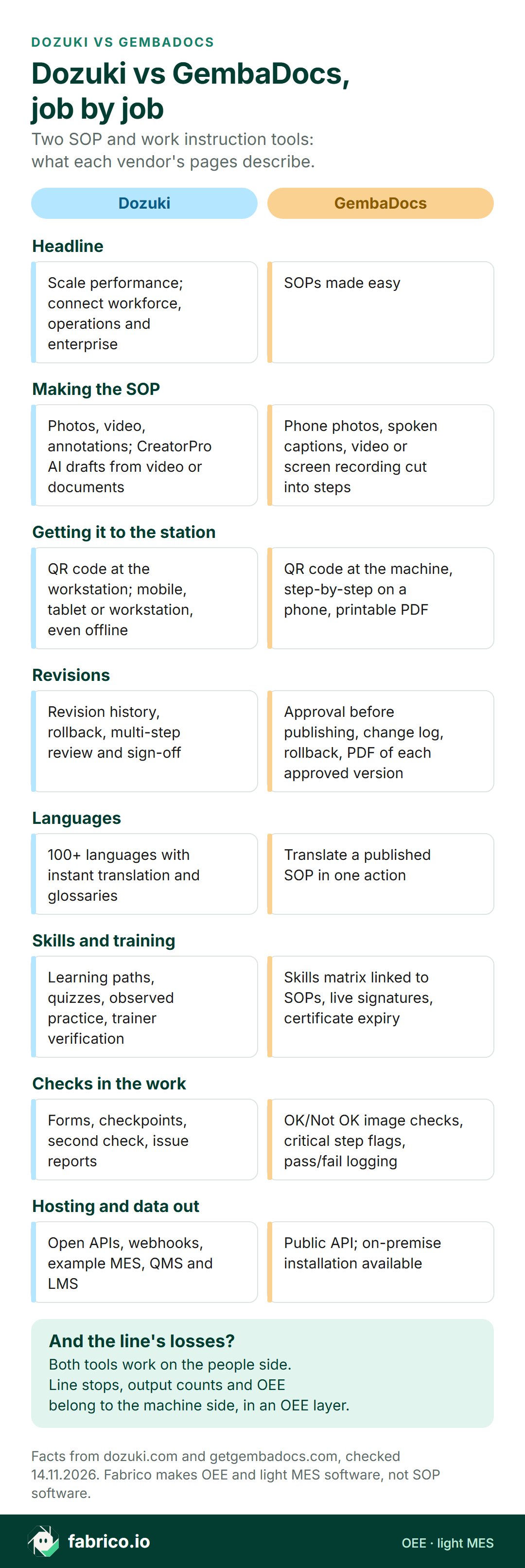
Text version of this infographic
- Headline. Dozuki: Scale performance; connect workforce, operations and enterprise. GembaDocs: SOPs made easy.
- Making the SOP. Dozuki: Photos, video, annotations; CreatorPro AI drafts from video or documents. GembaDocs: Phone photos, spoken captions, video or screen recording cut into steps.
- Getting it to the station. Dozuki: QR code at the workstation; mobile, tablet or workstation, even offline. GembaDocs: QR code at the machine, step-by-step on a phone, printable PDF.
- Revisions. Dozuki: Revision history, rollback, multi-step review and sign-off. GembaDocs: Approval before publishing, change log, rollback, PDF of each approved version.
- Languages. Dozuki: 100+ languages with instant translation and glossaries. GembaDocs: Translate a published SOP in one action.
- Skills and training. Dozuki: Learning paths, quizzes, observed practice, trainer verification. GembaDocs: Skills matrix linked to SOPs, live signatures, certificate expiry.
- Checks in the work. Dozuki: Forms, checkpoints, second check, issue reports. GembaDocs: OK/Not OK image checks, critical step flags, pass/fail logging.
- Hosting and data out. Dozuki: Open APIs, webhooks, example MES, QMS and LMS. GembaDocs: Public API; on-premise installation available.
- And the line's losses? Both tools work on the people side. Line stops, output counts and OEE belong to the machine side, in an OEE layer.
Test 1: one changeover clip, timed to an approved SOP
Film one real setup on a phone: the operator clearing the last job, swapping the cutting die, setting the anvil and feeding the first sheets. Send the same clip and the old setup sheet to both vendors, and start a stopwatch when the supervisor opens each tool. Stop it when an approved SOP opens from a QR code on the machine.
GembaDocs is built for this run. Its SOP page says you can "Capture the task on your phone, record your screen, or type it out", that the tool "automatically turns the recording into a clean, step-by-step procedure", and that "Most SOPs are done in under 30 minutes". The work instructions page adds a one-tap clean-up after voice capture and a QR code you "Fix it to the machine, the bench, or the wall beside the task."
Dozuki reaches a draft another way. Its knowledge management page describes CreatorPro AI, which will "Turn expert demonstrations and existing documents into a draft your team can review, refine, and share", and asks authors to "Use photos and video to show the right way, not just tell". Review can pass through several configured approval steps before anything reaches the floor.
What to record: minutes to a publishable draft, how many steps the supervisor rewrote, and whether the anvil gap, the one value that caused trouble last month, appears as a picture at the right step. A fast draft that misses the critical setting is not a pass.
Test 2: revision C goes live mid-shift
Engineering changes the feed pressure on the die-cutter at 01:00. Revision B is open on the operator's phone. What happens next is the real test of change control.
- GembaDocs says "Changes don't publish immediately": the current version stays live until the new one is signed off, every change is logged "with the date, the user, and what was changed", and "Every approved version is stored as a PDF record." The home page adds that you can "Track who has read it".
- Dozuki lists "full revision history and rollback options", and its worker collaboration page describes a gate where the crew must confirm an important update before the revised instruction will open. The AI page names ChangeAware AI for turning "every procedure update into clear communication."
Score three things on screen: what the operator with revision B open sees after release, how long until the night crew has acknowledged revision C, and whether you can print a list of who has not. If an auditor asked tomorrow which revision ran at 02:00, could either tool answer from its own records?
Test 3: a certificate expires and the SOP changes in the same week
Training is where the two diverge most. Dozuki's training and skills page builds a path: quizzes "tied directly to the content being learned", assessments "that measure both understanding and execution", refreshers set "to recur at custom intervals", and "Trainer verification completes the path to qualification." The same page says people are re-enrolled automatically when a standard is revised or lapses.
GembaDocs keeps the matrix next to the document. Its skills matrix page calls it "a live digital skills matrix linked directly to your SOPs", which "shows which operators need to re-verify against the updated version" when a procedure changes. Trainer and operator sign "with a live signature", and "Expired certifications turn red in the matrix." The training page promises "Sign-off on the floor, on a phone."
Load one operator whose forklift ticket expires during the pilot and who is signed off on revision B. Release revision C. A pass means both events show up for the supervisor without anyone building a report.
The duty behind this is old. In Great Britain, regulation 9 of PUWER 1998 says every employer shall ensure "that all persons who use work equipment have received adequate training", including "the methods which may be adopted when using the work equipment" (accessed 15.11.2026). A die-cutter setup is exactly such a method. The pressure on the record is new: in Eurostat's job vacancy statistics, "Manufacturing labourers" ranked second among all EU occupations for unfilled posts in 2024, with a vacancy rate of 7.3% (accessed 15.11.2026). Fewer experienced hands means more first nights on rarely run jobs.
A slow changeover SOP on a die-cutter night shift, priced
The plant and its numbers are fictional, built for this page as sample data; no product screen is shown. A corrugated box plant runs a rotary die-cutter that cuts and creases printed sheets into blanks. The night shift is 8 hours with a 30 minute break, so 450 minutes are planned. The ideal rate is 110 sheets a minute, so 49,500 sheets are possible.
Two jobs run. Job L is a weekly repeat and its changeover takes the usual 31 minutes. Job K is a die last used five months ago. The setup sheet lists settings with no pictures, the operator is in his third month, and the changeover takes 58 minutes, including a call to the day setter. The anvil cover is set slightly high, so creases crack, and the stacker check pulls 1,420 sheets before the cause is found. Another 520 sheets go to waste across the shift for ordinary reasons.
| Sample night shift | Minutes or sheets |
|---|---|
| Changeover to job K, setup sheet without pictures | 58 min |
| Changeover to job L, routine | 31 min |
| Feeder misfeeds | 14 min |
| Waiting for board from the corrugator | 9 min |
| Stopped in total | 112 min |
| Sheets cut | 33,800 |
| Waste: cracked creases after job K setup | 1,420 |
| Waste: other causes | 520 |
Availability, performance, quality. The die-cutter ran 450 minus 112, or 338 minutes, so availability is 338 / 450 = 75.1%. At 110 sheets a minute those 338 minutes allow 37,180 sheets; it cut 33,800, so performance is 33,800 / 37,180 = 90.9%. Waste of 1,940 leaves 31,860 good sheets, so quality is 31,860 / 33,800 = 94.3%. Multiplied, 75.1% x 90.9% x 94.3% = 64.4%, the same as 31,860 good of 49,500 possible. For the formula behind each factor, see how to calculate OEE.
What a usable SOP would have saved. With job K set in the routine 31 minutes, the machine gains 27 minutes. At the shift's performance that is 27 x 110 x 90.9% = 2,700 more sheets. Without the crease problem the waste rate is 520 of 33,800, so about 2,658 of those are good. Add back the 1,420 cracked sheets and the shift gains 4,078 good sheets: 35,938 in all, an OEE of about 72.6%.
Putting a margin on a sheet. Take a sample selling price of EUR 0.62 for one printed blank and price lost output at 15% of that, EUR 0.093 a sheet. The 15% is not picked to flatter the answer: it sits inside the band that NYU Stern's industry margin dataset reports for 19 US Packaging & Container firms in January 2026, between a pre-tax operating margin of 9.58% and a gross margin of 24.27% (accessed 15.11.2026). The 4,078 sheets are worth 4,078 x 0.093 = EUR 379.25 on this shift. Rarely run dies land on nights about twice a week here; over 46 working weeks that is 92 shifts and about EUR 34,891 a year, roughly EUR 2,908 a month. Each running minute on this machine is worth about EUR 8.77 (110 x 90.9% x 94.3% x 0.093). Swap in your own price, margin and frequency; the changeover time guide covers shortening the setup itself.
Who holds which half. The stop log says job K took 58 minutes and waste spiked afterwards. Only the SOP and skills records say why: no picture of the anvil setting, and an operator never signed off on that die. That is why the slow-changeover list from the machine should decide which SOP gets rewritten first.
Feeding slow changeovers back into the SOP queue
Fabrico sits on the machine side of that loop: OEE software that runs in the cloud, with a light MES, described on the MES and OEE solution overview; writing SOPs and keeping training records are outside it. Fabrico reads run, stop and count from the machine's PLC; see the OPC UA and OEE guide. For the die-cutter, the useful hand-off is a stop reason such as "changeover over standard" tagged with the job and the SOP revision in use, so each month's longest setups arrive at the SOP owner as a ranked list with euros beside them.
Where a step is manual, such as hand bundling, or the machine gives no signal worth using, the camera add-on does the counting; having that camera suggest why the line stopped is on the Roadmap. Where a camera covers the line, the video for the minute of a stop can be opened from the shift timeline; it is streamed on request and not stored. Details are on the camera add-on for OEE page, and converters can read computer vision for packaging converters. No ready connector to Dozuki or GembaDocs is claimed, so the SOP-revision tag is a pilot item. To see a night shift's changeover minutes ranked in euros, book a demo.
Five checks before the first vendor call
- Rank last month's changeovers by minutes over standard, with the waste that followed each one.
- Walk to the top three machines and photograph the instruction there: revision, date, pictures or none.
- Pull the sign-off record for whoever ran those setups. Who was qualified on that die, and since when?
- Count users honestly: authors, approvers and floor readers. GembaDocs' plans are capped by users, so the count sets the plan.
- Book the three tests above with both vendors on the same machine and the same clip, and write the pass marks down first.
Questions to put to Dozuki and GembaDocs
- From our phone clip of a die change, how many minutes to an approved SOP at the machine, with the anvil setting shown at its step?
- When revision C is released at 01:00, what does the operator with revision B open see, and how do we list who has not acknowledged it?
- When a ticket expires and an SOP changes in the same week, what does the supervisor see without building a report?
- Which users count toward the price, and what does year two cost at our headcount?
- If we host on our own servers, who handles updates and backups, and does any feature change?
- Which API call or webhook sends the SOP revision and sign-off to our other systems?
Related reading: skills matrix guide, standard work vs SOP and electronic work instruction software.
Dozuki and GembaDocs: common questions
Does GembaDocs publish its prices?
Yes. On 15.11.2026 its pricing page listed five plans in euros, from Lite at EUR 49 a month for 2 users to Multi-site at EUR 499 a month for 100 users, with annual billing and a free 30-day trial. On-premise is priced on request. Dozuki's pricing page showed no figure and a button to request pricing.
Can a night operator build an SOP in either tool?
Both vendors describe capture from the floor. GembaDocs talks about phone photos with spoken captions and recordings cut into steps. Dozuki's CreatorPro AI turns demonstrations and existing documents into a draft for review. Ask an operator to build one setup SOP in each during the pilot and time it.
Which tool goes deeper on training?
Dozuki's pages describe a learning path with quizzes, assessments, recurring refreshers, trainer verification and automatic re-enrolment when standards change. GembaDocs links its skills matrix to SOPs, flags who must re-verify after a change and tracks certificate expiry. Pick by whether you need a training programme or a live sign-off record.
Can GembaDocs run on our own servers?
Its on-premise page says the feature set is identical to the cloud version, data stays in your infrastructure, and your IT team handles installation, updates and backups. The pricing page lists on-premise as priced on request.
Where does Fabrico fit beside Dozuki or GembaDocs?
On the machine side. Fabrico takes run, stop and count from the machine, the operator adds the stop reason, and the longest changeovers can be ranked in euros. A REST API, webhooks and spreadsheet exports carry the results to other systems. No ready connector to either SOP tool is claimed, so test that hand-off on one die-cutter first.
Want a night shift's slow setups ranked in euros? Book a demo.
Related articles







Real Fabrico tiles, sample data.