


 Login
 Blog
How to Keep a Food Recall Narrow: Lot Codes, Time Windows and Line Data

In short: A food recall is as wide as the smallest group of product you can prove was affected. Food law presumes a whole lot is unsafe unless you show otherwise, so four things set the scope: the lot code, the time window, the first and last good unit, and whatever the product shared with other runs (packaging, ingredients, rework, a line).
- A lot code that carries line and time, backed by a documented check history, lets quality argue for hours of output instead of shifts or days.
- Scope widens through shared components, rework, codes nobody can decode and gaps between checks.
- Example plant: one event is 192,000 cans on a line-and-shift lot and 48,000 cans on a proven two-hour window. The difference is C$122,400 to C$247,680 of beer per event.
Guide, updated 14 November 2026. Sources are listed at the end.
Recall scope is decided in the first hours after a problem is found, with whatever records the plant has at that moment. This guide covers how that decision is made, what makes it bigger, and how line data makes it smaller. It leans on one idea: the lot is a data structure before it is a label, which is why a sound lot traceability data model is the thing to get right first. A beer recall in Canada in November 2026 is the worked case.
How the scope of a food recall is set
The starting rule is blunt. Article 14(6) of the EU's General Food Law, reproduced in the European Commission's guidance on Regulation 178/2002, says that when unsafe food is part of a batch, lot or consignment, the rest of that batch is "presumed" unsafe too, unless a detailed assessment finds no evidence that it is. The burden sits with the business. You do not prove which units are bad. You prove which units are not.
North American rules reach the same place from the other side. The US recall guidance in 21 CFR 7.59 asks firms to code products well enough to allow "positive lot identification" and to keep distribution records that locate what is being recalled. Canada's recall procedure guide for food businesses asks, at step 3, whether other sizes, brands, codes or foods are affected, and says to add them to the recall if so.
So the scope is whatever falls inside four boundaries. Each one is a record, and each one can be tight or loose.
- The lot code. The printed identifier that groups units. A code that means "this site, this day" groups far more product than one that means "line 2, 13:00 to 14:00".
- The time window. From the last moment you can prove the process was good to the moment it was stopped or fixed.
- The first and last good unit. The window turned into physical product: the counter reading, pallet number or case code at each edge.
- What the product shared. A packaging lot, an ingredient lot, rework, a filler, a crew. Anything shared carries the problem sideways into other lots.
The UK's Food Standards Agency and Food Standards Scotland put the first boundary plainly in their 2019 guidance on traceability, withdrawals and recalls: defining batches is essential for good traceability and may help limit the amount of food to be withdrawn or recalled. The same document lists the process records that make a batch provable, including the time of start and end of production, the food contact packaging and the batch codes of every ingredient used.
The lot is your choice
No regulator cited here tells a brewery or a bakery how big a lot must be. The Commission's guidance says the regulation does not compel a link between incoming and outgoing products, nor records of how batches are split and combined. Then it adds the commercial point: internal traceability would contribute to more targeted and accurate withdrawals, and operators are likely to save cost and avoid wider disruption.
That is the trade. A big lot is cheap to run and expensive to recall. A small lot costs a little printing, scanning and discipline every day, and pays back on the one day it is needed.
What widens a recall
A recall is often wide not because the fault was big, but because a record was missing and the presumption could not be rebutted. These are the ways it happens on a filling or packing line.
| What goes wrong | How it widens the scope | The record that stops it |
|---|---|---|
| The code shows only a date or a site | Product from other lines and shifts carries the same code, so it is all in scope | Line and time in the code, or a case code that maps to them |
| No documented last good check | The window runs back to the last check anyone can prove, which may be a shift start or a changeover days earlier | Timed checks of wear parts and detectors, logged on the line record |
| A shared packaging or ingredient lot | The problem follows the input to other lines, products and sites | Input lot scanned or logged against each run, with start and end time |
| Rework or carry-over | Suspect product is blended into later lots, so each one inherits the doubt | Rework logged as an input with its source lot, quantity and time |
| One liquid, many pack formats | One event becomes many products on the notice, each with its own UPC | A map from run to every pack format it fed |
| Codes nobody outside the site can read | The review slows down, and a slow review tends to widen the scope to be safe | One decoder page for every code format, held by quality |
| Late detection | More output passes before the stop, and more of it has shipped | Detector rejects and checks watched as a line signal, with a stop rule |
The Canadian Food Inspection Agency's (CFIA) recall statistics show how often scope multiplies after the first notice. An incident is one issue or source; a recall is each action that follows. In fiscal 2025-26 Canada had 185 incidents and 504 recalls, 2.7 recalls per incident, a jump the agency links mainly to pistachios, an ingredient with a long shelf life that reached many finished products. In the four years before, the ratio ran between 1.5 and 1.8. Extraneous material alone caused 37 incidents in 2025-26, up from 24 a year earlier.
The CFIA guide gives two tips that address the sideways spread. Record the lot codes of each ingredient, because ingredients can trigger recalls. Link packaging materials to their suppliers and to your own lot codes, because unsafe packaging can cause one too.
Case: the Molson Canada beer recall, November 2026
On 10 November 2026 the Government of Canada published recall notice RA-82913. Molson Canada 2005 recalled alcoholic and non-alcoholic beer because of pieces of metal, in the extraneous material category. The recall is Class 3, distributed nationally, at retail level, with a recall date of 2 November 2026.
The notice does not say how the metal was found, what it came from, or how many cans are involved. We make no claim about any of them, and nothing below is a judgement on how the company handled it. What the notice does give is the shape of a real scope, line by line.
| What the notice shows | Count |
|---|---|
| Products (UPCs) recalled | 29 |
| Brands | 7: Blue Moon, Brasseur de Montreal, Coors Light, Molson Canadian, Black Horse, Hop Valley, India Beer |
| Different codes listed | 21 |
| Code formats | 2: four characters (such as K026) and five (such as K0126) |
| Products carrying code K026 | 8, across Blue Moon and Coors Light |
| Codes on one product, Coors Light 12 x 355 mL | 4: J246, J256, K026, K146 |
| Container sizes and packs | 355 mL and 473 mL, from a single can to a 24-pack |
| Recall date to publication | 2 to 10 November 2026 |
Source: our count of the product table in notice RA-82913. The notice does not explain what the codes mean, and we do not try to decode them.
Two news reports add what the notice leaves out. Global News reported on 11 November that Molson Coors described a quality issue at four breweries, Creemore, Longueuil, Moncton and St. John's, said the affected products were limited to specific case codes that vary by region, and said it had no notification of consumer harm. A second Global News report on 13 November covered a separate recall by a Quebec brewer, Archibald, of a canned white IPA, also for pieces of metal. The report does not link the two recalls, and neither do we.
What this case teaches about scope
- One code, eight products. K026 sits on three Blue Moon Belgian White packs, three Mango Wheat packs and two Coors Light packs. Whatever K026 encodes, one coded event reached three liquids and five pack formats. Build the same map for your plant before you need it: for any code value, which UPCs can carry it.
- Twenty-one codes is not one bad hour. The codes start with three different letters, H, J and K, and one product alone lists four of them. A scope with that many codes means the window had no tight start. The record that tightens it is the last documented good check, so make that check a timed entry.
- Two code formats in one recall. K026 and K0126 sit side by side in the notice's table. Anyone reviewing across sites had to read both. A single decoder page, covering every format on every line, takes a day to write and removes that delay.
- Four breweries. A fault that shows up in Creemore, Longueuil, Moncton and St. John's is unlikely to be one worn part on one filler. The company has not said what the sites share. For your own plant the question is the same: which inputs, such as cans, ends, cartons and ingredients, are common to several lines, and can you say which input lot ran where and when?
- Codes that vary by region. The forward trace mattered as much as the backward one. Global News reports that Hop Valley was sold in Ontario and the West, and the Brasseur de Montreal beers in Quebec. A distribution record by code and by customer keeps a regional problem regional.
The next case will be added under this one, with its date in the heading.
Worked example: what a narrow scope is worth
Example plant. Every figure in this section is example data except the two unit values, which are sourced. The plant is not Molson, and the sums are not an estimate of that recall.
A cannery runs two can lines on two 8-hour shifts. Each line is rated at 36,000 cans an hour and averages 24,000 good 355 mL cans per planned hour, an OEE of 66.7%. On line 1, the 13:40 hourly check finds a damaged guide rail with a piece missing. The check at 12:40 was logged as good.
How much product is in scope depends on what the plant can prove.
| What the records support | Scope | Cans |
|---|---|---|
| A date-only code, the same on both lines | 2 lines x 16 hours | 768,000 |
| A code with line and shift (the baseline in this example) | 1 line x 8 hours | 192,000 |
| A code with line and hour, timed checks, counter readings at both edges | 1 line x 2 hours | 48,000 |
The two-hour window is not the one hour between checks. Quality takes the last good check at 12:40, steps back one more check interval to 11:40 as a margin, and ends the window at the 13:40 stop. Two hours at 24,000 cans is 48,000 cans. Whether a regulator accepts that margin is a quality and regulatory decision; the records only make the argument possible.
The value per can, from two sources
We use a range, because a recalled can has more than one value.
- Low: what a brewer books. Molson Coors' third quarter 2026 results, filed on 5 November 2026, report Americas net sales of US$2,232.8 million on 13.333 million hectolitres. That is US$167.46 a hectolitre (our arithmetic). At the Bank of Canada's rate of 1.4257 on 13 November 2026 it is C$238.75 a hectolitre, or about C$0.85 for a 355 mL can. This is revenue across a whole segment, not margin, and not specific to Canada or to any product.
- High: what the beer sells for. Statistics Canada reports beer sales of $9.1 billion on 1,876 million litres in the year to March 2025, through liquor authorities and their agents, before sales taxes. That is about C$4.85 a litre, or C$1.72 for a 355 mL can.
| Scope | Cans | At C$0.85 | At C$1.72 |
|---|---|---|---|
| Date-only code, both lines | 768,000 | C$652,800 | C$1,320,960 |
| Line and shift | 192,000 | C$163,200 | C$330,240 |
| Proven two-hour window | 48,000 | C$40,800 | C$82,560 |
Against the realistic baseline, a line-and-shift lot, the hour-level record keeps 192,000 minus 48,000 = 144,000 cans out of scope. That is 144,000 x C$0.85 = C$122,400 at the low value and 144,000 x C$1.72 = C$247,680 at the high one, for one event on one line. Against a date-only code the gap is 720,000 cans, or C$612,000 to C$1,238,400.
The range leaves out freight, retailer charges, destruction, the stop itself and lost sales, so it is a floor. It also assumes the product had shipped. If the cans are still in the warehouse, the same record turns a recall into a hold, and the sum becomes the cost of a rework or a scrap decision.
The loss shows up in OEE as well. The shift made 8 x 24,000 = 192,000 cans. Hold 48,000 and quality for that shift is 144,000 / 192,000 = 75%. Hold the whole shift lot and it is zero.
Book a demo and see OEE and losses per line and shift.
How line data narrows the window
Lot codes say which group a unit belongs to. They do not say what happened while the group was made. That second record lives on the line, and it is the same record OEE needs: what ran, when it ran, when it stopped and how many units passed.
Four pieces of line data do the narrowing.
- Run start and end per order. With time-stamped orders, a line that ran three products in a day splits into three windows, and only the ones that overlap the event stay in scope.
- Stops with a time and a reason. A jam cleared by hand, a guide adjusted, a part changed: each is a candidate start or end for the window. Logged as it happens, it is evidence. Written up at shift end, it is a recollection. Our list of beverage filling line downtime codes shows how to name these events so they can be found later.
- Counts at a point in time. A counter that can be read back at 11:40 and 13:40 turns a time window into a number of cans, and that number into pallets.
- Changeovers as events. The last unit of the old run and the first of the new one are natural lot boundaries. If the changeover is a timed stop, the boundary is already recorded.
None of this replaces the lot record, the detection equipment or the food safety plan. Line data answers "what was happening on this line at this minute". The lot record answers "which inputs went into which outputs". A recall review needs both, and the join between them is time. The difference between the two views is covered in traceability vs genealogy.
Lot code design: carry line and time
A code is a compressed record. What you leave out of it you have to reconstruct later, under pressure.
| Code carries | Smallest scope it can prove alone | Trade-off |
|---|---|---|
| Best-before date only | All product with that date, all lines and sites | Nothing to manage; the widest scope |
| Site and production day | One site-day | Simple; still several lines and shifts |
| Line, day and shift | One line-shift | The usual baseline; a full shift per event |
| Line, day and hour or minute | One line-hour, with check records | Printer must take a clock; the code gets longer |
| Case or pallet serial that maps to line and time | The pallets in the window | Needs the map kept and searchable |
Three rules keep any of these usable.
- One decoder, on one page. Every format in use, with an example and the meaning of each character. Quality at every site holds the same page.
- The printer clock is checked. A time in the code is only evidence if the clock is right. Check it at shift start with the line clock.
- The outer case agrees with the unit. If the can says one thing and the case another, the retailer reads the case. Verify both at each changeover.
US rules are moving the same way for higher-risk foods. The FDA's food traceability rule defines a traceability lot code, to be assigned when a food is first packed or transformed and not replaced when it is merely shipped, and requires records to reach the agency within 24 hours of a request. The FDA's page says enforcement will not begin before 20 July 2028. The rule covers foods on the Food Traceability List, not beer, but it shows the direction: one lot code that survives the supply chain, and a fast answer.
Canada already has the fast answer in law. Under the traceability requirements of the Safe Food for Canadians Regulations, a business must identify food by common name and lot code, trace it one step back and one step forward, keep the records for two years and hand them to the CFIA within 24 hours of a request, as a single plain-text file if they are electronic.
Rework, carry-over and shared components
These three are where a narrow window leaks.
Rework. When product from one run is fed back into a later one, the later lot inherits every open question about the earlier lot. Treat rework as an ingredient: give it its source lot, a quantity and a time of addition. Set a rule for how many generations rework may travel, and never rework product from a lot under review.
Carry-over. Liquid in a buffer tank, product on an accumulation table and cans on a conveyor at changeover belong to the old run until the line is cleared. Record the clear-down as part of the changeover, so the first unit of the new lot is a fact.
Shared components. Cans, ends, closures, cartons and film arrive in their own lots and often feed several lines. Log the component lot against the run when a new pallet or reel is opened, with the time. In the Molson case the quality issue was reported at four breweries; whatever the cause there, a plant that cannot say which component lot ran where has no way to rule the shared path in or out.
What quality, production and maintenance managers do next
This week
- Quality: pick one code from finished stock and ask two people at different sites or shifts to decode it without help. If they differ, write the decoder page.
- Production: take last Tuesday's 13:00 to 14:00 on one line. Name the product, the order, the first and last pallet and the component lots in use. Time how long it takes.
- Maintenance: list the wear parts in the product path of one filler or seamer and when each was last checked. Any check without a time is a gap in the window.
This quarter
- Put line and time in the code or on the case, on the highest-volume line first.
- Make wear-part and detector checks timed entries on the line record, at a fixed interval. The interval is your scope: hourly checks mean a two-hour window with margin, shift checks mean two shifts.
- Log component lots at the line when a pallet or reel is opened.
- Record first and last good unit at every changeover, with the counter reading.
- Run a trace drill each quarter. Pick a random hour and a random component lot, trace both ways, and score the time and the percentage of product accounted for. The UK guidance cited above advises reviewing the recall plan at least once a year, and suggests a mock exercise as the way to do it.
- Count held product as quality loss in OEE, so the cost of a wide hold is visible on the same chart as speed and downtime.
The line record is often the missing part. OEE software records run time, stops and counts per line automatically, and a light MES ties those hours to orders and products, so the question of what ran at 13:00 last Tuesday has an answer in minutes.
How Fabrico fits
Fabrico is a cloud OEE and light MES platform, not a food safety system: lot records and foreign-material controls stay with your quality systems. What it adds to a recall review is the time record of the line: orders, run hours, stop times and counts, with OEE and losses by machine, line and shift, from the PLC or a Fabrico IoT device, and the reasons operators add on a tablet or phone.
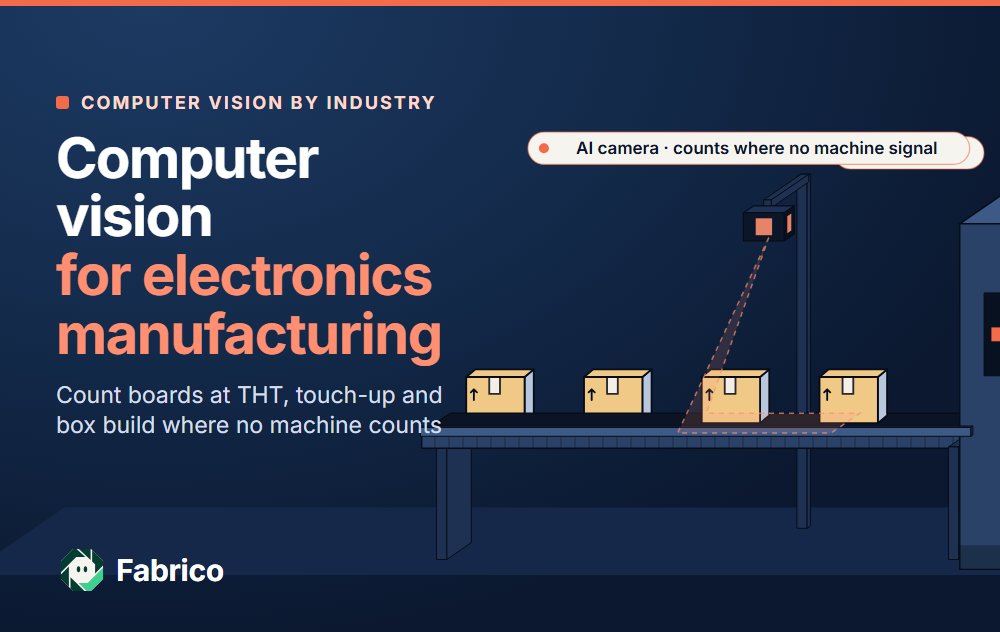
On manual stations, AI cameras (an add-on) count output.
Book a demo and see downtime per line and shift.
What people ask next
How is the scope of a food recall decided?
The business proposes it and the regulator reviews it. Food law presumes that the whole batch or lot is unsafe unless an assessment shows otherwise, so the scope is the smallest group of product the records can separate from the fault: by lot code, by time window, by first and last good unit, and by what the product shared with other runs.
What is the difference between a recall by lot code and by production date?
A production date groups everything made that day, often on several lines and shifts. A lot code can carry the line and the time as well, so it groups less product. In the example plant, a date-only code puts 768,000 cans in scope, a line-and-shift code 192,000, and an hour-level window with timed checks 48,000.
How small should a production lot be?
Small enough that losing one lot is affordable, and no smaller than your records can prove. No regulator cited here sets a size. A practical rule is to match the lot to the interval between documented checks on the line: hourly checks support hour-level lots, shift checks support shift lots.
Does rework widen a recall?
Yes, if it is not recorded. Rework carries the open questions of its source lot into each later lot it enters. Log rework as an ingredient with its source lot, quantity and time, limit how far it may travel, and never rework product from a lot that is under review.
How fast must a plant produce traceability records?
In Canada, within 24 hours of a request from the CFIA, or sooner if there is a health risk, under the Safe Food for Canadians Regulations. The US food traceability rule also sets 24 hours for foods on its list. EU guidance sets no number but says records must be available on demand without undue delay.
Can OEE or line data replace lot traceability?
No. Line data records what ran on a line, when it stopped and how many units passed. Lot traceability records which inputs went into which outputs and where they were shipped. A recall review uses both, joined by time: the line record sets the window, and the lot record says what is inside it.
Sources
All sources accessed on 14 November 2026. Dates are the publication dates shown on each page.
- Statistics Canada, The Daily: Control and sale of alcoholic beverages and cannabis, April 1, 2024 to March 31, 2025, 5 March 2026
- Government of Canada, Recalls and safety alerts: Various brands of alcoholic and non-alcoholic beer recalled due to pieces of metal (RA-82913), 10 November 2026
- Global News, Molson Canadian, Coors Light among 29 beers recalled across Canada, 11 November 2026
- Global News, Beer recall hits 2 more Canadian products, bringing total to 31, 13 November 2026
- European Commission, Guidance on the implementation of Articles 11, 12, 14, 17, 18, 19 and 20 of Regulation (EC) No 178/2002 on General Food Law, 26 January 2010
- Food Standards Agency and Food Standards Scotland, Guidance on Food Traceability, Withdrawals and Recalls within the UK Food Industry, March 2019
- Cornell Law School LII, 21 CFR 7.59, Recalls: general industry guidance (US Food and Drug Administration), undated
- US Food and Drug Administration, FSMA Final Rule on Requirements for Additional Traceability Records for Certain Foods, 4 November 2026
- Canadian Food Inspection Agency, Recall procedure: A guide for food businesses, 27 February 2023
- Canadian Food Inspection Agency, Regulatory requirements: Traceability for food, 26 August 2025
- Canadian Food Inspection Agency, Statistics: food recall incidents and food recalls, 13 August 2026
- Molson Coors Beverage Company, 2026 third quarter results (Form 8-K, Exhibit 99.1, US SEC), 5 November 2026
- Bank of Canada, Daily exchange rates, 13 November 2026
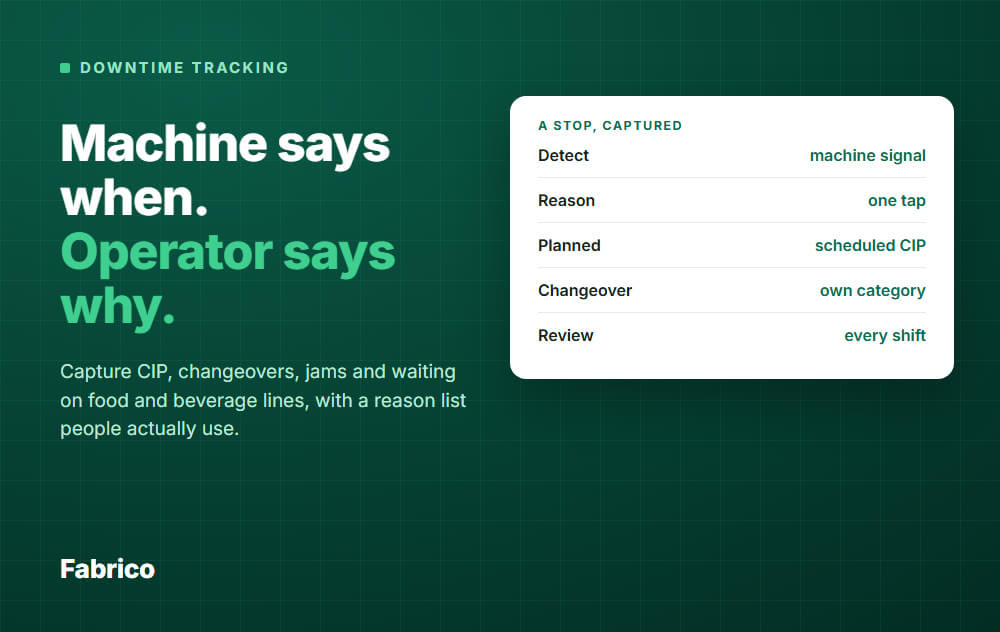




Real Fabrico tiles, sample data.