


 Login
 Blog

Computer Vision for Electric Scooter Manufacturing: Find What the Variant Mix Costs

In short: one e-scooter model ships in several legal variants, and each variant lands on a different station. Count by station, not by line.
- Germany caps design speed at 20 km/h and wants the VIN marked into the frame; other markets set their own rules.
- The frame marker, the flash station, the label bench and packing absorb the variants. Stem, wheel and deck work stays the same.
- Use one ideal time per model, a changeover code for each variant switch, and one output count at the deck exit.
- Fabrico's camera add-on counts stems, wheels, scooters and cartons. Inspection and tests stay with other systems.
Computer vision in electric scooter manufacturing counts stems, wheels, scooters and cartons at hand stations, so a mixed-variant line gets a true OEE.
It counts and does not inspect: weld, fold, brake and water checks stay with inspection systems and test rigs.
This guide covers stand-up e-scooters and adult kick scooters. E-bikes, seated e-mopeds and motor scooters are covered in computer vision for bicycle and motorcycle manufacturing; cameras on rental scooters are out of scope.
Variant-by-station matrix: what changes on one e-scooter model
Stand-up e-scooters sit outside EU vehicle type approval, so each market writes its own rules. A standardisation guide from LEVA-EU, the light electric vehicle trade association, and Small Business Standards notes that e-scooters are among the vehicles excluded from Regulation (EU) No 168/2013, and that many member states have introduced national technical requirements for e-scooters despite EN 17128. The matrix puts each difference on the station that absorbs it.
| What changes | German build | Build for other markets | Station and its count |
|---|---|---|---|
| Top speed in firmware | Design speed capped at 20 km/h | Up to 25 km/h within EN 17128, lower where local rules say so | Flash station; flash PC log |
| VIN in the frame | Struck, punched, etched or laser engraved, right side | Whatever that market requires | Frame marker; marker log |
| Maker's plate | VIN, design speed and approval number, right side | That market's label set | Label bench; camera add-on count |
| Lights, reflectors, bell | Kit to the eKFV lighting and sound signal rules | Kit to national rules | Label bench; same count |
| Charger plug, manual, carton label | German set | Destination set | Packing; camera add-on count at the carton |
| Stem, fold, wheels, deck, battery | Same | Same | Stem, wheel and deck benches; camera add-on counts |
The speed column comes from two texts. Germany's eKFV defines an e-scooter as a motor vehicle with a design speed above 6 km/h and no more than 20 km/h, a handlebar of at least 700 mm when there is no seat, and no more than 55 kg without the rider. EN 17128:2020, the European standard for personal light electric vehicles, specifies safety requirements, test methods, marking and information for vehicles with battery voltages up to 100 VDC; its scope leaves out vehicles designed for more than 25 km/h and vehicles intended for hire from unattended stations, and it notes that local regulation could limit a vehicle to less than 25 km/h.
Five of the six rows change with the market; the three benches that fill the shift do not. The variant problem is a counting problem at four stations and a changeover problem everywhere else.
Explainer presented by Iris, Fabrico's AI-generated presenter: how an add-on camera counts output where a machine has no signal. Book a demo.
Plays from YouTube. Google may set cookies when you press play. Privacy policy.
Why one ideal time per line lies on a mixed scooter line
A scooter line builds more than one model: a 10-inch commuter, a dual-motor version with a second hub motor and a larger pack. One ideal time for the line turns that mix into noise. Invented figures, one crew, two days of 400 running minutes each:
| Day | Scooters built | Performance at one line time (2.2 min) | Performance at the model's own time |
|---|---|---|---|
| Commuter only | 184 | 184 x 2.2 = 404.8 min, 101.2% | 184 x 2.0 = 368 min, 92.0% |
| Dual-motor only | 140 | 140 x 2.2 = 308 min, 77.0% | 140 x 2.6 = 364 min, 91.0% |
With one line time the crew looks better than perfect on the commuter day and poor on the dual-motor day. With an ideal time per model it ran at 92.0% and 91.0%: same crew, same pace. The 101.2% also buries 32 minutes of slow running. Paper rate versus the rate a station can hold is covered in theoretical vs actual cycle time.
Market variants are a different case. A German build and a 25 km/h build of the same commuter get the same work at the stem, wheel and deck benches, so they share the model's ideal time; their extra work sits at four stations and in the switch between them. Two rules follow:
- One ideal cycle time per model, set at the deck station, never per market and never per line.
- One unit of output per scooter, whatever its variant, counted once at the deck exit.
Planning the week around those times is covered in mixed-product capacity planning.
Germany's build: the 20 km/h cap, the VIN in the frame and the plate
The eKFV allows an e-scooter on public roads only with a type approval or individual approval, an insurance plate, and a vehicle identification number with a manufacturer's plate, plus lighting and sound signal rules. Three lines of its annex change what a plant counts.
- The VIN goes into the frame on the line. Anlage 1 requires the VIN on the maker's plate and on the chassis or frame when the vehicle leaves the production line, struck, punched, etched or laser engraved into an easily reached part on the right side. Marking cannot wait for the warehouse, so a German batch needs a marking step on the line, with its own log.
- The plate is variant-specific. It sits on the right side and carries the VIN, the design speed and the approval number, so the label bench changes rolls when the market changes.
- The marker log. The same annex makes the manufacturer trace each vehicle through its VIN for 30 years; a timestamp per marked frame turns that record into a count; lot vs serial tracking explains the difference to a batch record.
The German insurers' consumer portal (GDV) counts about 1.67 million e-scooters on German roads in 2025, 1.37 million of them privately owned. Each of them carries a VIN in its frame, so a German batch of any size needs the marker.
North America adds a test rather than a station: the electrical system can be certified to ANSI/CAN/UL 2272, and Intertek's UL 2272 page lists vibration tests that simulate regular use and transport, and water exposure tests that check moisture does not reach the electrical components.
Stations no variant touches: stem, wheel and deck
Stem and fold. A nutrunner may log torque per joint, but a logged joint is not a finished stem; a camera add-on over the outfeed counts completed stems. In a June 2024 report by TRL and WMG at the University of Warwick for the UK Department for Transport, manufacturers, retailers and operators named the handlebars and stem, the folding mechanism and its locking pins as the main points of structural failure, and the report recommends tightening the structural integrity requirements in BS EN 17128:2020. Proving that a fold holds is the work of the torque record, the fold check and the lab.
Wheel and deck. Hub motors, covered in computer vision for electrical equipment manufacturing, and packs from a battery line arrive built. A camera add-on counts front and rear wheels apart, since a shortage of either stops the deck. At the deck the pack goes in, the harness is routed, bench work described in OEE for wire harness assembly, and the cover closes. The same TRL interviews flagged electrical problems from water ingress into control boards, so gasket, screw torque and the IP test belong to quality. The camera add-on above the deck exit counts scooters leaving for test: the line's output for OEE.
The flow of this plant: two feeders, one deck, one test queue
Two benches feed the deck in parallel, packs arrive from goods-in, German frames detour through the marker, and failed scooters loop back. Each branch is a place where one station can starve or block another, as in starvation and blocking.
The flash station writes firmware, sets the speed cap for the market and logs each unit by serial. The end-of-line bench runs the motor, checks throttle, brake cut-off, lights and battery, and logs a pass or fail per serial.
Neither log sees the queue: a scooter that left the deck at 15:02 and reached the bench at 15:40 spent 38 minutes between the two, unseen. A camera add-on over the queue entry counts scooters in, the bench log counts them out, and the hourly difference shows whether the bench or the line holds output back. On a mixed line a batch of one variant can pile up while the flash station still holds the other profile. More on lines that mix machines and benches in OEE on manual and hybrid assembly lines.
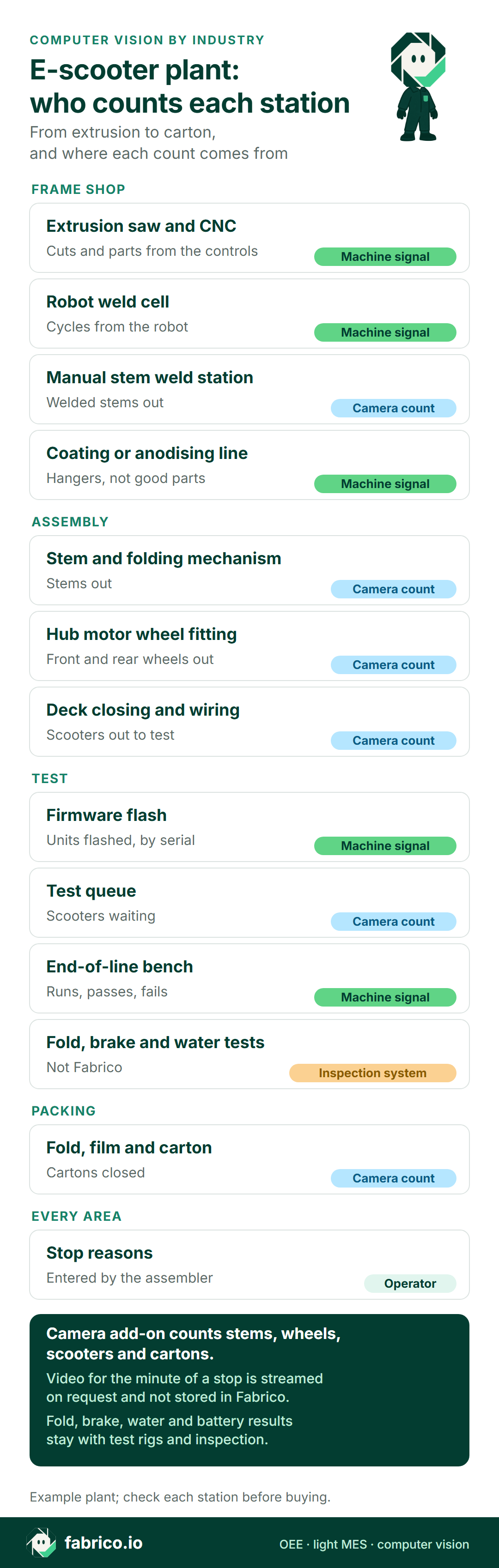
Text version of this infographic
- Frame shop: Extrusion saw and CNC: machine signal, cuts and parts from the controls
- Frame shop: Robot weld cell: machine signal, cycles from the robot
- Frame shop: Manual stem weld station: camera count, welded stems out
- Frame shop: Coating or anodising line: machine signal, hangers, not good parts
- Assembly: Stem and folding mechanism: camera count, stems out
- Assembly: Hub motor wheel fitting: camera count, front and rear wheels out
- Assembly: Deck closing and wiring: camera count, scooters out to test
- Test: Firmware flash: machine signal, units flashed, by serial
- Test: Test queue: camera count, scooters waiting
- Test: End-of-line bench: machine signal, runs, passes, fails
- Test: Fold, brake and water tests: inspection system, not Fabrico
- Packing: Fold, film and carton: camera count, cartons closed
- Every area: Stop reasons: operator, entered by the assembler
- Footer: AI cameras (an add-on) count stems, wheels, scooters and cartons; the video for the minute of a stop opens from the shift timeline, streamed on request and not stored
- Fold, brake, water and battery results stay with test rigs and inspection
- Example plant; check each station before buying.
Book a demo to see the stem bench, deck station and test queue on one timeline.
A variant switch is a changeover: codes and sequence
A switch from the German build to another market changes five things: the firmware profile, the plate and label rolls, the light and bell kits, the charger and manual bins, and the marker program. None takes long; together they stop the deck, because the label bench and flash station behind it block while rolls, kits and profile change.
- Define the interval. The changeover runs from the last scooter of one variant leaving the deck station to the first of the next. The camera add-on count gives both moments; the assembler picks the code.
- Give it its own code. "Variant change" sits beside battery wait and nutrunner fault in the stop list. Without it the minutes drift into slow running. The split between the swap and the adjustments after it is set out in changeover vs setup time.
- Check the first one. The first scooter after the switch proves the profile and the plate: flash log says 20 or 25, the plate matches. That wait belongs to the changeover, as in first-off approval after a changeover.
- Watch the hour after. Wrong label roll, wrong charger bin and a profile left from the last batch show up as short stops in the first hour; see stops after changeover.
- Sequence by market. Three small orders for three markets cost three switches; the minutes per switch are the figure planning needs.
A different model is a bigger switch. An adult kick scooter has no flash or bench log, so a camera add-on counts it at the assembly exit and packing as its own family with its own ideal time.
What a counting camera can and cannot do at a scooter bench
Published work says when a camera count at a hand bench holds. In a peer-reviewed study in the Journal of Imaging, researchers at Università Politecnica delle Marche counted manually assembled pieces placed on a bench between two operators at a high-mix, low-volume lighting manufacturer. Their improved algorithm reached 96.6% accuracy in an offline test on videos from that line, against 97.8% for a detector trained on the line's own products, on about 180 counting events. The paper is plain about the limits:
- Hands in the frame. It counts only when no hands are in view, and it could not handle two operators reaching into the framed area at once; the authors write that the company must train staff to avoid that.
- Lighting. Before a light ring was fitted, shadows and natural light made the signal unstable. The reported figures come from videos taken after the ring went in.
- The product and the background. The pieces were black-painted lighting devices on white tables, and the trained detector failed on other lines with other shapes.
- Throughput. The setup analysed between 3 and 10 frames per second, and the authors wanted more.
Those figures belong to that study, and none is claimed here for a scooter station. What carries over is the design: mount the camera above the spot where a finished stem, wheel or scooter is set down, keep hands out of it, give it steady light, and check the count against a hand tally for one shift. The test is in how accurate a camera part count is, and the follow-up in when the camera count and the operator record disagree.
What a counting camera does not do is judge. Stem welds and anodised decks go to weld and visual inspection, fold strength to the test rig, brake, light and motor function to the end-of-line bench, and the tests in EN 17128 and UL 2272 to the lab. Fabrico does no inspection.
People in view. A lens above the deck station also sees the assemblers. Tell the line its purpose before it goes up, involve the works council early, aim at the outfeed, the queue entry or the carton, and report per station and shift, never per assembler; the approval path is in works council approval for OEE monitoring.
Where Fabrico fits on a mixed-variant scooter line
Fabrico is cloud OEE software with light MES functions. On a scooter floor it covers three areas today:
- Frame shop: saws, CNC machines, benders, the weld robot and the furnace report run states and counts from their controls, so bar changes, tool changes and fixture waits carry their own codes on the timeline.
- Stem, wheel and deck benches, the test queue and packing: the camera add-on counts stems, wheels, scooters and cartons; where a camera add-on covers the station, the video for the minute of a stop can be opened from the shift timeline, streamed on request and not stored in Fabrico.
- End-of-line bench: passes and fails feed the quality figure as a signal or count, against the ideal cycle time of each model.
Assemblers add stop reasons from a tablet or phone, the variant change among them, and lost minutes appear in euros from the plant's own margin. Browser, iOS and Android; data out by REST API, webhooks, Excel or CSV.
Roadmap: the camera add-on flagging a growing queue at the bench or a quiet deck station, and suggesting a stop reason for the assembler to confirm or change.
Outside Fabrico: weld, fold, brake, water and battery tests, certificates, firmware files, VIN marking and serial records. Fails from those systems enter OEE as counts.
See camera-based OEE software, computer vision OEE for manual assembly and the MES and OEE software overview.
Worked example: a late shift that switches from the German build
Sample data from no real plant. A final assembly line for a 10-inch commuter e-scooter has four assemblers: stem and fold, wheels, deck and wiring, then brakes, lights and labels. The late shift runs 14:00 to 22:00 with a 20-minute meal break: 460 planned minutes. The deck station sets an ideal cycle time of 2.0 minutes a scooter. The German 20 km/h variant runs until 18:00, a 25 km/h variant after it. A camera add-on counts stems, wheels and scooters leaving the deck station, and assemblers enter stop reasons on a tablet.
Availability. The deck station stood for 60 minutes: 35 waiting for battery packs, 15 for the variant change at 18:00 and 10 after the stem clamp nutrunner faulted. It ran 400 of 460 minutes: 87.0%.
Performance. 184 scooters left the deck station, worth 368 minutes at 2.0 minutes each, in 400 minutes of running: 92.0%, or 32 minutes of slow running. The station counts put it at the wheel bench, where a new assembler was learning tubeless tyres.
Quality. 9 scooters failed their first bench run, 6 on throttle calibration and 3 on a brake light that stayed on. Their 18 minutes leave the good figure: 350 of 368, 95.1%, which is the line's first pass yield at the bench.
OEE. 87.0% x 92.0% x 95.1% = 76.1%, and 350 good minutes over 460 planned gives the same 76.1%. Both routes follow how to calculate OEE.
The deck was the victim of the battery wait, not its cause: from 15:20 to 15:55 the camera add-on counts showed stems and wheels still leaving their benches while nothing left the deck, as the packs sat at goods-in awaiting their incoming check. A packing count alone would have logged 35 minutes of "no parts". Whether such a wait counts against the line is argued in waiting for material in OEE.
What the lost minutes cost
Assume a contribution margin of EUR 60 per scooter and a crew rate of EUR 37.50 an hour. Both are example inputs; no public margin figure for stand-up scooters was found, and Fabrico prices lost time from the plant's own price or margin. At 2.0 minutes a scooter, a line minute is worth EUR 30 while the line is the constraint and the scooters it builds are sold.
| Loss | Minutes | Example value |
|---|---|---|
| Battery wait | 35 | EUR 1,050 |
| Slow running | 32 | EUR 960 |
| Variant change | 15 | EUR 450 |
| Nutrunner fault | 10 | EUR 300 |
| Test fails (repair time) | 108 in the bay | EUR 67.50 |
| Total | 92 line + 108 bay | EUR 2,827.50 |
The 92 line minutes lost to stops and slow running are 46 scooters not built: 46 x EUR 60 = EUR 2,760. The 9 bench fails are not lost scooters: a technician spends 12 minutes on each, 108 minutes inside the shift, EUR 67.50 at the crew rate. Together: EUR 2,827.50 for one shift. Fixing to specification versus passing some other way is drawn in rework vs repair.
Now the mix. One variant change cost 15 minutes, EUR 450. Three small orders for three markets would have meant three switches: 45 minutes, EUR 1,350, more than the battery wait. That is the figure for whoever sequences orders.
When the line is not the constraint, the 92 minutes cost crew time instead: four assemblers x 92 minutes = 368 crew minutes, EUR 230. Ranked by money, the battery wait leads at EUR 1,050, fixed by releasing battery pallets before 14:00; slow running at the wheel bench follows at EUR 960, a training question.
Before a pilot: five things to settle and four vendor checks
- List the variants of each model and mark, on the matrix above, the station that absorbs each difference.
- Agree one ideal cycle time per model with the line lead and a margin per model with finance.
- Export last month's marker, flash and bench logs and compare units per hour with the pallet counts of the same shifts.
- Draft deck station stop codes: battery wait, stem or wheel wait, variant change, nutrunner fault, repair backlog.
- Put three count points on the route card: deck exit for output, first bench pass for good, closed carton for shipped.
Pilot on the deck station, its two feeder benches and the bench queue, across at least one variant switch. Four checks for a camera or OEE vendor:
| Check | A good answer |
|---|---|
| How does the line earn minutes when one model ships in several variants? | One ideal cycle time per model; the variant switch is a changeover code. |
| Can flashed units and marked frames reach the shift timeline? | Yes, as a signal or count per unit, interface named. |
| Who supplies first-pass results from the end-of-line bench? | The bench, as a pass and fail signal or count, with no retyping. |
| Can the queue in front of the bench be counted? | Yes, a camera add-on at the queue entry against the bench count. |
Questions about variants on an e-scooter line
Can a counting camera tell a 20 km/h scooter from a 25 km/h one?
No. The variant comes from the order on the route card and the flash PC log; the camera add-on supplies how many left the station and when.
Can a counting camera check fold locks, brakes or water ingress?
No. Fold and stem strength belong to the test rig and the lab, brake and light function to the end-of-line bench, and water ingress to the IP test. Their fails reach the OEE quality figure as counts.
Want to see stem benches, the deck station and a variant switch on one shift timeline? Book a demo.
Related articles











Real Fabrico tiles, sample data.