


 Login
 Blog
Winery Production Software: Cellar Systems vs Bottling Hall OEE

In short: winery production software comes in two halves: cellar management software for crush, ferments, barrels, blends, lab work and excise or TTB records, and OEE with light MES for the bottling hall. Buy the cellar system for the wine itself, and line data when bottling days run short of cases.
- The cellar side is its own software category. It tracks vessels, lots, additions and the records a bonded winery must keep.
- The bottling hall loses time in label and vintage changes, bottle and closure changes, and waits for glass, corks, capsules or labels.
- Set the ideal rate at the filler for each bottle format, and keep non-bottling days out of planned time.
- Fabrico covers the bottling hall only: stops, counts and OEE by line and shift. It is not cellar, compliance or ERP software.
A winery is two plants under one roof. The cellar works to the calendar of the harvest and the wine. The bottling hall works to the calendar of orders, dry goods deliveries and, sometimes, a bottling truck booked months ahead.
Below, the systems are sorted by the building they serve, with where bottling line data pays back first.
Fabrico makes software for the bottling side only.
Winery production software, cellar to case
Most searches for "wine production software" lead to cellar tools. They are a real category, built around tanks, barrels and lots. The bottling line needs a different record.
| System | Its job at a winery | Owner | Fabrico? |
|---|---|---|---|
| Cellar management | Work orders, tanks and barrels, blends, additions, lab results, wine lots from fruit to bottling | Winemaker, cellar master | No |
| Compliance and excise | Bonded or excise records and reports, often inside the cellar system | Compliance, finance | No |
| Label and artwork | Label versions per vintage and market, label approvals | Marketing, compliance | No |
| ERP and stock | Orders, dry goods buying, case stock, costing, distributors | Finance, logistics | No |
| OEE and light MES | Bottling hall stops, counts, changeovers and dry goods waits, by line and shift | Bottling manager | Yes, this row |
Labels tie the two halves together, and label rules are strict. In the US, 27 CFR 4.50 says no person shall bottle or pack wine without a certificate of label approval from TTB, other than wine bottled or packed in U.S. Customs custody. The mandatory label items, such as brand name and class or type on the brand label, and name and address, net contents and alcohol content on a label, are set out in 27 CFR 4.32.
Vintage dating adds a cellar rule that lands on the bottling schedule. Under 27 CFR 4.27, for a wine labelled with a viticultural area, at least 95 percent of the wine must have been derived from grapes harvested in the labeled calendar year; with any other appellation, 85 percent. That is a blend record for the cellar system, and a label change for the bottling hall.
In the EU, the European Commission announced that from 8 December 2023, the new rules on labelling of ingredients and nutritional values on wine apply in the European Union. Label artwork per market belongs in the label and artwork row.
Wineries that also make juice or other drinks can compare with our food plant software guide.
How cellar, ERP and bottling data meet
A bottling run is where the cellar's bulk wine becomes the ERP's case stock. Five handoffs decide whether the numbers agree:
| Handoff | From | To | What moves |
|---|---|---|---|
| Wine released for bottling | Cellar system | Bottling plan | Wine lot, volume, bottling date |
| Dry goods on hand | ERP | Bottling plan | Glass, closures, capsules, labels and cartons per run |
| Bottled volume | Bottling line | Cellar system | Bottles per run, so bulk volume and losses close |
| Case stock | Bottling line | ERP | Cases packed per wine, vintage and market |
| Label version | Label file | Line clearance | The approved label for this run and market |
The third and fourth rows are often typed in by hand from a run sheet, a day or two late. Ask every vendor in the shortlist, cellar or line, which of these rows it sends or receives, and in what form.
One common gap: the cellar system knows how many litres left the tank, and the ERP knows how many cases arrived in the warehouse, but nothing records where the difference went on the line. That is the bottling hall's record.
Where bottling time goes
A fixed line runs depalletiser, rinser, filler, corker or screw capper, capsule spinner, labeller and case packer, often only a few days a week and more after harvest blends are ready. Its losses follow that calendar: short runs of one wine, one vintage and one market; frequent label and vintage changes; slower bottle and closure changes with change parts; waits for glass, corks, capsules, labels or cartons while the wine is ready; and labeller stops that send bottles to a hand relabel table. Where a mobile bottling truck comes in, the truck sets the day and the winery's job is to be ready. The machine by machine view is in our guide to OEE for wine bottling lines.
Which winery software to buy first
Start from the problem that cost the most this season.
| What hurts most | Start with | Why |
|---|---|---|
| Nobody can say which lot is in which tank or barrel | Cellar management software | Vessel and lot records belong in the cellar |
| Excise or bond reports take days to build | Compliance module, often in the cellar system | Reports are built from cellar records |
| Bottling days end short of the planned cases | OEE and light MES on the bottling line | Stops, waits and slow running in minutes and bottles |
| The line keeps waiting for glass, corks or labels | OEE first, then purchasing in the ERP | Wait codes by item show which supply fails |
| Order, stock and cost data live in spreadsheets | ERP | Orders, dry goods stock and costing are its job |
| Label versions get mixed up across markets | Label and artwork control | Version control belongs before the labeller |
Most wineries need the cellar system whatever else they buy. The bottling question is whether the line's lost hours are big enough to measure, and on a line with short runs they usually are. For cutting the change itself, see our SMED and changeover standards.
Want to see what a bottling day looks like as losses in bottles and cases? Bring a recent bottling run sheet to a Fabrico demo.
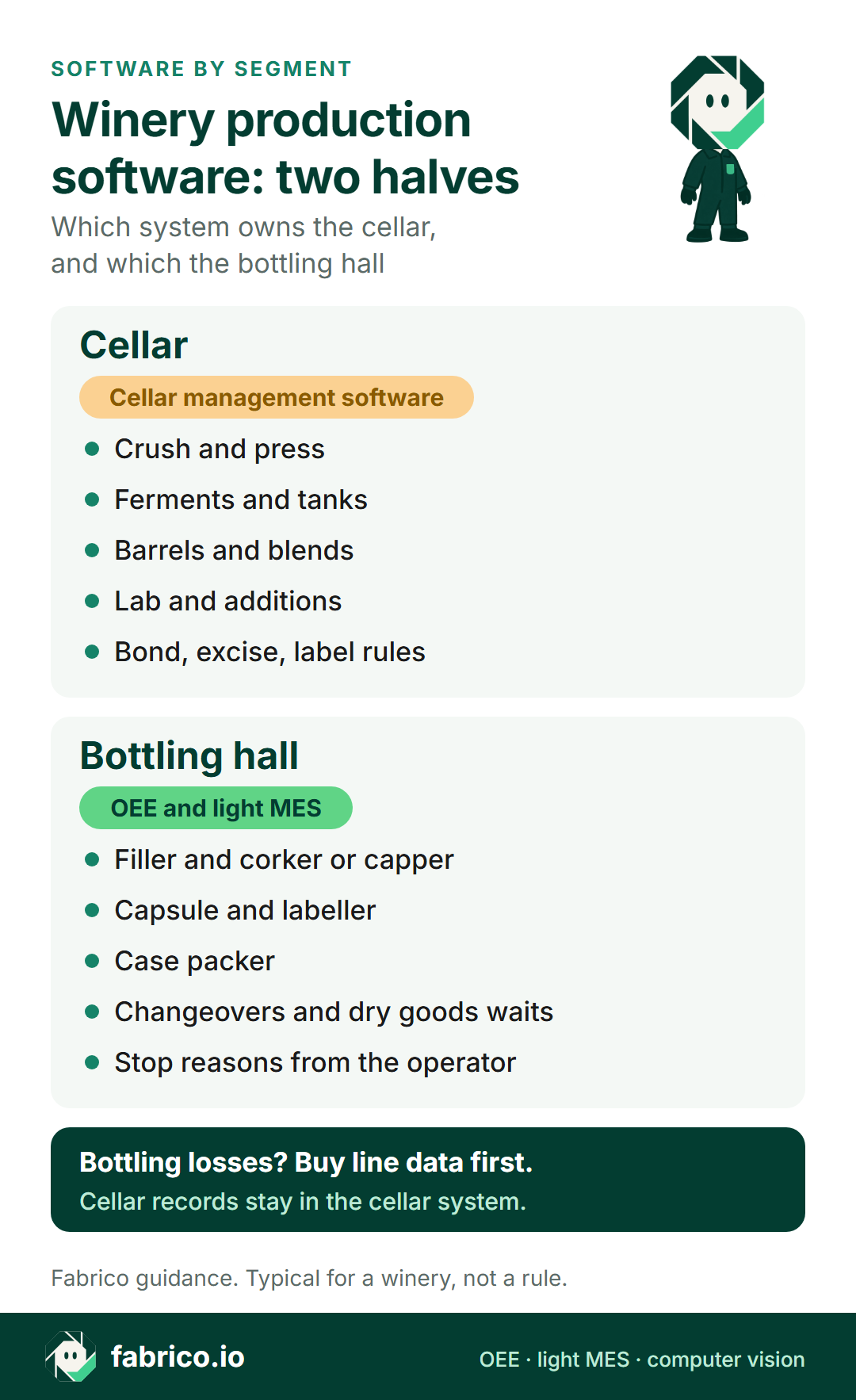
Text version of this infographic
- Winery production software card in two halves: the cellar, from crush and ferments to barrels, lab and excise rules, runs on cellar management software; the bottling hall, from filler to case packer, runs on OEE and light MES.
Who should wait on bottling line software
Not every winery needs line data. Find your group:
- Bottles only on a hired truck, a few days a year: a cellar system and a simple run log are usually enough. The truck operator owns the machines.
- Owns a line that bottles a few days a month: start with the cellar system and ERP; add line data when bottling days start running into overtime.
- Owns a line that bottles most weeks, many SKUs and markets: line data usually pays back early, because changeovers and dry goods waits repeat every week.
- Also bottles for other wineries: then the line is a contract business, and the software map for contract packaging applies too.
Which system records what, cellar to case
Dry goods waits named by item tell purchasing which supply fails; how to set them up is in OEE for wine bottling lines.
Worked example: tracing one wine lot from tank to case
Example records, from no real winery. A distributor reports a tainted cork in one case of a 2025 red and asks which tank lot the wine came from and which closure lot sealed it. The answer sits in four places. The cellar system holds the wine lot, the tank and the volume released for bottling. The ERP holds the closure lot received and the cases shipped to that distributor. The label file holds the label version approved for that market. The bottling line data shows when the run started and stopped and how many cases it packed. The hand-off breaks between the ERP and the line: if closures go to the filler by the pallet and nobody writes the closure lot against the run, the cork question has no answer, however good the cellar records are.
| Record | Held in | Where the hand-off breaks |
|---|---|---|
| Wine lot and tank released | Cellar system | Two tanks bottled in one run under one lot |
| Closure lot received | ERP | Closure lot not written against the run |
| Label version for the market | Label file, at line clearance | Clearance signed on paper only |
| Run times and cases packed | Bottling line data | Holds times and counts, not lots |
| Cases shipped to the distributor | ERP | Cases not tied to a run date |
Fabrico sits in the bottling line data row only, with run times, stops and counts by line and shift; the lot records stay in the cellar system and ERP. The OEE maths for a bottling day is in OEE for wine bottling lines.
Eight questions for winery software vendors
Use these with cellar and line vendors alike, and test each answer against a real bottling run sheet.
| Question for the vendor | What to look for |
|---|---|
| Is this cellar software, bottling line software, or both? | Ask which records it keeps in each building, in writing. |
| Which system is the source of bottled volume? | Line, cellar system or ERP: get one answer in writing. |
| Can the bottling plan see dry goods stock from the ERP? | Ask whether glass, closures and labels on hand show against each run before the day starts. |
| Can dry goods waits be split by item? | Glass, corks or caps, capsules, labels and cartons as separate codes. |
| Can label and vintage changes be told apart from bottle changes? | Ask for changeover types with their own minutes. |
| How is a mobile bottling truck day handled? | Ask whether the truck's day can be measured, and what the winery's side counts. |
| How is hand relabelling counted? | Bottles reworked at a table should show up as quality loss, not vanish. |
| What goes to the cellar system or ERP after a run? | Bottles and cases per run, the format, and who fixes the link when it breaks. |
And for cellar software vendors in particular:
- Does bottling close the bulk lot, moving litres out of the tank and into bottled case goods with the loss recorded?
- Can bottled quantities per run come in from line data or a file, rather than being typed from the run sheet?
- Does it hold the label approval and vintage per wine and market, so the bottling plan picks the right label?
Sparkling, fortified and canned wine lines add their own steps. Ask each vendor how its setup changes for them.
What Fabrico does in a winery bottling hall
- Bottling days measured: stops and counts from the filler, closer, labeller and case packer, read from their controllers or added sensors, give OEE by line and shift, with planned time following the bottling calendar.
- Dry goods waits named: the bottling crew tags waits for glass, closures, capsules and labels from a phone or tablet beside the labeller, so purchasing sees which supply fails and how often.
- Hand rework counted: at a relabel table with no machine count, the camera add-on counts finished bottles. Video for a moment on the shift timeline is streamed on request, not stored in Fabrico.
Platform details (money view of losses, apps, exports) sit on the MES and OEE software page and the computer vision add-on page. Fabrico is a light MES.
What Fabrico does not do: cellar management, wine lots and blends, lab records, bond or excise reports, label approvals, scheduling and fill level or label inspection. Those stay in your cellar system, ERP and inspection equipment. Bottling run order and mobile bottler bookings stay in your cellar or planning system.
For camera counting on drinks lines in general, see computer vision for beverage lines and computer vision for FMCG manufacturing.
What winemakers ask next
Does a winery need cellar software and OEE software?
Cellar software is close to a must for lots, vessels and compliance records. OEE software earns its place when bottling days lose hours to changeovers, dry goods waits and short stops. Smaller wineries often start with the cellar system and add line data later.
Can Fabrico produce TTB or excise reports?
No. Fabrico measures the bottling line: stops, counts and OEE. Bond, excise and TTB records belong in cellar or compliance software.
Which system should hold bottled volume per run?
The bottling line records it; the cellar system and the ERP should receive it. Agree one source before go-live, so the litres that left the tank and the cases in the warehouse close without retyping a run sheet.
Does cellar software cover the bottling line?
Most cellar software records the bottling as a cellar operation: wine out of the tank, cases into stock. It does not usually time the stops between. Ask each cellar vendor whether line stops, waits and counts are in scope, and get the answer in writing.
What should a winery bring to a software evaluation?
A bottling run sheet from a busy day, the bottling calendar for the season and a list of the dry goods that ran late. Those three show the losses faster than any feature list.
Want to read a busy bottling day as bottles and cases lost? Bring that day's bottling run sheet to a Fabrico demo and we will go through it with you.
Related articles


Real Fabrico tiles, sample data.