


 Login
 Blog
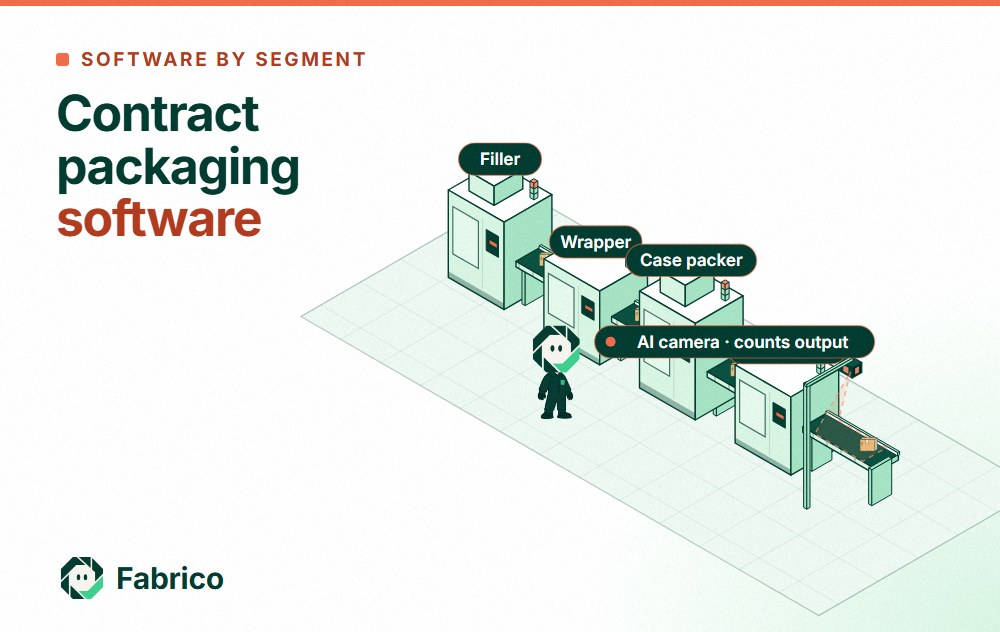
Contract Packaging Software: What a Co-Packer Needs First

In short: contract packaging software is four systems, not one: job costing in an ERP, customer stock and lots in a WMS, artwork and labels in a label system, and line time in OEE and light MES. Buy first for the problem that loses the most money on the next quote.
- A co-packer sells hours on shared lines, so the rate it quotes and the rate the line really runs decide the margin.
- The hours vanish in customer-to-customer changeovers, waits for customer-supplied components and hand-pack tables nobody counts.
- ERP, WMS and artwork tools hold the commercial and stock records. OEE and light MES hold the line minutes.
- Fabrico is the OEE and light MES row only: stops, counts and OEE by line and shift, with a camera add-on for hand work.
A contract packer owns almost nothing it packs. The product, the film, the cartons and often the artwork belong to the brand owner. What the co-packer owns is the line, the crew and the hours, and the price of those hours is set in a quote weeks before the job runs.
Below is which system does which job on a co-packing floor, and which one to buy first.
Fabrico builds the OEE and light MES row of this map and none of the others.
The contract packaging software map
Searches for "co packing software" or "copacking software" return everything from accounting suites to label printers. Split the market by the record each tool keeps.
| System | What it keeps for a co-packer | Owner | Fabrico? |
|---|---|---|---|
| ERP with job costing | Quotes, customer orders, a bill of materials per customer SKU, job cost against quote, invoices | Finance, sales | No |
| WMS and lot tracking | Customer-owned components in, lots and dates, what each job consumed, pallets out, leftovers returned | Warehouse | No |
| Label and artwork control | Artwork versions per customer, label printing, the version check at line clearance | Quality, packaging tech | No |
| Quality system | Customer specs, audits, complaints, corrective actions | Quality | No |
| OEE and light MES | Stops, counts, changeovers and rates on the shared lines, by line and shift | Operations | Yes, this row |
Most of the map is about other people's goods. In the EU, the European Commission's General Food Law page says a business must be able to identify at least the immediate supplier of the product and the immediate subsequent recipient. For a co-packer the supplier is often the brand owner itself, sending components that the co-packer must receive, hold and account for. That is WMS and lot work.
In the US, food co-packers who never cook anything still fall under food rules. The definition of manufacturing/processing in 21 CFR 117.3 lists labeling and packaging (including modified atmosphere packaging) among its examples. Packing a customer's product is food manufacturing in the eyes of that rule, and the records follow.
The line minutes are the one record none of those tools keeps well. That gap is where OEE and light MES sit. For a wider food view, see food manufacturing software: which type to buy first.
How the four systems hand data to each other
The map only works if the records flow. For a co-packer, five handoffs carry most of the money:
| Handoff | From | To | What moves |
|---|---|---|---|
| Job and SKU master | ERP | Line data | Customer, SKU, job number, the rate the quote assumed |
| Customer components | WMS | ERP | Lots and quantities received against each customer's order |
| Consumption and leftovers | WMS | ERP, customer | What each job used, scrapped and sent back |
| Actual hours and counts | Line data | ERP job cost | Run minutes, stops by reason, good units |
| Artwork version | Label system | Line clearance | The approved version for this run |
The fourth row is the one most co-packers lack. Without it, job cost is built from the quote, so a job that ran well below its quoted rate looks as profitable as one that ran to rate. A job quoted at 75 good packs a minute that runs at 60 needs a quarter more line hours than the quote paid for, and only the line data shows it. Ask any ERP vendor how actual line hours get in, and from where.
Two traps come up often. An ERP shop floor module that books start and finish times per job gives hours, not reasons: it cannot say the wrapper stood for 40 minutes waiting for film. And a WMS built only for the co-packer's own stock needs a way to hold customer-owned components, which must be received, held and accounted for separately.
Where a co-packer's hours go
Brand owners outsource for reasons that make a shared floor hard to run. A 2024 PMMI report found brand owners hire contract packers to access machinery or packaging formats not available in-house (59%) and for customized packs, especially short or limited runs (48%). PMMI, a US trade body, also found 87% of contract packers plan new equipment, with faster changeover (53%) among the aims.
So the hours go to customer-to-customer changeovers, waits for customer-supplied film and cartons, hand-pack and kitting tables nobody counts, display builds paced by agency crews, and shared machines run at one speed for every SKU. Proving line performance to brand owners is covered in line-level OEE for co-packers.
Which system to buy first
Pick the row that matches the loudest complaint in the last management meeting.
| What hurts most | Start with | Why |
|---|---|---|
| Jobs are quoted at a rate the line never hits | OEE and light MES | Real rates and stop minutes from the machines, by line and shift, before the next quote |
| Changeovers between customers eat the week | OEE and light MES | Time each changeover type first, then run SMED on the longest |
| Hand-pack and kitting tables have no count | A count at the table exit | A camera add-on count, or a tally on the operator tablet |
| A customer asks where their cartons went | WMS with lot tracking | Customer-owned stock in, consumed and returned needs its own ledger |
| Job margin is known only after invoicing | ERP job costing | Feed it actual line hours, not the quoted ones |
| A wrong artwork version reached the line | Label and artwork control | Version checks belong at line clearance, not in line data |
Two of the six rows point at line data, because a co-packer's quote is built on a rate and the rate lives on the line. Changeover methods are in changeover standards for FMCG lines.
Want the line rows tested on real numbers? Bring a recent customer job sheet to a Fabrico demo and compare its quoted rate with what a shared line can show.
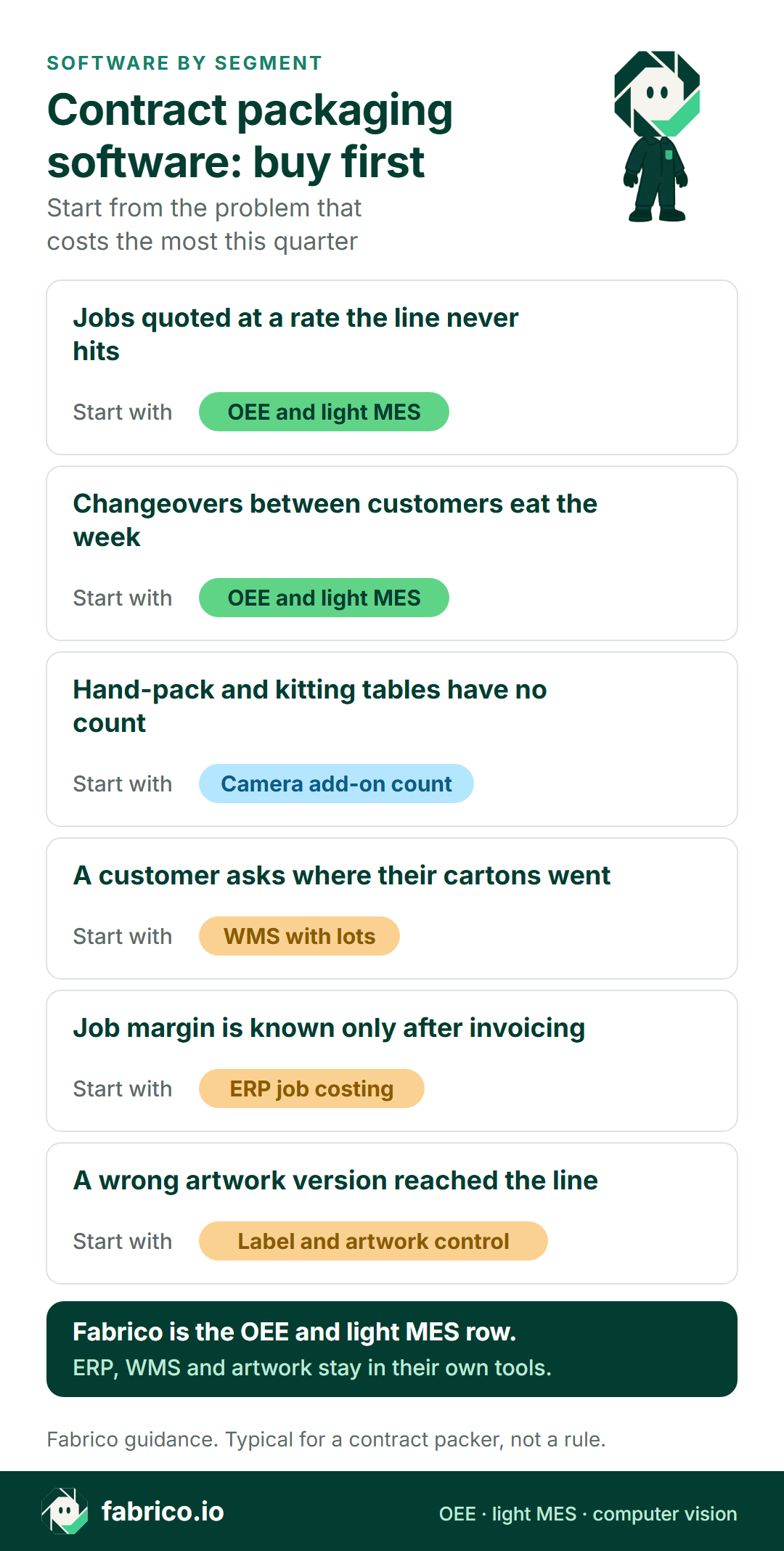
Text version of this infographic
- Contract packaging software card: six common co-packer problems and what to buy first, from OEE and light MES for missed rates and customer changeovers to a camera add-on count, WMS, ERP job costing and artwork control.
Buying in stages as a co-packer grows
Few co-packers buy the whole map at once. A common order, driven by pain rather than size:
- First, quotes and invoices: an ERP with job costing, once spreadsheets can no longer tie a quote to its invoice.
- Then, customer stock: a WMS with lots once the building holds more customer components than one person can track, or the first retailer audit asks for a trace.
- Then, line hours: OEE and light MES once shared lines decide the margin, usually when the same lines serve several customers a week.
- Alongside: artwork control as soon as customers send frequent artwork changes, and a quality system when audits multiply.
If the business is mostly hand assembly with no shared machines, line software can wait: a count at each table and a good ERP may be enough for a while.
Which system records what on a co-packing floor
On the lines, give customer-caused waits their own reason codes: late components, wrong versions and customer QA holds are a commercial conversation, not an engineering one. Camera counting of kits, displays and hand work is covered in computer vision for co-packers.
Worked example: tracing one customer's film lot through a job
Example records, from no real plant. A brand owner finds a bad seal on one cereal bar multipack and asks which of its film lots went into that pallet, and how much film came back. The answer sits in four systems. The WMS shows the film lot received from the customer and issued to the job. The ERP holds the job number, the order and the pallets invoiced. The label system holds the artwork version approved at line clearance. The line data shows when the wrapper ran that job and how many good packs it made. The hand-off breaks between the WMS and the wrapper: if all the film is issued to the job in one go, nobody can say which reel was running when that pack was made, unless reel changes are logged against the job.
| Record | Held in | Where the hand-off breaks |
|---|---|---|
| Film lot received from the customer | WMS | Booked in as the co-packer's own stock |
| Film issued to the job | WMS, against the ERP job number | Issued in one block, with no reel changes logged |
| Artwork version run | Label system, at line clearance | Clearance check kept on paper |
| Run times and good packs | Line data | Holds times and counts, not lots |
| Film sent back | WMS, ERP | Leftovers not counted before return |
Fabrico sits in the line data row only, with run times, stops and counts by line and shift; the lot records stay in the WMS and ERP. The OEE maths for a shared line is in line-level OEE for co-packers.
Eight questions for a contract packaging software vendor
Ask every vendor on the shortlist the same questions, with one customer job sheet on the table.
| Question | What a good answer shows |
|---|---|
| Can one shared line hold a different ideal rate for each customer SKU? | Ask to see two SKUs on the same wrapper with different rates, not one nameplate speed. |
| How are customer-caused waits kept apart from our own stops? | Ask for late components, wrong versions and customer QA holds as separate codes in the report. |
| Can changeovers be split by type? | Customer to customer, SKU within a customer and artwork only, each with its own minutes. |
| How does a hand-pack or kitting table get a count? | Camera, counter or tablet tally: ask what each costs in set-up and accuracy. |
| How quickly can a new customer SKU be added before its first run? | Watch it done: product, rate and reason list, by a supervisor, not by the vendor. |
| Can an agency worker log a reason on day one? | Hand a tablet to someone who has never seen the screen. |
| What can the brand owner be shown, and what stays inside? | Ask what an export or shared report contains, and who controls it. |
| How do actual hours and counts reach the job cost? | Ask what goes to the ERP, how often and who keeps the link working. |
Three more for the ERP and WMS vendors on the shortlist:
- Can it hold customer-owned stock apart from our own, with its own lots, counts and returns?
- Can a bill of materials mark components as customer-supplied, so they are tracked but not costed as ours?
- Can a job be costed from actual line hours fed in from another system, not only from the quote?
For OEE reporting in contract manufacturing more broadly, read MES for contract manufacturers.
What Fabrico does for a contract packer
- Shared lines, real rates: stops and counts from the wrapper, cartoner and case packer PLCs or sensors, OEE by line and shift, so the next quote starts from the rate the line really ran.
- Customer waits as evidence: operators tag waits for components, wrong versions and customer holds at the line, on a tablet or phone, from a reason list you set.
- Hand tables counted: where kits and displays are built by hand, the camera add-on counts finished output at the table exit. Video for a moment on the shift timeline is streamed on request, not stored in Fabrico.
Everything else, from losses in money to web and mobile apps and data export, is on the MES and OEE software page and the computer vision add-on page. Fabrico is a light MES.
What Fabrico does not do: quotes and job costing, customer stock and lot tracking, artwork control, quality records, scheduling and label or code inspection. Those stay in your ERP, WMS, label system and quality system.
For a camera view across FMCG sectors, see computer vision for FMCG manufacturing.
What co-packers ask next
Is there one contract packaging software that does everything?
Some ERP suites sell modules for stock, quality and shop floor data. Most co-packers still run two or three tools: an ERP for quotes and job cost, a WMS for customer stock, and line data for the hours. Pick by the record that is missing today.
Can Fabrico report OEE for each customer job?
Fabrico reports OEE, downtime and losses by line and shift. Whether a job-level view fits your contracts is worth asking in the demo, with a customer job sheet open.
Does a co-packer that only packs need food safety records?
In the US, the definition of manufacturing/processing in 21 CFR 117.3 lists packaging and labeling, so a food co-packer that only packs is still covered. Those records live in a quality system, not in OEE software.
How do you count work at hand-pack and kitting tables?
Count finished kits where they leave the table: with a counter if there is a conveyor, a tally on the operator tablet, or the camera add-on. Then the table gets a rate like any machine.
Should a small co-packer start with an ERP or with line data?
If jobs lose money and nobody knows why, start with line data on the busiest shared line. If invoicing, stock or lots are chaos, start with the ERP or WMS. Many co-packers need both within a year.
Want to check a quote against what a shared line really ran? Put last month's customer job sheet next to a Fabrico demo and we will read it together.
Related articles



Real Fabrico tiles, sample data.