


 Login
 Blog
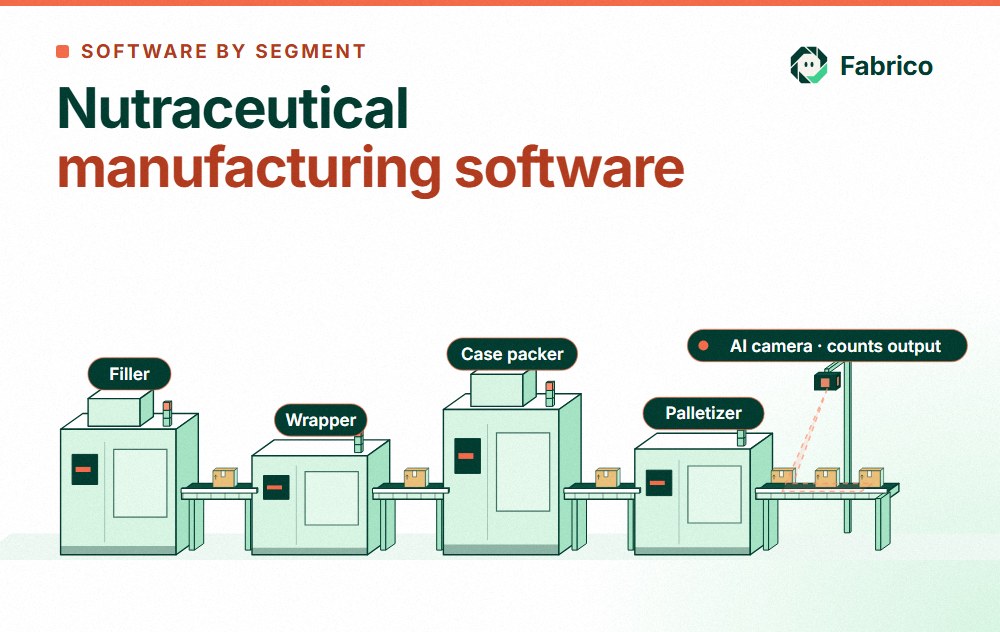
Nutraceutical Manufacturing Software: Which System Runs Which Job

In short: nutraceutical manufacturing software is a stack of products, not one: an ERP for orders, lots and stock, a QMS and batch record system for the 21 CFR Part 111 paperwork, often a WMS and a LIMS, and an OEE or light MES layer for the encapsulators, tablet presses and bottle lines. Buy the record systems first if an audit is your biggest risk. Buy OEE first if the lines lose hours nobody can explain.
- Batch production records, specifications and release decisions belong in a QMS or batch record system. Part 111 asks for a batch record every time a batch is made.
- The ERP and WMS carry lot numbers and quarantine status; the OEE layer carries minutes and stop reasons. Each one needs a clear owner.
- Short runs and many SKUs make line clearance and waiting for released bulk the losses a supplement plant buys OEE to see.
- Fabrico is the OEE and light MES layer. It holds no batch record and makes no Part 111 claim.
A supplement plant rarely runs out of speed first. It runs out of hours between products: blend, wait for release, clear the line, run a short SKU, clear again. The software question follows the same shape. Records of what was made sit in one set of systems, the hours in which nothing was made in another.
Nutraceutical and dietary supplement plants comparing dietary supplement production management software face the same sorting job. Below, the products are sorted by the job each one does on a capsule, tablet, powder and bottle site, then by what to buy first.
Fabrico appears in one row of the map below, the OEE and light MES row. Every other row is a job you buy from a different supplier, and none is named here.
The nutraceutical manufacturing software map, row by row
A supplement plant often ends up with five or more systems. The question is which row hurts first, not which suite has the longest feature list.
| System | What it does in a supplement plant | Owned by | Fabrico? |
|---|---|---|---|
| ERP | Orders, formulas as bills of material, lots, stock and costing | Finance, planning | No |
| QMS | Specifications, deviations, CAPA, supplier approval, release | Quality | No |
| Batch records | Master manufacturing record and batch production record, step by step, on paper or electronic | Quality, production | No |
| WMS | Raw materials, quarantined and released bulk, finished goods by location | Warehouse | No |
| LIMS | Test results for components and finished batches | QC lab | No |
| OEE and light MES | Stops, counts, stop reasons, clearance minutes and what lost time costs, per line and shift | Operations, CI | Yes |
| Inspection | Count, label, code and seal checks on the line | Engineering, quality | No, sits beside it |
The record rows carry the legal weight. Under 21 CFR 111.255, quoted on Cornell's copy of the CFR, "You must prepare a batch production record every time you manufacture a batch of a dietary supplement". The eCFR text of 111.260 lists what goes in it, including "The identity of equipment and processing lines used in producing the batch" and the date and time of the maintenance, cleaning and sanitizing of those lines.
So the cleaning times an auditor reads live in the batch record or a cross-referenced equipment log. A light MES timeline can show when a clearance started and ended and what it cost. It does not replace the signed record, and Fabrico makes no Part 111 or electronic record claim.
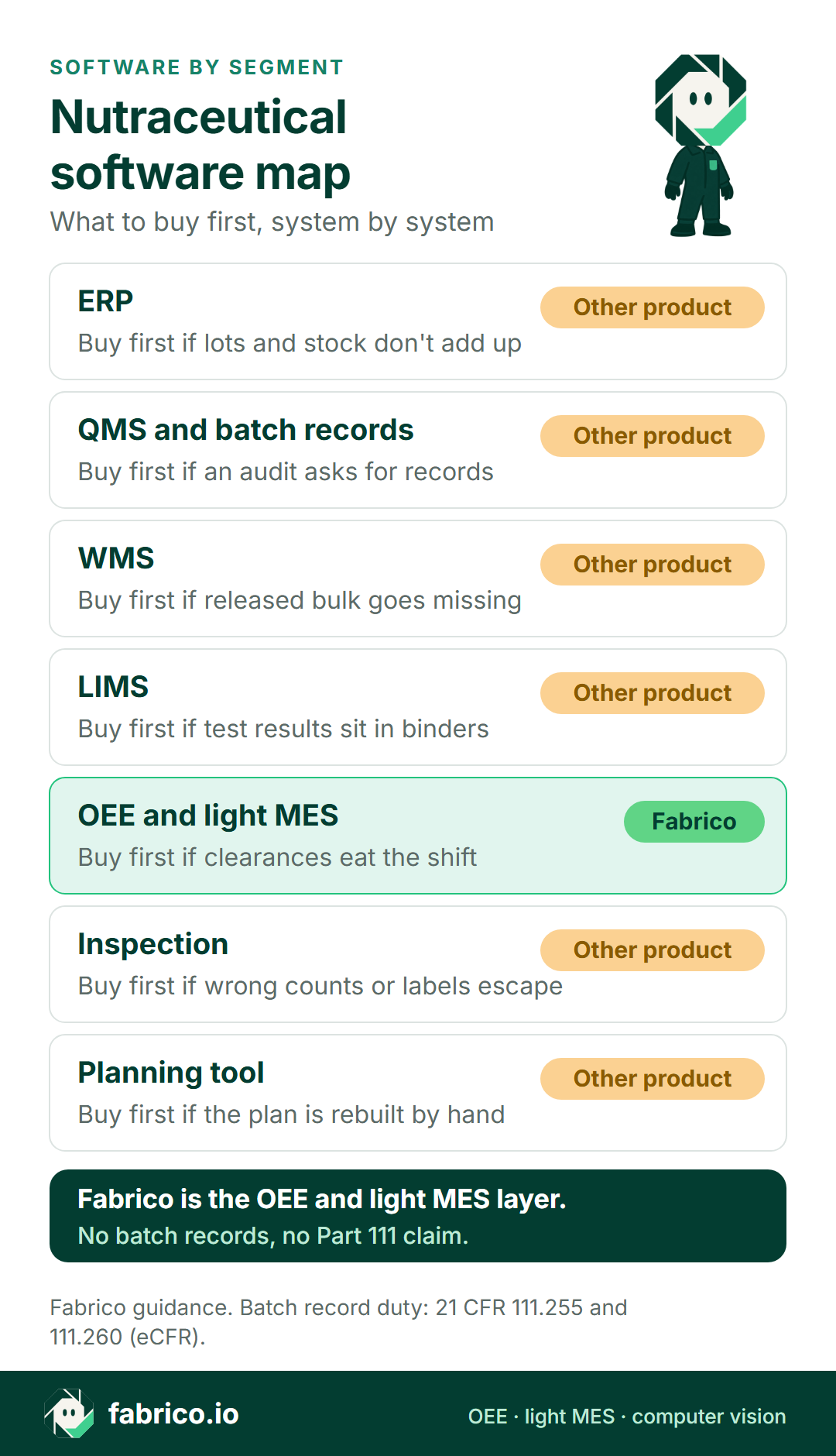
Text version of this infographic
- Nutraceutical software map card with seven rows: ERP, QMS and batch records as one row, WMS, LIMS, OEE and light MES, inspection, and a planning tool, the problem that makes each one the first buy, and Fabrico marked as the OEE and light MES layer only.
Choosing each system for a supplement plant
Every row has its own buying test. These are the ones that are specific to dietary supplements.
ERP: formulas, lots and short runs
The ERP holds the formula as a bill of material and the lot of every component. Test it on a real formula with an overage, a blend split into several capsule runs, and one finished batch packed into three bottle counts. If it cannot carry a lot from the blend through to each packed lot, the trace breaks before any auditor asks.
QMS and batch records: paper, hybrid or electronic
Many supplement plants still run batch records on paper and keep specifications, deviations and supplier approval in a QMS. Moving to electronic records is a quality project first: ask each vendor how its product handles electronic records and signatures, and check the answer with your quality team. Packaging and labeling rules matter here too. The eCFR text of 111.415 lists "Establishing physical or spatial separation of packaging and label operations from operations on other components and dietary supplements to prevent mixups", so the clearance checklist is part of the record, not an OEE form.
WMS: quarantine and released bulk
Bulk bins move from the blend room to quarantine, then to released stock, then to a line. A WMS, or the ERP's stock module, should show that status by location. When a released bin cannot be found, the bottle line waits, and that wait is a stock problem, not a machine one.
LIMS: test results before release
A LIMS holds component and finished-batch test results against the specification. Buy it when results sit in binders and release waits on someone finding a page. It feeds the QMS release decision, never the line directly.
OEE and light MES: the hours between products
This layer reads stops and counts from the encapsulator, press, counter and capper, and the operator adds the reason on a tablet or phone. Test it on a shift with three SKUs: it should hold a different ideal rate for each and show clearance as its own reason. See light MES vs full MES for where the light layer ends.
Inspection: counts, labels and codes
Tablet counter verification, label and code checks and seal checks are inspection systems on the line. They reject bad bottles. Their reject count can feed OEE quality, but they are a separate purchase.
How the systems hand data to each other
| From | To | What moves |
|---|---|---|
| ERP | OEE layer | Products, SKUs and orders for each line |
| OEE layer | ERP | Actual counts and run minutes by line and shift |
| LIMS | QMS | Test results for the release decision |
| QMS | WMS | Released or held status of each bulk lot |
| OEE layer | Planner | Clearance and changeover minutes by SKU pair |
| Batch record | Equipment log | Which line made the batch, and when it was cleaned |
Ask each vendor which of these links it builds, which it expects you to build, and who keeps them working after go-live.
Where supplement lines lose hours, in brief
Three loops, joined by bulk bins, lose time in different ways. Blenders finish, then the bulk waits for release and the next line starves. Encapsulators and tablet presses lose time to tooling and capsule-size changes and weight adjustment at start-up. Bottle counting lines lose minutes to counter jams and dust, capper torque faults and sealer rejects. Stick pack machines lose lanes. Across all of them, short runs make line clearance the loss that must never be squeezed, only reduced by needing fewer switches. The machine-by-machine detail is in OEE for supplement manufacturing, sachet and stick pack machine OEE and our line clearance guide.
What to buy first for a supplement plant
Start from the problem that costs most this quarter. Each row points at a different product.
The order also depends on what kind of plant you run.
| Plant | Usually first | Then |
|---|---|---|
| Contract manufacturer, many brand owners | QMS and batch records | OEE on the bottle lines, where switches pile up |
| Brand owner with its own plant | ERP with lot control | OEE and light MES on the pace lines |
| Plant growing past paper | Electronic batch records | WMS status for quarantine and release |
| Multi-site group | One ERP and QMS standard | OEE with the same reason codes at each site |
Most plants end up buying from both halves of the map: a record system the auditor reads and a line layer the planner reads. Neither replaces the other.
If clearance and waiting top your list, a demo lays out a bottle line's clearance, waiting and fault minutes on one shift timeline.
Worked example: one blend lot traced to its bottles
An invented case, from no real plant. A complaint names one bottle lot of a magnesium capsule. Quality has to find the blend lot, its components and the other bottle lots made from it, and the record sits in five places.
| System | What it holds for this lot | Where the hand-off can break |
|---|---|---|
| ERP | Formula, component lots, the blend split into packed lots | A split booked after the run, from paper |
| Batch record and QMS | Signed batch production record, release decision | Lot numbers copied by hand |
| LIMS | Component and finished-batch test results | Result held against the blend, not each packed lot |
| WMS | Where each released bin went, and when | A bin moved without a scan |
| OEE layer | Stops and counts for each bottle run, by shift | Holds no lot or batch record, only run data |
The trace usually breaks at a copy step between the blend lot and the packed lots. Fabrico plays no part in the trace; it supplies only when each bottle line stopped and how much it counted. The OEE maths for a bottle line shift is in OEE for supplement manufacturing.
Eight questions for nutraceutical software vendors
Put the same eight to the ERP, QMS and OEE vendors alike, and bring a real formula and last week's clearance checklists.
| Ask | How to test the answer |
|---|---|
| Which Part 111 records does your product hold? | Ask for the list in writing: batch record, master record, specifications, none. Check it with quality. |
| Can a blend lot be traced to each packed lot? | Give one blend split into three bottle counts and ask to see the trace. |
| Where does quarantine and release status live? | Ask which system holds it and how the line knows a bin is released. |
| Can it hold a rate per SKU and count size? | Ask for 30-count and 120-count rates on the same counter, side by side. |
| Is line clearance its own stop type? | Ask for clearance, format change and wet clean as separate reasons with their own minutes. |
| How is waiting for released bulk shown? | Ask whose loss it is on the report, apart from machine stops. |
| How are electronic records and signatures handled? | Ask for the vendor's written position and your quality team's view of it. |
| Which links does the vendor build? | ERP, WMS, LIMS: ask who builds each one and who keeps it working. |
Fabrico's place in a supplement plant
Fabrico is a cloud OEE and light MES platform. On a supplement site it does three jobs:
- Prices the switches: clearance, waiting for released bulk and format change become separate reason codes on the counter, press and encapsulator, so the planner sees what each SKU switch costs.
- Compares short runs fairly: an ideal rate per SKU, and the cost of lost time per line and shift, so a short run of a slow SKU is not judged against a fast one.
- Counts the hand benches: at gift set and rework benches with no machine count, the camera add-on counts output, and its video for a moment on the shift timeline is streamed on request, not stored in Fabrico. Camera placement is covered in computer vision for supplement manufacturing and the FMCG camera guide.
Outside Fabrico: batch production records, master manufacturing records, specifications and release, ERP, WMS, LIMS, label and code inspection, and campaign scheduling, which stays in your ERP or planning tool. Fabrico makes no Part 111 or electronic record claim.
Platform details sit on the MES and OEE software page, and the cameras on the computer vision add-on page. Other food segments are mapped in food manufacturing software.
What people ask next
Is there one nutraceutical manufacturing software that does everything?
Some suites cover several rows of the map; ask each one how long it takes to go live on the row you need first. Many plants combine an ERP, a quality system for batch records and an OEE layer. Pick by which row carries the most risk or the most lost hours.
Does OEE software meet 21 CFR Part 111?
No. Part 111 asks for records such as the batch production record, which names the equipment, the lines and their cleaning times. Those live in your batch record system or QMS. An OEE timeline helps a team see clearance minutes, but it is not the record.
Paper or electronic batch records first?
Paper works while the plant is small and audits pass. Move to electronic records when review and release slow down or errors repeat, and run it as a quality project with your quality team owning the validation.
Can the ERP hold our batch records?
Some ERPs offer a batch record module. Ask the vendor in writing which Part 111 records it holds, and have quality check the list. Many plants keep formulas and lots in the ERP and the signed batch record in a QMS or batch record system.
Does a small supplement plant need an MES?
Often not a full one. A small plant usually needs an ERP with lot control, a QMS or paper batch records, and a light OEE layer on the pace lines. A full MES makes sense when electronic batch execution is the goal.
Want to see what a shift of clearances costs on a bottle line? Book a demo with last week's clearance checklists and one redacted batch production record to hand.
Related articles




Real Fabrico tiles, sample data.