


 Login
 Blog
Brewery Production Software: Cellar Records vs Packaging Hall OEE

In short: brewery production software splits at the wall between the cellar and the packaging hall. Brewing and cellar software tracks recipes, brews, tanks and inventory and, in the US, feeds the TTB report of operations. Packaging hall software, OEE and light MES, tracks the depalletiser, filler, seamer or crowner, tunnel pasteuriser, packer and keg line. Buy the brewing layer first if tanks and excise figures live in spreadsheets. Buy packaging OEE first if the filler loses hours to brand changes nobody has costed.
- The cellar counts beer in hectolitres or barrels and days in a tank. The packaging hall counts cans, bottles and kegs by the minute.
- Excise, stock and costing live in brewing software and the ERP; minutes and stop reasons live in the packaging layer.
- Brand changes with a product flush, pack changes and a packer jam that blocks the pasteuriser are what breweries buy packaging OEE to see.
- Fabrico is the OEE and light MES layer for the packaging hall. It does not brew, track tanks or file TTB reports.
A brewery keeps two clocks. In the brewhouse and cellar, a batch of lager takes weeks from mash to bright tank. In the packaging hall, a can line fills hundreds of cans a minute, so a brand change is counted in thousands of cans.
Search for brewery production software and you get products built around one clock or the other. Below are both layers, the buying test for each, and which product solves which problem first.
Fabrico lives on the packaging side only. The cellar rows below describe product categories, not vendors.
Brewery production software, layer by layer
A brewery with its own packaging hall can run six or more systems. Most of them never see a can.
| System | What it does in a brewery | Owned by | Fabrico? |
|---|---|---|---|
| Brewing and recipes | Recipes, brew sheets, gravity and temperature logs | Head brewer | No |
| Cellar and tanks | Fermentation, conditioning, transfers, which tank is ready to package | Cellar team | No |
| Inventory and excise | Barrels made, removed and on hand; the TTB report in the US | Brewery admin, finance | No |
| ERP | Orders, malt, hop and packaging stock, costing, distributor sales | Finance, planning | No |
| QA lab | Dissolved oxygen, CO2 and micro results | Quality | No |
| Packaging OEE and light MES | Stops, counts, stop reasons and what lost hall time costs, per line and shift | Packaging, CI | Yes |
| Inspection | Fill height, seam, crown, label and code checks | Engineering, quality | No, a separate purchase |
| Keg tracking | Where the keg fleet is | Logistics | No |
The excise row is a legal duty in the US. Under 27 CFR 25.297, on Cornell's copy of the CFR, "each brewer shall prepare and submit a monthly report of brewery operations on Form 5130.9", with a quarterly option for smaller taxpayers. Those barrels come from brewing and inventory records. A filler count is not a tax record, and no packaging OEE tool should pretend to be one.
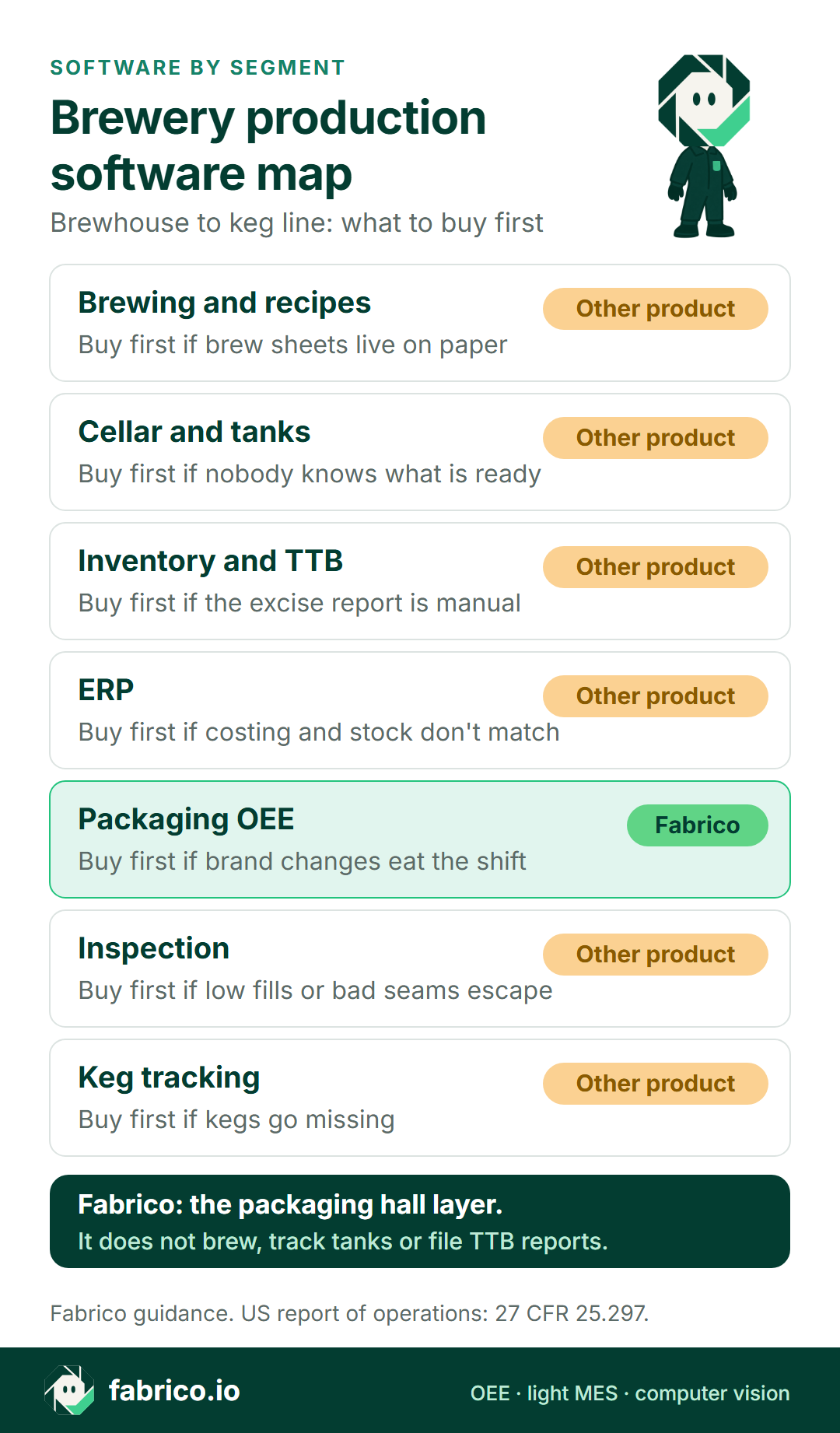
Text version of this infographic
- Brewery production software map card: seven of the eight systems in the table, from brewing and recipes, cellar and tanks, inventory and TTB reporting and ERP to packaging OEE, inspection and keg tracking (the QA lab is not on the card), the problem that makes each the first buy, and Fabrico marked as the packaging hall layer only.
How to judge each brewery system
Each layer has a test that only a brewery would set.
Brewing and recipe software
It should turn a recipe into a brew sheet, log gravity and temperature readings, and carry the brew number forward to the tank. Test it with a recipe scaled to two brewhouse sizes and a dry-hop addition logged days after the brew.
Cellar and tank management
The cellar team needs to see which fermenter or bright tank holds what, how long it has been there, and what is ready to package. Ask the vendor to show a blend of two tanks into one brite and a transfer that splits a batch.
Inventory and excise reporting
In the US, this row has to produce the brewer's report of operations from barrels brewed, packaged, removed and lost. Test it on one month: does the report come straight from the records, or does someone rebuild it in a spreadsheet? Packaged volume from the hall can help reconcile it, but the tax figure stays with this system.
ERP
Malt, hops, cans, crowns, labels and cartons, costing per brand and pack, distributor orders. Ask how packaging materials are booked when a run is cut short by a brand change, since that is where stock and costing drift apart.
QA lab records
Dissolved oxygen, CO2 and micro results should sit against the tank and brew they came from. Ask the vendor to show a failed result holding a tank back from packaging, and the release once a retest passes.
Packaging OEE and light MES
This layer reads stops and counts from the hall's machines, and the crew adds the reason at the line. Test it on a shift with two brands and a pack change: it should hold a rate per can size and pack and split the brand change from the pack change. See light MES vs full MES for where the light layer stops.
Inspection and keg tracking
Fill height, seam and crown inspection reject bad containers; their reject count can feed OEE quality. Keg tracking follows the fleet after the dock; ask its vendor to show one keg's last fills and where it is now. Both are separate purchases. Repairs on the filler, seamer and pasteuriser belong in a CMMS; for that job see maintenance software for breweries and distilleries.
What flows between brewery systems
| From | To | What moves |
|---|---|---|
| Cellar software | Packaging layer | Brand, tank and planned volume for each run |
| Packaging layer | Inventory and ERP | Cans, cases and kegs packed per brand and shift |
| Inventory | Excise report | Barrels removed and on hand for the TTB form |
| QA lab | Cellar software | Release of a tank to packaging |
| Packaging layer | Planner | Brand change and pack change minutes by pair |
| Inspection | Packaging layer | Reject counts for the quality figure |
Keg, can and bottle lines each count in their own unit. Report each line that way, then convert to hectolitres or barrels for the brewery view; our guide to OEE units: bottles, cases and pallets covers the conversion.
Packaging hall losses, briefly
The Brewers Association reports that "Overall U.S. beer production and imports were down 5.7% in 2025", while small and independent brewers raised their share by volume to 13.4%. When fewer barrels are spread over the same brands, runs get shorter and changes cost more of the shift. In the hall, the filler is the pace machine: brand changes with a flush, seamer jams and crown faults hit it directly. The tunnel pasteuriser is the long buffer, where heat is measured in pasteurisation units; as the Beer & Brewing dictionary puts it, "For every minute the beer is held at 60°C it is said to be subject to one pasteurization unit (PU)." Packer jams back up through it. Deep dives: filler OEE, can seamer OEE, tunnel pasteuriser OEE, keg lines and brewery packaging line OEE.
Which brewery software to buy first
Match the product to the problem that costs most, not to the longest feature list.
Brewery size changes the order.
| Brewery | Usually first | Then |
|---|---|---|
| Brewpub, kegs and a canning day | Brewing and inventory software | Packaging OEE only once canning runs daily |
| Regional packaging brewery | Cellar, inventory and ERP | Packaging OEE on the can or bottle line |
| Contract canning or co-packing brewery | Packaging OEE | Cellar links for each customer's brands |
| Multi-site brewery group | One ERP and excise standard | Packaging OEE with shared reason codes |
A brewery with a real packaging hall needs both layers in the end. The cellar layer proves what beer was made and taxed. The packaging layer shows the minutes in which no beer left the hall.
If brand changes top the list, a demo walks through brand changes, packer jams and pasteuriser blocking for a can line on one shift timeline.
Worked example: one brew traced from tank to distributor
An invented case, from no real brewery. A distributor reports flat cans from one IPA lot. To find each affected pallet, the brewery walks the lot back through five systems, and each one holds only its own part of the record.
| System | What it holds for this lot | Where the hand-off can break |
|---|---|---|
| Brewing software | Brew number, recipe, gravity log | Brew number not carried to the tank |
| Cellar software | Tank, transfers, the blend into one brite | A blend logged by hand |
| QA lab | CO2 and dissolved oxygen results, tank release | Result filed against the brew, not the tank |
| Packaging line layer | Stops and can counts for the run, by shift | Holds no lot record, only run data |
| Inventory and ERP | Lot code, cases shipped per distributor | Lot code not matched to the packaging run |
The trace breaks wherever a number is retyped: brew to tank, tank to packaging run, run to lot code. Fabrico is not a trace system; it supplies only when the can line stopped and how many cans it counted on that run. For the OEE maths of a can line shift, see brewery packaging line OEE.
Eight brewery questions that sort the vendors
Ask them of each product on the shortlist, with last week's packaging shift reports and one month's brewing records on the table.
| Ask | How to test the answer |
|---|---|
| Does the excise report come straight from the records? | Ask to see one month's TTB report built without a spreadsheet step. |
| Can it follow a blend or split from tank to brand? | Ask for two tanks into one brite, then into two pack formats. |
| What does the cellar send to packaging? | Brand, tank and planned volume in; actual cans out. |
| Where is the filler's ideal rate set? | Ask for a rate per can size and pack, not one nameplate speed for the hall. |
| How is a brand change split? | Ask for flush, CIP and pack change as separate types, each with its own minutes. |
| Who keeps the cellar-to-packaging link working? | Ask whether the vendor or your team maintains the brand and tank feed after go-live. |
| Is the keg line its own asset? | Ask for kegs as the unit and a separate OEE from the can line. |
| How does a crew on a wet, loud floor log a reason? | Ask to see it done at the line, on a tablet or phone, in seconds. |
Fabrico in the packaging hall
Fabrico is a cloud OEE and light MES platform. In a brewery it works between the bright tank and the dock:
- Costs each brand change: flush, CIP and pack change become their own reason codes at the filler and packer, so the price of one more brand a week shows in minutes and money.
- Puts the stop where it started: stops and counts come from the depalletiser, filler, pasteuriser and packer signals, and the crew tags the reason, so a packer jam that blocks the filler is booked to the packer.
- Keeps kegs apart and counts the tables: the keg line runs as its own asset. At hand-built variety pack tables with no machine count, the camera add-on counts output, and its video for a moment on the timeline is streamed on request, not stored in Fabrico. Camera placement is in computer vision for breweries and the FMCG camera guide.
Not Fabrico's job: recipes, brew sheets, tank and cellar management, inventory, TTB reports, lab results, fill and seam inspection, keg tracking, or the brew and packaging plan, which stays in your brewery system or planning tool.
For the platform as a whole, read our OEE software page; for the cameras, the computer vision add-on page.
What people ask next
Do we need brewing software and packaging OEE, or one system?
Most breweries with a real packaging hall run both. Brewing and cellar software tracks beer by brew and tank. Packaging OEE tracks the minutes on the filler and packer. Some suites try to cover both; ask to see each layer working on its own data.
Does packaging OEE software file TTB reports?
No. The brewer's report of operations under 27 CFR 25.297 comes from brewing and inventory records. A filler count can help reconcile packaged volume, but it is not the tax record.
When does a craft brewery need packaging OEE?
When canning or bottling runs most days and brand changes start to eat the shift. A brewpub that cans once a week usually gets more from brewing and inventory software first.
Can a brewery ERP module replace packaging OEE?
Usually not. A brewery ERP module books what was packed per brand and pack after the run. Packaging OEE records when the filler and packer stopped and why, during the run. Ask the ERP vendor to show one shift's stop minutes by reason; if it cannot, the two jobs stay separate.
Who should own packaging OEE in a brewery?
The packaging manager, with CI. The head brewer owns the brewing and cellar records, and finance owns excise and the ERP. Give each system one owner, and agree which one is the source of packaged volume before go-live.
Want a week of packaging shift reports turned into minutes and money? Book a demo with the brand change log and last week's packaging hall shift reports to hand.
Related articles




Real Fabrico tiles, sample data.