


 Login
 Blog
Distillery Production Software: Still House to Bottling Hall

In short: distillery production software splits at the bottling hall door. Distillery management software runs the still house and the warehouse: mash and fermentation records, pot and column still runs, cask inventory, gauging and excise. A light MES with OEE runs the bottling hall: stops, counts and changeovers by line and shift. If your lost hours are in bottling, the OEE layer comes first there.
- Excise shapes the first system. A US plant files monthly operating reports with TTB and keeps copies, and a UK producer keeps records of materials and quantities used, normally for 6 years.
- Fabrico does none of that: no gauging, no cask ledger, no excise returns.
- The bottling hall loses time to market changes, stopper feed jams, waits for blend release and hand finishing that sets the pace.
- Give the gift box or hand finishing table its own count, because it often decides the line's real speed.
A distillery runs on two timescales. In the still house and the warehouse, time is counted in fermentation days, still runs and years in cask. In the bottling hall it is counted in minutes, and a single export run of a few hundred bottles can spend more time in changeover than on the filler.
Whisky, gin, rum, vodka and brandy distilleries all run on both timescales. Below is which system owns which job, and which one to buy first.
Fabrico makes OEE and light MES software for the bottling hall. The still house systems below are other products, so we describe them by category and name no vendors.
Distillery production software, system by system
| System | What it does in a distillery | Usually owned by | Fabrico? |
|---|---|---|---|
| Distillery management software | Mash bills, fermentation, wash and still runs, cuts, spirit receiver, strength and volume | Distillery manager | No |
| Cask and warehouse inventory | Cask fills, locations, ageing, re-racking, regauges, losses in cask | Warehouse, excise | No |
| Excise and compliance | TTB reports in the US, HMRC records and returns in the UK | Finance, compliance | No |
| ERP | Orders, dry goods (glass, closures, labels, boxes), market SKUs, costing | Finance, planning | No |
| Lab and quality | Strength checks, blend approval, release to bottling | QA, blender | No |
| Light MES with OEE | Bottling hall stops, counts, changeovers, losses by line and shift | Operations | Yes |
Some distillery management products cover the first three rows together, and some reach into bottling records. Ask where their bottling data comes from: a run total typed in at the end, or a machine signal. Few distilleries need a full MES on top; light MES vs full MES shows where that line falls.
What the excise rules ask of the still house
Spirits are taxed on alcohol, so the still house and the warehouse are run around records. That is why distillery management software exists, and why it is usually the first system a distillery buys.
United States. Under 27 CFR 19.632 (Cornell LII copy), each distilled spirits plant sends TTB monthly reports on its operations, and "The proprietor must submit the original reports to TTB and must retain a copy for its records."
United Kingdom. HMRC's alcoholic products technical guide, section 9 lists the records producers must keep, including "materials and quantities used (including additives) in production" and details of stock-takes and any discrepancy they show. It adds: "You must normally keep your business records for 6 years."
Ageing. Cask inventory runs for years, not weeks. For Scotch, the Scotch Whisky Regulations 2009 define the spirit as one "that has been matured for a period of not less than three years", in oak casks of no more than 700 litres. Every one of those casks has to be tracked from fill to dump.
Gauging, the cask ledger and the returns are distillery management work. A light MES does not gauge spirit, hold the cask ledger or file anything with TTB or HMRC. If a line software vendor says it does, ask to see a return it has filed.
How distillery systems hand over to bottling
The still house and the bottling hall meet at a few handovers. Each one has an owner, and a buyer should know which system holds it.
- Lab to bottling: the blend is approved and released. Until then the filler waits.
- Distillery software to bottling: the spirit is gauged into the bottling tank, and the record is kept for excise.
- ERP to the line: the market SKU, the run size and the dry goods: glass, stoppers, labels, export tax stamps where a market needs them, and gift boxes.
- Line to the ERP: bottles and cases made, and rejects, so stock and costing match the run.
- Bottling records to excise: what was bottled and removed, kept in the distillery software for TTB or HMRC. OEE counts are operating data, not excise records.
- Line to planning: real market and format change times, which decide how runs are grouped.
A wait for blend release is a still house problem that the bottling hall pays for, so the line layer should time it and name it.
Ask each vendor which handovers it owns and which it only reads. A bottling hall tool should read SKU and market from the ERP or distillery software, not ask operators to type them again.
Where the bottling hall loses its hours
Spirits runs are short, the glass is shaped and heavy, and one liquid goes out in many dresses. The hours go to market changes (new front and back labels, strength statement, importer details), format changes (guides, star wheels, filler and stopper heads), bar-top stopper and T-cork jams, waits for blend release, and hand tables for wax, tags and gift boxes that set the pace with no counter. Some export markets need a fiscal stamp on each bottle. In the UK, HMRC says the measure "ends the scheme so that those retail containers are no longer required to be stamped", from 1 May 2025. Loss codes, run sequencing and pricing are in OEE for spirits bottling lines.
At a hand finishing table with no machine counter, a camera add-on can count boxed bottles. For camera counting on drinks lines, see computer vision for beverage lines.
Which distillery software to buy first
Buy for the problem that costs the most this year. For most distilleries the order is set by law first and by the bottling hall second.
| Where it hurts | Start with | Why |
|---|---|---|
| Monthly excise returns take days, from paper | Distillery management software | It builds the records the returns need |
| Nobody can say which casks are ready, or where | A cask and warehouse inventory tool | Fills, locations and regauges are its job |
| Glass or closures run out before a market run | ERP or stock control | Dry goods and orders live there |
| Bottling falls behind, and nobody agrees why | A light MES with OEE in the bottling hall | It times stops from the machines and gets the reason at the line |
| The hand finishing table holds up the line | A count at that table | Without one, the slow station stays invisible |
If bottling is where the hours go, see a demo of a spirits line with short export runs and a gift box table.
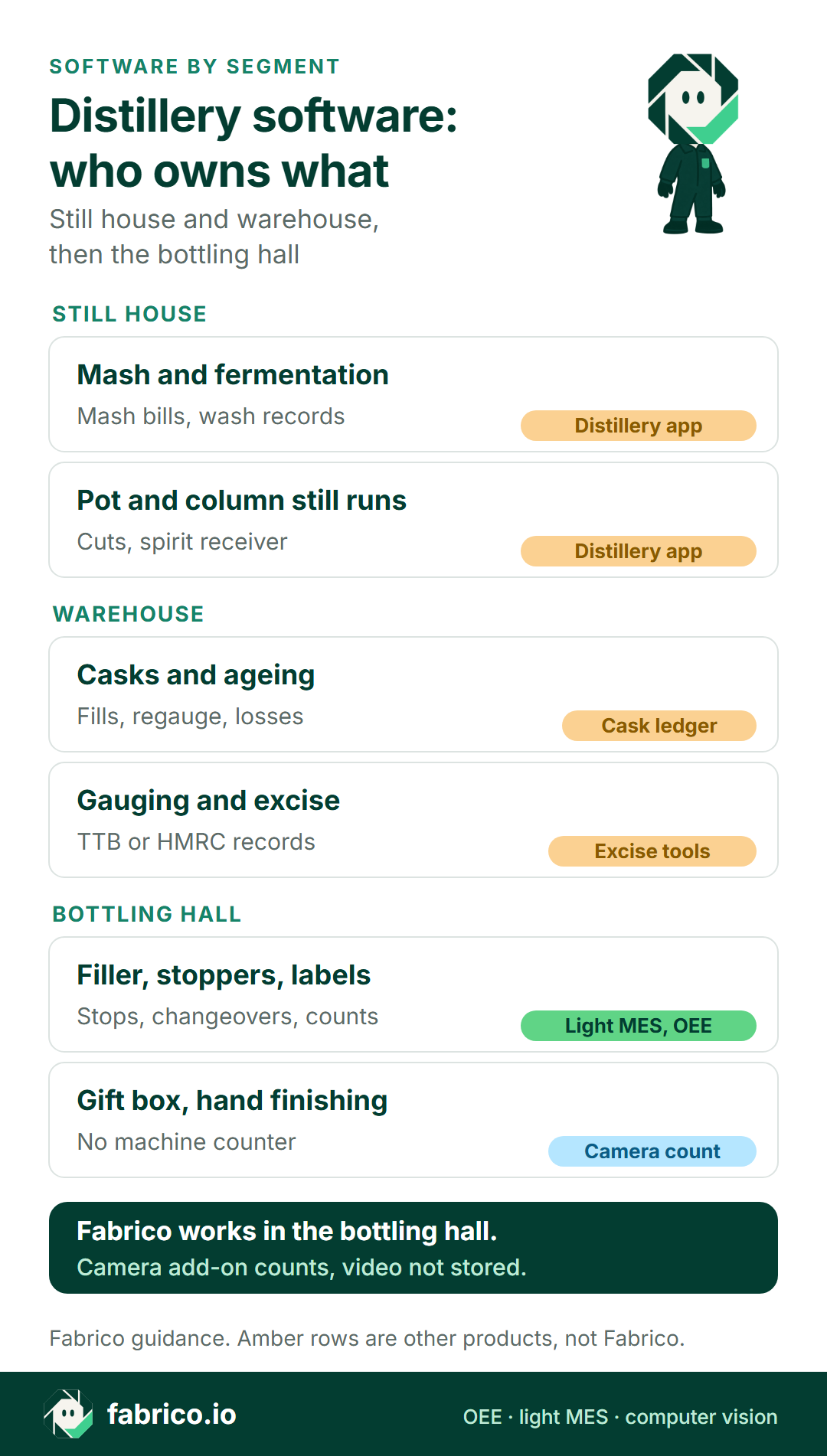
Text version of this infographic
- Distillery software card: mash, fermentation and still runs go to distillery software, casks and excise to cask and excise tools, and the bottling hall to a light MES with OEE, with a camera count at hand finishing.
Worked example: one bottling run traced back to its casks
An invented case, from no real distillery. An export market questions the strength on one bottling run of a single malt. The distillery has to show which casks went into it, the gauge, the blend approval and where each case went.
| System | What it holds for this lot | Where the hand-off can break |
|---|---|---|
| Cask and warehouse inventory | Cask numbers dumped for the batch, regauges | A cask dumped but not closed in the ledger |
| Distillery system | Gauge into the bottling tank, strength and volume | Tank number retyped on the bottling sheet |
| Lab and quality | Strength check and blend approval | Approval on paper, not against the tank |
| ERP | Market SKU, dry goods lots, cases shipped | Run size changed after the plan |
| Line OEE layer | Stops and bottle counts for the run, by shift | Holds no cask or excise record, only run data |
The trace breaks wherever a tank or cask number is copied by hand. Fabrico plays no part in the trace; it supplies only when the bottling line stopped and how many bottles it counted. The OEE maths for a bottling shift is in OEE for spirits bottling lines.
Eight questions for distillery software vendors
Have a week of bottling run sheets ready so you can check the replies.
- Can market changes and format changes carry separate reason codes? One "changeover" code hides which one costs more.
- How do you count at the hand finishing table? Ask what happens at a station with no machine counter, and see it working.
- Which system is the source of bottled volume for excise? Get a written answer: distillery software, ERP or line counts.
- How is waiting for blend release logged, and who sees it? The reason should reach the lab, not stay in the bottling report.
- Can it read market and SKU from our distillery software? Ask to see the run picked up with no retyping.
- What does it send back to the ERP? Actual bottles and cases out, per run. Agree who owns that interface.
- Can an operator in the bottling hall log a reason in seconds? Watch an operator do it at the labeller, gloves on.
- Where does your product stop? Gauging, the cask ledger and excise returns: get a written yes or no for each.
Fabrico in the bottling hall, not the still house
Fabrico is a light MES for the bottling hall. Its value to a distiller comes down to three points.
- Market and format changes kept apart: stops are timed from the machine signal, and the operator tags them as a market change, a format change or a stopper jam at the line, on a tablet or phone.
- The hand finishing table counted: the camera add-on counts gift boxes or finished bottles where no machine counter exists. With the camera add-on, video is streamed on request, not stored in Fabrico.
- Short runs priced in money: losses are shown in money by line and shift, so a short export run can be set next to a long home-market run.
The full platform is on our MES and OEE software page, and the cameras on the computer vision add-on page. For camera counting across FMCG lines, see computer vision for FMCG manufacturing and computer vision for beverage lines.
What Fabrico does not do: mash, fermentation and still records, gauging, cask inventory, excise records or returns to TTB or HMRC, blend approval, label compliance and inspection such as fill level or label checks. The bottling run order by market stays in your distillery system or planning tool.
What people ask next
What is distillery production software?
It usually means distillery management software for mashing, fermentation, still runs, cask inventory, gauging and excise records. The bottling hall is a separate job, where a light MES with OEE times stops and counts bottles.
Does a craft distillery need both kinds of software?
Not always at once. Excise records come first, because the law asks for them. OEE in the bottling hall pays once bottling runs often enough that lost hours cost real sales or overtime.
Can Fabrico file TTB or HMRC returns?
No. Fabrico does not gauge spirit, keep the cask ledger or file excise returns. Those stay in your distillery management software and with your compliance team.
Do UK spirits bottles still need duty stamps?
No. HMRC ended the Alcohol Duty Stamps Scheme from 1 May 2025, so those retail containers no longer need a UK duty stamp. Some export markets have their own tax stamps, so check each market.
Does OEE apply to the stills?
OEE fits continuous packaging lines best. Still runs are batch work measured in hours, so track run times and yields in the distillery software. Use OEE where bottles move.
Which bottling line should get OEE first?
The line with the most SKUs and markets, because that is where changeovers and short runs eat the most time. Start with one line and a week of run sheets as the baseline.
Want to see what a short export run really costs? Send a week of bottling run sheets ahead of a demo.
Related articles


Latest from our blog


Real Fabrico tiles, sample data.