


 Login
 Blog
MES vs PLM: As-Designed Specs vs As-Built Line Data

In short: in MES vs PLM, PLM holds the product as designed (formulas, specs, pack artwork and their versions) and MES holds the product as built (runs, stops, counts and rejects). A food or FMCG plant rarely needs both in full on day one: fix whichever hurts more, then build the link between them.
- PLM answers "what should we make?". MES answers "what did we make, and how did it run?".
- ERP sits between them: items, BOMs, orders and stock.
- Wrong versions on the line point to spec release first. Unknown losses point to line data first.
- The risk sits in the handoff: version on the order, a line check at start, and run data back to the spec owner.
You are weighing two kinds of system with three letters each, and the vendor pitches overlap. For the full stack, see our manufacturing software tech stack guide.
Disclosure: Fabrico makes OEE and light MES software, the as-built half of this comparison, so weigh our view with that in mind.
MES vs PLM: as-designed vs as-built
The cleanest way to split the two is by tense. PLM, product lifecycle management, is about the product as it should be. It holds the formula or recipe, the product and pack specs, the bill of materials, the pack artwork, and the change history that took each one from draft to released. MES, a manufacturing execution system, is about the product as it was made. It records which order ran on which line, when it stopped and why, how many good units came off, and what was rejected.
| Question | PLM | MES |
|---|---|---|
| Answers | What should we make? | What did we make? |
| Main records | Formula, spec, BOM, artwork, versions | Runs, stops, counts, rejects, deviations |
| Changes when | A product or pack changes | Every shift |
| Time scale | Weeks to months per change | Seconds to minutes |
| Main users | R&D, packaging, quality, regulatory | Operators, line leads, CI, maintenance |
| Key output | A released version | A record of how it ran |
In a food or FMCG plant the overlap is small but critical. A change in PLM is worthless until the line runs it, and the line's record is the only proof that it did. For what an MES covers in general, see our MES software guide.
Where ERP sits: ERP vs MES vs PLM
If your plant has an ERP, it carries the business copy of the product: the item, its BOM, the order, stock and cost. PLM releases a version; ERP turns it into orders and purchases; the line system records how each order ran. The ERP vs MES guide covers that split, and digital thread vs digital twin the wider data flow.
A common reference for that last link is ISA-95. In the words of the ISA's ISA-95 page, it is "an international set of standards aimed at integrating logistics systems with manufacturing control systems", and it "primarily deals with the interface between levels 3 and 4", where level 3 is manufacturing operations such as MES and level 4 is business planning such as ERP. PLM is not one of those levels. In practice its released data reaches the plant through ERP or through a direct feed, which is why the handoff deserves its own checklist.
How a spec change reaches the line
Take a common change: a new pack artwork with an updated allergen statement, or a reformulated recipe. Each step is a place where an old version can slip through.
- Release. The spec owner approves the new version in PLM or in a controlled spec file, with an effective date.
- ERP update. The item and BOM pick up the new version: new film, new label, new ingredient.
- Run-out. Planning and purchasing decide when old film and labels are used up or blocked.
- Order. The order sent to the line names the product and the version.
- Start-up check. At the line, someone checks film, label and code against the released version before the run counts.
- First runs. Speed, stops and rejects of the new version are recorded and compared with the old one.
- Feedback. Deviations and run data go back to the spec owner, who decides whether the spec or the set-up needs to change.
Why the label steps matter: a label that misses an allergen can force a recall, and the wrong label on the right product is a handoff failure, not a recipe failure.
Label and code checks themselves are an inspection job. Fabrico does not sell quality inspection. The guide to label and code vision vs OEE cameras shows how inspection systems and line data sit side by side, and coding and marking for high-speed lines covers the printer side.
Designed vs built is also a records rule
For some FMCG plants the split is written into law. Under US rules for dietary supplements, 21 CFR 111.205 says "You must prepare and follow a written master manufacturing record" for each unique formulation and batch size. That is the as-designed record. Then 21 CFR 111.255 says "You must prepare a batch production record every time you manufacture a batch of a dietary supplement". That is the as-built record.
Food plants outside that rule can apply the same logic in their own quality systems. The master record says what should happen; the batch or run record says what did. Whichever systems hold them, both must use the same product and version codes, or an auditor and your CI team will struggle to match them.
What a food or FMCG plant needs first
Buying a full PLM and a full MES in the same year is a big step. Pick the gap that costs more today.
Fix spec release first if old artwork or labels have reached the line, if specs live in copied spreadsheets and emails, or if launches stall because nobody knows which version is current. That can mean a PLM, or for a small range a controlled spec file with one owner and a version log.
Fix line data first if stops are logged on paper or not at all, if OEE is a guess made after the shift, or if nobody can say which losses cost the most. A light MES covers the part closest to the machine: machine data collection, production monitoring, OEE and downtime analytics. Our light MES vs full MES guide helps if you are unsure how much MES you need.
Plan both, plus the link, if you run many SKUs and launch or change products often. Then the question is less which system and more how a released version reaches the line and how run data gets back.
| Situation | Lean toward | Why |
|---|---|---|
| Old artwork or labels found on the line | Spec release first | A wrong label can mean a recall |
| Specs live in many copied files | Spec release first | Copies drift apart |
| Nobody trusts the OEE numbers | Line data first | You cannot improve what you guess |
| Stops logged on paper, or not at all | Line data first | Losses stay invisible |
| Many launches a year, many SKUs | Both, plus the link | Each change must reach the line |
| New versions run slower, no one knows why | Both, plus the link | The spec owner needs the run data |
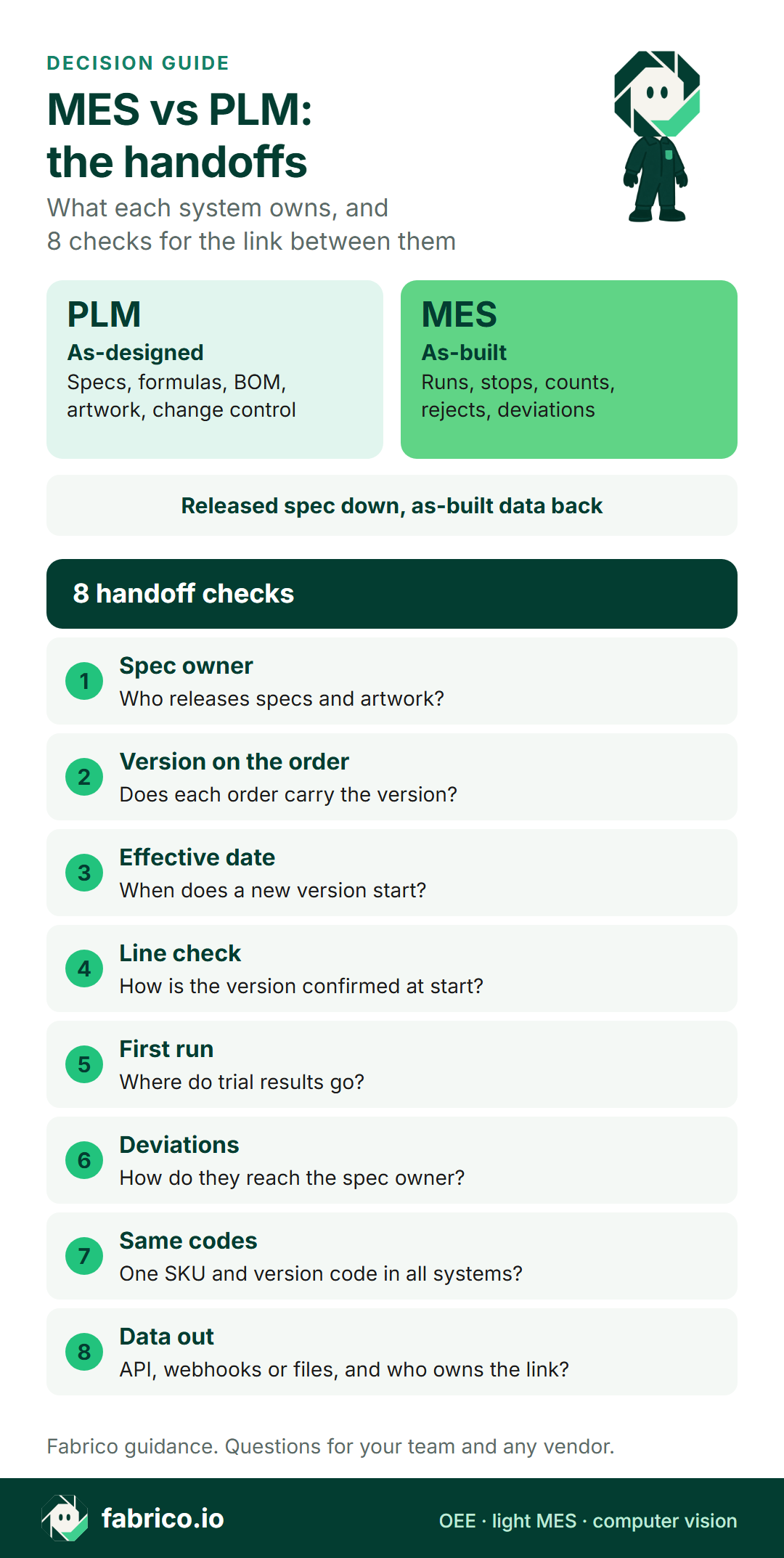
Text version of this infographic:
- Decision card titled MES vs PLM:
- the handoffs.
- PLM holds the as-designed product:
- specs, formulas, BOM, artwork and change control.
- MES holds the as-built record:
- runs, stops, counts, rejects and deviations.
- Released spec goes down, as-built data comes back, with 8 handoff checks:
- spec owner, version on the order, effective date, line check, first run, deviations, same codes and data out.
Want to see line data next to your spec process? Talk to us with your list of recent spec changes.
Worked example: the first run of a new version
Sample figures for illustration only. A packing line moves a snack product from version 4 to version 5: a new, thinner film and new artwork. The ideal rate is 100 packs a minute and each shift has 480 planned minutes. OEE = availability x performance x quality, and each loss is counted once.
- Version 4, last shift: 60 minutes of stops, so 420 minutes run. Availability 420 / 480 = 87.5%. Total count 37,800 of a possible 42,000 (420 x 100), so performance 90%. Good units 37,044, so quality 37,044 / 37,800 = 98%. OEE 0.875 x 0.90 x 0.98 = 77.2%, the same as 37,044 good / 48,000 possible.
- Version 5, first shift: 90 minutes of stops, mostly film tracking, so 390 minutes run. Availability 390 / 480 = 81.25%. Total count 33,150 of a possible 39,000, so performance 85%. Good units 31,824, so quality 31,824 / 33,150 = 96%. OEE 0.8125 x 0.85 x 0.96 = 66.3%, the same as 31,824 / 48,000.
The new version made 5,220 fewer good packs in the same shift (37,044 minus 31,824). Rejects rose from 756 to 1,326. Without line data, that gap shows up weeks later as a missed plan. With it, the spec owner sees on day one that the new film stops the line, and can decide with packaging and engineering whether the fix is in the spec, the machine set-up or the operator training.
Replace each figure with your own, and value the loss at the bottleneck, not at every machine on the line.
8 handoff checks between PLM and MES
Put these to your team and to any PLM or MES vendor. They match the card above.
- Spec owner. Who releases specs and artwork? One named role signs off a formula, a pack spec or an artwork file as released. Drafts never reach the line.
- Version on the order. Does each order carry the version? The order that reaches the line names the product and its version, not only the SKU. Without it, the line cannot tell old from new.
- Effective date. When does a new version start? A date, a batch or an order number, agreed with planning and purchasing, so old film and old labels run out on purpose.
- Line check. How is the version confirmed at start? At the start of the order, someone checks the film, the label and the code date against the released version, and the check is recorded.
- First run. Where do trial results go? Speed, stops, rejects and set-up notes from the first runs of a new version go back to the spec owner, not only into a shift report.
- Deviations. How do they reach the spec owner? When the line runs off spec, the record of what happened reaches the person who can change the spec, with a date and an owner.
- Same codes. One SKU and version code in all systems? PLM, ERP and the line system use the same product and version codes, or nobody can compare a version's runs.
- Data out. API, webhooks or files, and who owns the link? Agree how data moves between the systems, and name who fixes the link when it breaks.
Where Fabrico fits when a spec changes
In a spec change, Fabrico covers the as-built side: what the line did with each new version.
- First shift vs last shift: output, stops and OEE per shift put the new version's first shift next to the old one's last, as in the example above. Fabrico reads cycles, stops and output from the line's PLC, or from a Fabrico IoT device with external sensors on older machines.
- Why the new version stops: operators tag the cause of a stop on a tablet or phone, and downtime by cause, machine and shift shows whether film tracking is a new cause. Good parts and scrap can be entered on a tablet where no sensor counts them. See the solution overview and our guide to OEE software.
- Camera add-on: where there is no machine signal, the camera add-on counts output, and the camera add-on video for a stop is streamed when someone opens it, not stored in Fabrico in the standard setup. Stop-reason suggestions from the camera add-on are roadmap, in development. See computer vision for OEE.
- Next to other systems: Fabrico has a REST API and webhooks, and a connection to your ERP can be scoped per customer, so order and product data come in and results go back. Any list can be exported to Excel or CSV.
Devices are connected in about a month; the full rollout takes 3 to 4 months.
For sector detail, see MES for food manufacturing, MES for mid-size FMCG plants and cameras on FMCG lines, where the camera add-on counts output.
What people ask next
Do we need a PLM or an MES first?
Start where the loss is. If wrong versions, artwork errors or slow spec changes hurt most, fix spec release first. If you cannot say where the line loses time by shift and cause, measure the line first with OEE and a light MES.
Is PLM the same as ERP?
No. PLM holds how a product is designed and approved: formulas, specs, artwork and their versions. ERP holds the business side: items, orders, stock and costs. Many plants copy the released spec into the ERP item and its BOM.
How does a spec change reach the line?
The spec owner releases a new version with an effective date. The ERP item and BOM pick up that version, the order carries it to the line, and a start-up check confirms the right film, label and code before the run counts.
Can a spreadsheet replace a PLM?
For a small range with few changes, a controlled spec file with one owner and a version log can work. When SKUs, sites and change requests multiply, the manual copying between files becomes the risk.
What data should go back from the line to the spec owner?
Speed against the standard, stops by cause, rejects and deviations for each version, starting with the first runs. That shows whether a new version runs as well as the old one.
Does Fabrico connect to our PLM?
Fabrico is an OEE and light MES platform. Data leaves it through a REST API, webhooks and Excel or CSV export. How it would reach your PLM is a question to test with your own spec record.
Want the as-built record for your own first run of a new version? Talk to us with one recent spec change in hand.
Related articles



Real Fabrico tiles, sample data.