


 Login
 Blog
MES for Ready Meal Production: Who Holds Orders, Records and Line Data

In short: an MES for ready meal production has to keep pace with a plant that makes today what retailers ordered yesterday, on tray lines paced by people. Start with line data and OEE on one tray line, and keep orders, recipes, lots and labels in the systems that already hold them.
- The kitchen cooks and chills in batches; the tray line assembles and packs with a crew at the topping belt.
- Orders, recipes, cook and chill records, lots and labels usually live in the ERP, a quality system or a labelling system, not the MES.
- The usual gap is on the line: why line 3 ran short, how long each recipe change took, and whether today's orders will finish.
- Fabrico is a light MES: stops with reasons, counts, OEE and losses in money by line and shift. Production planning is on its roadmap, with no release date.
It is 14:00 in a chilled ready meal plant. Line 3 has run four recipes since six, and two more must be sealed, sleeved and packed before the evening trucks. The planner wants to know if they will make it. The ERP will know tomorrow.
This page is for plant managers and CI leads in chilled and frozen ready meal plants who are choosing an MES. For the measuring rules on the line itself, read OEE for ready meal production. We sell Fabrico, so test what we say like any vendor's claims.
What a ready meal plant needs from an MES
A ready meal plant has two halves that work on different clocks.
- The kitchen cooks rice, pasta, sauces and proteins in batches, then chills and holds them. Its world is recipes, weights, core temperatures, cooling times and lots.
- The tray line runs from the denester through depositors and the hand topping belt to the tray sealer, then weight and metal checks, sleeving and case packing. Its world is trays a minute, recipe changes, crew size and stops.
On top of both sits the order cycle. Chilled meals leave little room for stock, so many plants make close to the order: what the retailer called for last night runs today, often several recipes on one line.
The UK's Chilled Food Association says UK chilled food production runs at 130 sites and puts 15,000+ different foods on shelves each year. That trade body figure covers all chilled food, not only ready meals, but it shows how wide the mix is.
Temperature adds a second clock. The association's temperature guidance says chilled foods are designed to be stored at or below 8°C, targeting 5°C, and in England, Wales and Northern Ireland the 8°C rule covers ingredients at all stages of processing, with some exemptions. Components waiting at a stopped belt are on that clock.
The kitchen has to get it right and prove it; the tray line has to finish today's orders. Few plants run both in one system.
Ready meal MES functions, and where each one usually lives
The MESA model lists eleven MES functions. In a ready meal plant they turn into the jobs below. Read the right-hand column first: every row needs a home that works today.
| Function | What it does in a ready meal plant | Where it usually lives |
|---|---|---|
| Order intake and daily plan | Turns retailer orders into a run list for each line | ERP or a planning tool |
| Recipes and weighing | Component recipes, weights and depositor settings | Kitchen recipe and weighing system |
| Cook and chill records | Core temperatures and cooling times at critical control points | Quality or HACCP system, data loggers |
| Lot tracking | Links component lots to finished trays | ERP lot functions, or a full MES |
| Labels and use-by dates | The right sleeve, allergens and date on every pack | Labelling system linked to the ERP |
| Weights and giveaway | Tray weights against the declared weight | Checkweigher software |
| Crew and hours | Who stands where, and for how long | Time and attendance, the shift lead |
| Line data and OEE | Stops with reasons, counts, OEE by line, shift and recipe | Light MES |
Lots. Selling into the US? The FDA's Food Traceability Rule asks firms that manufacture, process, pack or hold listed foods to keep key data for set tracking events, and to give it to the FDA within 24 hours of a request, or an agreed time. The Food Traceability List includes refrigerated ready-to-eat deli salads, such as pasta salad, and the rule also covers foods that contain a listed food as an ingredient, if that ingredient stays in the same form, for example fresh. Congress has directed the FDA not to enforce it before July 20, 2028. Lot records belong in a system built for genealogy; see our lot traceability data model.
Weights. Under UK packaged goods rules for the average system, the average must not be below the label weight, few packs may fall short by more than the tolerable negative error, and none by more than twice it. For 300 to 500 g packs that error is 3%, so 12 g on a 400 g meal. Depositors run above 400 g to stay inside the rules, and the extra food is giveaway. The weights live in checkweigher software; see checkweigher rejects and OEE quality.
Only the last row of the table is light MES work. Our light MES guide shows the full split, and the card below adds Fabrico's part.
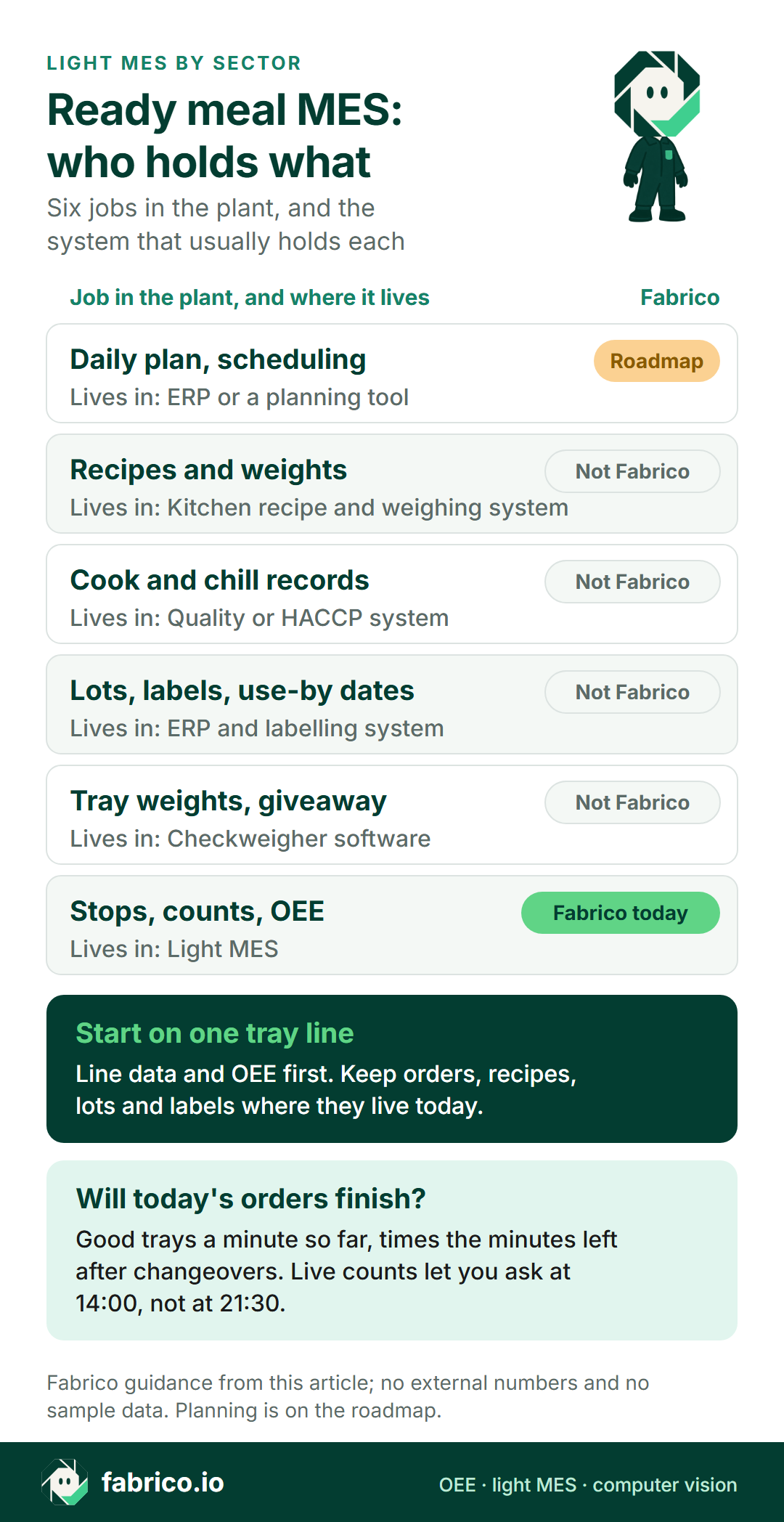
What the MES must keep apart on a ready meal line
The loss rules themselves are in OEE for ready meal production; the MES has to hold five kinds of time apart.
Many short runs
Recipe changes and validated allergen cleans come many times a day, so the line rarely reaches a dedicated line's OEE; see fair OEE targets for high-mix food lines.
Waiting for the kitchen
The MES needs a starved code with the kitchen as its cause, for the minutes the tray line waits for a component.
Crew-paced running
When the topping belt runs short of people, a short-crew reason keeps the slower running visible as a cost; see how OEE counts a missing operator.
The tray sealer
Film breaks, seal faults and denester jams add up to many short stops; our tray sealer OEE guide goes machine deep.
Late order changes
A retailer raises an order at noon, or cuts one, and the run list changes while the line runs. The ERP link has to carry the new quantity to the line screen, and the trays made back to the ERP, per recipe. If the line data cannot follow, the shift report compares today's output with yesterday's plan.
Start with line data and OEE on the tray line
The tray line is where today's orders are won or lost, and its sealer and depositors usually have a PLC to read. Start on one representative tray line.
- Count point: the tray sealer, or the slowest station if people set the pace.
- Recipe on every run: from the ERP or picked by the operator, so rates and losses read per recipe.
- Stop codes: recipe change, allergen clean, waiting for the kitchen, short crew, sealer fault, food safety check. Short enough to tap with gloves on.
- Hand stations: a camera count, or good and scrap trays entered on a tablet, so the topping belt is not a blind spot.
- Food safety stops: coded and counted, never shortened.
- Losses in money: so one 45-minute clean and twenty one-minute jams can be compared.
Worked example: will today's orders finish?
Example numbers, no real plant. Line 3 is a chilled tray line with an ideal rate of 50 trays a minute for its standard crew of eight. It runs from 06:00 to 21:30, with a 30-minute break in each half.
The morning. From 06:00 to 14:00, planned time is 450 minutes. Three changes took 75 minutes against a standard of 60: two 15-minute recipe changes and a 30-minute allergen clean between two similar recipes. The line made 15,000 good trays.
- OEE so far: 15,000 trays at 50 a minute is 300 minutes of ideal output, and 300 of 450 is 66.7%.
- Pace outside changeovers: 15,000 trays in 375 minutes is 40.0 good trays a minute. Stops, kitchen waits, short crew and rejects took the rest.
The afternoon. From 14:00 to 21:30, planned time is 420 minutes. Two changes are left at their standard times: a 15-minute recipe change and a 45-minute full allergen clean, from a milk recipe to a milk-free one. That leaves 360 running minutes. Orders left: 9,000 trays of recipe E and 6,600 of recipe F, so 15,600 trays.
- At the morning's pace: 360 x 40.0 = 14,400 trays. The line is 1,200 trays short, about 30 minutes of running.
- If the changes overrun like the morning's, by a quarter: 75 minutes, 345 running minutes and 13,800 trays. Then the gap is 1,800 trays.
The sum is simple. What matters is when you can do it. With live counts and coded stops, the planner sees the gap at 14:00 and still has choices: move part of recipe F to line 2, find cover for the topping belt, call the kitchen, or agree a short delivery now instead of at 21:30. The stop codes say which lever is real.
For planning on the rates a line has actually shown, see scheduling at demonstrated rates.
Light MES or full MES for a ready meal plant
A light MES covers the half closest to the machine, line data and OEE, and leaves orders and genealogy in the ERP. Pick by the pain you feel every day.
| If the daily pain is | Start with | Fabrico's part |
|---|---|---|
| Nobody can say why line 3 ran short | A light MES on one tray line | This is the core |
| The run list is rebuilt by hand each morning | Your ERP or a planning tool | Roadmap, not live |
| A mock recall takes hours | Lot tracking in the ERP, or a full MES | None |
| Auditors want electronic cook and chill records | A quality or HACCP system, or a full MES | None |
| A wrong sleeve or date reaches a pack | A labelling system and label checks | None |
| Depositors give away food | Checkweigher software and depositor settings | None; rejects can feed quality |
Many plants end up with both: genealogy where a retailer or regulator requires it, line data and OEE on every tray line. Our light MES vs full MES guide gives four checks to decide.
Bring one day's run list and a week of stop sheets to a demo, and we will show which rows Fabrico can fill and which it cannot.
Seven questions for any ready meal MES vendor
Ask every vendor, us included, to answer in writing, and test the answers in a pilot on one line.
| Ask | How to test the answer |
|---|---|
| How does a late order change reach the line? | Change a quantity in your ERP test system and time it to the line screen. |
| Can the ideal rate follow the recipe and the crew? | Ask for rates per recipe for a standard crew, and short crew as speed loss. |
| Are kitchen waits charged to the kitchen? | Find a starved code with the kitchen as its cause in the loss report. |
| How are hand stations counted? | Camera, tablet entry or nothing? Run it beside a hand count for one shift. |
| How does a gloved operator tag a stop? | Watch one of your operators do it at the topping belt, in high care. |
| What stays in our ERP? | Ask which data comes in, which goes back, and who owns the link. |
| What is live, and what is roadmap? | Get it in writing, with a date for live data on one line. |
Still comparing platforms in general? Our guide to OEE software sets out what to compare.
Crews, cameras and the works council
Software that measures a crew-paced line can feel like it measures the crew. Measure the line, never the person: report by line, shift and recipe, not by name, and tell staff before anything goes live. In many European countries, talk to the works council first.
If you add cameras to count trays at the topping belt or the sleever, frame them on the trays. Our page on computer vision for ready meal production shows where a camera earns its place, and production line cameras without surveillance has a fuller checklist.
Where Fabrico fits
Fabrico is a cloud OEE and light MES platform. On a ready meal line it does this today:
- Line data: stops and counts from the sealer or depositor PLC, or from an IoT device with sensors on older machines. Stop reasons come from the operator, on a tablet or phone.
- OEE and losses: OEE, downtime and losses by line and shift, shown in money, with micro-stops detected from the signal. Live output shows how much each line has made so far in the shift. On the web, iOS and Android.
- Cameras: AI cameras, an add-on on request, count output at manual steps such as hand topping and sleeving, and you can open the video for any moment on the shift timeline. In the standard setup, video is streamed when someone opens it and is not stored in Fabrico.
- Your ERP and your data: a connection to SAP or another ERP, scoped per customer, plus a REST API, webhooks and Excel or CSV export.
Maintenance is built in, so a technician opens a work order from the stop, on the same machine record. Devices connected in about a month; full rollout in 3 to 4 months.
Roadmap, not live today: Production planning is on our roadmap, with no release date. Today Fabrico does not build or schedule your plan: it shows what the lines can do. Also on the roadmap for the camera add-on: stop-reason suggestions from the camera, confirmed by the operator.
What Fabrico does not do: recipes and weighing, cook and chill records, lots and genealogy, labels and use-by dates, giveaway statistics and inspection. Those stay in your ERP, quality, labelling and checkweigher systems, and Fabrico makes no HACCP claim.
See the full scope on our MES and OEE software page and the camera add-on on Fabrico computer vision for OEE. Related reading: computer vision for FMCG manufacturing and the parent guide, MES for food manufacturing.
What people ask next
What does an MES do in a ready meal plant?
It runs and records production between the ERP and the lines: recipes, weights and cook and chill records in the kitchen, and counts, stops, recipe changes and OEE on the tray line. Most plants split these across the ERP, a quality system and a light MES.
Do ready meal plants need a full MES?
Only where a retailer, an auditor or the law expects electronic batch and lot records that your ERP and quality systems cannot keep. Where lost output is the main cost, start with line data and OEE on one tray line.
Can an MES plan tomorrow's ready meal orders?
Some full MES suites and planning tools can. Production planning is on Fabrico's roadmap, with no release date. Today Fabrico does not build or schedule your plan: it shows what the lines can do.
Does Fabrico track lots and use-by dates?
No. Lots, genealogy, labels and use-by dates stay in your ERP and labelling system. Fabrico records what each line did, when it stopped and why.
Where does an MES get counts at hand stations?
From a camera, such as Fabrico's AI camera add-on, which counts output at manual steps, or from good and scrap trays entered on a tablet. Where the camera goes is covered in computer vision for ready meal production.
How long does it take to start?
Here is Fabrico's timeline. Devices connected in about a month; full rollout in 3 to 4 months. Ask every vendor for the same, with what you must have ready.
Want to see it on a line like yours? Book a demo and bring one day's run list from a tray line.
Related articles

Latest from our blog



Real Fabrico tiles, sample data.