





 Login
 Blog

Epicor Mattec MES alternatives: 5 options by the job you need done

In short
- Choose by the job: If mould availability should drive the job plan, look at the ARBURG host computer system (ALS). If your presses come from several makers, look at ENGEL authentig. If packaging or medical moulds need one view from the resin silo to part handling, look at Husky Shotscope 4.0. If shot counts, setting data and colour sequences belong in one MES, look at MPDV HYDRA X. If ERP and MES are replaced together, look at DELMIAWorks.
- What Epicor offers today: Epicor's pages call the product Epicor Advanced MES, and an Epicor customer video page writes "Epicor Advanced MES (Mattec)". It collects data from equipment and operators in real time, and the rubber and plastics page names active cavity tracking and family molding.
- Map the losses before any demo: the loss map on this page gives every press one row for mould changes, purging and colour changes, start-up scrap, short shots and other rejects, and waiting for material or an operator.
- In this example: a 6-week pilot on a cell of four presses lifts OEE from 70.65% to 74.85%, worth EUR 3,656.52 a month and EUR 43,878.24 a year if the gain holds.
- Put the same seven questions to every vendor: two of them ask where start-up parts after a mould change are booked and how a blocked cavity changes the part count.
Searching for Epicor Mattec MES alternatives means choosing the system that every press in the plant will report to. For an injection moulder that choice turns on five losses: mould changes, purging and colour changes, start-up scrap, short shots and other rejects, and waiting for material or an operator.
Below you will find what Epicor's pages say about the product today, a loss map to fill in press by press, and five alternatives described from their makers' own sites. A decision matrix, a four-press pilot priced in EUR and seven vendor questions follow.
Epicor Advanced MES: what Epicor's own pages describe
Epicor's product page and its rubber and plastics page, both read for this article, use one name: Epicor Advanced MES. An Epicor customer video page about Sistema Plastics writes "Epicor Advanced MES (Mattec)" (Epicor, Sistema Plastics video page, accessed 27.11.2026).
The product page says Epicor Advanced MES "collects data directly from equipment and operators on the shop floor in real-time" (Epicor Advanced MES, accessed 27.11.2026). Its capability list covers:
- real-time production scheduling, and business intelligence and analytics;
- data integration through the Data Exchange module, an import and export wizard;
- alerts and notifications with automatic messaging and escalation;
- quality management with a module for statistical process control (SPC) and statistical quality control (SQC);
- energy monitoring by plant, department, resource, job or part;
- maintenance, and edge computing through the Epicor Advanced MES CF-MIU.
The same page names nine industries: aerospace and defense, construction and engineering, electronics and high tech, fabricated metals, furniture and fixtures, industrial machinery, medical devices, metal service centers, and rubbers and plastics.
For moulders, the rubber and plastics page says Advanced MES supports "active cavity tracking and family molding". It builds schedules that take mould and tooling changeovers into account, and its SPC and SQC module can automate parts rejection (Epicor, Rubber and Plastics, accessed 27.11.2026).
On the ERP side, that page presents Advanced MES next to Epicor Kinetic, Epicor's manufacturing ERP. The Advanced MES scheduling page lists ERP integration: a connection with the existing ERP system that creates one unified production plan (Epicor Advanced MES, Scheduling, accessed 27.11.2026).
This page covers the MES. For the ERP, a separate article on shop-floor maintenance alongside Epicor Kinetic explains keeping Kinetic for finance and adding an execution and maintenance layer on the floor.
The moulding-shop loss map: one row per press
A vendor demo starts from screens. A moulding plant gets more from starting with the minutes and parts each press loses in a normal week, split into the losses that belong to moulding. The map below holds five of them. Breakdowns and short stops get their own rows in the worked example further down.
ISO 22400-2:2014 sets out manufacturing KPIs by formula, elements, time behaviour and unit, and relates them to work units "as specified in IEC 62264" (ISO 22400-2:2014, accessed 27.11.2026).
This page treats one press with its mould, robot and dryer as the work unit. So the map is filled in per press, and only then summed for a cell or a hall.
| Loss | What it looks like at the press | How to capture it, per press | Your press: min or parts a day |
|---|---|---|---|
| Mould changes | From the last good part of the old mould to the first approved part of the new one: clamps, water hoses, gripper fingers, heating | A planned stop with the mould number, start and end, against a standard time for that mould | ___ |
| Purging and colour changes | Barrel and hot runner flushed until the new colour runs clean; dark to light takes the longest | A stop reason of its own, apart from the mould change, with the purge material weighed | ___ |
| Start-up scrap after a change | Shots set aside until the part is approved: wrong shade, unstable size, marks | Parts counted into a labelled bin at each press and booked by product and reason | ___ |
| Short shots and other rejects | Short shots, flash, sink marks and black specks during the run | Booked by product and defect each shift; by cavity where the mould has several | ___ |
| Waiting for material or an operator | Dryer not ready, wrong grade at the hopper, no setter free, no one to clear a robot fault | Two stop reasons, not one, chosen by the operator at the press | ___ |
Fill in the last column with the setter and the shift lead for two or three presses. A week of notes on paper is enough for a first map, and it tells you which rows the new system has to get right.
Why measuring a change comes before fixing it
Agung and Hasbullah studied a maker of plastic packaging that moulds by injection. At the start, the plant had no measurement of its changeover time. After SMED and 5S work, the changeover time fell by 18% (Agung and Hasbullah, SINERGI 23(3), 2019, accessed 27.11.2026).
The point for an MES choice is narrow. A system earns its place on a moulding floor when it puts a number per press on each of the five rows. During the pilot, ask every vendor to fill in the map for one of your own presses.
Three ways to read a filled-in map
- If mould changes and start-up scrap lead the map, the system has to tie both to the mould number and to the standard time of that mould.
- If purging and colour changes lead, look for colour sequencing in planning and a stop reason for purging that is kept apart from the mould change.
- If waiting for material or an operator leads, the fix lies in material flow and staffing, and the system only has to tell the two kinds of waiting apart.
Treat the three rules as a working method of this article; no standard sets them. Agree the thresholds with the plant team before the first demo.
Five alternatives for moulders, from the press outward
The order runs from systems that come from makers of moulding machines and moulds to a plant-wide MES and an ERP suite. The sequence reflects the buyer's situation and says nothing about merit. All vendor facts below were read on the vendors' own sites (accessed 27.11.2026).
For a wider view, the guide to MES alternatives for mid-sized plants compares lighter options across industries. The best MES software guide compares seven systems and explains who needs a full suite. This page stays with injection moulding.
ARBURG host computer system (ALS): mould availability in the job plan
ARBURG calls ALS its modular production management tool and a Manufacturing Execution System (MES) for planning and controlling plastic parts production. In ARBURG's words, ALS is "tailor-made for injection moulding production" (ARBURG host computer system (ALS), accessed 27.11.2026).
When jobs are planned, ALS takes into account the storage location and availability of injection moulds, including inserts and accessories. It documents the life cycle of the equipment: shot counts, operating hours and set-up processes are determined automatically.
A machine, its peripheral equipment, a mould and a material can be defined as one combination with a single validated data set, which the page says enables GMP-compliant documentation.
The whole production system can be integrated, manual workstations included. Process data is available across several locations and to higher-level PPC and ERP systems, and ALS Mobile and an MES cloud solution are listed as features.
Look at it if mould availability should decide which press runs which job, and medical or other regulated work needs validated combinations of machine, mould and material. The page's next step is a white paper.
ENGEL authentig: a machine maker's MES across press brands
ENGEL presents authentig as modular MES software that networks injection moulding machines and returns results and KPIs by article and by order. ENGEL says it develops its MES "especially for the requirements of plastics processing" and for injection moulding machines (ENGEL, authentig machine data acquisition, accessed 27.11.2026).
Dashboards show pieces per shift, cycle time deviation and plant availability. Process and part data can be recorded to determine process capability (cmp) and machine capability (cmk), for example to catch weight fluctuations early.
The modules fall into four groups: production monitoring, production control (set-up, maintenance, order management, quality measuring, a web terminal), analysis, and networking with ERP, CAQ and APS systems. According to the same page, authentig is designed for use across different machine manufacturers, with industry interfaces such as EUROMAP, and older machines can join through retrofit solutions or added signal detection.
Look at it if the press park mixes ENGEL machines with other brands and the plant wants a machine maker's MES with process and machine capability studies per press. The page invites an expert request.
Husky Shotscope 4.0: from the resin silo to part handling
Husky describes Shotscope 4.0 as its integrated "Real Time Plant Monitoring Software" for production and process data. It promises access to the data "from the silo all the way down the part handling equipment", and its data collector connects the process from pellet to part (Husky, Shotscope 4.0, accessed 27.11.2026).
Husky frames the work in four verbs: plan, track, analyze and act. Shotscope 4.0 runs on a virtual server and can be viewed on any device. Its tutorial list covers SQC data entry, scrap entry, job creation and a job scheduler, process SPC, a maintenance module, shift set-up and a reporting module.
Husky's industries menu lists beverage packaging, food packaging and consumer goods, medical applications, and hot runner and controller markets.
Look at it if the plant runs packaging or medical moulds and wants resin, process and part handling data in one monitoring view, with SPC and scrap entered by shift. The page ends with a contact form.
MPDV HYDRA X: tools, setting data and colour sequences in one MES
MPDV describes HYDRA X as an MES for all sectors of industry and gives plastics production a page of its own. It names mApps that collect operating, machine, tool and process data, up to personnel time recording (MPDV, MES for the plastic production, accessed 27.11.2026).
For moulds with several cavities, HYDRA X manages the tools, including the number of shots and maintenance intervals. It transfers setting data to injection moulding machines from different makers, and the page names Arburg, Boy, Engel, Fanuc, KraussMaffei and Wittmann Battenfeld as examples.
Other functions on the page: material consumption in real time, energy consumption per produced article, process data such as screw temperature and injection pressure, cavities included in inspections, and traceability of the raw material and tools used.
Together with the planning system APS FEDRA, the page describes planning of secondary resources such as material drying and special moulds. It also covers sequence-dependent set-ups: a colour change from dark to light needs extra cleaning that the reverse change may not.
Look at it if shot counts, setting data and the colour sequence should sit in one MES, and toolmaking or assembly should report into the same system. MPDV's main menu links to a contact page.
DELMIAWorks: ERP and MES in one database for plastics
Dassault Systèmes presents DELMIAWorks, formerly known as IQMS, as a manufacturing ERP and MES system for small-to-mid-sized and mid-market manufacturers. Its page says ERP and MES are blended into "one shared database" (Dassault Systèmes, DELMIAWorks, accessed 27.11.2026).
The FAQ on that page names plastics, automotive, aerospace, medical devices and industrial equipment among its discrete industries, with modules for injection molding, stamping, machining, assembly and tooling management.
The plastics ERP page lists family tools, multi-level and multi-process BOMs, regrind usage and consumption, recipes and blends, and cavitation. Its RealTime Production Monitoring System tracks data directly from work centers and updates production schedules and inventory (DELMIAWorks, Plastics Manufacturing ERP, accessed 27.11.2026).
Look at DELMIAWorks if a new ERP is due at the same time and the plant wants quotes, family tools, regrind and press monitoring in one database. The page offers a contact request.
If the map points to a narrower first step, such as stops and scrap on a handful of presses, start with the light MES guide, then weigh light MES vs OEE software.
Decision matrix for a moulding plant
The table keeps only rows that point to different products. Every reason repeats a fact from the vendor page cited earlier, and every test can run within the six-week pilot below. The final row covers a plant that stays with Epicor Advanced MES and adds to it.
| If this is you | Look first at | Why (from the vendor's own page) | Prove it in the pilot by |
|---|---|---|---|
| Mould availability decides the job plan, and regulated work needs validated sets | ARBURG host computer system (ALS) | Plans with mould storage location and availability; one validated data set per machine, mould and material | One week of cell jobs planned with mould locations; one validated set documented |
| Presses from several makers, with capability studies per press | ENGEL authentig | Designed for use across machine manufacturers; cmp and cmk from process and part data | One press from another maker and one older press connected; pieces per shift matched to the packed count |
| Packaging or medical moulds, with one view from silo to part handling | Husky Shotscope 4.0 | Plant monitoring from silo to part handling; SPC, scrap entry and a job scheduler | Scrap and SPC entered by shift on one mould for two weeks; one resin lot traced to a box |
| Colour changes on every shift, and tools with shot counts and service intervals | MPDV HYDRA X | Tools with shots and maintenance intervals; APS FEDRA for sequence-dependent set-ups | Mould shot count matched to the press counter; one week planned from light to dark |
| The ERP is replaced too, with regrind and family tools in scope | DELMIAWorks | ERP and MES in one shared database; family tools, regrind, cavitation | One family-tool job quoted, run and costed, with regrind booked |
| Epicor Advanced MES stays, and the next job is rejects per cavity | Epicor Advanced MES | Active cavity tracking and family molding; SPC and SQC module | Cavity tracking switched on for one family mould; rejects per cavity compared over two weeks |
Worked example: six weeks on a four-press cell
Every number in this section is sample data made up to show the arithmetic. It comes from no customer and describes no vendor's results.
The cell and the plan
- Presses: four 180-tonne presses at a custom moulder, each with a robot and a dryer, running 4-cavity moulds for PP caps and housings in six colours. To keep the arithmetic short, all moulds share an ideal cycle of 20 seconds: 3 shots a minute, 12 parts a minute per press.
- Time: 24 hours a day and 21 production days a month. Each press has 1,440 planned minutes a day, so the cell has 5,760. Ideal output: 5,760 × 12 = 69,120 parts a day.
- Week 1: a run signal and a shot count on each press, 12 stop reasons that include the five losses of the map, and standard times of 50 minutes for a mould change and 15 minutes for a colour change.
- Weeks 2-3: a baseline of 10 production days with nothing changed.
- Weeks 4-5: three fixes.
- Week 6: compare, price and decide.
The baseline, press by press
Stop minutes per day, averaged over the 10 baseline days:
| Stop minutes a day | P1 | P2 | P3 | P4 |
|---|---|---|---|---|
| Mould changes (cell: 5 a day, 400 min) | 110 | 60 | 150 | 80 |
| Purging and colour changes (cell: 8 a day, 180 min) | 70 | 30 | 20 | 60 |
| Waiting for material or an operator (cell: 190 min) | 40 | 85 | 25 | 40 |
| Breakdowns: robot, hot runner, water (cell: 240 min) | 60 | 45 | 100 | 35 |
| All stops (cell: 1,010 min) | 280 | 220 | 295 | 215 |
Each press tells a different story. P3 carries the longest mould changes: its heavy housing mould waits for the crane and is heated on the press. P1 and P4 hold 130 of the 180 colour-change minutes, because the plan switches from black to white twice a day. P2 loses 85 minutes waiting for dried material after each grade change.
Scrap per day for the cell:
- Start-up after mould changes: 5 changes × 40 shots × 4 cavities = 800 parts
- Start-up after colour changes: 8 changes × 20 shots × 4 cavities = 640 parts
- Short shots and other rejects in the run: 2% of the parts counted (worked out below) = 1,026 parts
OEE from the baseline, step by step:
- Availability: (5,760 - 1,010) / 5,760 = 4,750 / 5,760 = 82.47%
- Performance: short stops (missed gripper picks, parts hanging in the mould) take 300 minutes and slow cycles 175 minutes. Net run: 4,750 - 475 = 4,275 minutes; 4,275 / 4,750 = 90.00%
- Parts counted: 4,275 × 12 = 51,300, so the reject line is 2% × 51,300 = 1,026
- Quality: scrap 800 + 640 + 1,026 = 2,466; good parts 51,300 - 2,466 = 48,834; 48,834 / 51,300 = 95.19%
- OEE: 0.8247 × 0.9000 × 0.9519 = 70.65%. Check without rounding: 48,834 / 69,120 = 70.65%.
Three fixes in weeks 4-5, carried to EUR
- Mould changes: the next mould is preheated on a heating station and staged on a cart with its hoses and gripper fingers. The average change falls from 80 to 56 minutes: 5 × 56 = 280 minutes a day instead of 400.
- Colour changes: the weekly plan runs from light to dark, and purging follows a written procedure. The average falls from 22.5 to 15 minutes: 8 × 15 = 120 minutes instead of 180. Start-up scrap drops from 20 to 12 shots per colour change.
- Waiting for material: each dryer is loaded to the plan one hour before a grade change. Waiting falls from 190 to 120 minutes a day.
Breakdowns (240 minutes), the 90.00% performance and the 2% reject rate in the run stay as they were.
- Availability: (5,760 - 280 - 120 - 120 - 240) / 5,760 = 5,000 / 5,760 = 86.81%
- Net run: 5,000 × 0.90 = 4,500 minutes; parts counted 4,500 × 12 = 54,000
- Scrap: 800 after mould changes + 8 × 12 × 4 = 384 after colour changes + 2% × 54,000 = 1,080 in the run = 2,264
- Good parts: 54,000 - 2,264 = 51,736; quality 51,736 / 54,000 = 95.81%
- OEE: 51,736 / 69,120 = 74.85%, up 4.20 points
- Extra good parts: 51,736 - 48,834 = 2,902 a day
In this example each good part adds EUR 0.06 of contribution margin. So 2,902 × EUR 0.06 = EUR 174.12 a day; × 21 production days = EUR 3,656.52 a month; × 12 months = EUR 43,878.24 a year if the gain holds, provided customers take the extra caps and housings.
If orders stay flat, the gain is press time instead. The baseline makes 21 × 48,834 = 1,025,514 good parts a month. At 51,736 a day that volume needs 1,025,514 / 51,736 = 19.82 days, so in this example about 1.2 days of the whole cell are free each month for other jobs.
The money holds only if the count holds. Before pricing, check shots × active cavities against the parts packed for at least five days, and make sure a blocked cavity is entered: a 4-cavity mould running on 3 cavities makes 9 parts a minute, not 12.
Seven questions to put to each moulding MES vendor
Send the questions in writing with your filled-in loss map, and ask for an answer per press. Answers tied to your own presses compare far better than slides.
- On a press from another maker, and on the oldest press in the hall, which signal marks one shot, and who wires it?
- When one cavity of a 4-cavity mould is blocked off, how does the part count change, and who enters it?
- How is a mould change booked: as a planned stop with the mould number, from the last good part to the first approved part, against a standard time?
- Where do start-up parts after a mould or colour change go: a scrap reason of their own by product, or one total for the shift?
- Can purging and colour changes be kept apart from mould changes, and can the purge material be booked by weight?
- Which reject reasons (short shot, flash, sink mark, black specks) does the operator book, in how many taps, and by product?
- What goes back to the ERP after each job: good parts, scrap by reason, mould shots, times?
On question 7, the ISA page gives IEC 62264 as another name for ISA-95 and says the series aims to integrate logistics systems with manufacturing control systems. Its Part 5 defines the transactions between business and manufacturing applications at levels 3 and 4 of the model (ISA, ISA-95 Series of Standards, accessed 27.11.2026).
Then find out which of those exchanges each vendor supports when a job is reported back.
On question 3, write your standard time per mould into the question. A vendor who knows the 50 minutes you expect can show the overrun on a real change instead of a generic chart.
This week on the moulding floor
- Print the loss map and fill it in for your four busiest presses with the setter and the shift lead.
- Time the next three mould changes from the last good part to the first approved part, and note what the crew waited for.
- Put a labelled bin at each press for start-up scrap after mould and colour changes, and weigh it at the end of every shift.
- Ask the material handler to note each wait for dried material and each wait for a setter, as two separate lines.
- Write down the contribution margin per part for the main moulds, so the last pilot day ends with a EUR figure.
- Send the seven questions with the filled-in map to two or three vendors.
These steps cost staff time only, and they put your own numbers on the table at the first vendor meeting.
The shortlist card for a moulding plant
One page holds the five situations, the stay-with-Epicor option and a pilot test for each. Take it to the shortlist meeting where two or three vendors are chosen.
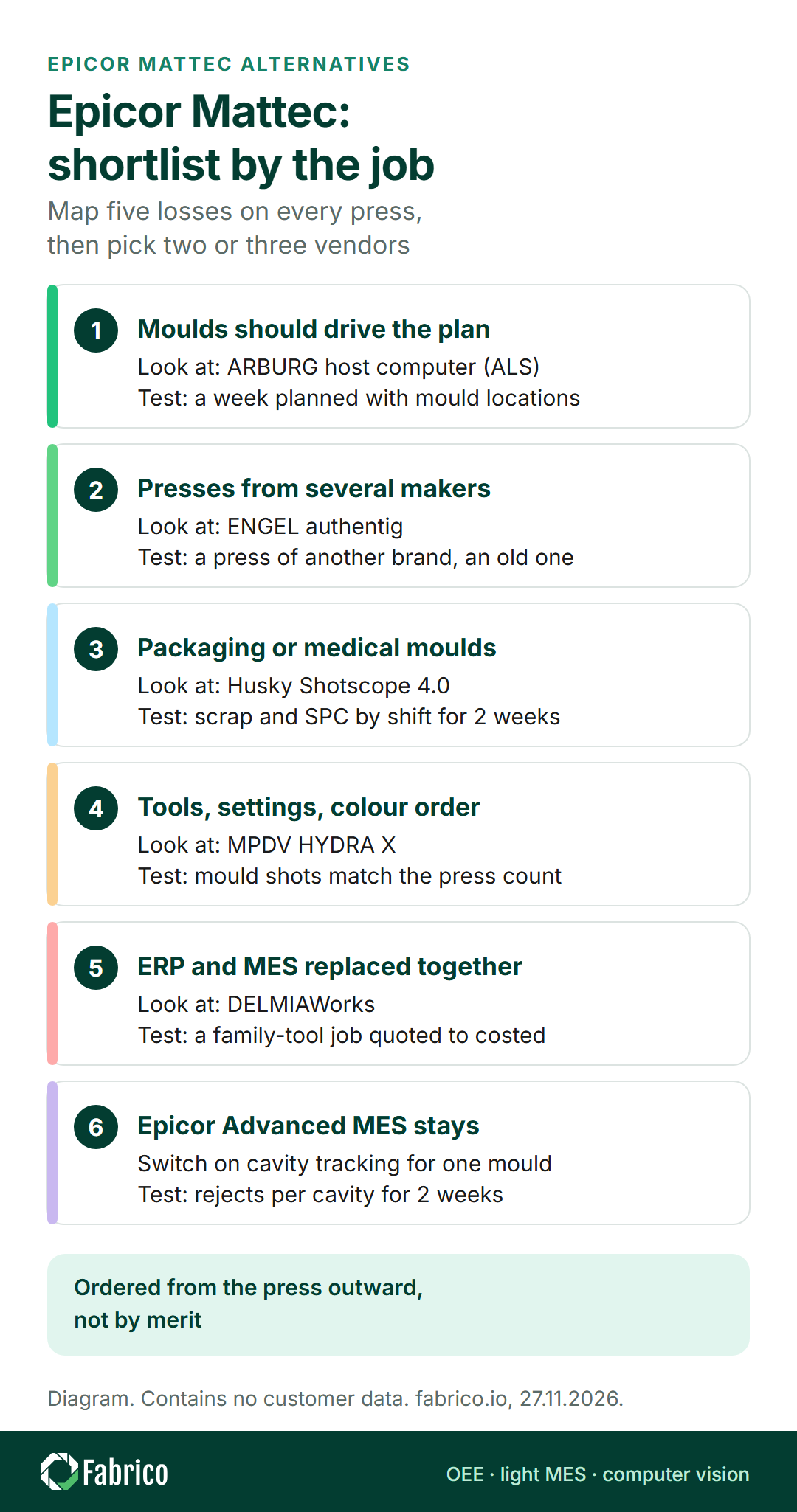
Text version of the diagram
- Mould availability should drive the plan: look at the ARBURG host computer system (ALS). Test: one week of jobs planned with mould locations.
- Presses from several makers: look at ENGEL authentig. Test: one press from another maker and one older press connected.
- Packaging or medical moulds: look at Husky Shotscope 4.0. Test: scrap and SPC entered by shift for two weeks.
- Tools, setting data and colour order in one MES: look at MPDV HYDRA X. Test: mould shots matched to the press counter.
- ERP and MES replaced together: look at DELMIAWorks. Test: one family-tool job quoted, run and costed.
- Epicor Advanced MES stays: switch on cavity tracking for one mould. Test: rejects per cavity compared for two weeks.
Where Fabrico fits
Fabrico suits a moulder whose first step is narrower than an MES with tool management: OEE, stops and scrap on each press, priced in money, before an MES contract is signed.
- OEE per press: live by machine and shift for each stand-alone press, fed by the press PLC or a Fabrico IoT device. If a press gives no usable signal, a camera that covers it counts output.
- Mould and colour changes: kept as planned stops apart from unplanned ones such as breakdowns, with each changeover tracked against a standard time.
- Stop reasons and scrap: operators add the stop reason in a few taps, so waiting for material and waiting for an operator stay two reasons. Scrap is recorded by product and reason, so start-up scrap and short shots stay apart.
- Money: the Financial impact module prices losses in EUR per SKU and ranks stops by what they cost.
Fabrico is made by the publisher of this article.
The MES and OEE solution overview describes the product. To walk through a press of your own, book a demo.
Frequently asked questions
Is Epicor Mattec the same as Epicor Advanced MES?
Epicor's product page and its rubber and plastics page use the name Epicor Advanced MES, and an Epicor customer video page writes "Epicor Advanced MES (Mattec)". This article uses the current name for every fact it cites.
What does Epicor Advanced MES do for injection molding?
Epicor says it collects data from equipment and operators on the shop floor in real time. For plastics it names active cavity tracking, family molding, schedules that account for mould and tooling changeovers, and an SPC and SQC module that can automate parts rejection.
What are the alternatives to Epicor Mattec MES?
By situation: the ARBURG host computer system (ALS) where mould availability drives planning, ENGEL authentig for presses from several makers, Husky Shotscope 4.0 for packaging and medical moulding from silo to part handling, MPDV HYDRA X for tools, setting data and colour sequences in one MES, and DELMIAWorks where ERP and MES are replaced together.
Does Epicor Advanced MES work with Epicor Kinetic?
Epicor's rubber and plastics page presents Advanced MES next to Epicor Kinetic, and the Advanced MES scheduling page lists integration with the existing ERP system for one production plan. The product page also names a Data Exchange module for importing and exporting data.
Which industries does Epicor Advanced MES serve?
The product page lists nine: aerospace and defense, construction and engineering, electronics and high tech, fabricated metals, furniture and fixtures, industrial machinery, medical devices, metal service centers, and rubbers and plastics.
Which MES products come from injection moulding machine makers?
ARBURG offers its host computer system ALS, and ENGEL offers authentig, which ENGEL says is designed for use across different machine manufacturers. Husky, whose solutions menu lists systems, moulds and hot runners, offers Shotscope 4.0 for plant monitoring.
How is OEE calculated for an injection moulding press?
Availability is run time over planned time, with mould changes, colour changes and waits counted as stops. Performance compares the shots made with the ideal cycle, and quality is good parts over parts counted, start-up scrap included. On a multi-cavity mould, parts equal shots times the cavities in use.
Want to see a mould change priced in EUR? In a demo, one press shows its stops by reason, its changeovers against a standard time, and the cost of each loss in the Financial impact module.
Latest from our blog




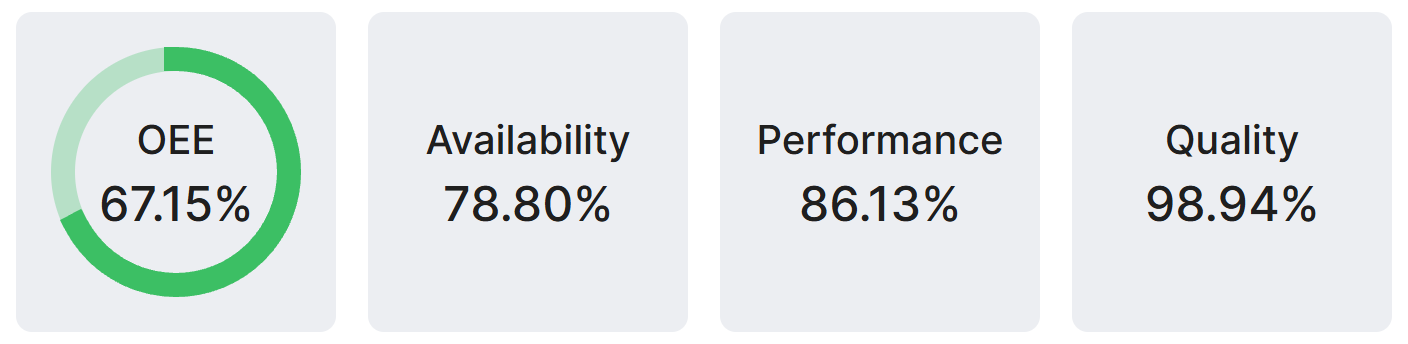
Fabrico screen, sample data.