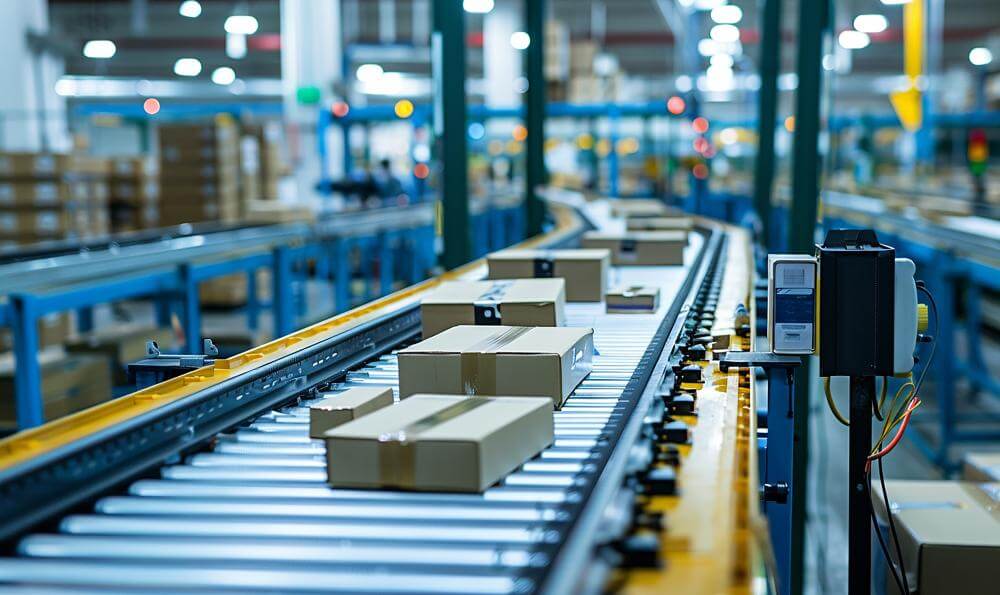

A water spider (mizusumashi) is a dedicated material-handling operator who runs a fixed, timed route to deliver parts, remove finished goods, and replenish supermarkets so production cells never stop to fetch their own materials.
The Japanese term mizusumashi refers to the whirligig beetle that skims across a pond in constant motion, a fitting image for a role built around continuous, predictable circulation.
In a lean plant the water spider is the circulatory system: value-adding operators stay at their stations, and one trained runner keeps every cell fed on a repeating cadence. Done well, this role converts chaotic, on-demand fetching into a scheduled, standardized flow of materials.
The water spider is not a general gofer. The role is deliberately standardized so that the same tasks happen at the same points on every loop. A typical route bundles several jobs into one pass:
Because the water spider touches every cell on a known schedule, the role also becomes the plant's early-warning sensor. This tight coupling with a pull system and physical kanban signals is what separates a real mizusumashi from ordinary forklift shuttling.
When operators leave their stations to hunt for parts, three things happen: the machine sits idle, walking time balloons, and delivery becomes unpredictable. A fixed-cycle route solves all three by making replenishment a scheduled event rather than a reaction.
The route runs on a set interval (often called the pitch), whether or not any single cell is urgently short, because the interval is sized so no cell can starve before the next visit.
This predictability is what protects flow. If you have mapped your process with value stream mapping, the water spider is frequently the mechanism that shrinks the waiting and transport waste those maps expose. It also stabilizes throughput because material availability stops being the random variable that stalls a line.
A route is engineered, not improvised. Four inputs drive the design:
The design goal is a loop time that is comfortably shorter than the fastest cell's time-to-starve. If any cell would run dry before the runner returns, you either shorten the loop, add a runner, or raise the point-of-use buffer.
Consider a small assembly area with five cells arranged along one aisle. You want to confirm that a single water spider on a 20-minute cycle can keep every cell supplied.
Time-to-starve for the tightest cell is 2 bins x 60 minutes, which is 120 minutes of runway. A 20-minute planned cycle refreshes every cell six times within that window, so the buffer is never at risk. The measured 17-minute workload also leaves about 3 minutes of slack inside the 20-minute pitch to absorb small variation.
Conclusion: one runner on a 20-minute standardized loop is sufficient, with margin. If consumption doubled (a bin every 30 minutes), time-to-starve would fall to 60 minutes; a 20-minute loop still covers it three times over, so you would keep one runner but might trim the point-of-use buffer to reduce inventory.
This is essentially a small application of Little's Law thinking: the inventory sitting at each point of use is a direct function of replenishment interval and consumption rate.
The water spider role only delivers stable flow if it runs on documented standard work. Each loop should have a defined sequence, a target cycle time, and a visual route map posted at the runner's start point.
Common practices include a timed departure at each pitch, a checklist of pickups and drops per stop, and a rule that the runner never deviates from the route to chase a one-off request (those get logged and handled by exception).
Container standardization and clearly labeled lanes keep load and unload times consistent, which is what makes the cycle time repeatable enough to trust.
When the route is stable, the water spider becomes a reliable audit of shop-floor conditions and a natural extension of autonomous maintenance habits, since the runner routinely spots leaks, loose guards, or abnormal noise while passing each machine.
A water spider route runs on trust in the numbers: how fast each cell is actually consuming material, when a machine stops, and where flow is breaking down. Fabrico provides that real-time data foundation.
Its real-time OEE and production monitoring show live consumption and stoppage signals per cell, so route intervals and buffer sizes can be set from measured reality rather than guesswork, and its MES and OEE solution makes those signals visible on the floor.
Because Fabrico can read machine state with computer vision even on equipment that has no PLC, cells that were previously invisible to your data become part of the picture.
On the maintenance side, Fabrico is a field-ready CMMS with work orders, assets, preventive scheduling, and spare-parts tracking, so when the water spider surfaces a problem on a pass, it can become a logged work order instead of a forgotten verbal note.
See the CMMS solution overview for how that follows through. Fabrico is EU-built with EU data residency.
No. A forklift driver typically responds to individual requests and moves large loads on demand. A water spider runs a fixed, timed route that bundles many small deliveries and pickups into one standardized loop, keeping cells replenished on a cadence rather than reacting to shortages. The mizusumashi is a lean role defined by its route discipline, not just by moving material.
It depends on total route work versus the required cycle time. If one loop's work (walking plus loading, unloading, and scanning) fits comfortably inside a pitch that is shorter than the fastest cell's time-to-starve, one runner is enough. When consumption rises, cells are added, or the aisle grows, you either shorten the loop, split the route, or add a second runner. Size it from measured consumption and cycle-time data.
Yes. The fixed-route replenishment principle applies to machining cells, packaging areas, warehouses, and even lab or kitting operations. Anywhere value-adding people currently interrupt their work to fetch materials, a timed replenishment loop can recover that lost time and stabilize flow, as long as containers are standardized and consumption is predictable enough to schedule.
Ready to set your water spider routes from real consumption and machine-stop data instead of guesswork? Book a Fabrico demo to see live OEE, production monitoring, and a field-ready CMMS working together on your floor.
See how Fabrico unifies OEE and maintenance in one platform.
Request a demo












 Login
Login
 Blog
Blog