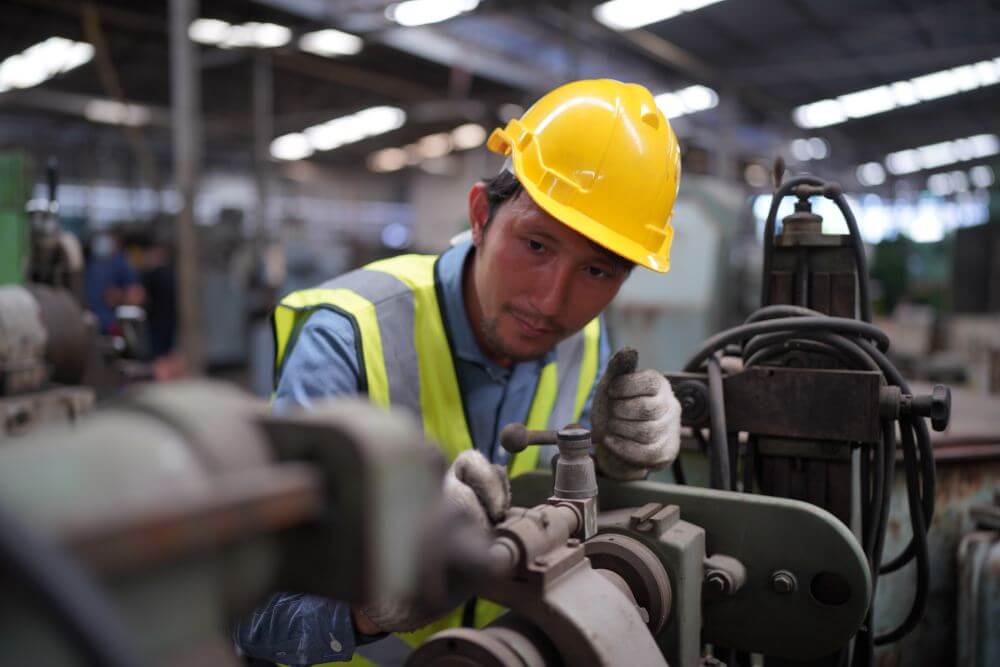
Autonomous maintenance (known in Japanese as Jishu Hozen ) is the practice of training machine operators to perform the basic daily care of their own equipment: cleaning, inspection, lubrication, and tightening.
It is one of the eight pillars of Total Productive Maintenance (TPM), and its core idea is simple: the person closest to the machine catches small problems first.
By shifting routine care to operators, maintenance technicians are freed from firefighting minor issues so they can focus on skilled, higher-value repair and improvement work.
Autonomous maintenance restructures who owns equipment health on the shop floor. Traditionally, operators run the machine and technicians fix it. That split creates a gap: a loose bolt, a small leak, or contamination goes unnoticed until it becomes a breakdown. Autonomous maintenance closes the gap by giving operators the skills and ownership to detect and prevent early-stage deterioration.
It is important to be precise here. Autonomous maintenance is one pillar of TPM, not the whole program. It does not replace planned maintenance, quality maintenance, or skilled repair. It complements them by making operators the first line of defense against the small abnormalities that quietly erode Overall Equipment Effectiveness (OEE).
The daily heartbeat of autonomous maintenance is often called CIL (Cleaning, Inspection, Lubrication), sometimes extended to CLAIR (Clean, Lubricate, Adjust, Inspect, Repair). The routine is deceptively powerful:
Autonomous maintenance is deployed through a structured seven-step progression. Each step builds operator capability before the next begins:
Consider a filling line running two shifts, 16 hours a day, 5 days a week (80 hours weekly). Suppose unplanned downtime currently averages 6 hours per week, and a maintenance review finds that 40 percent of those stops trace back to preventable causes: under-lubrication, minor leaks, and loose fittings.
That is 6 hours times 0.40 = 2.4 hours of avoidable downtime every week. If autonomous maintenance eliminates 75 percent of that preventable portion, the line recovers 2.4 times 0.75 = 1.8 hours per week. Over a 50-week year that is 1.8 times 50 = 90 hours of extra runtime.
The Availability component of OEE also improves. Availability was 74 of 80 hours = 92.5 percent. Adding back 1.8 hours lifts it to 75.8 of 80 = 94.75 percent, a 2.25 point gain from a routine that costs a few minutes per operator per shift.
Every small fault an operator catches or prevents is a work order a technician does not have to chase. When operators handle the CIL basics, the maintenance team stops living in reactive mode and moves toward proactive, planned work: root-cause analysis, precision alignment, reliability improvement, and refining preventive schedules.
In practice this raises both mean time between failures and the quality of every repair, because technicians are no longer rushing between minor breakdowns.
Autonomous maintenance is a people-and-process discipline, but it runs far better on a reliable data foundation. A CMMS gives operators and technicians a shared system for checklists, standards, and the small work orders that come out of daily inspections.
Fabrico provides exactly this foundation: real-time OEE and production monitoring so you can see the availability gains autonomous maintenance produces, plus CMMS capabilities for work orders, asset records, spare-parts tracking, and preventive scheduling.
Fabrico also offers camera and computer-vision monitoring that works even on older machines without a PLC, so the abnormalities operators find during CIL are backed by objective data rather than memory.
No. Preventive maintenance is scheduled, technician-led work such as component replacement at set intervals. Autonomous maintenance is operator-led daily care (cleaning, inspection, lubrication, tightening) that catches problems early. The two work together: operators handle the basics, technicians handle the planned and skilled work.
You can begin with paper checklists, but it scales poorly. A CMMS turns operator findings into trackable work orders, stores your cleaning and lubrication standards, and links daily care to asset history. It makes the pillar sustainable rather than a one-off event.
Predictive maintenance is an industry concept that uses condition data to forecast failures before they happen. Autonomous maintenance is human-driven, hands-on daily care performed by operators. They are complementary approaches: strong autonomous maintenance provides clean, consistent equipment and better data, which strengthens any condition-based or predictive effort.
Ready to give your operators and technicians the shared data foundation that makes autonomous maintenance stick? See real-time OEE, CMMS work orders, and camera-based monitoring in action by booking a Fabrico demo.
See how Fabrico unifies OEE and maintenance in one platform.
Request a demo

















 Login
Login
 Blog
Blog