


 Login
 Blog
Computer Vision for Toy Manufacturing: What Each Window Box and Assortment Case Costs

In short: Computer vision for toy manufacturing puts a camera add-on over hand benches to count window boxes and assortment cases that no press or sealer counts.
- Presses, pad printers and blister sealers already report shots, strokes and indexes; the hand bench and the case table report nothing.
- A racer box, a deluxe set and a 24 figure assortment case take 0.5, 1.25 and 1.0 cell minutes. One line rate hides that.
- With ideal times set by SKU, the example late shift scores 70.9% OEE; one 0.5 minute line rate reports 50.1%.
- Priced by SKU while autumn orders wait, the lost minutes cost EUR 650 a shift, and EUR 288 of it sits at the case table.
Defect checks stay with the quality team and the EN 71 or ASTM F963 safety tests with an accredited lab; the camera add-on only counts units.
The toy variant-by-station matrix
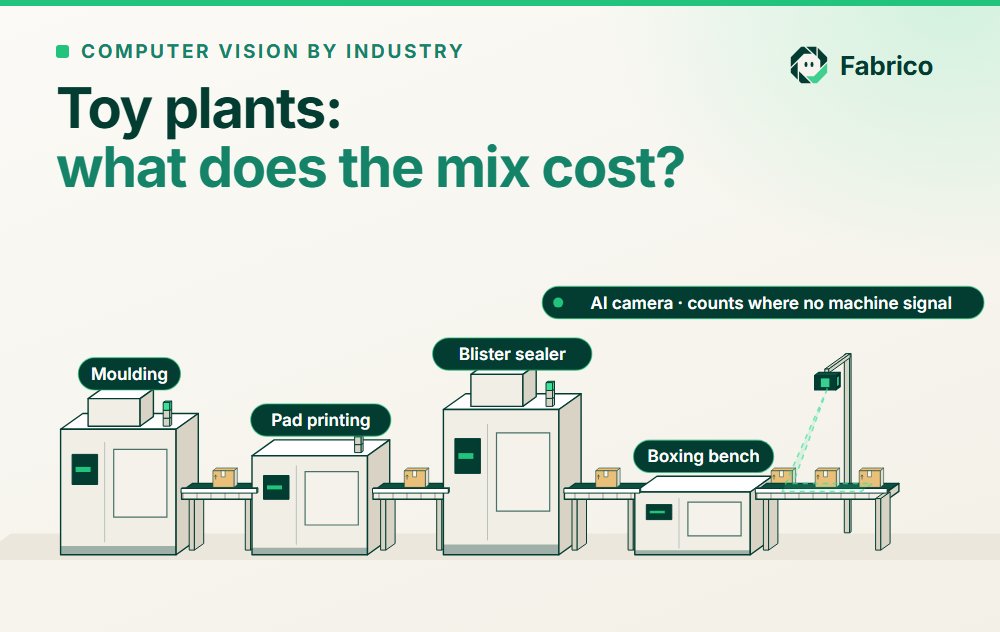
The example plant moulds, decorates, assembles and packs a plastic vehicle range for EU and US retailers. Twelve injection presses feed two pad printers, a spray mask booth and a blister sealer. Bench line B, a crew of four, assembles vehicles, closes window boxes and packs cases at its end. Four products share that bench: a racer in a six language EU window box, the same racer in a US box, a rescue deluxe set with three figures and a ladder, and a figure assortment case of 24 blister cards, six of each of four designs.
| Station | Racer (EU or US box) | Rescue deluxe set | Figure assortment case |
|---|---|---|---|
| Injection presses | Body family mould, colour change per livery | Three more tools: ladder, figures, base | One 4 cavity family mould, one of each design a shot |
| Pad printers | Two hits, livery decal | Four hits plus figure faces | Face print, a cliché per design |
| Spray mask booth | None, moulded colour | Two tone body on mask jigs | Hair mask on two of four designs |
| Bench line B | Axles, wheels, one figure, box; 0.5 cell min | Three figures, ladder, leaflet; 1.25 cell min | Not on the bench |
| Blister sealer | Not used | Not used | Six cards per index |
| Case table | Six boxes to a shipper | Four sets to a shipper | 24 cards in a fixed mix; 1.0 cell min a case |
| Who absorbs the change | Presses (colour) and box station (market) | Bench line B (work content) | Case table (what one unit is) |
The presses and pad printers absorb changes as stops: a mould or colour change, a cliché swap and its first-off check. Bench line B absorbs work content: a deluxe set holds two and a half times the work of a racer. The case table absorbs a change in the unit itself, because an assortment case is one item, not 24. The further down the flow, the less one rate per line can say.
Explainer presented by Iris, Fabrico's AI-generated presenter: how an add-on camera counts output where a machine has no signal. Book a demo.
Plays from YouTube. Google may set cookies when you press play. Privacy policy.
Presses, pad printers and sealers already report; hand benches do not
A toy press already knows its shots. The controller gives the cycle and the mould number, and the part count is shots times cavities: a 4 cavity family mould makes one of each figure design per shot, so 1,000 shots are 1,000 sets of four, not 4,000 of one figure. The same logic, and where a camera adds to it after the press, is set out in the guide to computer vision for plastics injection molding.
Pad printers report strokes. One stroke prints every part sitting in the fixture nests, so the count is strokes times nests, and the stops that matter are cliché changes and the wait for the colour and position check before the run restarts. That check belongs on the shift record as a stop with a reason, which the guide to first-off approval after a changeover explains. The blister sealer reports indexes, and each index seals a fixed number of cards: six on the example plant's tooling.
The spray mask booth, the assembly bench, window boxing and the case table report nothing. People load mask jigs, snap axles, fit figures, close boxes and fill cases, and a paper tally arrives too late to show which product lost the time, the gap between a production counter and OEE software. The pattern is the same as at any manual packing station with an OEE camera: the camera add-on counts the unit as it leaves the station, the box closed or the case sealed.
Text version of this infographic
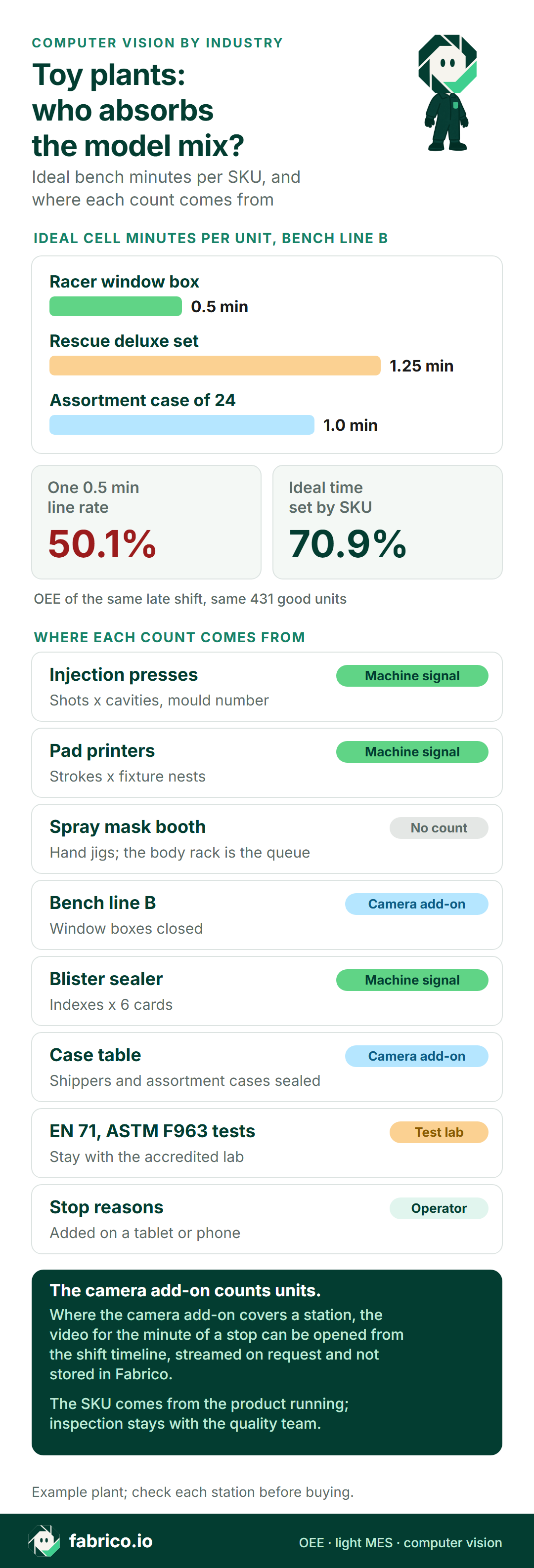
- Ideal cell minutes per unit at bench line B: racer window box 0.5, rescue deluxe set 1.25, figure assortment case of 24 at 1.0.
- One line rate of 0.5 minutes reports an OEE of 50.1% for the shift; ideal times set by SKU give 70.9%.
- Injection presses: machine signal, shots times cavities, mould number from the controller.
- Pad printers: machine signal, strokes times fixture nests.
- Spray mask booth: hand jigs, no count; the painted body rack is the queue.
- Bench line B: camera add-on, window boxes closed.
- Blister sealer: machine signal, indexes times six cards.
- Case table: camera add-on, shippers and assortment cases sealed.
- EN 71 and ASTM F963 tests: stay with the accredited lab.
- Stop reasons: the operator, on a tablet or phone.
- The camera add-on counts units. Where the camera add-on covers a station, the video for the minute of a stop can be opened from the shift timeline, streamed on request and not stored in Fabrico.
- The SKU comes from the product running on the bench; inspection stays with the quality team.
- Example plant; check each station before buying.
Counting rules for market boxes, date codes and assortment cases
The market box is a different item. In the EU, the Toy Safety Directive 2009/48/EC requires that a toy bears "a type, batch, serial or model number or other element allowing their identification", with instructions and safety information in the languages the Member State sets. Its successor, Toy Safety Regulation (EU) 2025/2509, keeps that rule, adds a digital product passport per toy and applies from 1 August 2030. A racer for six EU markets and the same racer for the US leave the bench in different boxes: two products in the count.
The barcode follows the box. The GS1 GTIN Management Standard (Release 1.1) gives a Spanish language only version of a pack its own GTIN, and treats a predefined assortment as one trade item: changing one item inside it "requires assignment of a new GTIN". The 24 card case is one unit. Counting it as 24 figures counts the cards twice, once at the sealer and once in the case.
The US run carries a date and a run number. 15 U.S.C. 2063 (CPSIA tracking labels) requires permanent marks on a children's product and its packaging with the date of production and cohort information, "including the batch, run number, or other identifying characteristic", plus third-party testing and a certificate. 16 CFR part 1250 adds: "Each toy must comply with all applicable provisions of ASTM F963-23".
| Situation at the bench | One unit is | Who owns the count |
|---|---|---|
| Racer in the EU box, then the US box | One closed box, booked to the box SKU | Camera add-on at window boxing |
| Figure assortment case | One sealed case of 24 cards | Camera add-on at the case table |
| Blister cards from the sealer | Indexes times six cards | Sealer signal, never added again |
| Test samples for the lab | A sample, not output or scrap | Quality team |
| Date code and run number | Printed by the coder | Coder and ERP |
A late shift on bench line B, earned SKU by SKU
The example shift runs from 14:00 to 22:00, less two 15 minute breaks and a 20 minute handover and bench clean-down: 430 planned minutes. The crew runs the EU racer, the US racer, the deluxe set, then the assortment cases. Ideal times are cell minutes per unit for the crew of four: 0.5 for a racer box, 1.25 for a deluxe set, 1.0 for a case. All figures are example inputs.
Stops add up to 52 minutes: 9 for the box and leaflet change from EU to US, 18 for the fixture, parts bins and leaflet change to the deluxe set, 15 waiting for painted deluxe bodies from the spray mask booth, and 10 to set up the case table for the assortment. That leaves 378 minutes of run time.
| SKU (ideal cell min) | Run min | Counted, good | Earned min, good min |
|---|---|---|---|
| Racer, EU box (0.5) | 100 | 180, 176 | 90, 88 |
| Racer, US box (0.5) | 66 | 120, 120 | 60, 60 |
| Rescue deluxe set (1.25) | 155 | 96, 88 | 120, 110 |
| Figure assortment case (1.0) | 57 | 47, 47 | 47, 47 |
| Shift | 378 | 443, 431 | 317, 305 |
The camera add-on counted 443 closed boxes and cases; the SKU came from the product set as running. Earned at each SKU's ideal time they are worth 317 minutes, so slow running cost 61: 10 on the EU racer, 6 on the US racer, 35 on the deluxe set, 10 on the cases. Quality cost 12: 4 EU boxes reboxed for a wrong language leaflet (2 minutes) and 8 deluxe sets sent back for a missing figure or a loose ladder (10 minutes).
Availability is 378 / 430 = 87.9%. Performance is 317 / 378 = 83.9%. Quality is 305 / 317 = 96.2%. OEE for bench line B on this shift is 87.9% x 83.9% x 96.2% = 70.9%, the same as 305 good minutes out of 430 planned.
The deluxe set is where the shift went. It ran at 77.4% performance (120 earned in 155 run minutes) against 90.0% and 90.9% for the two racer boxes, and it carried 33 of the 52 stop minutes. That points the team at the deluxe parts bins and the painted body rack, not at the crew.
What a single line rate would have reported
Here is what two single standards would do to the same 431 good units.
- The racer rate for everything, 0.5 minutes a unit. 431 good units earn 215.5 minutes, so OEE reads 215.5 / 430 = 50.1% and performance 221.5 / 378 = 58.6%. The deluxe set looks like a disaster and the case table like a slow crew, when 89.5 of the missing minutes are the extra work content of 88 good deluxe sets (66 minutes) and 47 cases (23.5 minutes).
- A blended weekly standard, 0.75 minutes a unit. 431 good units earn 323.25 minutes: OEE 75.2%, which flatters this shift by 4.3 points because racers made up two thirds of the units. A shift with more deluxe sets and the same losses would score worse on the same scale.
Neither number tells the team lead what to fix. Different products have different ideal cycle times on the same bench, and one blanket value spreads the loss over the wrong products. The fix is a cell minute value per SKU, taken from a timed run, checked again after the first peak week, and changed only on purpose.
What the lost minutes cost while autumn orders wait
Toy demand bunches at the end of the year. In the UK, Circana reported in November 2026 that the final three months typically account for 45% of annual toy sales, after GBP 2.64bn of sales and 257m toys in the first nine months of 2026, about GBP 10.27 a toy at retail. A plant building for that peak has orders waiting through the autumn, and only then is a lost bench minute a lost sale worth its margin.
No vetted public margin exists per toy SKU, so the contributions below are example inputs. As a scale check, the NYU Stern margin data (January 2026) puts the US Recreation industry group at a 39.79% gross margin and a 9.69% pre-tax operating margin. The example contributions sit between the two: EUR 1.80 on a EUR 6.00 ex-works racer box (30%), EUR 5.00 on a EUR 20.00 deluxe set (25%), EUR 14.40 on a EUR 48.00 assortment case (30%). Divided by the ideal time, that is EUR 3.60, EUR 4.00 and EUR 14.40 per bench minute, the SKU-level output value of a lost minute.
| SKU | Lost min (stops + slow) | Example per ideal min | Lost a shift |
|---|---|---|---|
| Racer, EU box | 10 | EUR 3.60 | EUR 36.00 |
| Racer, US box | 15 | EUR 3.60 | EUR 54.00 |
| Rescue deluxe set | 68 | EUR 4.00 | EUR 272.00 |
| Figure assortment case | 20 | EUR 14.40 | EUR 288.00 |
| Shift | 113 | EUR 650.00 |
The 113 lost minutes cost EUR 650.00 a shift while orders wait, EUR 26,000 over an example 40 late shifts of the autumn build, before anyone books overtime or weekend shifts to catch up. The deluxe set lost the most minutes, the case table the most money: one case minute carries 24 figures. The single 0.5 minute rate at the racer's EUR 3.60 would show 214.5 lost minutes and EUR 772.20, EUR 122.20 too much, and it would price the case table at a quarter of its true rate.
The 12 quality minutes are not lost margin: reboxed racers and repaired sets ship later and are made once. They cost about 32 crew minutes (8 sets at 3, 4 boxes at 2), EUR 16.00 at an example EUR 30 an hour. In the spring, with no orders waiting, the 113 minutes are crew time only: 4 people x 113 minutes = 7.5 hours, EUR 226.00.
Two moves follow. Run the cases straight after the US racer, while the case table is set for shippers, so the 10 minute set-up shrinks (see SKU changeover sequence optimization). And fill the painted body rack before the deluxe set starts: the 15 minute wait for bodies is the largest stop of the shift.
Book a demo to see window boxes and assortment cases counted next to the press and sealer signals.
Plush, wooden and licensed ranges: where to start counting
Plush. Panels are cut, sewn, stuffed and closed. The sewing room absorbs size and design changes; the count of finished plush belongs at the closing station. Strength is tested, not counted: Toy Industries of Europe lists seam strength tests next to torque, tension, drop and flammability tests, and those stay with the lab. The sewing side is covered in computer vision for textile manufacturing.
Wooden toys. CNC routers and lathes give controller counts. The mix shows at sanding, painting and packing, where a puzzle and a pull-along toy need different hand time and a set of blocks is one box.
Licensed ranges. Each character adds a pad print cliché and a first-off check, and launch dates bunch the work before the peak. More SKUs and shorter runs mean more changeovers, which is why downtime by SKU matters more here than one figure for the bench.
Questions to put to any vendor about a toy bench
| Question | Why it matters in a toy plant |
|---|---|
| Can the bench carry an ideal time per SKU that changes at the SKU change? | Racer, deluxe and case run 0.5, 1.25 and 1.0 cell minutes on one bench |
| Is a sealed assortment case one unit, apart from the cards the sealer counted? | GS1 makes the case one item; 24 cards counted twice inflate output |
| Can the EU box and the US box of one toy be two SKUs? | Different boxes, leaflets, warnings and GTINs |
| Are press counts shots times cavities, with the mould number? | A 4 cavity family mould makes four designs per shot |
| Do pad printer stops show the cliché change and first-off wait apart? | Licensed ranges add a cliché per character |
| Can the quality team book reworked sets without changing the camera count? | Reboxed toys ship later and are made once |
| Where does the camera look when hands cover the box as it closes? | Hands and stacked cards hide units |
| How do counts reach the ERP that holds the plan and the date codes? | The US run number and date code sit outside the bench |
Ask every vendor the same eight questions, with the same four SKUs and their ideal times, so the answers compare.
Where the camera add-on sits in the plant flow
The plant needs two cameras, not twelve: one over window boxing, one over the case table. Presses, pad printers and the sealer stay on their signals. The spray mask booth needs no count, because the painted body rack in front of the bench shows when the booth holds the bench up. Sizing is covered in how many cameras per line for OEE.
Cameras have limits, and a toy bench shows them. A review of object detection from Óbuda University, Saleh, Szénási and Vámossy (2021), says detectors fall short of people for several reasons, "occlusion being one of them". It separates intra-class occlusion, an object hidden by objects of the same type, from inter-class occlusion, an object hidden by something else. Both happen here: stacked blister cards hide each other, and hands cover a box as it closes. The review covers general scenes, not a toy plant: a warning, not a measured rate.
So the camera add-on counts where one unit stands apart: a closed box on the outfeed, a taped case leaving the table, never cards in an open case. Window film and blister plastic reflect light, so the lamp goes beside the camera. A box lifted twice must count once, a test for the pilot, the way OEE computer vision is checked against a hand count. No accuracy figure is promised here.
Where Fabrico fits in a toy plant
Fabrico is OEE software and a light MES in the cloud. In the example plant, the presses, pad printers and blister sealer give stops and counts from their PLC or controller signal, and at window boxing and the case table the computer vision camera add-on counts units. The operator adds the stop reason on a tablet or phone, and the SKU comes from the product set as running. OEE is shown by station and shift, and losses are priced from each SKU's price or margin.
Where the camera add-on covers a station, the video for the minute of a stop can be opened from the shift timeline, streamed on request and not stored in Fabrico. On Fabrico's roadmap, not live today: the camera add-on spotting a stop at a bench and proposing its reason; until then the operator adds it. Defect checks stay with the quality team, and EN 71 and ASTM F963 testing with the accredited lab.
The production plan lives in the ERP, APS or spreadsheet. Fabrico supplies the rates and counts the plan is built on: reports export to Excel, and Fabrico also has a REST API and webhooks.
Cameras over hand benches and the works council
A camera over window boxing sees hands and arms. Tell the crew before it goes up, point it at the outfeed rather than at faces, and where a works council exists, agree the purpose and the access with it first. The legal side is set out in GDPR and production line cameras.
Toy plant questions managers ask next
Does a toy plant need a camera on its injection presses?
No. The press controller gives shots and the mould number, and parts are shots times cavities. Cameras belong where people finish the product: window boxing, the case table, the plush closing station.
How is an assortment case counted?
As one unit with its own GTIN. Its 24 blister cards were already counted at the sealer by index, so they are not counted again.
Can the camera add-on tell a racer from a deluxe set?
The camera add-on counts units. The SKU comes from the product set as running on the bench, which also sets the ideal time.
Do EN 71 and ASTM F963 tests change the count?
The tests stay with the accredited lab. The quality team books samples pulled from a run as samples, neither good output nor scrap.
What changes in a plush or wooden toy plant?
The stations. Plush is counted at the stuffing and closing station, wooden toys at sanding, painting and packing. The rule stays the same: an ideal time per SKU at every hand station that runs more than one product.
How do US date codes and run numbers fit with the count?
The coder prints them and the ERP keeps them. The shift count shows how many boxes each run made, so a run number on a box can be matched to the shift and the bench that made it.
Want racer, deluxe and assortment minutes side by side for one bench? Book a demo.
Related articles



Latest from our blog





Real Fabrico tiles, sample data.