


 Login
 Blog
Computer Vision for Eyewear Manufacturing: A Bench Pilot That Finds the Lost Frames

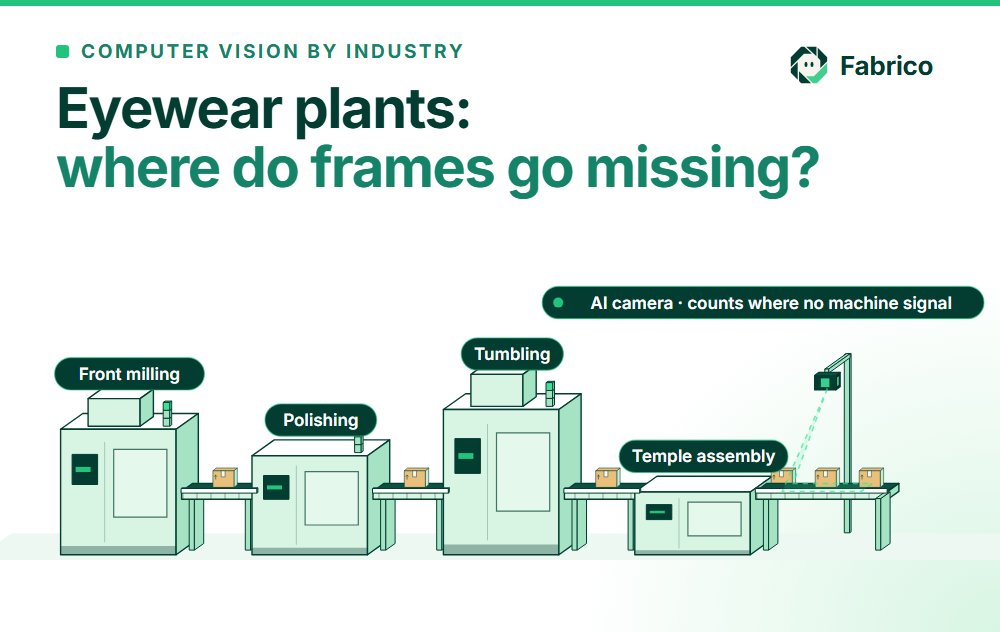
In short: Computer vision in eyewear manufacturing counts frames at hand benches with no machine signal: temple assembly, hand polishing, carding and lens glazing.
- Inspection stays with the quality inspectors and the lens lab; the camera add-on counts frames placed in a tray, nothing more.
- Run the first pilot at one temple assembly bench, with the final inspection tray sheet as the referee.
- Six checkpoints, A to F. Each closes when its record exists, never on a date.
- Example late shift: OEE 75.1%, and only 59 of the 97 lost minutes belong to the bench itself.
- Count clear crystal acetate against a dark tray liner: transparent frames take their look from the background.
Judging a frame and counting it are two jobs. Whether a hinge is tight, a temple aligned or a front free of scratches is decided by the inspectors; a camera add-on only answers how many frames reached the tray.
Below is a plan a frame plant runs itself at one station: what to mount, what to compare against, what counts as proof and when to stop. The figures are an example plant.
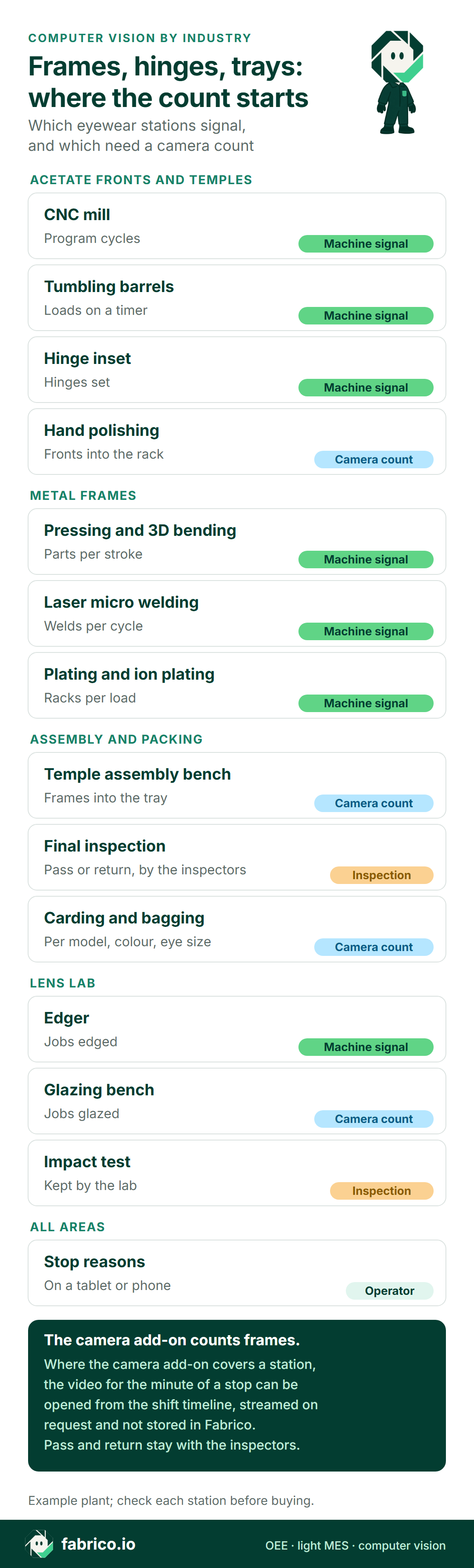
Text version of this infographic
- Frames, hinges, trays: where the count starts. Which eyewear stations signal, and which need a camera count.
- Acetate fronts and temples: CNC mill, machine signal, program cycles
- Tumbling barrels: machine signal, loads on a timer
- Hinge inset: machine signal, hinges set
- Hand polishing: camera count, fronts into the rack
- Metal frames: pressing and 3D bending, machine signal, parts per stroke
- Laser micro welding: machine signal, welds per cycle
- Plating and ion plating: machine signal, racks per load
- Assembly and packing: temple assembly bench, camera count, frames into the tray
- Final inspection: inspection, pass or return by the inspectors
- Carding and bagging: camera count, frames per model, colour and eye size
- Lens lab: edger, machine signal, jobs edged
- Glazing bench: camera count, jobs glazed
- Impact test: inspection, kept by the lab
- All areas: stop reasons from the operator, on a tablet or phone
- The camera add-on counts frames. Where the camera add-on covers a station, the video for the minute of a stop can be opened from the shift timeline, streamed on request and not stored in Fabrico. Pass and return stay with the inspectors.
- Example plant; check each station before buying.
Where the count already exists, from CNC mill to carding
An acetate frame starts as a sheet or block. CNC mills cut fronts and temples and report program cycles from the controller. Tumbling barrels run loads of fronts on a timer, so the record is a load, not a frame. Hinge inset machines carry a cycle counter. From there the work turns manual, and the counts go with it.
Metal frames have more machines before assembly. The city of Sabae, the area that produces about 90% of eyeglasses frames manufactured in Japan, lists swaging of wire, pressing of parts, rim wires formed by 3D bending, laser micro welding and ion plating, then a finish where "skilled experts take care of every detail". The same page names the fact every frame planner deals with: "Multi-variety production and small lot production". A collection runs many models, each in several colours and eye sizes, in small lots.
| Station | Signal today | What the record counts | Who judges pass or fail |
|---|---|---|---|
| CNC mill, fronts and temples | Controller cycles | Fronts or temple pairs cut | Setter, first piece |
| Tumbling barrels | Timer only | Loads, not frames | Finishing lead |
| Hinge inset or riveting | Cycle counter | Hinges set | Setter |
| Hand polishing wheels | None | Fronts polished, by tally | Polisher, then inspection |
| Temple assembly and alignment | None | Frames assembled, by tally | Inspectors |
| Final inspection | Tray sheet | Frames passed or sent back | Quality inspectors |
| Carding and bagging | Label printer at best | Frames per model, colour, eye size | Packing lead |
| Lens lab edging and glazing | Edger job count | Jobs edged; glazing by ticket | Lab, impact test |
The unit leaving a frame plant is set by the frame standard. ISO 12870:2024 covers "unglazed spectacle frames designed for use with prescription lenses" and applies "at the point of sale by the manufacturer or supplier to the retailer". The count that matters at the dock is one unglazed frame, with the prescription lenses fitted later in a lab. The trade counts in pairs: ANFAO, the Italian optical manufacturers association, reports 106 million pairs exported in 2025, 63 million sunglasses and 43 million prescription frames.
Explainer presented by Iris, Fabrico's AI-generated presenter: how an add-on camera counts output where a machine has no signal. Book a demo.
Plays from YouTube. Google may set cookies when you press play. Privacy policy.
Why the pilot bench is temple assembly, not the polishing wheel
Hand polishing looks like the obvious target: slow, manual and often the queue. It is a poor first station. Fronts sit under a wheel in the polisher's hands, compound and dust coat the view, and a front can pass the wheel three times before it is done.
Temple assembly is cleaner. The assembler screws both temples to a polished front, checks the fold and the alignment, and puts the frame into one slot of an out tray. That slot is a fixed spot, the first point where the plant owns a frame rather than parts, and one tray holds one model, one colour and one eye size. The tray then goes to final inspection, which already signs each tray. The plant has a referee before it buys anything.
The layout shows why the pilot is one bench and not a line. Fronts and temples arrive on two feeders, and the fronts feeder passes the polishing benches, where the queue builds. A count at the assembly bench sees both the frames out and the minutes the bench waits for fronts. The checks in how to pick an OEE pilot line apply, and so does the advice to measure a manual station before automating it.
The plant sets its own pace. A checkpoint closes when its record exists, never on a date, and nothing here is a delivery time.
| Checkpoint | What happens | Record that closes it |
|---|---|---|
| A. Rule card | Define one frame, a tray, a return | Card signed by the bench lead and inspection |
| B. Hand baseline | Tally against the inspection sheet, no camera | 20 trays signed by both, one colour change included |
| C. Mount | One camera add-on over the out tray | A test tray of each colour counted right three times |
| D. Three counts | Camera, tally and referee side by side | 40 signed trays, each colour and a half tray included |
| E. Price | Lost minutes split by owner | One priced shift sheet the controller accepts |
| F. Decide | Widen, change or stop | A written decision with its trigger |
Checkpoint A: write the rule card for one assembled frame
Most count arguments in a frame plant are rule arguments. Write the rules down first, and get the bench lead and the inspection lead to sign the same card.
- One frame: a front with both temples screwed, folded once and placed in a tray slot. A front waiting for temples is not a frame.
- One tray: 12 slots, one model, one colour, one eye size. A half tray at shift end counts what is in it, and its card says so.
- Returns: a frame sent back to polishing was counted when it first reached the tray. When it comes back, it is rework, not a new frame.
- Variant: model, colour and eye size come from the tray card and the job running at the bench, never from the camera.
The eye size line matters beyond the bench. In the EU, spectacle frames are medical devices, like the products in computer vision for medical device manufacturing, and Commission Delegated Regulation (EU) 2025/1920 says: "A UDI-DI shall be assigned to spectacle frames that have the same combination of design parameters, including at least the horizontal boxed lens size". It applies from 1 November 2028. A count kept per model, colour and eye size lines up with the identifiers the labels will carry, and with OEE per SKU rather than one blended rate.
The card also settles which number is output. The bench produces a total count; inspection turns it into a good count. Keep both: the gap is the quality loss.
Checkpoint B: a hand count against the inspection sheet
Before a camera goes up, run the bench on paper. The assembler ticks a frame on the tray card as it goes into a slot. Final inspection signs the card with frames received, passed and returned, and the reason for each return. Nothing else changes.
The baseline shows how well the tally already works: the number any camera has to beat.
Judging stays where it is. Hinge tension, temple alignment, finish and dimensions against the plant's specification and its ISO 12870 requirements are the inspectors' calls, and so is the first-off approval after a changeover when a new colour starts. Close Checkpoint B when 20 trays carry both signatures with at least one colour change among them, because a colour change is where tallies drift: half trays, a new card, screws of another length.
Checkpoint C: mount one camera add-on over the out tray
One camera add-on, fixed above the out tray, looking down at the 12 slots and the bench edge where a finished frame is set down. It counts a frame when it lands in a slot. Framing the tray, not the assembler, keeps hands in view only when the count happens.
Eyewear brings one optical problem most benches do not: clear frames. Crystal acetate and clear demo lenses almost vanish against a pale tray. A review of transparent object perception by Jiang and colleagues (IEEE Transactions on Artificial Intelligence) puts it plainly: "Transparent objects lack salient surface features such as colour and texture, making their appearance highly dependent on the image background." The same review describes polarised cameras that use "a polarising filter to eliminate unwanted reflections and glare", which matters for polished metal and mirror coatings. The fixes are physical: a dark matte tray liner, diffuse side light and a test run of the clearest model first, as in camera placement and lighting on a production line.
Tell the assembler and the works council before the bracket goes up, show them the field of view, and agree who sees the stop video. Where the camera add-on covers a station, the video for the minute of a stop can be opened from the shift timeline, streamed on request and not stored in Fabrico.
Close Checkpoint C when a test tray of each colour, crystal included, is counted right three times in a row. If crystal fails with the dark liner in place, note it; it decides a Checkpoint F rule.
Checkpoint D: three counts, one tray sign-off
Now the bench runs with all three counts: the camera add-on, the assembler's tally and the inspection sheet as referee. The plant writes the acceptance rule before the first tray. The example card says: on every colour run the camera and the referee agree, or the gap has a named cause the bench can remove. No accuracy figure is promised here; this checkpoint is where the plant measures its own.
One example shift, three colours of the same model, 14 full trays and a half tray:
| Colour run | Inspection sheet | Camera add-on | Tally |
|---|---|---|---|
| Black, 6 trays | 72 | 72 | 78 |
| Havana, 5.5 trays | 66 | 66 | 66 |
| Crystal, 3 trays | 36 | 33 | 36 |
| Shift | 174 | 171 | 180 |
Example data, not a product result. The tally is six high because the half tray at the black to havana change was ticked on both cards. The camera is three low on crystal, all on the first crystal tray, before the dark liner went in. Both gaps have a cause, both causes are removable, and the referee decides which count was right. Close Checkpoint D when 40 trays carry all three counts, every colour and a half tray among them, with a cause beside every gap.
Checkpoint E: price the late-shift minutes by owner
A count alone does not change a plant; the minutes around it do. The example is the late shift on bench 2, 14:00 to 22:00, less a 30 minute break and a 5 minute handover brief: 445 planned minutes. The model is a full-rim acetate front with riveted hinges at an ideal 2.0 bench minutes a frame, an example input each plant replaces with a timed tray of its own.
- Stops, 64 minutes: the fronts queue ran empty twice (22 and 16, so 38), two colour changes took 9 minutes each (18), and the screwdriver lost torque once (8).
- Availability: 445 minus 64 = 381 run minutes; 381 / 445 = 85.62%.
- Performance: 174 frames x 2.0 = 348 earned minutes, 33 minutes slow, mostly re-aligning temples on the havana run; 348 / 381 = 91.34%.
- Quality: inspection sent back 7 frames, 4 scratched fronts to polishing and 3 for alignment, 14 minutes. 167 good frames earn 334 minutes; 334 / 348 = 95.98%.
- OEE: 85.62% x 91.34% x 95.98% = 75.06%, rounded 75.1%, the same as 334 good minutes out of 445.
Now the money. ANFAO puts Italian frame exports at EUR 1.6 billion for 43 million pairs in 2025, about EUR 37 a frame at export value. No vetted public margin exists for frame makers, so the example takes a contribution of EUR 10 a frame, 27% of EUR 37, as an input the plant replaces. It sits between the US NYU Stern apparel margins (data as of January 2026) of 10.18% pre-tax operating (before stock compensation) and 56.88% gross. At 2.0 minutes a frame, one ideal bench minute is worth EUR 5.
| Lost minutes | Min | Owner | Example price |
|---|---|---|---|
| Fronts queue empty | 38 | Polishing benches | EUR 190, booked to polishing |
| Colour changes | 18 | Bench and tray sequence | EUR 90 |
| Driver torque fault | 8 | Bench tooling | EUR 40 |
| Slow re-alignment | 33 | Bench method | EUR 165 |
| 7 frames sent back | 14 | Rework at crew time | EUR 21.01, not margin |
The split is the point. Of 97 stop and slow minutes, 59 belong to the bench: EUR 295 a shift, EUR 29,500 over 100 late shifts, only while orders wait for frames. The 38 minutes without fronts are worth EUR 190 on paper and nothing at the bench, because a faster assembler cannot build frames from fronts not yet polished. That money sits at the polishing benches, which a bottleneck analysis would name next. The 18 colour change minutes are partly a sequence question: SKU changeover sequence optimization orders black, havana and crystal so screws and cards change less often.
The 7 returned frames ship later, so they are rework, not lost sales: 4 re-polishes of about 6 minutes and 3 re-alignments of 3 minutes are 33 crew minutes, EUR 21.01 at the Eurostat 2025 euro area average of EUR 38.2 an hour. If orders are not waiting, the 59 bench minutes are crew time too, EUR 37.56 a shift. Returns also set the first pass rate, the start of first pass yield versus rolled throughput yield once polishing is counted.
Checkpoint F: widen, change or stop as next steps
The pilot ends with a decision, and each branch has a trigger written on the rule card before Checkpoint D began.
- Widen when the three counts meet the acceptance rule on 40 trays and the loss sheet names an owner outside the bench. In the example the empty fronts queue points at polishing; the next camera add-on counts polished fronts into the rack, which turns the queue into a number.
- Change when one model keeps missing after liner and light are fixed, usually crystal or a mirror-finish metal front. Try a second angle or a polarising filter, or count that model at carding, where frames lie flat on a card.
- Stop when the tally already matches the referee and the bench minutes are too small to act on, or when the works council and the bench cannot agree a field of view. Keep the tray sheet; it is a better count than before. Repeated drift in the first trays after a colour change belongs on the changeover checklist, not on the camera.
Widening has its own traps: more benches, more tray rules, more referees. Scaling a computer vision pilot to the plant and manufacturing software pilot design cover them.
Lens labs, sunglass variants and the rules that change the count
Lens labs in the US. The FDA rule, 21 CFR 801.410, says: "Each finished impact-resistant glass lens for prescription use shall be individually tested for impact resistance". Most other lenses are proven on "a statistically significant sampling of lenses from each production batch". The test drops a 5/8 inch steel ball "from a height of 50 inches upon the horizontal upper surface of the lens". So in a US lab the drop-ball log equals output for glass prescription lenses and is only a sample for plastic ones. Never read a sample log as output. The tests stay with the lab; a camera add-on at the glazing bench counts finished jobs, a pair of lenses fitted to a frame, against the job ticket.
Sunglass lines. ISO 12312-1:2022 covers "all afocal (plano power) sunglasses and clip-ons for general use, including road use and driving". Sunglasses with prescription power are not afocal, so they fall outside it, and ISO 12870 in turn excludes sunglasses with afocal filters. A sunglass line counts finished pairs with filters mounted, and its rule card needs lines for filter category and for clip-ons sold as a set.
Questions for any vendor before the camera goes up
Ask each vendor the same eight questions and judge the answers against the Checkpoint D sheet, not a slide.
| Question | Why it matters at a frame bench |
|---|---|
| Can counts be held per model, colour and eye size from the tray card? | The variant comes from the job; the camera only counts |
| How are crystal acetate and mirror-finish metal handled? | Clear frames vanish on pale trays |
| Can a half tray at shift end be counted without a manual fix? | Half trays are where tallies drift |
| Can a frame back from polishing be booked as rework? | Returns otherwise inflate output |
| Can a wait for fronts be booked to the polishing benches? | Otherwise the bench carries another station's loss |
| Can the count be compared tray by tray with the inspection sheet? | The referee stays in the loop |
| What sits in the field of view, and can faces stay out? | The works council and the assembler sign first |
| How do counts reach the ERP that holds the collection plan? | The plan is kept there, not in the camera. |
Where Fabrico fits on an eyewear floor
Fabrico is OEE software and a light MES for discrete plants. On a frame floor, stops and counts come from the machine signal where one exists: CNC controllers, hinge inset counters and plating line PLCs, read directly or through an IoT device. At the hand benches, the camera add-on for OEE counts frames into the tray, as described in OEE with computer vision. The operator adds the stop reason on a tablet or phone. OEE and stops show by bench and shift, and losses are priced from each SKU's price or margin.
Where the camera add-on covers a station, the video for the minute of a stop can be opened from the shift timeline, streamed on request and not stored in Fabrico. On Fabrico's roadmap, not live today: the camera add-on spotting a stop at the bench on its own and proposing a reason for the assembler to confirm.
Pass, return and finish judgements stay with the quality inspectors, and lens impact tests stay with the lab. The collection plan stays in the ERP, APS or spreadsheet; Fabrico supplies the counts and rates it reads. Reports export to Excel, and Fabrico also has a REST API and webhooks.
Want to see a bench count next to its inspection sheet before a single bracket is mounted? Book a demo.
Questions eyewear plants raise about a first camera pilot
How is a frame counted when it goes back to polishing?
Once, when it first reaches the tray. Back from polishing it is rework: the second pass adds crew time but no new frame, and the inspection sheet shows the return.
Can one camera add-on count fronts at the polishing wheel?
It is a poor first station: hands, compound and dust hide the front, and a front passes the wheel several times. Count polished fronts where they go into the rack instead.
Does a sunglass line need a different rule card?
Yes. ISO 12312-1 covers afocal sunglasses, so the unit is a finished pair with filters mounted, with lines for filter category and for clip-ons sold as a set.
How many cameras does the first pilot need?
One, over the out tray of one assembly bench. A second view is added only if a clear or mirror-finish model keeps missing after the liner and light are fixed.
What ends the pilot early?
Two events: the tally already matches the inspection sheet and the bench minutes are too small to act on, or the works council and the bench cannot agree a field of view.
Want the frames from one assembly bench, the trays signed at inspection and the lost minutes by owner in one report? Book a demo.





Latest from our blog






Real Fabrico tiles, sample data.