


 Login
 Blog
Fabriq Alternatives: 5 Options by the Job You Need Done

In short: pick by the routine the software must run. Stay with Fabriq if you want SQCDP boards, 8D and 5-Why problem solving, audits and field rounds, priced per site. If gemba walks and a Tier 1 to Tier 3 escalation are the core, look at Tervene; if the huddle board should fill itself before the meeting, Poka; if improvement projects and strategy goals are the backlog, KPI Fire; if a stop must climb a timed alert ladder, L2L; if live OEE from the line should feed the huddle, Redzone.
- Vendor facts come from each vendor's own pages, read on 19.11.2026 and linked in place.
- Fabrico sits outside the five and gets one section near the end.
Fabriq is operational excellence software for the routines a CI lead runs daily: tier meetings, gemba walks, checklists and action plans. Its home page is in French, with English pages beside it. This page sorts five alternatives by the routine they run, then takes one bad morning on a filling line through three of them, priced in euros.
Key takeaways
- Fabriq, Tervene and Poka centre on the board, the walk and the action; L2L and Redzone add OEE from the line; KPI Fire sits at projects and strategy.
- None of the six publishes a figure. Fabriq states a unit, "Priced per site, billed annually", for its Standard offer; Redzone says sites and modules; KPI Fire counts project leaders (checked 19.11.2026).
- The question that separates the tools is where the board's numbers come from: a person, an API, or the machine.
- In the sample shift below, a cup filler loses 9,762 cups, EUR 859.06 of margin, and a 26 minute jam at 07:20 is EUR 219.65 of it.
What Fabriq does, read from its English pages
The English home page calls Fabriq "The all-in-one solution for the shop floor." and says it is "Deployed across 1000+ sites in 64 countries." Its pricing page is the clearest list of what it does. As of 19.11.2026:
- Boards. "See SQCDP performance in real time." The dashboards page adds "Build the views you need for tier meetings and daily management." and "Replace static whiteboards with dynamic, digital dashboards your whole team can actually use."
- Walks and routines. The routines page says "Digitize your audits and Gemba Walks on the shop floor." and "Schedule walks daily, weekly, or on a custom cadence."
- Problems and actions. "Structured problem-solving built in. 8D, 5-Why, and custom action plans" (pricing page). On the floor, "operators tap once to create a ticket, attach a photo, and route it to the right team."
- Indicators. The indicators page says "Connect your tools (MES, ERP, Data warehouse, etc.) to the API" and that "it is possible to connect external sources and update the indicators automatically".
- Scale. The dashboards page says "Define your dashboard template centrally, then push it to every site with one click." Enterprise is "For manufacturing networks of 10+ plants running multi-region operations."
Price. Fabriq: no public price; quote on request (checked 19.11.2026). Standard is "Priced per site, billed annually"; Advanced and Enterprise state no unit. The French offers page calls Standard "Digitalisez vos processus d'Excellence Opérationnelle." (Digitise your operational excellence processes.) No review score is quoted: Capterra refused an automated read on 19.11.2026, and nothing unread is cited.
The daily loop, and where each tool enters it
The Lean Enterprise Institute defines the gemba walk as "A management practice for grasping the current situation through direct observation and inquiry before taking action." (accessed 19.11.2026). In most plants it sits inside a loop: the line produces a number, a board shows it, a leader walks to the place, an action gets an owner, and the next shift checks the fix. Each tool here enters that loop at a different step, and that step is the real choice.
Five Fabriq alternatives, from the walk to the machine
The order follows the loop, from the walk to the line's own data, not merit.
Tervene: gemba walks and tiered meetings in one subscription
The Tervene home page promises to "Structure meetings and escalation from Tier 1 to Tier 3" and to "Standardize Gemba walks with mobile checklists and completion tracking". Its gemba walk app page says leaders can "Take photos and attach notes." and "Assign actions directly to team members to address issues that require immediate attention.", with walks set "to daily, weekly, monthly, or choose a custom recurrence." A tiered meetings page covers the cascade.
Price. Tervene: no public price; quote on request (checked 19.11.2026).
Look at it if leader standard work is the program: the walk, the layered audit and the tier cascade, run alike on every line, so that "Every fix gets an owner and a root cause" (home page).
Poka: a huddle board that fills itself, plus skills and instructions
Its daily management page says live SQDCP data and open issues reach the huddle board "before the meeting starts", and that unresolved issues move on automatically "at the right tier." The same platform carries work instructions and skills management, which the Tulip vs Poka comparison covers in depth.
Price. Poka: no public price; quote on request (checked 19.11.2026). The Poka pricing page names no plan and no figure.
Look at it if training records and standard instructions across plants matter as much as the meeting. The Poka vs L2L comparison sets the two side by side.
KPI Fire: improvement projects, ideas and strategy deployment
The KPI Fire home page offers to "improve the accountability of weekly or daily tier meetings" and claims "Daily Huddles can all be done with less time and higher quality decision making". Its weight sits higher up: a "Single Source of Truth for Your Business Improvement program", software to "collect and prioritize improvement ideas, manage projects, track progress in real time", templates "for methodologies like DMAIC, PDCA, and Lean Six Sigma", and an X-Matrix for Hoshin Kanri.
Price. KPI Fire: no public price; quote on request (checked 19.11.2026). The KPI Fire pricing page ties licences to project leaders: "Determine how many people will be leading projects at any given time."
Look at it if the problem is not the morning meeting but the improvement projects that leave it, and the plant manager wants them linked to yearly goals.
L2L: escalation ladders, audits and OEE on one platform
The L2L factory notification page says "Log an issue once, and the right person gets notified automatically", with a timed ladder: "Alert the Line Lead immediately, Supervisor at 30 minutes, Area Manager at 1 hour, Plant Manager at 4 hours". Its production management page offers to "Calculate overall equipment effectiveness (OEE) in seconds" and to "Run structured audits and inspections from one system."
Price. L2L: no public price; quote on request (checked 19.11.2026). The pages read name no plan or figure.
Look at it if unanswered stops are the failure you see most, and OEE and the alert chain belong in one system.
Redzone: live OEE and downtime feeding the shift huddle
Redzone's productivity page says "Manufacturers get live OEE tracking for every line, cell, and shift.", with downtime and throughput collected automatically and tied to the line and the run. The meeting is built in: "Structured digital huddle routines keep every shift aligned on targets, top issues, and interventions."
Price. Redzone: no public price; quote on request (checked 19.11.2026). The Redzone pricing page says "Pricing is based on the number of sites and modules deployed."
Look at it if the huddle should open on the line's own numbers, from one vendor.
Decision matrix: Fabriq or an alternative for your plant
Each row pairs a situation with the option whose page speaks to it and a floor test. Rows where all six answer alike were cut.
| If this is you | Look first at | Why (vendor page) | Prove it in the pilot by |
|---|---|---|---|
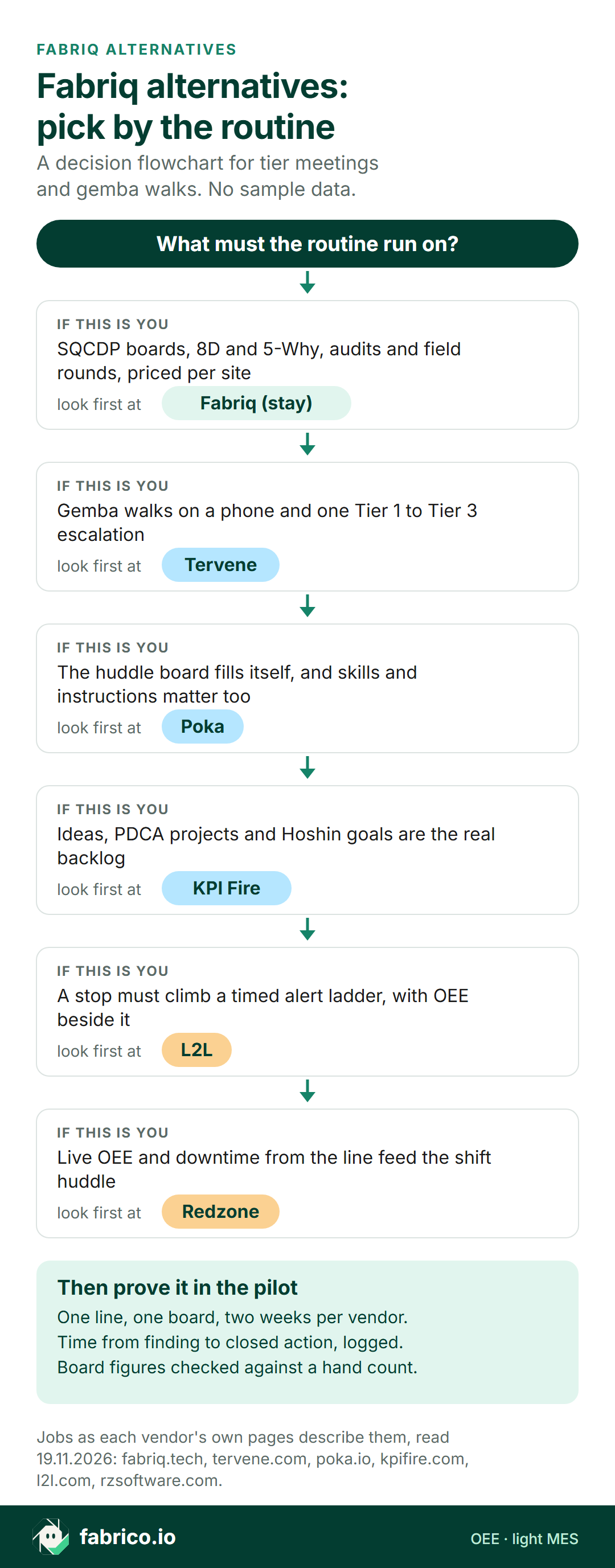
| SQCDP boards, 8D and 5-Why, audits and field rounds, in one tool | Fabriq (stay) | Pricing: "8D, 5-Why, and custom action plans" | Closing one 5-Why from a ticket raised on the floor, start to finish |
| Leader standard work: walks, layered audits, a three-tier cascade | Tervene | Home: "Structure meetings and escalation from Tier 1 to Tier 3" | Running one walk a day for two weeks and counting completed checklists |
| The board must fill itself, and skills and instructions matter too | Poka | Daily management: data on the board "before the meeting starts" | Opening the board at 08:00 and finding nothing left to type |
| Ideas, PDCA projects and yearly goals are the backlog | KPI Fire | Home: "DMAIC, PDCA, and Lean Six Sigma" templates | Linking one tier board issue to a project and a yearly goal |
| Unanswered stops are the failure you see most | L2L | Notification system: Line Lead, then Supervisor at 30 minutes | Leaving one test alert open and timing each step of the ladder |
| The huddle should open on measured OEE and downtime | Redzone | Productivity: "live OEE tracking for every line" | Matching one shift's downtime minutes to a stopwatch log |
Cut because they do not separate the six: a mobile app, photos on an issue, wall-screen dashboards, and assigning an action to a named person. All six pages describe these.
Text version of this infographic
- SQCDP boards, 8D and 5-Why, audits and field rounds, priced per site: Fabriq (stay).
- Gemba walks on a phone and one Tier 1 to Tier 3 escalation: Tervene.
- The huddle board fills itself, and skills and instructions matter too: Poka.
- Ideas, PDCA projects and Hoshin goals are the real backlog: KPI Fire.
- A stop must climb a timed alert ladder, with OEE beside it: L2L.
- Live OEE and downtime from the line feed the shift huddle: Redzone.
- Then prove it in the pilot: one line, one board, two weeks per vendor; time from finding to closed action logged; board figures checked against a hand count.
What each site says about price and the buying unit
No vendor here prints a figure, so the useful fact is the unit each names (19.11.2026).
| Vendor | Unit the page names | Published figure |
|---|---|---|
| Fabriq | Standard "Priced per site, billed annually"; three offers | no public price; quote on request (checked 19.11.2026) |
| Tervene | Not stated on the pages read | no public price; quote on request (checked 19.11.2026) |
| Poka | Not stated on the pricing page | no public price; quote on request (checked 19.11.2026) |
| KPI Fire | Licences per person leading projects | no public price; quote on request (checked 19.11.2026) |
| L2L | Not stated on the pages read | no public price; quote on request (checked 19.11.2026) |
| Redzone | "number of sites and modules deployed" | no public price; quote on request (checked 19.11.2026) |
A per-site price favours a big plant with many users; a per-project-leader licence favours one where few people run projects. Ask every vendor, Fabriq included, for a three-year total for one site with 120 users and two board screens, with onboarding in it.
Worked example: a filler jam at 07:20, before the 08:00 tier 1 meeting
Sample data, made up for this page. No customer, no product screen. Line 2 in a dairy fills yoghurt cups on a four-lane filler at an ideal 96 cups a minute. The early shift runs 06:00 to 14:00 less a 20 minute break: 460 planned minutes and 44,160 cups possible.
At 07:20 a cup magazine jams and the filler stands for 26 minutes. After the restart the checkweigher rejects underfilled cups. The tier 1 meeting is at 08:00. Three of the tools, as their pages describe them:
- Fabriq. The operator taps once to create a ticket with a photo; it appears on the tier 1 board, and if the stop count arrives from an MES or another source through the API, the indicator updates itself. Otherwise the team lead types it in before 08:00. A 5-Why opens from the ticket.
- Redzone. The 26 minutes are collected from the line with a timestamp, the operator adds context "from the line in seconds", and the huddle opens on the top loss.
- Tervene. The 09:30 gemba walk records the jam with photos and notes, assigns the action to the maintenance lead, and escalates it to tier 2 if it is still open the next day.
All three end in an owned action; they differ in where the 26 comes from: a person, an API, or the line. The shift log: a 35 minute flavour changeover, the jam, and 9 minutes of short stops with no reason yet, 70 minutes in all.
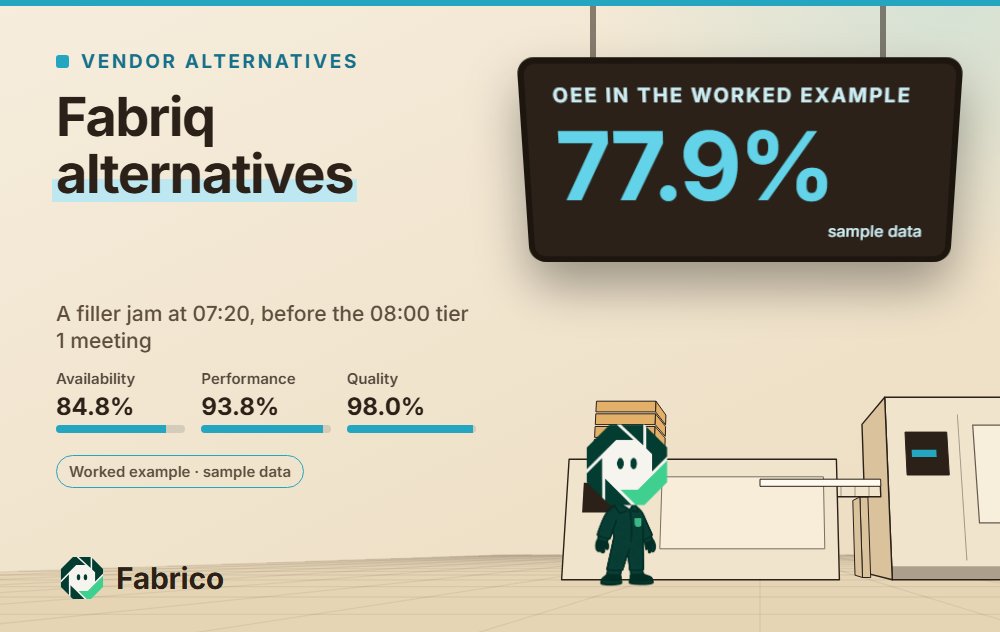
The OEE arithmetic. The Lean Enterprise Institute multiplies the three rates (accessed 19.11.2026). Run time is 460 less 70, so 390 minutes, and availability is 390 / 460 = 84.8%. In 390 minutes the ideal is 37,440 cups; the filler made 35,100, so performance is 35,100 / 37,440 = 93.8%. The checkweigher rejected 702, leaving 34,398 good: quality is 98.0%. OEE is 84.8% x 93.8% x 98.0% = 77.9%, the same as 34,398 good cups of 44,160 possible. The OEE calculation guide shows the method step by step.
The same shift in euros
The 9,762 missing cups are priced at margin. Take a sample price of EUR 0.40 a cup and a sample margin of 22%, so EUR 0.088 a cup. The 22% sits just under the January 2026 gross margin of 23.23% for Food Processing (78 firms) in Damodaran's US industry dataset (accessed 19.11.2026), so the euro figure stays cautious.
| Loss (sample data) | Cups | Per shift (EUR) | Per year (EUR) |
|---|---|---|---|
| Stops, 70 min | 6,720 | 591.36 | 283,853 |
| Slow running, 37,440 less 35,100 | 2,340 | 205.92 | 98,842 |
| Checkweigher rejects | 702 | 61.78 | 29,652 |
| Total gap to ideal | 9,762 | 859.06 | 412,347 |
The year assumes two shifts a day, five days a week, 48 weeks: 480 shifts, so EUR 34,362.24 a month. The jam alone is 2,496 cups, EUR 219.65 a shift; if it came back twice a week, 96 times a year, it would cost EUR 21,086. The total is a ceiling: no filler runs a year at its ideal rate. For a tier board, the split matters: 69 percent of the gap is stops.
Board rule. For two weeks, write each stop over two minutes on paper at the line, and compare the sheet with what the tier 1 board shows at 08:00. If the board misses more than a few minutes a shift, the gap is in the data feed, not in the meeting.
Questions to ask every vendor before a pilot
- Where does the board's number come from? Typed by a team lead, pulled by API from an MES or ERP, or measured on the line. Ask for the answer per indicator.
- How does an open action escalate? By tier, by time, or both, and who sees it at tier 3.
- What does a gemba finding become? A ticket, an action or a project, traceable to the walk.
- What is the buying unit? Site, user, project leader or module, and what a second plant adds.
The shop floor management software review covers more tools; tier board meetings and the gemba walk guide cover the routines.
Where Fabrico fits
Fabrico is OEE software in the cloud with light MES functions, and in this loop it works at step 1: it supplies measured OEE, stop causes and losses priced in money that a tier board or a gemba routine can act on. Its MES and OEE solution overview sets out the scope:
- Signal. Run, stop and count come from the machine PLC or signal, so the 26 minutes are measured, not recalled.
- Cause. Operators add the reason on a tablet or phone, against the product that ran.
- Lines with no signal. The camera add-on counts output, and where a camera covers the line, the video for the minute of a stop can be opened from the shift timeline, streamed on request and not stored in Fabrico.
- Money. Losses show by line and shift, priced from selling price and margin per product.
It can sit beside Fabriq or any tool above, with the board and the walk staying there, or cover the OEE side. Fabriq's indicators page says external sources can update indicators automatically; ask both vendors how a measured figure would arrive. Digital tier boards vs OEE software explains the split, and a demo shows it on a sample line.
What to do this week
- Write down the loop. For one line: who produces each board number, who walks, who owns actions.
- Mark the weak step. Typed numbers mean step 1; overdue actions, step 4.
- Pick two rows from the matrix. Those two tools plus Fabriq make three quotes.
- Ask for a three-year total. One site, the same user count, screens and onboarding included.
- Run the paper check. Two weeks of stops over two minutes, written at the line, against the 08:00 board.
- Price the gap. Replace the sample EUR 0.088 a cup with the plant's own margin per product.
Questions CI leads ask about Fabriq alternatives
What is Fabriq?
Fabriq is operational excellence software for the shop floor: SQCDP dashboards for tier meetings, digital audits and gemba walks, tickets with 8D and 5-Why, and indicators that can be fed through an API.
Does Fabriq publish a price?
Fabriq: no public price; quote on request (checked 19.11.2026). The pricing page names three offers, Standard, Advanced and Enterprise, and says Standard is priced per site and billed annually.
Which Fabriq alternatives are built for gemba walks?
Tervene has a gemba walk app with mobile checklists, photos, notes and actions on a set cadence. L2L runs structured audits and inspections. Fabriq itself schedules walks and audits.
Do any Fabriq alternatives measure OEE?
Two of the five, as their pages describe them: Redzone offers live OEE tracking, and L2L calculates OEE and tracks the Six Big Losses. Fabriq describes connecting an MES or ERP through its API.
Where does Fabrico fit among Fabriq alternatives?
Outside the five. Fabrico is cloud OEE software with light MES functions. It measures run, stop and count from the machine, operators add the reason on a tablet or phone, and losses are priced in euros for a tier board to act on.
Want the 08:00 board to open on measured losses in euros? Book a demo.
Related articles



Latest from our blog


Real Fabrico tiles, sample data.