


 Login
 Blog
Mestric Alternatives: 5 Options by the Job You Need Done

In short: pick by the first job. Stay with Mestric if you want OEE, stop history and work-order progress from a Slovenian vendor whose presentation centre runs on a real moulding floor. If you need OEE first, in the cloud, at a published price, look at Symestic; if you want published MES tiers from plant KPIs up to traceability, TrakSYS; if engineers will build their own operator apps, Tulip; if torque and serial numbers decide quality, PINpoint; if moulding sits beside traceability-heavy assembly, iTAC.MOM.Suite.
- All vendor facts come from each vendor's own pages, read on 18.11.2026 and linked in place.
- Fabrico sits outside the five and gets one section near the end.
Mestric is MES software from Infotrend d.o.o. in Slovenia, and the customer cases on its site include injection moulding plants. Before a plant signs, three questions sort the field: what else covers the same jobs, which of those publish a price, and how each would record the same bad hour on a press. This page answers the three for five Mestric alternatives, ordered from the smallest first project to the widest MOM scope.
Key takeaways
- Mestric, Symestic and Tulip all start from machine status, stops and OEE; TrakSYS, PINpoint and iTAC carry more of the execution layer: serials, genealogy, batch records.
- Three alternatives publish figures: Symestic, TrakSYS and Tulip. Mestric, PINpoint and iTAC quote on request (checked 18.11.2026).
- For a moulding plant, the interface question comes first: ask whether each vendor reads EUROMAP 77 from your presses.
- In the sample shift below, press 7 loses 921 clips, EUR 138.15 of margin, and 32 minutes of it trace to one dryer alarm.
Mestric, from its own pages
Mestric's solution page opens with one line: "Mestric™ MES is an all-in-one solution that turns production floor equipment into a smart factory environment." The homepage footer names Infotrend d.o.o. as the company behind it. As of 18.11.2026 the pages describe:
- Machines and stops. "See the current status, efficiency, and downtime of any connected machine", and "analyze the history of productions stops and prevent them in the future."
- OEE and plan. "Get current and past machine OEE data", and track performance per shift or product "and compare it to the planned production."
- Work-order progress. "See customized displays for work-order progress on each of the production operations."
- Quality, cost, ERP. The homepage lists "Monitor QA parameters." and production cost monitoring; the solution page adds "sync data to an ERP system".
- Price. Mestric: no public price; quote on request (checked 18.11.2026). The homepage offers a "Free consultation".
The industry cases page gives customers' own results: Pucihar raised a welding standard "from 1100 pieces per shift to 1550 pieces per shift", and Poclain reports OEE "increased by at least 4.3%". Plants can watch the system on "~24 machines in a real production environment" at Orodjarstvo Knific in Naklo. Ask in writing which interface each press uses and where the data is hosted. No review score is quoted: G2 and Capterra refused automated reads on 18.11.2026.
Five Mestric alternatives, from the smallest first project to the widest
The order follows scope, not merit: how much of the plant the first project must model before it runs. Stops on presses: read the first two. Serials and genealogy: read the last two. The generic MES alternatives guide covers the wider field.
Symestic: cloud OEE and machine data at a published price
The Symestic homepage calls it "The cloud-native manufacturing platform for mid-sized manufacturers." with "Cloud SaaS, no server per plant". Its OEE software page says a Cloud Gateway on your server "reads the data from the controller via OPC UA", and "Neither variant makes changes to the PLC." The cause comes from the floor: "Stops are detected automatically and explained at the workstation using your downtime reason catalog."
Price. The Symestic pricing page publishes figures in US dollars (accessed 18.11.2026): Starter at $560 a month, Professional "from $11,400 / year" with "5 machines/workstations included", and Enterprise "from $45,000 / year" from 30 machines. All prices are net, billed annually, and "Billed in euros". A "Proof of Value without a subscription." comes first.
Look at it if the first job is OEE and stop reasons on a set of presses, and finance wants a number before the first call. The Symestic alternatives page covers the reverse question.
Tulip: operator apps your engineers compose
Tulip's composable MES page describes "composable, AI-native, app-based MES solutions" whose apps "use the same common data structure" so they "can be combined to build a larger solution." Its OEE tracking page says "Tulip connects to shop floor equipment through Edge Devices and native protocols.", and that the operator picks the reason code as soon as the line halts.
Price. The Tulip plans page (accessed 18.11.2026) lists Essentials at $100 and Professional at $250 per interface a month, billed annually, with a "10 interface minimum"; Enterprise is quoted. An interface is a device running Tulip apps. The page prints a $ sign and names no currency.
Look at it if a process engineer will own the screens and wants to change them without a vendor ticket. The Ignition vs Tulip comparison shows how it sits beside a SCADA layer.
TrakSYS: plant KPIs first, MES tiers on one platform
Parsec Automation's homepage presents TrakSYS as an MES with recipe control, "lot genealogy" and faster changeovers. On the performance page, counts, scrap and equipment status are gathered "to gain a clear view of plant floor activities." For the ERP, LIMS and historian side, Parsec points to "low-code tools".
Price. On the TrakSYS plans page (accessed 18.11.2026), Essentials starts at $1,999 a month and Ultimate at $15,999, with Growth and Premier between, all "starting points for annual subscription terms". Premier is where traceability and an audit trail join the plan. The page prints a $ sign and names no currency.
Look at it if KPI boards on one site should later grow into batch records, genealogy and more plants on the same platform. The TrakSYS vs PINpoint comparison goes deeper on this entry and the next.
PINpoint: assembly control, torque and serial numbers
On its product page, Advantive positions PINpoint as no-code MES for discrete plants. At the assembly station it controls torque and angle on the fastening tool, and lost time is booked in a "5-Bucket Time Model". Engineers configure it by pointing and clicking, with drivers, barcode scanning and an API toward the ERP, PLC and QMS.
Price. PINpoint: no public price; quote on request (checked 18.11.2026); the Advantive pricing page says the quote covers pricing, licensing and "projected implementation fees."
Look at it if moulded parts go into an assembly where a missed torque or step is the defect that matters. See PINpoint MES alternatives.
iTAC.MOM.Suite: moulding plus traceability across plants
The iTAC homepage says "iTAC Software AG is headquartered in Montabaur, Germany" and lists the industries it addresses, injection molding among them, beside automotive, electronics and medical technology. The MOM Suite page calls it "a comprehensive Manufacturing Operations Management (MOM) solution" with "integrated quality management tools, traceability, and real-time monitoring" and "a wide range of deployment options".
Price. iTAC.MOM.Suite: no public price; quote on request (checked 18.11.2026).
Look at it if you supply automotive or electronics customers who audit single-part traceability, across more than one plant. See iTAC MES alternatives.
What each vendor publishes about price
Each cell comes from the vendor's own page on 18.11.2026, in the currency that page prints. Nothing is converted or estimated.
| Vendor | How it charges (its page) | Published figure |
|---|---|---|
| Mestric | Quote after a consultation and demo | no public price; quote on request (checked 18.11.2026) |
| Symestic | Annual subscription per plan, machines included, billed in euros | $560 a month (Starter); from $11,400 a year (Professional); from $45,000 a year (Enterprise), net (accessed 18.11.2026) |
| Tulip | Per active interface a month, billed annually, 10 interface minimum | $100 (Essentials) and $250 (Professional) per interface a month (accessed 18.11.2026) |
| TrakSYS | Annual subscription, four plans | Starting at $1,999 to $15,999 a month (accessed 18.11.2026) |
| PINpoint | Customised quote incl. licensing and implementation | no public price; quote on request (checked 18.11.2026) |
| iTAC.MOM.Suite | Quote on request | no public price; quote on request (checked 18.11.2026) |
The units differ: Symestic counts machines or workstations, Tulip counts devices running apps, Parsec prices a plan and adjusts for sites and modules. Ask every vendor, Mestric included, for a three-year total on one press list, with connection work, hardware and services in it.
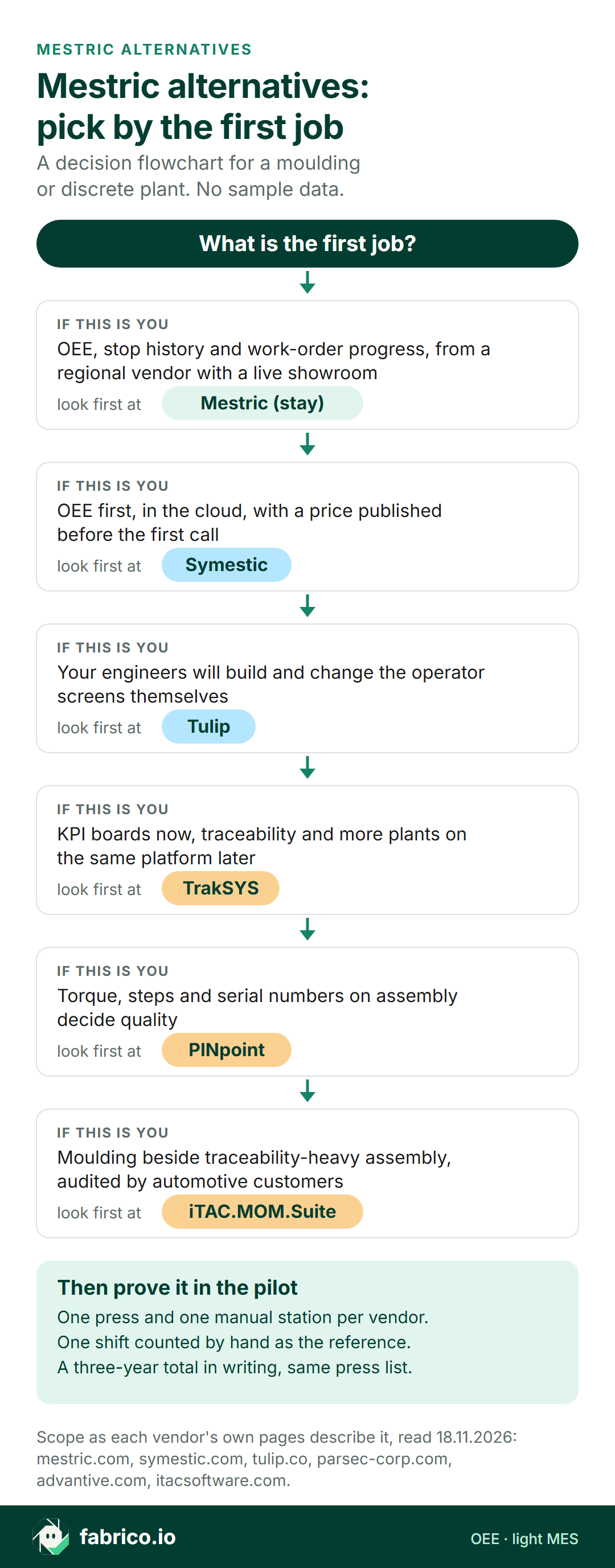
Text version of this infographic
- OEE, stop history and work-order progress from a regional vendor with a live showroom: Mestric (stay).
- OEE first, in the cloud, with a price published before the first call: Symestic.
- Engineers will build and change the operator screens themselves: Tulip.
- KPI boards now, traceability and more plants on the same platform later: TrakSYS.
- Torque, steps and serial numbers on assembly decide quality: PINpoint.
- Moulding beside traceability-heavy assembly, audited by automotive or electronics customers: iTAC.MOM.Suite.
- Then prove it in the pilot: one press and one manual station per vendor, one shift counted by hand, a three-year total in writing.
Decision matrix: Mestric or an alternative for your plant
Each row is a situation, the option whose own page speaks to it, and a floor test that settles it. Rows where all six answer alike were cut; they are named under the table.
| If this is you | Look first at | Why (vendor page) | Prove it in the pilot by |
|---|---|---|---|
| You want OEE, stop history and work-order progress, and a showroom you can visit | Mestric (stay) | Industry cases: "~24 machines in a real production environment" | Watching one stop get its reason on the Naklo floor |
| OEE first, in the cloud, and the budget must be known before the first call | Symestic | Pricing: Professional "from $11,400 / year" (accessed 18.11.2026) | Running the Proof of Value on one press and matching its count to the press counter |
| Your engineers will build and change the screens themselves | Tulip | Composable MES: apps "can be combined to build a larger solution." | Having an engineer change one screen in the pilot, timed, with no vendor help |
| KPI boards now, traceability and more sites later on one platform | TrakSYS | Plans: traceability and audit trail from Premier | Writing down which plan tier the pilot modules sit in, before it starts |
| Torque and serial numbers on assembly decide quality | PINpoint | PINpoint: torque and angle control at the fastening tool | Forcing one out-of-range torque and checking the part is held |
| Customers audit single-part traceability across plants | iTAC.MOM.Suite | MOM Suite: "traceability, and real-time monitoring" | Tracing one finished part back to its moulding shot in the pilot |
Cut because they do not separate the six: an OEE figure, stop reasons entered at the machine, a link to the ERP, and dashboards on a wall screen. All six pages describe these.
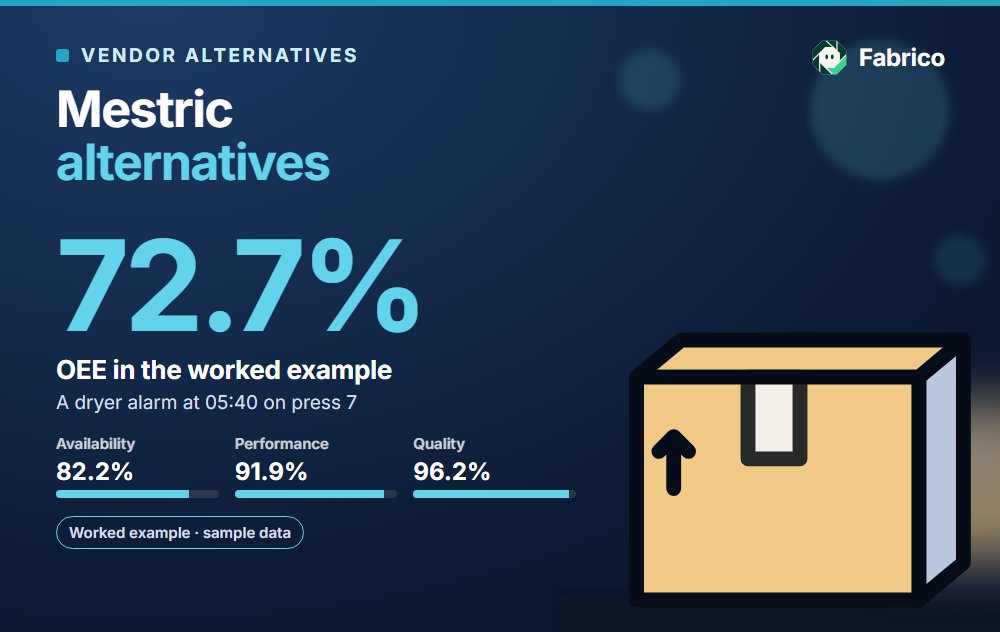
Worked example: a dryer alarm at 05:40 on press 7
Sample data, made up for this page. No customer, no product screen. Press 7 runs a 4-cavity mould for an interior trim clip on a 32 second cycle, so 7.5 clips a minute at the ideal. The shift is 8 hours less a 30 minute break: 450 planned minutes and 3,375 clips possible.
At 05:40 the material dryer raises a dew point alarm and the press waits 32 minutes for dry granulate. The first shots after the restart are short. Three of the tools, as their pages describe them:
- Mestric. The 32 minutes show as downtime on the press and go into the stop history its page says you can "analyze"; the short shots fall under its QA parameters.
- Symestic. "Stops are detected automatically and explained at the workstation using your downtime reason catalog", so the setter picks "material not dry" on the press screen, and OEE shows "each factor individually".
- Tulip. The setter picks a reason code in an app, and the page says Tulip "captures machine uptime, cycle durations, and defect logs", so the short shots land in a scrap app someone built.
All three hold the 32 minutes; they differ in who built the screen the setter taps. The rest of the log: a 41 minute mould change and 7 minutes with no reason yet, 80 minutes of stops in all.
The OEE arithmetic. Run time is 450 less 80, so 370 minutes: availability is 370 / 450 = 82.2%. In 370 minutes the ideal is 2,775 clips; the press made 2,550, so performance is 2,550 / 2,775 = 91.9%. Short shots scrapped 96, leaving 2,454 good: quality is 2,454 / 2,550 = 96.2%. OEE is 82.2% x 91.9% x 96.2% = 72.7%, the same as 2,454 good clips of 3,375 possible. The OEE calculation guide shows the method.
The same shift in euros
The 921 missing clips are priced at margin, the loss if the clips could have been sold. Take a sample price of EUR 0.75 a clip and a sample margin of 20%, so EUR 0.15 a clip. The 20% sits inside the January 2026 gross margins in Damodaran's US industry dataset: 15.84% for Auto Parts and 24.27% for Packaging & Container (accessed 18.11.2026).
| Loss (sample data) | Clips | Per shift (EUR) | Per year (EUR) |
|---|---|---|---|
| Stops, 80 min | 600 | 90.00 | 68,040 |
| Slow cycles, 2,775 less 2,550 | 225 | 33.75 | 25,515 |
| Short shots | 96 | 14.40 | 10,886 |
| Total gap to ideal | 921 | 138.15 | 104,441 |
The year assumes three shifts on 21 days a month: 63 shifts a month, 756 a year, so EUR 8,703.45 a month. The dryer wait alone is 240 clips, EUR 36.00 a shift; if it came back every shift it would be EUR 27,216 a year. The total is a ceiling: no press runs a year at its ideal cycle.
Pilot rule. Count one shift on press 7 by hand: clips, scrap, stops and reasons on paper. A pilot whose count misses that sheet by more than a few clips is not ready to compare.
Two checks before you compare quotes
What the presses can expose. EUROMAP 77 "describes the interface between injection moulding machines (IMM) and manufacturing execution systems (MES)". It was first released on 4 May 2018; Release 1.01 of 1 June 2020 "is identical to OPC 40077" (accessed 18.11.2026). Ask the press maker whether it is enabled on your presses, and each MES vendor which press models it already reads. Presses without it need a signal tap or gateway, priced in the quote.
Where the MES boundary sits. ISA-95 says "Level 3 describes manufacturing execution systems (MES)" (accessed 18.11.2026). Write down which jobs sit there in your plant (OEE, stop reasons, work-order progress, genealogy) and which stay in the ERP. Light MES vs full MES sets out the trade.
Where Fabrico fits
Fabrico's product is OEE software in the cloud, carrying light MES functions; its MES and OEE solution overview sets out the scope. In a moulding hall it covers four jobs:
- Signal. Run, stop and count come from the press PLC or machine signal.
- Cause. Operators add the reason on a tablet or phone, against the product that ran.
- Stations with no signal. At a manual trimming, assembly or packing table, the camera add-on counts output, and where a camera covers the line, the video for the minute of a stop can be opened from the shift timeline, streamed on request and not stored in Fabrico.
- Money. OEE, downtime and lost output show by line and shift, with losses priced from selling price and margin per product.
Fabrico supplies measured rates per line; the plan itself is made in the ERP, APS or planning spreadsheet. Lot genealogy and traces stay in the ERP or traceability system. That makes it a fit where the first question is which press losses cost the most, in euros. A demo walks through it on a sample line; computer vision for plastics injection molding covers the camera side.
What to do this week
- List the presses. Make, controller, year and whether EUROMAP 77 is enabled, plus every manual station after the press.
- Write the three definitions. Planned time, ideal cycle per mould and cavity count, and how long a stop must last before it counts.
- Pick two rows from the matrix. Those two vendors plus Mestric make three quotes.
- Ask for a three-year total. Software, connection work per press, hardware, tablets and services, on the same press list.
- Count one shift by hand. That sheet is the pilot reference.
- Price the gap with the plant's margin. Replace the sample EUR 0.15 a clip with the real figure, and the pilot result comes out in euros.
Questions plant managers ask about Mestric alternatives
What is Mestric?
Mestric is MES and smart factory software from Infotrend d.o.o. in Slovenia. Its pages describe machine status, downtime and OEE, quality and QA parameters, work-order progress per operation, production cost monitoring and a sync to the ERP.
Does Mestric publish a price?
Mestric: no public price; quote on request (checked 18.11.2026). The site offers a free consultation and a demo, so the figure comes by quote. Ask for it split into software, connection work and services.
Which Mestric alternatives publish prices?
Three of the five, as of 18.11.2026. Symestic: Starter $560 a month, Professional from $11,400 a year, net and invoiced in euros. TrakSYS: $1,999 a month for Essentials up to $15,999 for Ultimate, as annual-term starting points. Tulip: $100 or $250 per interface a month, billed annually, 10 interfaces minimum. PINpoint and iTAC quote on request.
What is EUROMAP 77 and why ask about it?
EUROMAP 77 describes the interface between injection moulding machines and MES, first released on 4 May 2018. Release 1.01 is identical to OPC 40077. Ask each vendor whether it reads EUROMAP 77 and on which press models.
Where does Fabrico fit among Mestric alternatives?
Outside the five. Fabrico is cloud OEE software with light MES functions. Run, stop and count come from the machine signal, operators add the reason on a tablet or phone, and losses are priced in euros by line and shift. Where a machine has no usable signal, a camera add-on counts output.
Want a press hall shown with its OEE, stop reasons and losses in euros? Book a demo.
Related articles








Real Fabrico tiles, sample data.