


 Login
 Blog
SafetyChain Alternatives: 5 Options by the Job You Need Done

In short: pick by the job. Stay with SafetyChain if quality checks and production monitoring should share one system priced per facility. For a full HACCP and supplier programme built from modules, look at Ideagen Safefood 360; for a HACCP plan and logs at a published price, FoodDocs; for supplier documents, TraceGains; for fill weights and giveaway, InfinityQS Enact; for line performance and shift routines, Redzone.
- SafetyChain sells an annual subscription per facility with a one-time setup fee, per its pricing page; no figure is published.
- Every vendor fact below comes from that vendor's own pages, read on 18.11.2026 and linked in place.
SafetyChain sits across three jobs that many food and beverage plants still run in separate places: the food safety programme, in-process quality checks and production monitoring. Someone searching for an alternative usually needs one of those jobs done differently, and the options split along exactly those lines. Five alternatives a food or beverage plant would put on a shortlist follow, grouped by the job each one starts from. Fabrico, maker of OEE and light MES software, is covered in one short section after the five and is not counted among them.
Key takeaways
- The five alternatives start from different jobs: two from food safety programmes, one from supplier documents, one from SPC and fill weights, one from line performance.
- FoodDocs publishes figures, USD 99 to USD 299 per site per month on monthly billing, exclusive of VAT (accessed 18.11.2026); SafetyChain and the other four quote on request.
- Any option has to keep HACCP monitoring, corrective action and records, which both FDA guidance and EU Regulation 852/2004 require.
- In the sample cereal bar shift below, a failed metal detector check costs 42 minutes and EUR 441.00 of gross margin, out of a EUR 1,829.80 gap to ideal.
What SafetyChain covers, by its own pages
The SafetyChain homepage says it is "trusted in 2,500+ manufacturing facilities" and groups the product into six areas: food safety programs, regulatory and customer compliance, in-process quality, production monitoring, process and data controls, and supplier compliance. As of 18.11.2026 its pages say:
- Food safety. The food safety programs page says it can "Execute HACCP monitoring and required verification workflows with built-in accountability" and "Standardize and enforce Pre-Op inspections, GMPs, sanitation checks, and facility audits."
- Quality. The digital plant management page describes monitoring "production and quality using Statistical Process Control and built-in CAPA/RCA tools", and scoring suppliers on overdue tasks and performance.
- Production. The production performance page lists "Live OEE monitoring", "downtime automatically logged by source and reason as conditions drift" and "Flexible data collection (sensors or Ignition)", and says the Operator View shows "throughput, downtime, yield, and scrap live".
- Devices. The same plant management page says it runs on Windows, iOS and Android, and that it works "both online and offline".
- Price. SafetyChain: no public price; quote on request (checked 18.11.2026). The pricing page names Essential, Advanced and Supplier plans and calls the model "an annual subscription cost per facility", with "no user-based pricing" and "a one-time set-up fee based on the number of plant on-sites and specific product package details". Production Monitoring and "IoT Data and SafetyChain Module for Ignition" appear there as add-ons.
User signal. App Store, SafetyChain App: 2.8 out of 5 from 16 ratings, read 18.11.2026 (listing). Sixteen ratings of a mobile companion app say little about the platform, but they are the only public score that could be read today; the two large review sites returned 403.
What any option has to keep doing
Before the vendor list, the floor. Whatever replaces or sits next to SafetyChain inherits the plant's legal record-keeping, and that narrows the field faster than any feature list.
HACCP monitoring and records. In the EU, Article 5(1) of Regulation (EC) No 852/2004 says food business operators "shall put in place, implement and maintain a permanent procedure or procedures based on the HACCP principles", and Article 5(4) asks them to "retain any other documents and records for an appropriate period" (accessed 18.11.2026). The FDA HACCP guidelines spell the principles out, among them "Establish monitoring procedures", "Establish corrective actions" and "Establish record-keeping and documentation procedures", and define monitoring as observations that "produce an accurate record for future use in verification" (accessed 18.11.2026). Any tool on the shortlist must show a CCP check, the corrective action that followed a miss, and the signed record, in one trail.
Traceability on a clock. For sites in the United States, the FDA Food Traceability Rule page says records "must be made available to the FDA within 24 hours after a request is made", including "an electronic sortable spreadsheet", and that FDA proposed to extend the compliance date "by 30 months to July 20, 2028" (accessed 18.11.2026). A plant that ships foods on the traceability list should ask each vendor to produce that spreadsheet from pilot data, not describe it.
Pilot rule of thumb: pick one CCP, say the metal detector, and make every vendor show the full loop on your data: the scheduled check, a failed result, the hold, the corrective action, the sign-off and the export an auditor would ask for.
Five SafetyChain alternatives, grouped by the job
The order runs from the food safety programme outward: programmes first, then supplier documents, then quality data on the line, then line performance. Read the entries that match the job your plant is short of.
Ideagen Safefood 360: a modular food safety and supplier system
The Safefood 360 homepage carries the Ideagen name and describes the product as "Integrating food safety, supplier quality, and compliance management into one cloud-based platform", with "over 35 modules". It says the HACCP module can "Create HACCP, PCP and Food Safety Plans, integrating risk assessment models, decision trees". The monitoring module page says it lets a plant "build all your CCP and operational monitoring programs in one place" and "Receive alerts when monitoring programs breach limits".
Price. Ideagen Safefood 360: no public price; quote on request (checked 18.11.2026). The homepage offers a demo request and an ROI calculator; no pricing page is linked.
Look at it if the food safety programme itself, from hazard analysis to PRPs and supplier approval, is the job, and production monitoring can stay elsewhere.
FoodDocs: a HACCP plan and monitoring logs at a published price
The FoodDocs homepage calls it "a HACCP-based food safety management software platform" that "supports businesses in the food manufacturing industry" as well as restaurants. It promises "Automatically generated Hazard Analysis, Critical Control Points, Standard Operating Procedures, and Flow Chart", and says a plant can "connect with smart devices and temperature sensors to make monitoring faster".
Price. The FoodDocs pricing page publishes figures in USD (accessed 18.11.2026): Lite at USD 99, Standard at USD 199 and Professional at USD 299 per site per month on monthly billing, or USD 79, USD 167 and USD 250 per site per month billed annually; Enterprise is custom. Prices are "exclusive of VAT", and the page offers a "Free 14-day trial. No credit card required." The HACCP plan builder starts at Standard; Professional adds batch-based monitoring linked to traceability.
Look at it if the site is a single plant or a small group, the HACCP plan needs rebuilding, and the budget has to be known before a sales call.
TraceGains: supplier documents and specifications
The TraceGains homepage describes "a purpose-built food and beverage product development, supplier management, quality and compliance platform" and asks plants to "Keep supplier docs, specs, certifications and approvals current and connected." Its supplier compliance page says it "automates supplier document collection, validation, and monitoring" and helps "support GFSI, FSMA, and internal audits with complete, traceable records".
Price. TraceGains: no public price; quote on request (checked 18.11.2026). The homepage links demo requests; no pricing page is linked.
Look at it if the audit findings are about supplier certificates, specifications and approvals rather than what happens on the line.
InfinityQS Enact: SPC and fill weights across lines
Advantive's Enact page says "InfinityQS Enact is a cloud-based SPC platform" that can "Collect data from machines, devices, and operators in real time", with "Email, text, or in-app notifications when limits are exceeded". For food and beverage lines the page names the money directly: "reduce giveaway", "preventing underfilling" and "ensuring consistent net content levels".
Price. InfinityQS Enact: no public price; quote on request (checked 18.11.2026). Advantive's pricing page asks plants to request "a customized quote", which it says covers licensing costs and projected implementation fees.
Look at it if overfill, underfill and net content are where the plant loses money, and quality wants control charts on every filler and checkweigher.
Redzone: line performance with compliance routines on top
The Redzone productivity page puts OEE live on screen "for every line, cell, and shift". Downtime and throughput, it says, are collected and timestamped without manual entry and tied to the line, run and asset, while "Operators can digitally log additional context from the line in seconds." Its compliance page describes "digital HACCP checks, automated corrective actions, and audit-ready records for every run" and offers to "Replace paper checklists with digital inspections tied to live production". It lists ISO, FDA, SQF, BRC and GMP among the standards it can be configured to.
Price. Redzone: no public price; quote on request (checked 18.11.2026). The Redzone pricing page says "Pricing is based on the number of sites and modules deployed."
Look at it if the plant's first problem is line performance and shift discipline, with food safety checks run on the same screens. The Redzone alternatives page covers the reverse question.
Decision matrix: SafetyChain or an alternative for your plant
Each row is a situation, the option whose own page speaks to it, and a floor test that settles it. Rows where all six answer alike are listed under the table instead.
| If this is you | Look first at | Why (vendor page) | Prove it in the pilot by |
|---|---|---|---|
| Quality checks, SPC and production monitoring should share one record, priced per facility | SafetyChain (stay) | Pricing: "an annual subscription cost per facility"; plant management: SPC and CAPA | Logging one CCP miss and seeing the hold, CAPA and line downtime in one trail |
| Operators log checks in areas where the network drops | SafetyChain (stay) | Plant management: works "both online and offline" | Turning Wi-Fi off in the cold store, logging three checks, then checking the sync |
| The HACCP plan, PRPs and supplier approval need one modular system | Ideagen Safefood 360 | Homepage: "Create HACCP, PCP and Food Safety Plans" | Rebuilding one product's hazard analysis and CCP table in the pilot |
| A small site needs a HACCP plan and logs, budget known up front | FoodDocs | Pricing: USD 99 to USD 299 per site per month, monthly billing (accessed 18.11.2026) | Running the 14-day trial on one CCP and one temperature log |
| Audit findings are about supplier certificates and specifications | TraceGains | Supplier compliance: "automates supplier document collection, validation, and monitoring" | Loading 20 live suppliers and counting the expired documents it flags |
| Overfill and net content drive the losses | InfinityQS Enact | Enact: "reduce giveaway", "ensuring consistent net content levels" | Charting one week of checkweigher data and pricing the overfill |
| Line performance and shift huddles come first, food safety checks on the same screen | Redzone | Productivity: OEE "for every line, cell, and shift" | Comparing one shift's counted output with the hand tally and the ERP posting |
Left out because they do not separate the six: corrective action tracking, audit-ready records, dashboards and mobile apps. Each vendor describes these on its own pages, so they cannot decide the choice.
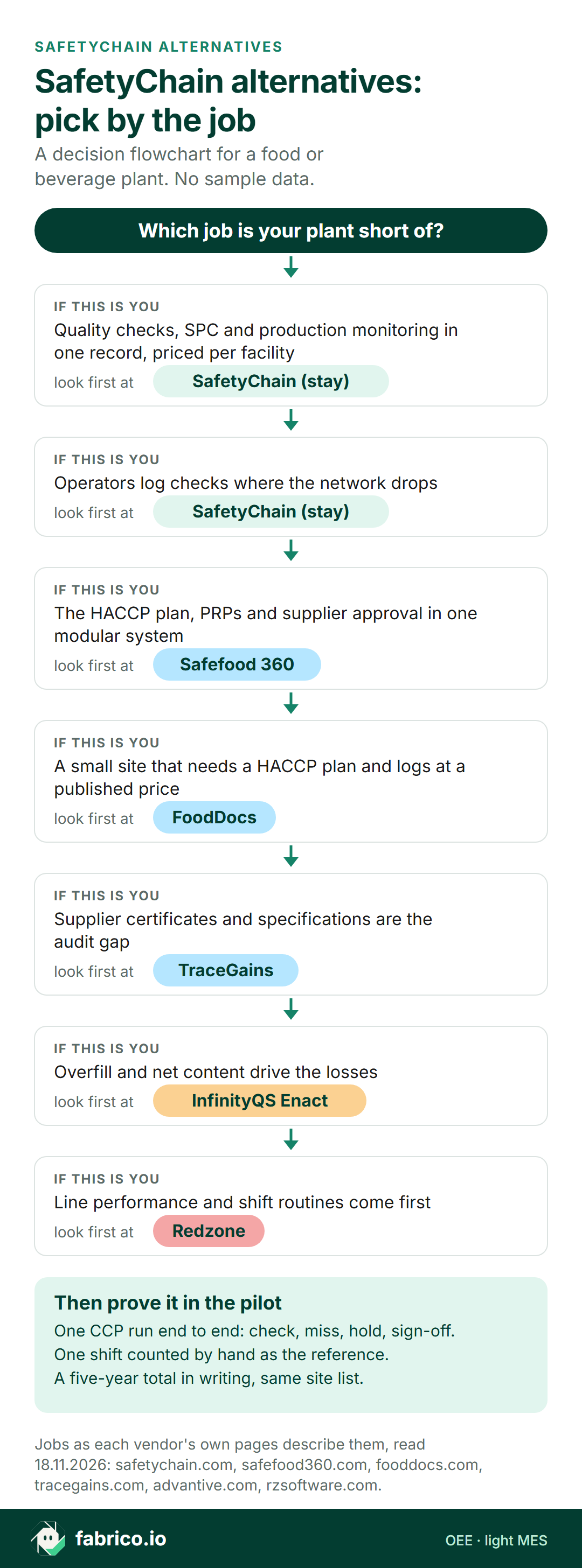
Text version of this infographic
- Quality checks, SPC and production monitoring in one record, priced per facility: SafetyChain (stay).
- Operators log checks where the network drops: SafetyChain (stay).
- The HACCP plan, PRPs and supplier approval in one modular system: Ideagen Safefood 360.
- A small site that needs a HACCP plan and logs at a published price: FoodDocs.
- Supplier certificates and specifications are the audit gap: TraceGains.
- Overfill and net content drive the losses: InfinityQS Enact.
- Line performance and shift routines first: Redzone.
- Then prove it in the pilot: one CCP run end to end, one shift counted by hand, a five-year total in writing for the same site list.
Price shapes, as published
Every cell is from the vendor's own page on 18.11.2026, in the currency that page uses. Nothing is converted or estimated.
| Vendor | How it charges (its page) | Published figure |
|---|---|---|
| SafetyChain | Annual subscription per facility, no user-based pricing, one-time setup fee | no public price; quote on request (checked 18.11.2026) |
| Ideagen Safefood 360 | Demo request and ROI calculator; no pricing page linked | no public price; quote on request (checked 18.11.2026) |
| FoodDocs | Per site per month, monthly or annual billing, VAT extra | USD 99 to USD 299 per site per month, monthly billing; Enterprise custom (accessed 18.11.2026) |
| TraceGains | Demo request; no pricing page linked | no public price; quote on request (checked 18.11.2026) |
| InfinityQS Enact | Custom quote with licensing and implementation fees | no public price; quote on request (checked 18.11.2026) |
| Redzone | Based on the number of sites and modules | no public price; quote on request (checked 18.11.2026) |
Per facility and per site sound alike but bill differently once a group adds plants, and SafetyChain's add-ons sit outside the base plans. Send every vendor the same list of sites, lines, CCPs and suppliers, and ask for a five-year total with setup, add-ons, devices and training included.
Worked example: a metal detector check fails at 10:15 on a cereal bar line
Sample data, made up for this page. No customer, no product screen. A cereal bar line forms, cuts and flow-wraps bars, then passes them through a metal detector that is a CCP in the plant's HACCP plan. The shift is 10 hours with 30 minutes of breaks, so 570 planned minutes. The ideal rate is 150 bars a minute, which makes 85,500 bars possible.
At 10:15 the hourly verification fails: the ferrous test piece passes the detector without a reject. The line stops, everything packed since the last good check at 09:15 goes on hold to be re-run through a second detector, and an engineer resets and re-verifies the head. The line waits 42 minutes. Three of the tools, as their own pages describe them:
- SafetyChain. The failed check is a HACCP monitoring record, and the food safety programs page says workflows run "with built-in accountability". The production performance page says downtime is "automatically logged by source and reason", so the 42 minutes can sit in the same platform as the failed check, where Production Monitoring is part of the plan.
- Redzone. The compliance page describes "digital HACCP checks, automated corrective actions" and says "Corrective actions start in the moment"; the productivity page logs the 42 minutes against the line and run without manual entry, and describes "Structured digital huddle routines" where the next shift sees the issue.
- Ideagen Safefood 360. The monitoring module raises an alert "when monitoring programs breach limits", and the CCP record and verification live with the HACCP plan. The 42 minutes of line time are recorded wherever the plant tracks production.
All three hold the failed check; what differs is whether the lost time and the lost bars land in the same record as the CCP. The rest of the shift log reads: allergen changeover from a nut bar to a nut-free bar 48 minutes, jams at the wrapper infeed 22, and 8 minutes with no reason yet. Stops total 120 minutes.
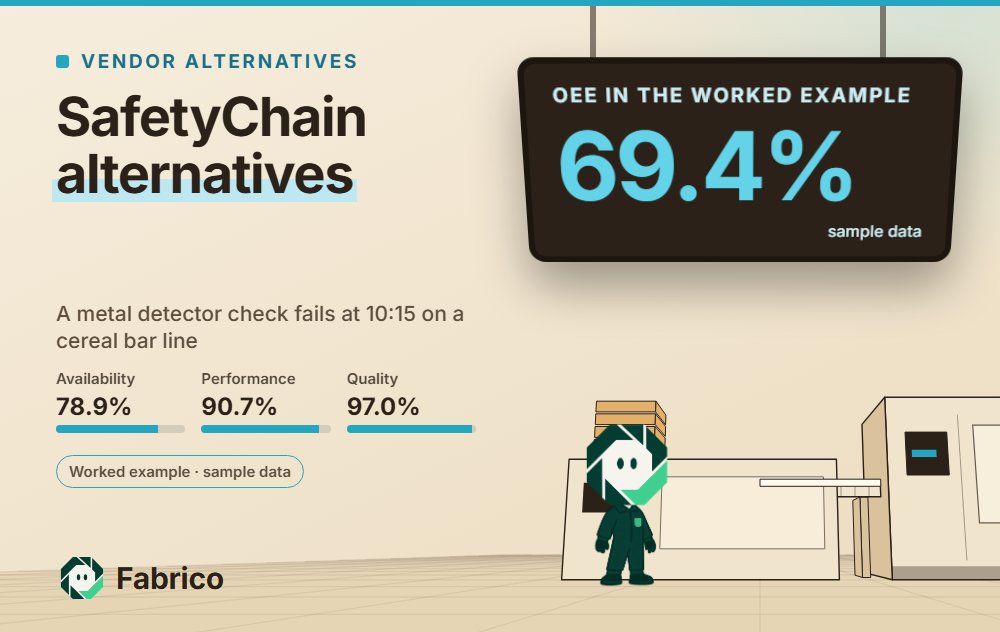
The OEE arithmetic. Run time is 570 less 120, so 450 minutes: availability is 450 / 570 = 78.9%. In 450 minutes the ideal is 67,500 bars; the line made 61,200, so performance is 61,200 / 67,500 = 90.7%. Rejects were 1,840 bars, 1,200 of them damaged while the held lot was re-run and 640 with bad seals, leaving 59,360 good: quality is 59,360 / 61,200 = 97.0%. OEE is 78.9% x 90.7% x 97.0% = 69.4%, the same as 59,360 good bars of 85,500 possible. The OEE calculation guide walks through the method.
The same shift in euros
The margin per bar is anchored to a sourced range. Aswath Damodaran's margins by sector dataset at NYU Stern, data as of January 2026, gives food processing firms in the United States a gross margin of 23.23% and soft beverage firms 54.74% (accessed 18.11.2026). Take a sample selling price of EUR 0.30 a bar and a gross margin of 23.3%, at the food processing end of that range: EUR 0.07 a bar.
| Loss (sample data) | Bars | Per shift (EUR) | Per year (EUR) |
|---|---|---|---|
| Stops, 120 min x 150 bars | 18,000 | 1,260.00 | 952,560 |
| Slow running, 67,500 less 61,200 | 6,300 | 441.00 | 333,396 |
| Rejects | 1,840 | 128.80 | 97,373 |
| Total gap to ideal | 26,140 | 1,829.80 | 1,383,329 |
The year assumes three shifts a day on 21 days a month: 63 shifts a month, 756 a year, so a month is EUR 115,277.40. The total is a ceiling, since gross margin is only lost where the bars could have been sold and no line runs a year at its ideal rate. The detector event alone is 42 minutes, 6,300 bars and EUR 441.00, plus EUR 84.00 for the 1,200 bars damaged in the re-run. If it happened once a week, that is EUR 27,300 a year, which is the size of problem a better verification routine or a spare detector head would be judged against.
Where Fabrico fits
Fabrico is cloud-hosted OEE software with light MES functions, and the MES and OEE solution overview sets out the scope. In a food plant it takes the line side of the example above, while HACCP plans, environmental monitoring, swabs and CCP records stay with the food safety system the plant already runs.
- Signal. Run, stop and count come from the machine's PLC, a sensor or a counter.
- Cause. Operators add the reason on a tablet or phone, so the 42 minutes carry "metal detector verification" rather than a blank.
- Stations with no signal. At a manual packing or case-loading step, the camera add-on counts output. Where the camera add-on covers the line, the video for the minute of a stop can be opened from the shift timeline, streamed on request and not stored in Fabrico.
- Money. OEE, downtime and lost output show by line and shift, priced from selling price and margin per product, the same arithmetic as the table above.
That fits a plant whose food safety system works and whose open question is which line losses cost most. The computer vision guide for food manufacturing and the FMCG computer vision hub show where cameras sit on such lines. A demo walks through a sample line.
What to do this week
- Name the short job. Write down whether the pain is the HACCP programme, supplier documents, fill weights or line performance. That picks the two rows of the matrix to follow.
- Pick one CCP for every pilot. The metal detector or a cook step. Ask each vendor to run the full loop on it: check, miss, hold, corrective action, sign-off, export.
- Ask for the traceability export. For sites in the United States that ship foods on the traceability list, ask each vendor to produce the sortable spreadsheet FDA can request, from pilot data.
- Ask for a five-year total. Send SafetyChain and two alternatives the same list of sites, lines, CCPs and suppliers, and ask for subscription, setup, add-ons, devices and training over five years.
- Count one shift by hand. Output, stops and reasons on paper for one line. That sheet is the reference any production number in a pilot has to match.
- Put the plant's margin in the table. Swap the EUR 0.07 sample for your margin per unit, so the pilot result reads in money.
Questions SafetyChain buyers ask
What is SafetyChain?
SafetyChain is plant management software for food and beverage manufacturers. Its own pages group the product into food safety programs, regulatory and customer compliance, in-process quality, production monitoring, process and data controls, and supplier compliance, and say it is used in 2,500+ manufacturing facilities. It is sold as an annual subscription per facility, with a one-time setup fee.
Does SafetyChain publish its prices?
No. As of 18.11.2026 its pricing page names the Essential, Advanced and Supplier plans and the pricing model, an annual subscription per facility with no user-based pricing, but lists no figure. Each plan has a request button, so the number comes by quote.
Which SafetyChain alternatives publish a price?
One of the five on this page, as of 18.11.2026. FoodDocs lists Lite, Standard and Professional plans at USD 99, 199 and 299 per site per month on monthly billing, exclusive of VAT, with an Enterprise plan on custom pricing. Redzone, InfinityQS Enact, TraceGains and Ideagen Safefood 360 quote on request.
Is there a SafetyChain alternative built around line performance?
Redzone is the closest of the five. Its productivity page offers OEE per line, cell and shift, with downtime collected automatically, and its compliance page describes digital HACCP checks tied to live production. The other four start from food safety, supplier or SPC work.
Where does Fabrico fit next to SafetyChain and its alternatives?
Outside the five. Fabrico is OEE software with light MES functions: run, stop and count come from the machine signal, operators add the stop reason on a tablet or phone, and losses are priced in euros from selling price and margin per product. HACCP plans, environmental monitoring and swab results stay in the food safety system the plant already runs.
Want a food line shown with its OEE, stop reasons and losses in euros? Book a demo.
Related articles





Real Fabrico tiles, sample data.