


 Login
 Blog

Computer Vision for Elevator Manufacturing: Score Each Lift Job at Its Own Ideal Time

In short: Computer vision in elevator manufacturing counts output at manual stations, such as landing door benches and job kitting, where no machine reports a count.
Inspection is a separate job: door checks, controller tests and acceptance tests stay with the testers and inspectors.
- Lifts are engineered per building, so door sets, slings and rails change with every job; one ideal time per line misreads the shift.
- Score each door family at its own ideal: the example shift is 70.5%; one 13 minute standard says 71.4% and blames the wrong job.
- The factory ships job kits, not lifts: under the EU Lifts Directive the installer places the lift on the market, so a kit counts once.
- Escalators are built one per rise: the truss counts once per escalator, and the rise travels with the job, not the line.
- Lost bench minutes are priced per door family and only while jobs wait; otherwise they cost crew time.
Which station absorbs each lift and escalator variant
A lift plant does not build one product many times. Each order is a building: car size, rated load, door type and width, speed, drive, controller and the number of landings are fixed per job. Escalators are fixed per rise, inclination and step width. Each choice lands on one station first, and that station carries the swing in work content. The decision matrix below shows which station absorbs which variant and where its count can come from.
The rules think in variants too. The EU Lifts Directive defines a model lift as a representative lift "defined by objective parameters" (Directive 2014/33/EU, Article 2). A job card carries the same parameters, which makes a lift plant mostly configure to order, with engineering on the special jobs; see make to order vs engineer to order.
| Variant (per job) | Station that absorbs it | What changes there | Count from |
|---|---|---|---|
| Shaft height, landings | Rail machining; landing door bench | Rail lengths; one door set per landing | Machine signal; camera add-on |
| Rated load, car size | Sling and platform bench; car panel line | Sling section, platform, wall panels | Camera add-on; machine signal |
| Door type and width | Landing door bench; door check stand | Centre or side opening, 2 or 4 panels, fixture | Camera add-on; test result |
| Drive: traction or hydraulic | Machine assembly | Machine and brake, or jack and tank | Test bench log |
| Speed, controller | Controller and harness benches | Drive size, harness length by landings | Test bench log |
| Car finish | Car panel line; kitting | Stainless, painted or laminate panels | Machine signal; camera add-on |
| Escalator rise | Truss welding; step band | Truss length, steps, handrail length | Robot signal; camera add-on |
| Inclination, step width | Truss jig; balustrade | Jig setting, step width, glass panels | Robot signal; camera add-on |
Two rows carry most of the mix on the lift side: landings and door type. A nine-stop residential lift needs nine landing door sets, a fourteen-stop hotel lift fourteen, and a hospital bed lift may need wide four-panel doors at only four landings. The same bench sees all three in one shift, at very different minutes per set.
Rated load sets the car. The US code ASME A17.1 carries a table of "Maximum Inside Net Platform Areas for the Various Rated Loads" (ASME A17.1-2022 contents). In Europe the standard the Commission cites for lifts is EN 81-20:2020 (European Commission lifts page). Neither sets a factory minute, but both fix what the sling bench and the panel line build for each job.
The drive row is lopsided: of the new lifts counted in Europe in 2024, 96% were electrical and 4% hydraulic (ELA industrial statistics 2024). The hydraulic branch is a small side line, but on the day it runs it needs its own ideal time.
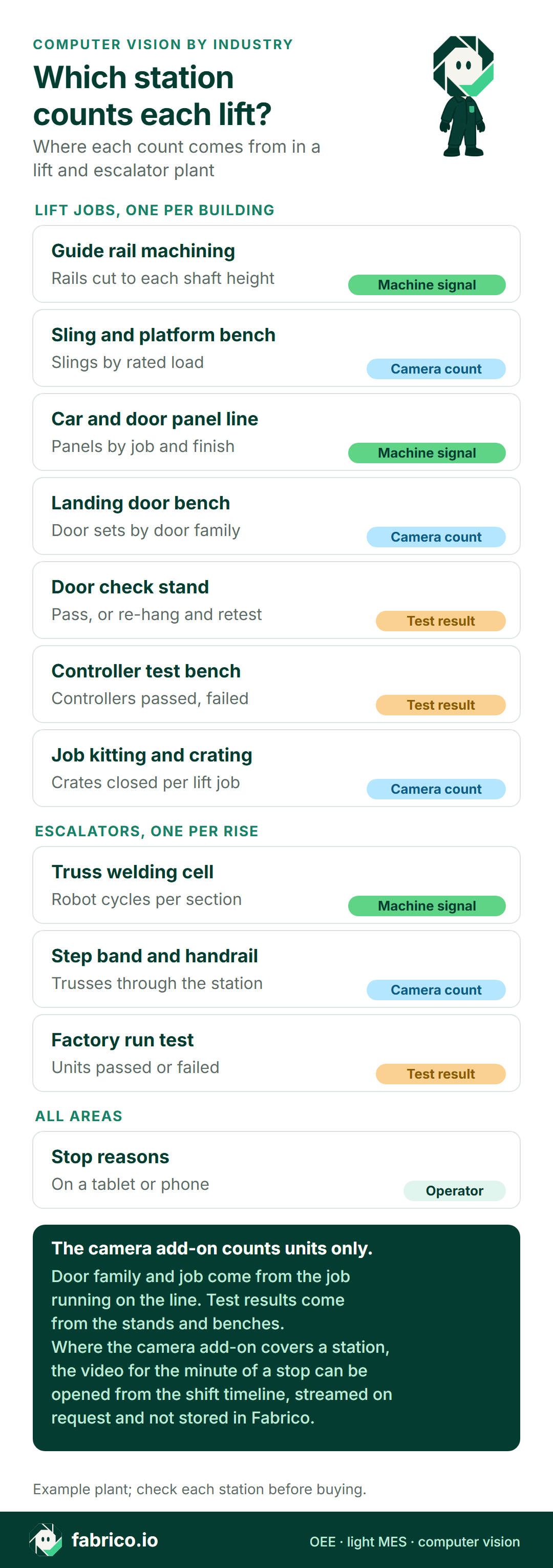
Text version of this infographic
- Lift jobs, one per building: guide rail machining, machine signal, rails cut to each shaft height.
- Sling and platform bench, camera count, slings by rated load.
- Car and door panel line, machine signal, panels by job and finish.
- Landing door bench, camera count, door sets by door family.
- Door check stand, test result, pass, or re-hang and retest.
- Controller test bench, test result, controllers passed, failed.
- Job kitting and crating, camera count, crates closed per lift job.
- Escalators, one per rise: truss welding cell, machine signal, robot cycles per section.
- Step band and handrail, camera count, trusses through the station.
- Factory run test, test result, units passed or failed.
- All areas: stop reasons, operator, on a tablet or phone.
- The camera add-on counts units only. Door family and job come from the job running on the line. Test results come from the stands and benches.
- Where the camera add-on covers a station, the video for the minute of a stop can be opened from the shift timeline, streamed on request and not stored in Fabrico.
- Example plant; check each station before buying.
Explainer presented by Iris, Fabrico's AI-generated presenter: how an add-on camera counts output where a machine has no signal. Book a demo.
Plays from YouTube. Google may set cookies when you press play. Privacy policy.
The lift is finished on site, so the plant counts job kits
Article 2 of the same Directive names the installer as "the natural or legal person who takes responsibility for the design, manufacture, installation and placing on the market of the lift". The Commission's page adds that the Directive covers lifts for people that "travel at a speed greater than 0.15 m/s" and that it is "mainly relevant for lift installers and components manufacturers" (Commission guidance on the Lifts Directive).
So the factory never ships a lift. It ships rails, a sling, car panels, landing doors, a machine, a controller and harnesses, crated for one building. That changes the output count:
- The plant output unit is the job kit. One lift, all crates closed, counted once when its last crate closes. A half-packed kit stays in the queue.
- Station counts are not lifts. Door sets, slings and controllers added up give a number nobody ships.
- A set re-hung at the check stand is still one set, good after its retest but not first pass good.
- Job type travels with the count. Replacement and modernisation kits run through the same benches but should not swell the new-lift figure.
The last point is not small. The European Lift Association counted 26,394 replacement lifts in 2024 against 142,448 new lifts (ELA 2024 tables). Tagging each job as new or replacement keeps both counts honest.
Acceptance is not a factory event either. In the US, ASME A17.1 has a "Section 8.10 Acceptance Inspections and Tests", with an "Acceptance Test for Escalators" among its tables (ASME A17.1-2022 table of contents), made on the installed unit. The plant's last count is dispatch; the handover count belongs to the installer.
Where the machines already report, and where nothing does
Most metal work in a lift plant already has a signal. Guide rail lines cut and machine rails on CNC equipment that reports cycles. The panel line punches and bends on machines with counters. Welding robots in an escalator truss cell report arc time and cycles. The controller test bench logs every unit it tests. Read those signals first; a camera over a CNC rail line adds nothing.
The gaps are the hand stations: the sling and platform bench, the landing door bench where fitters hang panels and fit hangers, locks and sills, the kitting tables where a job is packed into crates, and the step band and handrail station. Nothing there reports a count, so the shift report is a tally sheet. These are the stations for a camera add-on.
Harness benches sit in between: controller harnesses are cut to the landing count, built by hand on boards and tested with the controller, so the test bench is the count, as in OEE for wire harness assembly. Truss sections follow OEE for robotic welding cells: keep the ideal at the robot cycle and let the waits show.
The queue is the useful part. Rails, slings, checked door sets and tested controllers wait at kitting for their job, and when a kit cannot close, the queue shows which feeder is short. That feeder sets how many kits close, whatever the other benches could build, the gap capacity vs throughput explains; in a plant like this one, it is usually the door bench.
Escalators: one truss per rise, built a few at a time
Escalators are a different trade. The European Lift Association counted 3,064 new escalators in 2025 across 32 countries, worth EUR 413 million, against 151,400 new lifts worth EUR 6.2 billion (ELA summary sheet, 2025 data): about EUR 135,000 of market value per escalator and EUR 41,000 per lift, market averages, not factory prices. An escalator line builds few, large units.
The rise sets the truss length, and the truss length sets the number of steps and the length of the handrail. Inclination and step width set the jig and the balustrade glass. So the unit is one truss, one escalator, with the rise as the job attribute. If a long truss is welded in sections, the sections are a station count; output is still one escalator.
One ideal for the step band station misleads the same way. A long-rise unit scored at a short-rise ideal looks slow on a good day, and a short-rise unit scored at the long-rise ideal can climb past 100%. Set the ideal per rise band, from a time study at the plant.
One shift at the landing door bench, scored per door family
The example is a landing door bench with a crew of three, on a day shift from 06:00 to 14:15 with two 20 minute breaks: 455 planned minutes. It builds three door families at example ideals: C2 centre opening two-panel sets at 10 minutes, T2 side opening telescopic sets at 13, C4 wide four-panel sets at 18. A plant sets its own.
- Job 1, residential block, 9 landings, C2. 9 sets in 100 run minutes.
- Fixture change to T2: 18 minutes.
- Job 2, hotel, 14 landings, T2. 14 sets in 205 run minutes, plus 40 minutes waiting for powder coated door panels from the panel line.
- Fixture change to C4: 12 minutes.
- Job 3, hospital bed lift, 4 landings, C4. 4 sets in 80 run minutes.
- Door check stand: one T2 set fails on its panel gap and one C2 set on a lock contact. The stand fitter re-hangs and retests both before the end of the shift.
Stops are 18 + 40 + 12 = 70 minutes, so the bench ran 385 minutes. At each family's own ideal it earned 90 + 182 + 72 = 344 minutes, so slow running cost 41. The two failed sets carry 13 + 10 = 23 ideal minutes, which leaves 321 good minutes.
| Job, door family | Sets x ideal | Run minutes | Performance: own ideal / 13 min |
|---|---|---|---|
| 1, C2 | 9 x 10 = 90 | 100 | 90.0% / 117.0% |
| 2, T2 | 14 x 13 = 182 | 205 | 88.8% / 88.8% |
| 3, C4 | 4 x 18 = 72 | 80 | 90.0% / 65.0% |
| Shift | 344 | 385 | 89.4% / 91.2% |
Scored per family: availability 385 / 455 = 84.6%, performance 344 / 385 = 89.4%, quality 321 / 344 = 93.3%, and OEE 321 / 455 = 70.5%. All three jobs ran at 88.8% to 90.0% of their own ideal. The hotel job lost the most time, almost all of it from outside the bench: the fixture change and the panel wait.
Now score the same shift with one door standard of 13 minutes, the middle family. Performance reads 351 / 385 = 91.2%, the 25 good sets earn 325 minutes, and OEE reads 71.4%. Worse, the job view turns upside down: the residential job shows an impossible 117.0% and the hospital job 65.0%, so the morning meeting sends the CI lead to the C4 fixture, which ran fine. A 10 minute standard, the fastest family, drops OEE to 250 / 455 = 54.9%, a bench that looks broken.
The fix is one ideal per product, set where the work is done. Ideal cycle time explains why it is the best demonstrated time, theoretical vs actual cycle time shows how far a routing time can sit from the bench, and takt time covers why the line rate is a different number again.
What the lost bench minutes are worth while jobs wait
The door bench gates the kit: a lift job cannot ship without its landing doors. So while signed jobs wait for kits, a lost bench minute delays a lift; when kits run ahead of site dates, it costs only crew time. That is the logic of throughput accounting: price the shift both ways and say which one applies.
No public source gives a margin per door set, so the values below are example inputs that a plant replaces with its own. For scale, the average market value of a new lift in Europe in 2025 was about EUR 41,000 (EUR 6.2 billion over 151,400 units, ELA 2025). For margin, US machinery firms in the January 2026 NYU Stern dataset show a 37.47% gross margin and a 15.86% pre-tax operating margin (NYU Stern margins by sector). The example contributions are EUR 250 a C2 set, EUR 455 a T2 set and EUR 810 a C4 set, which is EUR 25, EUR 35 and EUR 45 per ideal bench minute. Nine C2 sets at EUR 250 are EUR 2,250, about 5.5% of an average lift.
| Job, door family | Lost minutes | Example value per ideal minute | Lost while jobs wait |
|---|---|---|---|
| 1, C2 | 10 slow | EUR 25 | EUR 250 |
| 2, T2 | 81 (18 change, 40 wait, 23 slow) | EUR 35 | EUR 2,835 |
| 3, C4 | 20 (12 change, 8 slow) | EUR 45 | EUR 900 |
| Shift | 111 | EUR 3,985 |
That is EUR 3,985 a shift, or EUR 167,370 over 42 shifts a month, only while jobs wait. The biggest item is the panel wait, 40 minutes at EUR 35, or EUR 1,400, and it starts at the panel line, so it is coded there. The 13 minute view would price 104 minutes at a blended EUR 35, EUR 3,640: EUR 345 short, with 40 minutes on the hospital job and minus 17 on the residential one.
The two re-hung sets ship with their kits, so they are not lost margin. They cost the stand fitter 45 minutes, which at the 2025 euro area average hourly labour cost of EUR 38.2 (Eurostat) is EUR 28.65. When kits run ahead of site dates, the 111 lost minutes cost the crew of three 5.55 hours, or EUR 212.01, about 19 times less. Fabrico prices losses from the plant's own price or margin per product, so these become the plant's numbers.
Camera add-on counts in a lift plant, and their limits
The places are the hand stations from the signal map: the door bench rack, the sling bench, the crate lids at kitting, and the step band station. At each, the camera add-on counts whole units as they cross a fixed zone: a door set placed on the rack, a crate closed, a truss leaving the station. It counts units only. The door family and the job come from the job running on the bench; the pass or fail comes from the check stand.
Be clear about the limits. In a 2025 study from Bursa Uludağ University, a system that recognised fine-grained manual tasks from video at "an industrial assembly station" reached "85.23% accuracy in real-time task recognition", and its dataset included "occlusions caused by large assembly parts" (Ay and Emel, IEEE Access 2025). A lift plant is full of large parts: car wall panels, door leaves, fitters inside a sling frame. So count units at a clear handover point, not steps inside the work, mount above the rack, and test under the plant's own light, because brushed stainless throws reflections. No accuracy figure is claimed here; check the count against the job cards.
People work at every one of these stations, so the works council or staff representatives see the plan before a camera goes up. The zone covers the rack or the crate, not faces, and the purpose is output per job, never timing a fitter; GDPR and production line cameras lists the points to agree in writing.
Door check stand and acceptance tests: inspection stays with the testers
Quality here is decided by tests, not by a camera. The door check stand runs each set, checks lock contacts and panel gaps, and passes or fails it; the controller test bench and the escalator run test do the same. On site, the installer and the inspector run the acceptance tests.
OEE needs only the result: pass first time, pass after rework, or fail. The stand fitter enters it at the stand, or the bench writes it to its log. A set counts good once it passes, and first pass good only if it passed the first time. Inspection stays with the testers and the quality team.
Eight questions for any vendor quoting a lift plant
- Can the ideal time be set per door family and per rise band, not per line?
- Can each count carry the job number from the job card, so 9, 14 and 4 door sets roll up to three lifts?
- Does a job kit count once, when its last crate closes, and not once per crate?
- Can the door check stand result feed quality, with re-hung sets good but not first pass?
- Can new lift, replacement and modernisation jobs be told apart in the output figure?
- Where the rail line, panel machines or welding robots already report, is that signal read instead of a camera?
- How does the counting handle a door set hidden for a moment behind a car wall panel or a fitter?
- Are lost minutes priced per door family from the plant's own margin, and only while jobs wait?
How Fabrico handles per-job ideal times
Fabrico is cloud OEE and light MES. Stops and counts come from the machine signal where one exists: rail lines, panel machines, welding robots and test benches. At the hand stations, the camera add-on counts output. The operator or team lead adds the stop reason on a tablet or phone, so the panel wait is coded to the panel line.
Each door family or rise band carries its own ideal time, so performance is scored per job, and losses show in money from the plant's own price or margin per product. The job sequence lives in the ERP, APS or spreadsheet; Fabrico supplies the rates and counts per job. Reports export to Excel, and Fabrico also has a REST API and webhooks.
Where the camera add-on covers a station, the video for the minute of a stop can be opened from the shift timeline, streamed on request and not stored in Fabrico. On Fabrico's roadmap, not live today: the camera add-on finding stops by itself and proposing a reason. See computer vision OEE software, MES and OEE software and computer vision for OEE.
Want to see a lift job scored per door family? Book a demo.
Five steps for this quarter
- Write the variant list from the job card: landings, door family, rated load, drive and, for escalators, rise.
- Time-study one ideal per door family at the door bench, and one per rise band at the step band.
- Count a run of jobs by hand at the door rack and the crate lid, and compare with the job cards; manual data entry vs automated capture shows where tallies drift.
- Read the signals that exist on the rail line, panel machines, robot cells and test benches.
- Put the camera add-on where nothing reports, starting at the door bench rack, and review the kit queue each shift with short interval control.
The plant sets its own pace for each step.
What people ask next
How is a lift counted when the factory only ships parts?
As a job kit. The installer places the lift on the market, so the plant's output is one complete kit per lift, counted once when its last crate closes. Door sets, slings and controllers are station counts on the way there.
Can one camera add-on count door sets of different door families?
Yes. The camera add-on counts door sets as they reach the rack; the door family comes from the job running on the bench, which carries its own ideal time.
Why does a single 13 minute door standard flatter the example shift?
The shift ran 9 sets with a 10 minute ideal and only 4 with an 18 minute ideal. At 13 minutes the bench earns 351 minutes instead of 344, so OEE reads 71.4% instead of 70.5%, and the hospital job looks slow.
How are re-hung door sets counted?
Once, and good after the retest, but not first pass good, so their ideal minutes are a quality loss. The re-hang is priced at crew time, because the set still ships with its kit.
Which manual station in a lift plant needs a count first?
Usually the landing door bench, because its content swings with every job and it gates the kit. Job kitting comes next, because it is the plant's real output count.
Want the door bench, the kitting tables and the truss line on one OEE view? Book a demo.
Related articles











Real Fabrico tiles, sample data.