


 Login
 Blog
Computer Vision for Caravan and RV Manufacturing: See Which Station Each Model Slows

In short: Computer vision in caravan manufacturing counts finished units at stations with no machine signal, so each model is scored against its own ideal time.
It does not judge seams, gas joints or finish: the water, gas and electrical tests stay with the plant's testers.
Key takeaways
- A caravan and a motorhome on one line do not need the same minutes at the same station, so one takt misplaces the loss.
- Map each variant to the station that absorbs it: length at the panel presses, floor plan at furniture build, base vehicle at final assembly.
- Count units crossing station boundaries, not units sitting in a station, and record water test retests as quality loss.
- Price lost minutes by the model that was in the station, and only while orders wait.
Which station absorbs which variant: the caravan and RV matrix
The example hall on this page builds more than one product. It runs a 5.6 metre single axle caravan, a 7 metre twin axle and a semi-integrated motorhome on two base vehicles, each with its own floor plan, furniture pack and market specification. Every choice lands on a station. Some stations barely notice it; others need more minutes, more parts or a longer test.
The matrix below is the starting point for a camera or OEE project on a mixed caravan or motorhome line. It describes an example plant, so walk the hall with it and correct it before anything is bought.
| Variant | Absorbed at | What changes there | Count there |
|---|---|---|---|
| Caravan or motorhome | Chassis | A towed chassis frame or a base vehicle cab and chassis | Chassis started, by body type |
| Body length | Floor, wall and roof presses | Panel sizes, press loads, cut-outs | Panel sets per unit |
| Single or twin axle | Chassis, final assembly | Second axle, brakes, wheel arches | Units by axle type |
| Floor plan | Furniture build, final assembly | A different kit and different fit-out minutes | Kits finished per layout |
| Furniture pack | Furniture build, gas test | Extra lockers, or an oven on the gas circuit | Kits by pack, gas retests |
| Base vehicle | Final assembly, electric test | Cab interface and wiring to the vehicle | Motorhomes by base vehicle |
| Market spec | Wall press, final assembly | Door side, sockets, gas connection, handbook | Units by market |
Two rows are plain facts of the trade. The UK trade body's NCC manufacturer approval scheme lists "Type Approval (for motorised vehicles only)" among its checks, and "Approved touring caravans carry the BS EN 1645 badge, while motorhomes and campervans display the BS EN 1646 badge." Two standards, one line. The base vehicle comes from an automotive plant with its own takt and its own OEE software for automotive manufacturing; for the converter it arrives with a date, and when it misses that date the line waits.
The test load moves with the specification too. Under the same scheme, "depending upon specification, there may be 500 to 600 individual points checked on any one unit." The more a unit carries, the more there is to check.
That is also the split between counting and inspection. Water ingress, gas tightness and the 12 V and mains circuits are tested by the plant's own test equipment and inspectors. A counting camera counts units; the tests decide which are good. Truck bodies and trailers are a different trade, covered in computer vision for truck body and trailer manufacturing.
Explainer presented by Iris, Fabrico's AI-generated presenter: how an add-on camera counts output where a machine has no signal. Book a demo.
Plays from YouTube. Google may set cookies when you press play. Privacy policy.
A caravan, then a motorhome: what one takt hides
A line planned with one takt time divides available minutes by units needed. That is right for planning the day and wrong for scoring it once caravans and motorhomes share the stations, because work content differs by model and the takt does not. The difference is set out in cycle time vs takt time vs lead time.
Martin Kohnle of Lignum Consulting, writing on German RV assembly lines, describes the shift. Product groups "are increasingly manufactured/assembled on multi-functional, flexible, assembly lines", so that "a camper trailer is followed by a motorhome". His conclusion: "The different production times of the different products require extensive line balancing." Line balancing plans for that difference. Scoring has to respect it too.
On a pulled line, a tow-line conveyor signal gives line speed. It does not say which model crossed a station, or whether its minutes there were work content or a wait for parts.
Compare a single-model day: with one model all day, one takt is honest. Mix two caravan lengths and a motorhome into one shift and one takt either blames the crew for motorhome work content or flatters a caravan-heavy shift. The worked example shows both.
The fix is an ideal cycle time per model at the station that paces the line, from timed builds. Planning keeps its takt; OEE gets per-model ideal times.
The example hall: where the variants split and meet
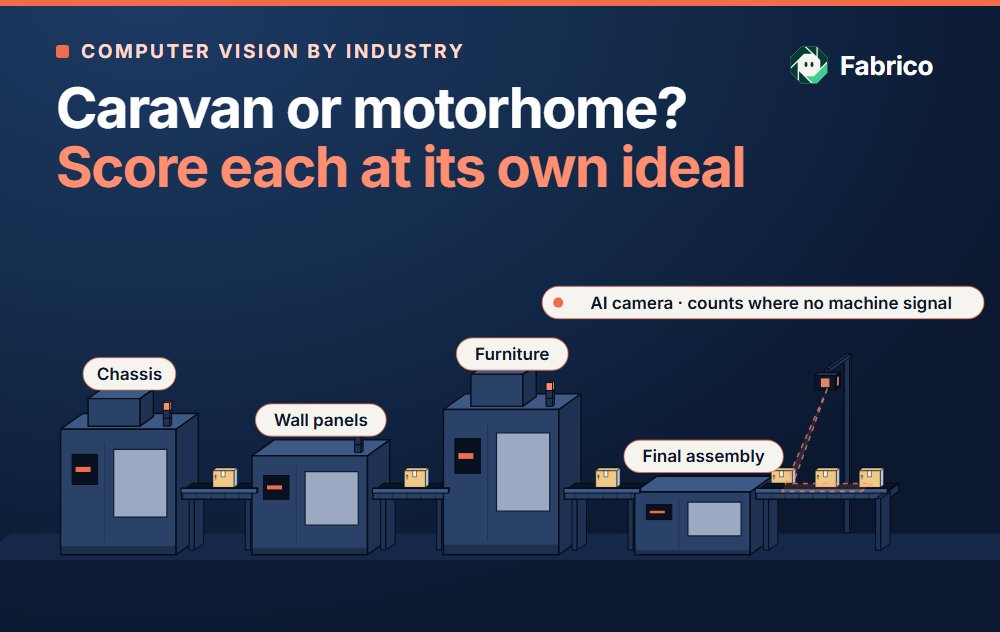
The flow below is an example layout, not a real plant. Towed chassis frames and motorhome base vehicles meet at the start, three feeders join the line, and the walls go on after the furniture, interior first and shell second.
The queue that matters is the kit queue. When the furniture shop builds kits out of sequence, or a premium pack is short a locker set, station 2 waits with a chassis in it, and so does everything behind it. A count at the kit outfeed and at each station exit shows the gap for what it is: a feeder starving the line, as in starvation and blocking on a balanced line.
Where the count comes from at each station
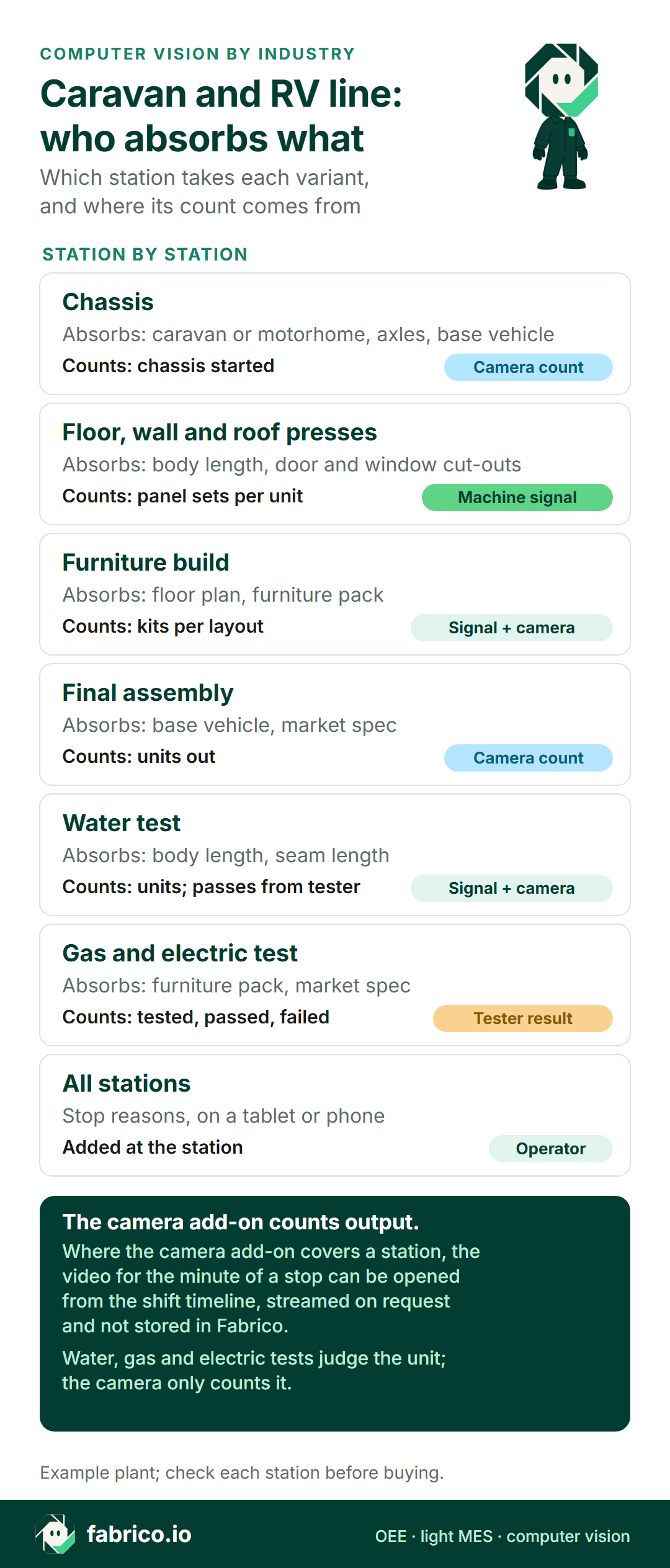
Text version of this infographic
- Chassis. Absorbs: caravan or motorhome, axles, base vehicle. Counts: chassis started. Camera count.
- Floor, wall and roof presses. Absorbs: body length, door and window cut-outs. Counts: panel sets per unit. Machine signal.
- Furniture build. Absorbs: floor plan, furniture pack. Counts: kits per layout. Signal + camera.
- Final assembly. Absorbs: base vehicle, market spec. Counts: units out. Camera count.
- Water test. Absorbs: body length, seam length. Counts: units; passes from tester. Signal + camera.
- Gas and electric test. Absorbs: furniture pack, market spec. Counts: tested, passed, failed. Tester result.
- All stations. Stop reasons, on a tablet or phone. Added at the station. Operator.
- The camera add-on counts output. Where the camera add-on covers a station, the video for the minute of a stop can be opened from the shift timeline, streamed on request and not stored in Fabrico. Water, gas and electric tests judge the unit; the camera only counts it.
- Example plant; check each station before buying.
Some stations already give a usable signal. Panel presses and the CNC nesting and edge banding machines in the furniture shop report cycles and part counts from their controllers. A tow-line conveyor reports that the line moved. Test benches log tested, passed and failed. Those signals stay the source for those stations.
The gaps are the boundaries of a manual or pushed line: a unit leaving station 2, a kit trolley leaving the furniture shop, a caravan rolling out of the water booth. Nothing reports those moments, so they end up on a whiteboard. That is where a camera add-on earns its place: it counts finished units crossing a line on the floor and timestamps each crossing, and the build sequence says which model it was. The method is covered in AI visual counting in manufacturing.
Be clear about what a camera finds hard here. A peer-reviewed Sensors study of camera monitoring in modular building factories, where large units move from station to station, found that earlier vision methods "fail to account for changes in the appearance of the modular units during production" and "are difficult to adapt to other stations and factories". A caravan hall has both problems: a unit changes shape as walls and roof go on, and fitters walk around and inside it for half an hour or more.
- Count the crossing, not the presence: a unit parked in station 3 for 45 minutes is one unit.
- Mount the water booth camera outside the spray, at the exit.
- Keep the kit outfeed camera away from saws and sanders.
- Check the camera count against the shift tally, model by model, before anyone is scored by it.
No accuracy figure is quoted here; none would carry over from another hall. The count earns trust by matching a hand count.
A mixed shift scored three ways
One example early shift on the final assembly line of the hall above, the station that paces it. All figures are sample data.
| Model | Ideal min at the pacing station | Built | Good first time |
|---|---|---|---|
| C1 caravan, 5.6 m, single axle | 33 | 3 | 3 |
| C2 caravan, 7.0 m, twin axle | 39 | 3 | 2 |
| M1 semi-integrated, Fiat base | 45 | 1 | 1 |
| M2 same layout, Ford base | 51 | 2 | 2 |
Planned time is 465 minutes. Stops took 64: the gap from a Ford base vehicle 26 minutes late reached the line, a C2 premium kit was short a locker set for 22 minutes, and a pump fault at the water booth backed the line up for 16. That leaves 401 minutes of run time.
Earned ideal time is the sum of each unit's own ideal: 3 x 33 + 3 x 39 + 1 x 45 + 2 x 51 = 99 + 117 + 45 + 102 = 363 minutes. The 38 minutes between 401 and 363 are slow running: 20 on the first M1 with the new washroom pack, 18 on C2 units whose kits arrived out of sequence. One C2 failed the water test and went to the fixer for a reseal, so its 39 earned minutes are not good first time, leaving 324.
Availability is 401 / 465 = 86.2%. Performance is 363 / 401 = 90.5%. Quality is 324 / 363 = 89.3%. OEE is 86.2% x 90.5% x 89.3% = 69.7%, the same as 324 / 465.
Now score the same shift with one line takt.
| How the shift is scored | Performance | OEE | What the line is told |
|---|---|---|---|
| Ideal time per model | 90.5% | 69.7% | 38 slow minutes, on the M1 pack and the C2 kits |
| One takt of 36 min (caravan balance) | 80.8% | 61.9% | 77 slow minutes, 39 of them motorhome work content |
| One takt of 45 min (motorhome balance) | 101.0% | 77.4% | Performance over 100%: the ideal is wrong |
At a 36 minute takt, the caravan balance, 9 units earn 324 minutes, so performance drops to 80.8% and the line seems to have lost 77 minutes to slow running. Net, 39 of those minutes are the extra work the motorhomes need over a caravan. A CI team chasing them would be chasing the floor plan, not the line. With 8 good units, OEE reads 288 / 465 = 61.9%.
At a 45 minute takt, the motorhome balance, the same 9 units earn 405 minutes in 401 minutes of run time. Performance reads 101.0%, which no line can achieve, and OEE reads 360 / 465 = 77.4%. Neither view is a rounding problem. Each one sends the loss to the wrong station.
What the lost minutes cost, model by model
Margins differ by model as much as minutes do. No public source gives a margin per caravan or motorhome model, so the figures below are example inputs.
Example contribution margins, which a plant replaces with its own: C1 EUR 3,300, C2 EUR 3,900, M1 EUR 7,200, M2 EUR 7,650. Divided by each model's ideal minutes, that is EUR 100 a minute for both caravans, EUR 160 for M1 and EUR 150 for M2. A lost minute is priced at the rate of the model in the pacing station when it was lost.
| Lost minutes | Model held up | Example margin a minute | Cost while orders wait |
|---|---|---|---|
| Base vehicle late, 26 stop | M2 | EUR 150 | EUR 3,900 |
| Kit short a locker set, 22 stop | C2 | EUR 100 | EUR 2,200 |
| Water booth backed up, 16 stop | C1 | EUR 100 | EUR 1,600 |
| New washroom pack, 20 slow | M1 | EUR 160 | EUR 3,200 |
| Kits out of sequence, 18 slow | C2 | EUR 100 | EUR 1,800 |
| Total, 102 minutes | EUR 12,700 |
The one-takt view prices differently. Pair the 36 minute takt with one average margin, an example EUR 4,500 a unit, or EUR 125 a takt minute. It would charge 64 stop minutes plus 77 slow minutes, 141 in all, at EUR 125: EUR 17,625. That overstates the shift by EUR 4,925 and hangs the biggest number on the final line crew.
Two limits keep these numbers honest. First, lost minutes are lost margin only while orders wait. CIVD, the German caravanning industry association, reports for 2025 that "The caravan segment recorded around 54,200 new registrations across Europe in 2025, which was around 11 per cent below the previous year’s level", while "Around 161,000 new motor caravans were registered across Europe". The mix of demand is moving towards motorhomes, and German makers made "targeted adjustments to production volumes" in 2025, per CIVD's German annual results. In a week when the caravan order book is short, a lost caravan minute costs crew time, not margin. Fourteen people on the final line for the 56 caravan minutes is 13.1 hours, which at Eurostat’s 2025 average hourly labour cost of EUR 38.2 in the euro area is about EUR 499 a shift; the 46 motorhome minutes keep their EUR 7,100.
Second, the reseal is not lost margin at all. The C2 ships after the fixer's work, so it is priced at crew time: two fitters for 1.5 hours, 3 hours at EUR 38.2, EUR 114.60. The crew of 14 and the reseal time are example inputs too.
Water and gas test: count the retest, not only the pass
The test bay is where quality loss lives on a caravan line, and where double counts start. The NCC scheme checks "Gas and electrical safety", "making sure installations on models are tested, secure, and fit for purpose". A unit that fails the water test, goes to the fixer and comes back through the booth crosses the booth exit twice.
Count the first pass as the unit's result and the second crossing as a retest of the same unit. The camera add-on sees a caravan leave the booth; the booth's result or the tester's entry says pass or fail. Joined by sequence or chassis number, the retest becomes quality loss on the right model instead of a tenth unit built. Whether a seam leaks or a joint holds pressure stays the tester's and the inspector's call; a counting camera does not inspect.
Per-model first pass yield at the test bay can be the most useful early number on a mixed line. If twin axles fail the water test far more often than single axles, the seam length, the panel press and the sealing station own the problem, not the test crew.
Questions for any vendor on a mixed caravan line
- Can the ideal time be set per model and per station, and changed at model-year changeover without losing history?
- Can a unit carry its configuration from the ERP (body type, length, floor plan, pack, base vehicle, market) so counts and losses split by variant?
- Can the camera count a caravan crossing a station boundary while fitters walk around it, without counting twice a unit that stands still for 40 minutes?
- Is a water test retest recorded as quality loss on the same unit, or as a new unit?
- Can stop reasons differ by station, so "base vehicle late" at chassis and "kit short" at fit-out stay separate?
- Are lost minutes priced by the model in the station, from the plant's own margins, with crew cost when orders do not wait?
- Can the kit count at the furniture shop be matched to the line sequence, so a short kit shows as the cause of its stop?
- How do counts reach the ERP that holds the sequence: per chassis number, by API, webhook or file?
Cameras and the crew. Fitters work in and around every unit. Point cameras at the station boundary and the unit, not at benches; agree with the works council what is filmed and who may open video; and show the crew the count before anyone is scored by it. GDPR and production line cameras sets out the legal side.
Where Fabrico fits in a caravan and motorhome plant
Fabrico is a cloud OEE and light MES platform. Where a press, a CNC machine or a test bench already gives a signal, Fabrico reads it. At a station without one, the camera add-on counts finished units, such as a unit crossing the final line exit or a caravan leaving the water booth. The computer vision for OEE and MES feature page shows the set-up, and OEE computer vision explains the method.
The operator or team lead types the reason for a stop at the station, on a tablet or phone. OEE, downtime and losses show per station and shift, priced from the plant's own price or margin per product, so a motorhome minute and a caravan minute are not priced the same. Where a camera add-on covers the line, the video for the minute of a stop can be opened from the shift timeline, streamed on request and not stored in Fabrico.
On Fabrico's roadmap, not live today: the camera add-on finding stops by itself and proposing a reason. The water, gas and electrical tests stay with the plant's test equipment and inspectors, and their pass and fail results can feed the quality part of OEE. The build sequence lives in the ERP, APS or spreadsheet; Fabrico supplies the per-model rates and counts it uses; reports export to Excel, and Fabrico also has a REST API and webhooks. The MES and OEE solution overview lists the modules.
Want to see a mixed caravan and motorhome line scored per model? Book a demo.
What to do this quarter
- Fill in the matrix for the hall: every variant driver, the station that absorbs it, and whether that station has a signal.
- Pick the station that paces the line most often and set an ideal time per model there, from timed builds, not from the takt.
- List the boundaries with no signal (kit outfeed, final line exit, booth exit) and hand-count them for a few shifts as a reference.
- Agree the retest rule at the test bay with quality: one unit, one first-pass result. Yield vs first pass yield explains why the two differ.
- Get per-model margins and a crew cost from finance, then score one week both ways, per model and with one takt, and show the line leads the difference.
What caravan and RV makers ask next
Is computer vision in caravan manufacturing about inspection or counting?
Two different jobs. Inspection systems and the water, gas and electrical tests judge the unit. A counting camera counts finished units at stations with no usable signal. Fabrico's camera add-on does the counting; the tests and inspectors judge the unit.
Can one camera count caravans and motorhomes on the same line?
Yes, it counts units crossing a station boundary whatever the body type, and the model comes from the build sequence or chassis number the ERP holds. Compare it with a hand count per model for a few shifts.
What ideal time should a mixed caravan line use?
One per model at the station that paces the line, taken from timed builds of that model. A single takt suits planning the day but misplaces losses: in the example shift, a 36 minute takt read 61.9% where per-model ideal times read 69.7%.
How is a caravan that fails the water test counted?
As one unit with a failed first pass. The second trip through the booth is a retest of the same unit. Price it at the crew time of the reseal, not as lost margin, because the caravan still ships.
Where does the first camera go on a caravan line?
The uncounted boundary next to the station pacing the line. In the example hall that is the final line exit, then the water booth exit: together they decide how many units really left the shift.
Want per-model OEE for a caravan and motorhome hall? Book a demo.








Real Fabrico tiles, sample data.