


 Login
 Blog

Computer Vision for Boat Building: One Count per Hull, From Mould to Dock

In short: Computer vision in boat building counts pulled hulls and finished boats where no machine gives a signal, so rework and parked boats stop inflating output. It counts; judging gelcoat, laminate and leaks stays with quality inspection and the water test.
- Count a boat once, by its hull number, when it first clears final QA; hulls out of the mould are work in progress.
- A boat back from the water test is a quality loss, not a second boat.
- Boats parked for engines are a queue with waiting minutes, not output.
- In the example shift the tally said 92.6% OEE; the audited count says 67.4%.
- The camera add-on counts hulls at demould and boats at the line exit, where no machine signal exists.
Eight miscounts in a boat plant, and who owns each count
Ask a boat plant how many boats it built last week and three numbers come back: hulls out of the moulds, boats through final QA, and boats on trucks to dealers. All three are real; only one is output. The table audits each way the count goes wrong, with the fix and the station that owns it.
| Miscount | What the sheet shows | Fix | Owner |
|---|---|---|---|
| 1. Hulls pulled as boats | Twelve hulls out of the moulds, booked as twelve boats | Hulls pulled are work in progress; a boat counts when it clears final QA | Final QA exit |
| 2. Decks and liners as units | Deck mould pulls added to the hull count | Hull, deck and liner make one boat, married at capping | Capping |
| 3. Options and kits as boats | T-tops, trailers or canvas kits in the daily total | Count boats; options change the ideal time per model and pack | Outfitting |
| 4. Water test return counted twice | A reworked boat crosses the line exit again | One count per hull number, at its first pass; the return is a quality loss | Water test |
| 5. Parked boat booked as built | "Complete less engine" in the built column | Counts after engine fit and final QA; parked boats are a queue | Engine fit |
| 6. Shipped and built mixed up | Dealer holds and truck loads move the built number | Build counts at final QA; shipments count at the dock | Shipping dock |
| 7. Serial gap read as output | Hull numbers issued read as boats built | Hulls pulled minus scrap; numbers are never reused | Demould |
| 8. Handover boat on two sheets | One boat written by both shifts | A time-stamped pass, not a handwritten line | Line exit |
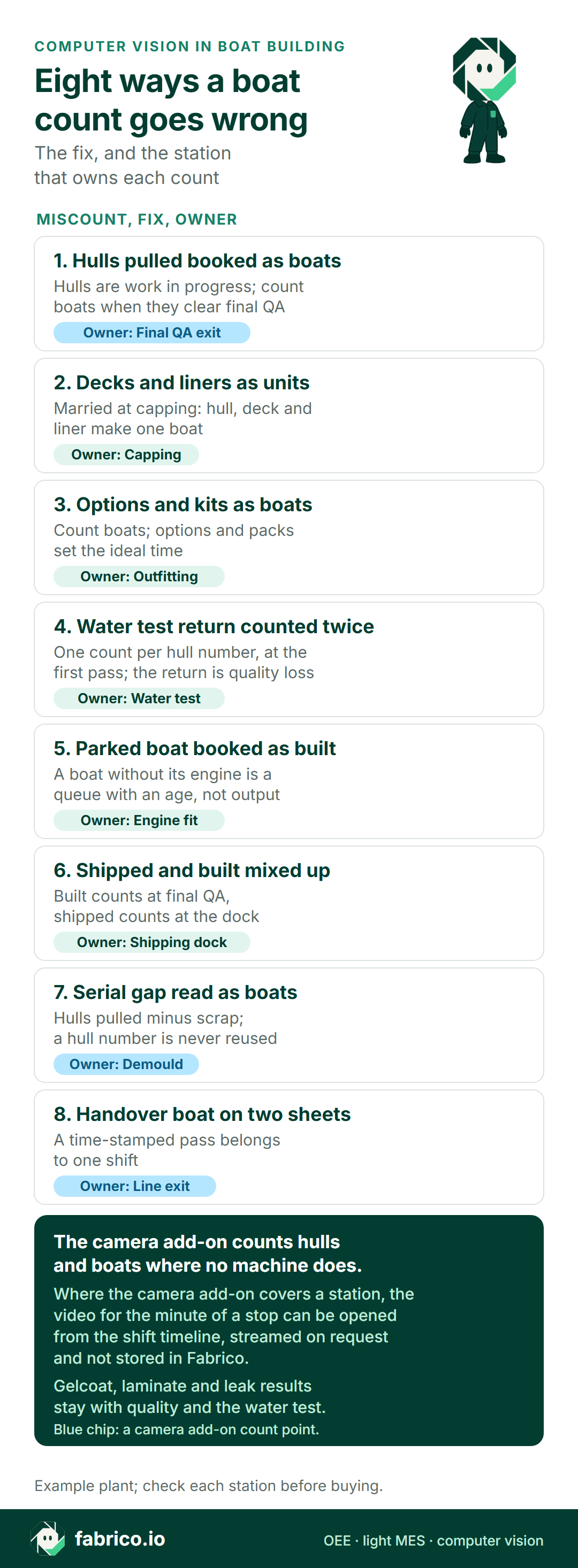
Text version of this infographic
- 1. Hulls pulled booked as boats. Hulls are work in progress; count boats when they clear final QA. Owner: final QA exit.
- 2. Decks and liners as units. Married at capping: hull, deck and liner make one boat. Owner: capping.
- 3. Options and kits as boats. Count boats; options and packs set the ideal time. Owner: outfitting.
- 4. Water test return counted twice. One count per hull number, at the first pass; the return is quality loss. Owner: water test.
- 5. Parked boat booked as built. A boat without its engine is a queue with an age, not output. Owner: engine fit.
- 6. Shipped and built mixed up. Built counts at final QA, shipped counts at the dock. Owner: shipping dock.
- 7. Serial gap read as boats. Hulls pulled minus scrap; a hull number is never reused. Owner: demould.
- 8. Handover boat on two sheets. A time-stamped pass belongs to one shift. Owner: line exit.
- The camera add-on counts hulls and boats where no machine does. Where the camera add-on covers a station, the video for the minute of a stop can be opened from the shift timeline, streamed on request and not stored in Fabrico. Gelcoat, laminate and leak results stay with quality and the water test. Blue chip: a camera add-on count point.
- Example plant; check each station before buying.
Explainer presented by Iris, Fabrico's AI-generated presenter: how an add-on camera counts output where a machine has no signal. Book a demo.
Plays from YouTube. Google may set cookies when you press play. Privacy policy.
From mould to water test: where a hull becomes a boat
A fibreglass boat plant runs two flows that meet once. The mould shop makes the hull, the deck and the liner in separate moulds: gelcoat sprayed into a waxed mould, glass laid by hand or infused under vacuum, then a cure. The US boat manufacturing air rule defines the mould as the cavity or surface into or on which gel coat, resin, and fibers are placed and from which finished fiberglass parts take their form, and files infusion under closed moulding, where pressure drives the resin through the reinforcing fabric placed between two mold surfaces. Where the stringer grid is bonded in before demould, the mould stays busy through grid bonding, and a hull pulled means a hull with its grid.
The assembly line takes the pulled hull: wiring harness, plumbing and pumps, the liner fitted, the deck bonded at capping, engine fit, then outfitting with upholstery, canvas, electronics and the option pack. Final QA and a water test, in a test tank or at the plant's own slip, close it. Final QA covers the whole boat, from engine rigging to canvas fit, wiring and plumbing. That is why final QA, not the mould shop, is where a boat should be counted.
In the example layout a few machines already count: the CNC router that trims hulls and decks reports its cycles, and an RTM injection unit for hatches logs its shots. Fabrico reads those from the machine signal. The rest has no signal. Hulls hang from a crane at demould, boats roll between stations on cradles, and nothing notes that one crossed a line. Demould and the line exit are where a camera add-on earns its place. Gelcoat finish, laminate checks and the water test result stay with the quality team and their own tools.
Hulls out of the mould are not boats finished
The mould shop has the easiest count in the plant, so it lands on the daily report as "boats". But a pulled hull still needs every hour of assembly. When the moulds run ahead of the line, hulls rise while finished boats stay flat, and the gap is a row of hulls on cradles: work in progress that the report hides.
The boat's identity rule points the same way. For boats sold in the United States, the hull identification number belongs to the hull: two identical hull identification numbers are required to be displayed on each boat hull, and the rule adds that a number must not be attached to parts of the boat that are removable. The date inside the number can be no earlier than the date construction or assembly began and no later than the date the boat leaves the place of manufacture, so a plant may issue it early in the build. For craft sold in Europe, ISO 10087 sets a craft identification code built from the maker's code, a serial number, the month and year of manufacture and the model year, for small craft up to 24 m. Either way, one hull carries one number for its whole life.
That makes miscount 7 easy to see. The US rule says no person may assign the same HIN to more than one boat, so a hull scrapped after demould for delamination retires its number, and the week's serial range reads one boat high. The fix is a count at demould: hulls pulled minus hulls scrapped equals hulls sent to the line. A camera add-on over the demould bay counts hulls as they are lifted; the scrap call is the mould shop supervisor's, entered on a tablet. Hull numbers become an audit list, not the count.
Decks, liners, options and kits: one boat, counted once
Deck and liner moulds are feeders, and with few moulds per model they can set the pace: a missing deck stops capping, but a deck is not a boat. Miscount 2 happens when every pull from every mould goes into one "units moulded" figure. Hull, deck and liner are married at capping; from there the line counts one boat per hull number, and decks and liners stay feeder stock shown beside the line.
Options are harder, because they carry real money. A T-top, a second engine or a canvas kit can be a large share of a boat's price, which tempts a plant to count option packs or convert them into "boat equivalents". Both blur the count of boats through final QA.
Let options change time, not count. If a twin engine pack adds rigging work, the ideal time for that model and pack goes up, and performance stays honest. Kits that ship loose, such as a cover or a trailer from a line like those in truck body and trailer plants, are counted at the dock with the shipment. Upholstered seats and canvas come from cut and sew benches with their own counts, as on furniture upholstery lines; they feed outfitting and never enter boat output.
Water test rework and the double count at the line exit
The water test is where a boat proves its plumbing, pumps, steering and engine. A weeping through-hull or a miswired bilge pump sends it back for rework, and when it rolls past the line exit again, a tally counts it twice. Miscount 4 flatters the days with the most returns.
The rule: each hull number counts once, at its first pass through final QA. A boat that fails the water test is not first-pass good; its standard time is quality loss, and fixing it is crew time. It ships after the fix but never counts again. With a time-stamped pass, the second crossing shows as a return.
Miscount 8 has the same cure: a boat between stations at 14:20 gets written by both shifts, while a pass on the shift timeline belongs to one. Hand-keyed counts drift in exactly these handover minutes.
Boats parked for engines, and boats held for dealers
When an engine pallet is late, the supervisor holds the line or pulls the boat aside and keeps going. Pulled boats sit in the yard as "complete less engine", and a sheet that puts them in the built column makes miscount 5: engine fit and water test are still ahead, and when the engine arrives the boat gets counted again.
A parked boat is a queue, not output. Count it in when it is pulled and out when it returns to engine fit; the queue's size and age in hours are what purchasing needs. The boat counts once, after engine fit and final QA.
Miscount 6 lives at the other end: a finished boat waits in the yard because a dealer cannot take it yet. The industry keeps the counts apart. NMMA's monthly reports use data available from members on the wholesale side and from state government on new boat registrations, and they put US new powerboat retail sales for 2024 at 231,576 units, down 9.1%. Wholesale is plant to dealer, retail is dealer to owner, and a plant's output is neither: it is boats through final QA.
Dealer stock changes the money. When dealers are full, a lost line hour costs crew time, not a sale. The dock owns the shipped count, final QA the built count, and the yard between them is inventory with an age.
One shift on the assembly line, audited and priced
Example plant, example inputs. A fibreglass line building 23 ft outboard centre consoles runs a day shift from 06:00 to 14:20 with 25 minutes of breaks: 475 planned minutes. The line moves one station every 40 minutes, so the ideal time is 40 minutes per boat at the line exit.
- 06:00 to 06:25: the first hull was still in its mould, the grid bond not yet cured. The line stood. Stop: 25 minutes.
- 09:40 to 10:30: the engine pallet for boat 5 was late. The crew waited 50 minutes, then the supervisor pulled boat 6 aside, short of its twin engine pack. Stop: 50 minutes.
- Rigging ran two people short all morning. Boats left the exit slower than every 40 minutes: 40 minutes of slow running.
- Nine boats crossed the line exit. One failed the water test on a weeping through-hull and went back. Eight passed first time.
Both stops in the example shift above are waits: for a hull, then for an engine pallet. Chalmers researchers who studied 884 machines found that 90% of the stop time that was classified could be directly related to supporting activities performed by operators and not the automatic process itself. So the reason has to come from the person at the station, entered on a tablet or phone.
Availability: 475 minus 75 minutes of stops leaves 400 minutes of run time. 400 of 475 is 84.2%.
Performance: 9 boats at 40 minutes is 360 standard minutes. 360 of 400 is 90.0%.
Quality: 8 first-pass boats are 320 minutes. 320 of 360 is 88.9%.
OEE: 84.2% x 90.0% x 88.9% = 67.4%. Check: 320 good minutes over 475 planned is 67.4%.
The shift sheet told another story. It listed eleven boats, all good: the nine through the exit, yesterday's reworked boat crossing again, and boat 6 parked without engines, written as built.
| Shift sheet | Audited count | |
|---|---|---|
| Boats | 11, all good | 9 counted, 8 first-pass good |
| Standard minutes | 440 | 360 counted, 320 good |
| OEE | 92.6% | 67.4% |
| Minutes lost to stops and slow running | 35 | 115 |
| Priced at EUR 300 a minute, orders waiting | EUR 10,500 | EUR 34,500 |
Now the money. No vetted public source gives a margin per boat, so the example uses EUR 12,000 of contribution per boat, an example input each plant replaces with its own. At 40 minutes a boat that is EUR 300 per ideal line minute. Fabrico prices losses from the plant's own margin per model.
- Stops and slow running: 115 minutes x EUR 300 = EUR 34,500 a shift. The engine wait alone is EUR 15,000, the hull not yet out EUR 7,500, the short crew EUR 12,000.
- The water test return ships after the fix, so it is not lost margin. Five crew hours of rework at the euro area average labour cost of EUR 38.2 an hour in 2025 come to EUR 191.
- The sheet priced 35 lost minutes, EUR 10,500. The audit finds EUR 24,000 a shift that the sheet never showed.
The EUR 300 a minute applies only while orders wait for boats. When dealers are full, a lost line minute costs the crew's time: 12 people x 115 minutes is 23 crew hours, EUR 878.60 a shift at the same labour rate. Pricing the second case at margin would overstate it about 39 times.
The order of work follows the money: engines first, then hull release from the mould shop, then crew balance in rigging.
Hull bays, glare and open doors: limits of a camera count
Boats are large and slow, which helps a camera; cranes, people and other hulls in front of them do not. The closest public guidance is from road traffic, where cameras count large objects crossing a line. The US Federal Highway Administration's detector handbook warns that camera mounting position and continued full occlusion of smaller vehicles by trucks still deteriorate performance. It adds that artifacts persist and the user should evaluate VIP performance under the above conditions and other local conditions that may exist, and that agencies reported poor results "when the sun shines directly at the video camera".
A boat plant has the same three traps. A hull on the crane hides the cradle behind it, so mount the demould camera high and count the lift. Polished gelcoat reflects overhead lights, so test the count under both shifts' lighting. Where the water test bay opens onto the yard, keep the exit view off the sky and the low sun. Count where boats move one at a time: the demould lift and the line exit.
The honest accuracy figure is the plant's: run the camera add-on count beside the hull number list for a week. How accurate a camera part count is sets out that test.
Where Fabrico fits in a boat plant
Fabrico is a cloud OEE and light MES platform. In a boat plant it reads cycles from the machines that already report them, such as the CNC router and RTM units. Where nothing reports, the camera add-on counts output: hulls lifted at demould and boats crossing the line exit. The operator adds the stop reason on a tablet or phone. Where a camera add-on covers the line, the video for the minute of a stop is streamed on request and not stored in Fabrico.
OEE, stops and losses show by line, station and shift, priced from the plant's own margin per model; see the MES and OEE solution overview. The build sequence stays in the ERP, APS or spreadsheet; Fabrico supplies the counts and rates it uses; reports export to Excel, and Fabrico also has a REST API and webhooks. Who owns which number is set out in integrating MES and OEE with ERP and quality systems.
On Fabrico's roadmap, not live today: the camera add-on suggesting a stop reason, such as "waiting for engine", for the operator to accept or change.
Works council and privacy. The exit camera looks at boats crossing a line, the demould camera at the lift. Neither needs faces. Agree the views and who may open video before anything is mounted.
Want to see the demould lift and the line exit counted on one timeline? Book a demo.
Six vendor questions for a boat plant
Ask every vendor the same six. The answers show whether a system understands hulls, returns and queues.
| Question | Why it matters in a boat plant |
|---|---|
| Can one hull number be counted once even if the boat passes the exit twice? | Water test returns are the main double count. |
| Can a pulled boat sit in a queue with its age in hours? | Boats parked for engines are inventory, not output. |
| Can ideal time be set per model and option pack? | A twin engine pack and a base boat do not take the same rigging time. |
| Can hull, deck and liner pulls show as feeder stock next to the line? | A missing deck stops capping; it is not a boat. |
| How does the count cope with a hull on a crane hiding the cradle behind it? | Occlusion at demould is the hardest camera view in the plant. |
| Can built and shipped counts stay apart, with the yard between them? | Dealer holds move the shipped number, never the built one. |
First steps: audit the boat count this quarter
- Pull last month's numbers. Hulls pulled, boats through final QA, boats shipped. Write the three side by side, per week.
- Check the hull number list against the QA count. Every number that appears twice is a return; every gap is a scrapped hull or a parked boat.
- Walk the yard. Count boats parked without engines and boats on dealer hold. Note each one's age in days.
- Write the counting rule on one page. Who owns hulls, boats, queues and shipments, and when a boat counts; OEE governance covers who owns definitions.
- Price one shift. Use the arithmetic above with the plant's margin, and once more at crew time for the weeks when dealers are full.
Review the counts at the morning standup, run as short interval control, and the losses at the plant manager's weekly OEE review. For the losses a camera sees that sensors miss, read manufacturing vision systems for OEE.
Questions boat builders ask
Can a camera read the hull identification number?
Treat the hull number as the audit list, not the camera's job. The camera add-on counts hulls and boats crossing a line; the number list comes from your ERP or build sheet, and the two are compared.
Where should the first camera go in a boat plant?
At the line exit into final QA. It is the count that settles output, water test returns and handover arguments. Demould comes second.
Does a boat that fails the water test count when it passes later?
No. It counts once, at its first pass through final QA, and is not first-pass good. The rework is crew time, and the boat ships after the fix.
How are boats waiting for engines counted?
As a queue with an age in hours, not as output. The boat counts after engine fit and final QA, once.
Is this only for fibreglass boats?
No. Aluminium boat lines have the same counting points: a hull leaving welding, boats through final QA, the water test and the yard. Only the moulding differs.
Want hulls, parked boats and water test returns on one shift timeline? Book a demo.
Related articles











Real Fabrico tiles, sample data.