


 Login
 Blog
GlobalReader vs Vorne XL: Which Fits Your OEE Tracking Setup

In short: GlobalReader and Vorne XL both track OEE from a sensor on the machine; the split is how you pay and where data goes. Choose GlobalReader if you want a monthly fee per machine with the sensor box included (from EUR 125); choose Vorne XL if you would rather buy the device once with no recurring costs; look at neither first if your process is batch or continuous, since both pages describe discrete work (GlobalReader, Vorne).
- GlobalReader OÜ is based in Tartu, Estonia; Vorne lists an address in Itasca, Illinois. Both makers checked on their own pages, 19.11.2026.
- Prices as published on 19.11.2026: GlobalReader from EUR 125 per machine a month plus EUR 137 per device once; Vorne XL from USD 4,490 to USD 4,990 a unit.
- Sample roll former: 71.0% OEE; faster coil changes and no forklift wait are worth about EUR 312 a shift.
One is an Estonian subscription with a sensor box. The other is an American appliance you buy and fit next to the machine. Both promise live OEE without a big IT project, so the useful comparison is what happens on the floor between the first coil of the morning and the shift report. Fabrico, a cloud OEE and light MES vendor, has a short section before the FAQ.
Key takeaways
- Decide first how finance wants to pay: a monthly fee per machine or a one-time device purchase.
- On one machine, GlobalReader's list fees pass the XL HD+ list price, in euros, in about month 28.
- Ask IT which data path it accepts: an LTE box sending to EU servers, or a device on the plant Ethernet.
- Agree one short-stop rule before the pilot; it moves availability without moving OEE.
- Count one shift by hand on the pilot machine as the referee for both tools.
Who makes each one, from their own pages
GlobalReader. The site is globalreader.eu. The footer gives the legal name "GlobalReader OÜ" and a Tartu street address, Spektri 6, postcode 50411, Estonia. The GlobalReader company page dates its history from 7 May 2014 and lists grants from Enterprise Estonia, and the homepage pitches live factory tracking to European SMEs (all as of 19.11.2026). Before signing, take the registry code from the Estonian business register and match it to the contract.
Vorne. The Vorne homepage lists "1445 Industrial Dr. Itasca, IL 60143" and claims "50+Years in Business". It says "XL works on any discrete manufacturing process." (as of 19.11.2026).
GlobalReader pitches an "SME-friendly price and deployment". The EU SME definition caps a medium-sized firm at under 250 staff and EUR 50 million turnover or EUR 43 million balance sheet (accessed 19.11.2026). At that size, who fits the sensor and owns the data path is a real cost.
GlobalReader vs Vorne XL: a fair comparison table
Each cell rests on the linked vendor page, read 19.11.2026. Where both say the same thing, the row is folded into the line under the table.
| Question | GlobalReader | Vorne XL |
|---|---|---|
| Hardware at the machine | One Scoutbox per machine, three sensor inputs (Scoutbox page) | XL device, one or two sensor inputs; tech specs list eight digital I/O (XL page, specs) |
| Sensors named | Photo-eye, inductive, current or relay; OPC UA or MQTT for machines that share data | Photo-eye, relay, proximity switch or encoder (homepage) |
| What it counts | "pieces, metres and work time" | "counts and cycles"; over 140 metrics |
| How data travels | SIM card and LTE, or LAN or WiFi | Ethernet port; data "behind your firewall" |
| Where data lives | "On GlobalReader's servers in Europe", or the whole system on the plant's own server | On the device; XL Enterprise cloud "is entirely optional" (homepage) |
| Reasons from operators | Touchscreen at the machine; Operator feature on tablets or phones (Operator page) | Barcode scanner at XL; XL Sidekick app on tablet or phone (Sidekick page) |
| ERP link | Partner builds listed for Dynamics 365, Directo, Monitor G5, NOOM, MRPeasy (integrations page) | API, Data Link ERP, Data Collector to SQL (integration tools) |
| How it is paid | Monthly per machine, hardware included (pricing) | One-time purchase per unit (models and prices) |
Both show availability, performance and quality live and report in a browser. GlobalReader promises "SMS/email alerts when a machine stops unexpectedly" (homepage); Vorne turns a TV or monitor of any size into the operator scoreboard (XL page). Matched strengths; they do not decide it.
What one machine costs over 24 months, from list prices
Both vendors publish prices. On GlobalReader's pricing page, monitoring starts at EUR 125 a machine per month with the Scoutbox hardware inside that fee, billing is monthly with no lock-in, and paying for a year saves 5%. A footnote adds a one-off deployment charge of EUR 137 per device. Features such as Operator start from EUR 26 per machine a month, add-ons from EUR 13 each. Vorne's models page puts a single XL at USD 4,490 to 4,990, mentions discounts for volume, and says every model runs the same software. All checked 19.11.2026. Dollars are converted at the ECB euro reference rate of 1.0968 USD per euro for 18 November 2026 (accessed 19.11.2026). VAT, shipping, extra sensors and fitting are left out on both sides; ask for them in writing.
| One machine, list prices | GlobalReader | Vorne XL HD+ |
|---|---|---|
| Up front | EUR 137 deployment | USD 4,690, about EUR 4,276 |
| Each month | EUR 125 monitoring + EUR 26 Operator = EUR 151 | No recurring cost stated |
| After 12 months | EUR 1,949 | About EUR 4,276 |
| After 24 months | EUR 3,761 | About EUR 4,276 |
| Six machines, 24 months | EUR 22,566 | About EUR 25,656 before volume discount |
The month the lines cross. At EUR 151 a month after a EUR 137 fee, GlobalReader's cumulative list fees reach the XL HD+ price, about EUR 4,276, in month 28. Tracking the same machines for three years favours buying; testing two machines with the option to walk away favours renting. The table assumes reason entry needs the Operator feature; ask GlobalReader.
Trials differ too: Vorne invites plants to run XL on site for 90 days at no charge; GlobalReader offers a free demo account.
How the signal reaches the report
An IT manager asks about this row first. The Scoutbox page says "Every Scoutbox ships with a SIM card and connects over LTE", switches to LAN or WiFi if one link drops, and "Readings wait on the device until they are delivered." XL starts from the other end: the XL page offers "browserbased reporting and configuration", and the tech specs list one RJ-45 Ethernet port, two RS-232 ports and eight 5 to 24 VDC digital I/O. Vorne's homepage adds that XL Enterprise, the cloud part, is "entirely optional, and many of its services are free."
With no cable near the machine, a SIM in the box saves a job. If IT bars data leaving over a mobile network, price the Ethernet path or GlobalReader's own-server option. If cloud versus local is still open, read edge vs cloud shop floor data.
One roll-former shift, run through both tools
Sample data only: the plant, line and numbers are made up for this page, and no product screen is shown. A family-owned plant roll-forms galvanised steel studs for drywall. Line 2 runs at an ideal 40 metres a minute. Shift A covers 06:00 to 14:00 less 35 minutes of breaks: 445 planned minutes, 17,800 metres possible. Here is that shift on each tool, as each vendor's pages describe it.
| Time and event | GlobalReader | Vorne XL |
|---|---|---|
| 06:00 order for 2,400 m of 75 mm studs starts | Order imported from a listed ERP such as MRPeasy, or recorded by the operator (integrations) | Operator scans a barcode to start the part run, or Data Link ERP sends the job (homepage) |
| 06:00 line runs; length comes off the encoder | Scoutbox "counts pieces, metres and work time" | Encoder wired to XL as one of its sensor inputs |
| 07:12 first of three coil changes, 11 min | Operator logs the reason on the touchscreen at the machine | Operator scans the reason with the barcode scanner |
| 09:40 cut-off press hydraulic fault, 19 min | SMS or e-mail alert to the shift lead (homepage) | Reason assigned on a phone in XL Sidekick, which "enables you to assign a reason when the line goes down" (Sidekick) |
| 11:05 punch die jam, 14 min; 12:30 forklift late with a coil, 9 min | Reasons logged at the machine | Vorne's OEE page advises letting operators enter the reason once the line runs again |
| Through the shift, 40 stops of about 30 s at the straightener | GlobalReader's OEE page lists micro-stops as a loss under performance | Vorne says many plants set the short-stop line as "a multiplier of the Ideal Cycle Time" (OEE page) |
| 310 m of coil ends and mis-cuts scrapped | Quality Control add-on pop-ups for the operator (Operator page) | Sidekick action screens to "enter reject quantities" |
| 14:00 shift report | KPIs split per shift, operator group and machine (analytics) | Top Losses report "ranks every loss in terms of time"; instant Excel export |
Two rows need a pilot test of their own. Length: a missed encoder pulse is a missed stud, so check each tool's metres against the cut-off counter for a whole shift. Short stops: forty half-minute halts add up to 20 minutes, and where they land changes what the report tells maintenance to fix.
The roll-former shift in OEE and euros
| Sample shift, line 2 | Minutes or metres |
|---|---|
| Planned time | 445 min |
| Coil changes, 3 x 11 min | 33 min |
| Cut-off press hydraulic fault | 19 min |
| Punch die jam | 14 min |
| Waiting for forklift and coil | 9 min |
| Stops over two minutes | 75 min |
| Metres formed | 12,950 m |
| Scrapped, coil ends and mis-cuts | 310 m |
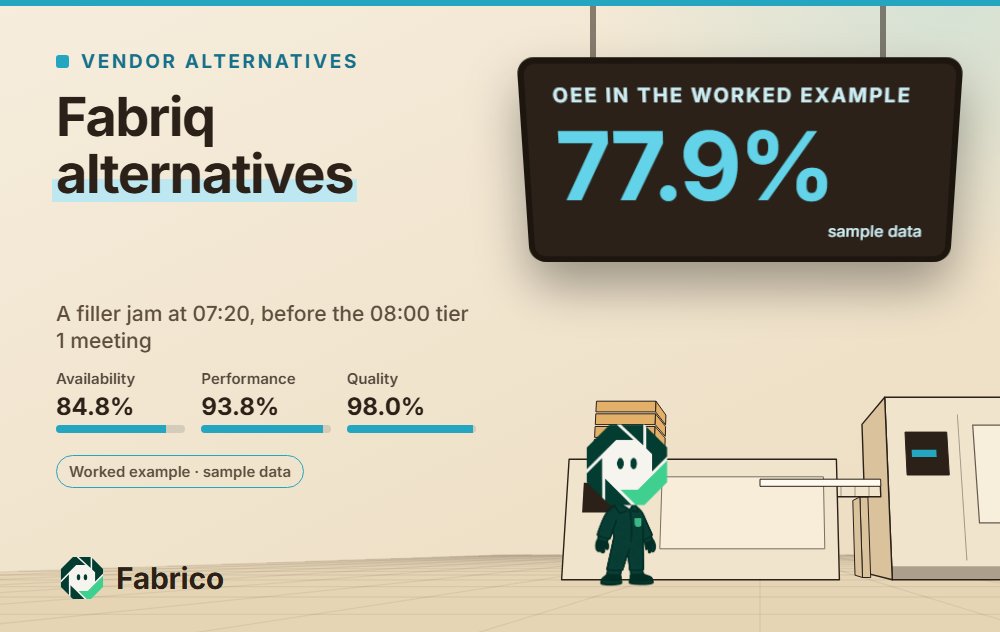
- Availability. 445 minus 75 leaves 370 running minutes: 370 / 445 = 83.1%.
- Performance. 370 minutes at 40 m a minute allow 14,800 m; the line formed 12,950 m: 12,950 / 14,800 = 87.5%.
- Quality. 12,950 minus 310 leaves 12,640 good metres: 12,640 / 12,950 = 97.6%.
- OEE. 83.1% x 87.5% x 97.6% = 71.0%, the same as 12,640 good metres out of 17,800 possible.
Now book the 20 minutes of short stops as downtime instead. Running time falls to 350 minutes, so availability reads 350 / 445 = 78.7%; 350 minutes allow 14,000 m, so performance reads 12,950 / 14,000 = 92.5%. OEE stays at 71.0%. Nothing on the line changed, but the first report points at a speed problem and the second at a stop problem. Set the rule once, in writing, for both tools.
What the pilot aims at. Two stops are organisational. A staged next coil and a fixed threading routine take each coil change from 11 to 7 minutes, 12 in all; a forklift call 15 minutes ahead removes 7 of the 9 minutes of waiting. Those 19 minutes at 40 m a minute, 87.5% performance and 97.6% quality give about 649 more good metres, or 13,289 m in all, and an OEE of about 74.7%, up 3.7 points.
Which margin to use. Price a metre of stud at a sample EUR 2.40 and value each lost metre at 20% of that, EUR 0.48. For 41 US Building Materials firms, the margin dataset Aswath Damodaran keeps at NYU Stern, dated January 2026, runs from 12.64% pre-tax operating margin to 30.94% gross margin (accessed 19.11.2026); 20% sits inside it. The gain is 649 x 0.48 = about EUR 312 a shift. At two shifts a day, five days a week, over 47 weeks, 470 shifts, that is about EUR 146,400 a year, roughly EUR 12,200 a month. The 75 stopped minutes on this one shift cost about 2,562 good metres, about EUR 1,230.
Next to that loss, either tool costs little on one line, so pick on fit. More in OEE for roll forming and the OEE calculation guide.
Decision matrix: GlobalReader or Vorne XL for your plant
Rows both tools answer alike were cut; each row left names a test.
| If this is you | Look first at | Why (vendor page) | Prove it in the pilot by |
|---|---|---|---|
| Finance will approve a monthly fee per machine, not a capital purchase | GlobalReader | Per machine a month, hardware included | A written 24-month total with every add-on you use |
| Finance wants to buy the kit once and own it | Vorne XL | Single-unit prices, no recurring costs | A written quote with sensors, shipping and fitting |
| No network cable reaches the machine | GlobalReader | SIM card and LTE in every Scoutbox | A week of counts with no dropped hours in the report |
| IT wants machine data to stay on the plant network | Vorne XL, or GlobalReader on your own server | Data behind your firewall; own-server option | IT signing off the network diagram before the box is fitted |
| You want to test on the machine before paying | Vorne XL | Free for 90 days in your plant | Ninety days ending in a dated keep or return decision |
| The ERP is Dynamics 365, Directo, Monitor G5, NOOM or MRPeasy | GlobalReader | Partner integrations listed by name | One order down and its metres back up, checked in the ERP |
| Your own developer will write the ERP or SQL link | Vorne XL | API, Data Link ERP, Data Collector | One shift written to the SQL table and reconciled |
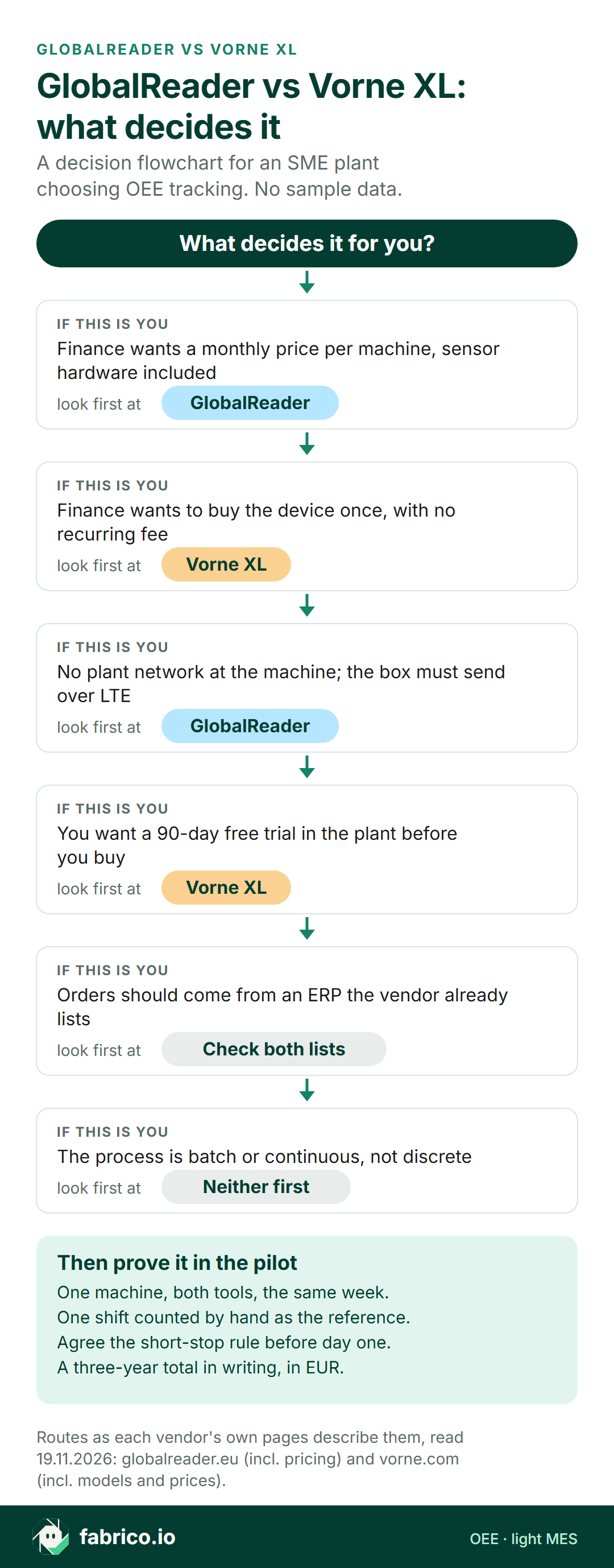
Text version of this flowchart
- Finance wants a monthly price per machine, sensor hardware included: look first at GlobalReader.
- Finance wants to buy the device once, with no recurring fee: look first at Vorne XL.
- No plant network at the machine; the box must send over LTE: look first at GlobalReader.
- You want a 90-day free trial in the plant before you buy: look first at Vorne XL.
- Orders should come from an ERP the vendor already lists: check both lists.
- The process is batch or continuous, not discrete: neither first.
- Then prove it in the pilot: one machine, both tools, the same week; one shift counted by hand as the reference; agree the short-stop rule before day one; a three-year total in writing, in EUR.
Where Fabrico fits
Fabrico runs OEE software and light MES in the cloud; the MES and OEE solution overview lists what it covers. The machine's PLC, a sensor or a counter supplies run, stop and count. Operators pick the reason on a phone or tablet, tagged to the product that ran, and each loss is priced in money per line and shift, as in the roll-former sums. Where nothing on a machine can be wired, the camera add-on counts output, and where the camera covers the line, the video for the minute of a stop can be opened from the shift timeline, streamed on request and not stored in Fabrico. EU customers are hosted on AWS in Frankfurt. Reports export to Excel, and figures also go out by REST API or webhooks; prove any hand-off to GlobalReader, XL or an ERP in a pilot. To see a sample shift priced in euros, book a demo.
When Fabrico is not the right pick. A plant that wants sensor boxes, fitting and software from one EU vendor for a monthly fee per machine is describing GlobalReader. A plant that wants a device bought once and data kept on its own network is describing Vorne XL. A site where machine data may not leave the building belongs with a tool that runs there, because Fabrico runs as a cloud service.
Questions to put to GlobalReader and Vorne
- How is length counted on a roll former, and how far off was it from the cut-off counter at a reference plant?
- Where does a 30-second stop land out of the box, availability or performance, and can the plant change the threshold itself?
- Which sensors, mounts and fitting hours are in the price, and which are extra on the plant's machine list?
- For GlobalReader: does reason entry at the machine need the Operator feature, and what does the 5% annual saving apply to?
- For Vorne: what does a unit cost delivered to the EU, with which warranty, and which XL Enterprise services carry a fee?
What to do this week
- Pick one pilot machine with a known problem and an encoder, photo-eye or relay you can reach.
- Ask finance one question: monthly fee or capital purchase.
- Ask IT which data path it will approve: LTE out, plant Ethernet or a server on site.
- Write the short-stop rule on one line and send it to both vendors.
- Count one shift by hand and price it with a margin inside a published range.
Also on this shortlist: Mingo vs Vorne XL, a cloud platform set against the same device, and camera or sensor for OEE by machine for stations where no sensor fits.
What people ask next
How does GlobalReader compare with Vorne for tracking OEE?
Both count a machine through a sensor and report availability, performance and quality. GlobalReader includes its Scoutbox sensor box in a fee from EUR 125 per machine a month and sends data over LTE, LAN or WiFi. Vorne sells the XL device outright, from USD 4,490 a unit with no recurring costs, and keeps data behind the plant firewall.
What do GlobalReader and Vorne XL cost?
On 19.11.2026: GlobalReader from EUR 125 per machine a month, hardware included, plus EUR 137 per device once. Vorne XL at USD 4,490, 4,690 or 4,990 a single unit.
Who makes GlobalReader?
GlobalReader's own pages name GlobalReader OÜ of Tartu, Estonia, and date the company from May 2014. Vorne lists an address in Itasca, Illinois.
Do GlobalReader and Vorne XL need the plant network?
GlobalReader says every Scoutbox ships with a SIM card and connects over LTE, with LAN or WiFi as options. Vorne's tech specs list an Ethernet port on XL, and its product page says data is stored behind the plant firewall.
Can either one connect to an ERP?
GlobalReader lists partner builds for Microsoft Dynamics 365, Directo, Monitor G5, NOOM and MRPeasy, among others. Vorne names an API, a Data Link ERP for jobs in and production data out, and a Data Collector that writes to SQL.
Can Fabrico run beside GlobalReader or Vorne XL?
Yes, on lines where a plant wants stop reasons priced in money in a cloud OEE and light MES tool. Fabrico gets run, stop and count from a machine signal; test any hand-off between the systems in a pilot.
Want a sample shift's stops sorted by euros lost, with OEE by line and shift beside them? Book a demo.
Related articles


Latest from our blog



Real Fabrico tiles, sample data.