


 Login
 Blog

Computer Vision for Air Filter Manufacturing: Stop Counting Rescans and Repairs as Output

Key takeaways, in short: In an air filter plant, computer vision earns its place counting filters at hand benches and packing tables, while the scan rig and pleater keep their own counts.
- Most wrong output numbers come from counting packs, scans or cartons instead of finished, first-pass filters.
- On HEPA lines the scan rig's serial log is the count; rescans and repairs are never new filters.
- Set an ideal time per size, class and bag count, or the mix moves the OEE.
- In the example shift the tally sheet says 80.9% OEE; the audit says 72.2%.
Computer vision helps air filter manufacturing by counting finished filters at manual framing, bag, potting and packing stations, where no machine signal exists.
Inspection is a separate job: leak scans, efficiency tests and pleat checks stay with the test rigs and the quality lab, and the camera add-on only counts units.
One roll of media becomes pleat packs, then panels, bag filters or HEPA elements, which are tested, sometimes repaired, packed by the dozen and shipped. Each step has a number, and the numbers do not agree. This page audits where they part and what that is worth on one shift.
The air filter miscount audit, row by row
Each row is a way the output number drifts from the filters that passed and shipped. The last column names the count that settles it, so the morning stand-up argues about the line, not about whose tally is right.
| Miscount | What the sheet does | Fix | Count kept by |
|---|---|---|---|
| Pleat packs booked as filters | The pleater's pack count goes on the sheet, so packs waiting for a frame count as made. | Treat packs as work in progress; count framed filters at the bench exit. | Framing bench exit (camera add-on) |
| One serial scanned twice | A restarted scan gets a second tick. | Count unique serials in the rig log, not scans. | Scan test rig, serial log |
| Leak repair booked as new output | A sealed filter is rescanned and ticked as new. | Retest under the first serial; the first result decides. | Scan rig log plus the repair bench |
| Cure rack called done | Potted packs are booked while the compound still cures. | Count at the rig in-feed; the rack is a queue. | Scan test rig in-feed |
| Re-framed panels counted again | A crushed panel gets a new frame and crosses the bench count twice. | Run the re-frame bench outside the counting zone, as rework. | Re-frame bench, rework count |
| Cartons times 12 | The last carton of a size run holds 7, the sheet says 12. | Count filters into the carton; the label carries the real quantity. | Packing table (camera add-on) |
| One ideal time for every size | A 1220 x 610 panel scans longer than a 610 x 610; 10 bags take longer than 6. | An ideal time per size, class and bag count. | Product master, per variant |
| Lab samples shipped on paper | Filters pulled for a test sample stay on the shipped count. | Book sample pulls as their own count. | QA sample log |
Text version of this infographic
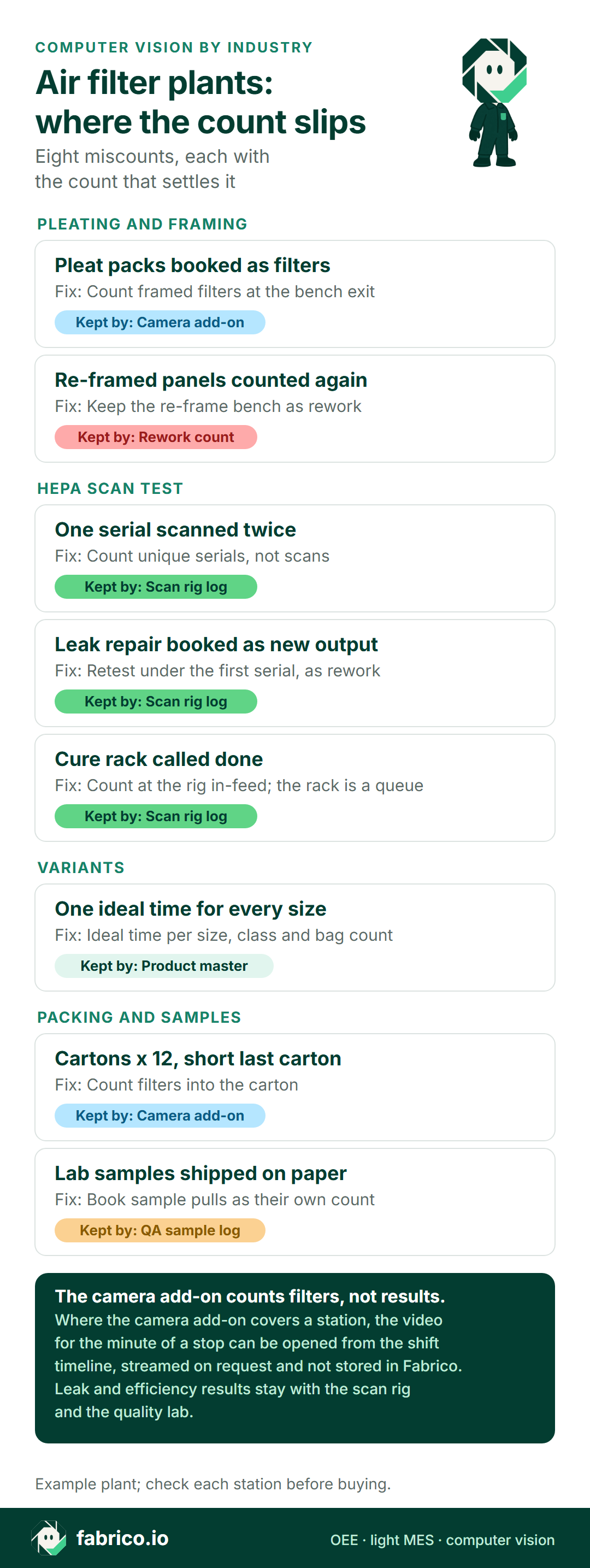
- Air filter plants: where the count slips. Eight miscounts, each with the count that settles it.
- Pleat packs booked as filters. Fix: count framed filters at the bench exit. Kept by: camera add-on.
- One serial scanned twice. Fix: count unique serials, not scans. Kept by: scan rig log.
- Leak repair booked as new output. Fix: retest under the first serial, as rework. Kept by: scan rig log.
- Filters in the cure rack called done. Fix: count after cure, at the rig in-feed. Kept by: scan rig log.
- Re-framed panels counted again. Fix: keep the re-frame bench as rework. Kept by: rework count.
- Cartons times 12 with a short last carton. Fix: count filters into the carton. Kept by: camera add-on.
- One ideal time for every size. Fix: an ideal time per size, class and bag count. Kept by: product master.
- Lab samples shipped on paper. Fix: book sample pulls as their own count. Kept by: QA sample log.
- The camera add-on counts filters, not results. Where the camera add-on covers a station, the video for the minute of a stop can be opened from the shift timeline, streamed on request and not stored in Fabrico. Leak and efficiency results stay with the scan rig and the quality lab.
- Example plant; check each station before buying.
Explainer presented by Iris, Fabrico's AI-generated presenter: how an add-on camera counts output where a machine has no signal. Book a demo.
Plays from YouTube. Google may set cookies when you press play. Privacy policy.
Machine signals an air filter hall already has, pleater to scan rig
Before a camera goes anywhere, list what the machines already report. The split between automated steps and hand work decides where a count can be trusted.
| Station | Signal it gives | What to count there |
|---|---|---|
| Pleater (knife or rotary) | PLC: pleats and packs | Nothing; packs are WIP |
| Potting dispenser | Dispense cycles, if wired | A cycle is not a filter |
| Framing and bag benches | None | Camera add-on count at the exit |
| Cure oven or rack | Temperature, door cycles | An empty rig in-feed is a stop |
| Scan test rig | Serial, pass or fail, rescans | Its log is the HEPA count |
| Packing tables | None, or a label printer | Camera add-on count into the carton |
The scan test rig is the strongest source. In the US, the Department of Energy's HEPA specification for its contractors, DOE-STD-3020-2015, says the maker "shall perform production tests for each filter manufactured", with results "documented and identified by serial number for each individual filter unit". A rig that writes one line per serial already holds the count. Mistakes start when someone counts scans, or counts the same filters again at packing.
The pleater is the opposite case. Its PLC counts pleats and packs exactly, but a pack is a part, not a product. The benches are where the hall goes blind: framing panels, assembling bag filters and potting HEPA packs are hand jobs with no counter. Those, with the packing tables, are the stations for the camera add-on.
Pleat packs are not filters: where the pleater's number stops
Pleat count is a design setting. A 2011 modelling study in Chemical Engineering Science, indexed in the US EPA HERO database, found "there exists an optimum pleat count for clean filters at which pressure drop reaches a minimum". So each model carries its own pleat count and height, and the pleater is reset at a model change.
Two counting rules follow. First, the customer buys a framed filter, not a pack. A shift that pleats 300 packs and frames 280 made 280 filters; the 20 packs on the cart are work in progress. Second, a model change at the pleater is a changeover stop with its own reason, because pleat count, height and media width all change.
The framing bench exit is the first count that matters. Point the camera add-on at the exit, not the bench top. A panel crushed later and re-framed must not cross that line again; run the re-frame bench outside the camera's view with its own rework count. Scrap versus rework explains why the two are priced differently.
HEPA and ULPA cells: the scan rig serial log settles it
High efficiency filters are tested at the plant. In Europe, EN 1822-1:2019, from CEN/TC 195 and previewed by the Italian standards body UNI, is "dealing with the performance testing" of EPA, HEPA and ULPA filters "at the manufacturers site". Its test survey has three steps, the sheet medium, then "Step 2: Leak test of the filter element", then an efficiency test of the element. It lists ISO 2859-1, the attribute sampling scheme, among its normative references, and it drops the aerosol photometer scan leak test.
So the scan rig owns three facts per filter: its serial, its first result and any later result. Three rules keep the count honest.
- A rescan is not a filter. When a probe stops mid-scan and restarts, the log shows the same serial twice. Count serials.
- A repaired filter is rework. A leak sealed and scanned again is the same filter, and it was not good the first time. It ships, but outside the good count; serial tracking makes that easy.
- A filter in the cure rack is not finished. Count it at the rig in-feed, and treat the rack as a queue.
The cure rack is also where the cell's stops hide. When it runs dry, the rig waits. Book that wait on the rig's timeline as a stop, "cured filters not ready", next to the oven loads; the batch OEE formula covers how to measure the oven itself.
In the US, the same DOE specification sets the bar: "The filter shall exhibit a minimum efficiency of 99.97% when tested with an aerosol of 0.3 micrometer diameter." The camera add-on has no part in that judgement. Pass or fail comes from the rig; the first-pass count comes from its log.
Sizes, bag counts and filter classes: one ideal time per variant
Air filter plants run far more variants than buyers expect. The Eurovent Certified Performance air filter programme covers ISO ePM1, ePM2.5 and ePM10 filters with "a front frame size of 592x592mm according to standard EN 15805:2010", and it groups depths into families "within a tolerance of +/- 10% or 50 mm (whatever is the smaller)". Its certified data carry the number of bags, or Vs for V-type filters, as a field of its own.
A REHVA Journal article by Eurovent Certita Certification gives the scale: "In 2016 this certification programme covers 25 manufacturers representing 25 brands and more than 2300 references." That is over 90 references per brand, before cabin and HEPA ranges.
In the US the labels change, not the problem. The US EPA explains that MERVs "report an air filter's ability to capture particles between 0.3 and 10 microns", from an ASHRAE test method. A plant shipping to both markets carries ISO 16890 classes and MERV ratings on the same frame sizes.
Each variant changes work content somewhere: more bags at the bag bench, more pleats in a deeper panel, a longer scan for a larger HEPA face. One ideal time per line turns that mix into fake swings: a 10 bag week looks slow, a 6 bag week fast. Set the ideal cycle time per size, class and bag count, and read OEE per SKU when the mix shifts.
Cartons of 12, short cartons and lab samples at the packing table
Panel and bag filters go into cartons of a fixed quantity, 12 in this example plant, and the tally sheet multiplies cartons by 12. The last carton of a size run rarely holds 12: a run of 103 panels fills eight cartons and a ninth with 7, and the sheet says 108.
Count filters into the carton, not cartons. A camera add-on above the packing table counts each filter as it goes in, so a short carton shows its real quantity, and the label, stock and OEE agree.
Large HEPA elements usually go one to a carton. The DOE specification has a rule worth copying into packing instructions: "Filters shall not be stacked more than three (3) high."
Lab samples are the last leak. Filters pulled for an efficiency or leak sample never ship, or come back destroyed. Book each pull as its own count; destroyed samples are never good count.
A worked shift on the HEPA cell, priced in euros
One early shift on the example HEPA cell: 06:00 to 14:00 with a 20 minute break, 460 planned minutes. The scan rig is the constraint, as a bottleneck analysis of the cell would show. Two sizes run: 610 x 610 at an example ideal scan time of 6 minutes, 1220 x 610 at 10. These are example inputs; a plant times its own rig.
- Stops, 60 minutes: cured filters not ready 35, scan frame change 15, particle counter zero check 10. Run time 400 minutes.
- First scans: 40 of 610 x 610 and 12 of 1220 x 610. Earned time 40 x 6 + 12 x 10 = 360 minutes, so 40 minutes went to slow and restarted scans.
- Leak fails: 3 of 610 x 610, sealed for a retest next shift, and 1 of 1220 x 610, scrapped. Quality loss 3 x 6 + 1 x 10 = 28 minutes.
- Good first-pass filters: 37 + 11 = 48, worth 37 x 6 + 11 x 10 = 332 minutes.
Availability is 400 / 460 = 87.0%. Performance is 360 / 400 = 90.0%. Quality is 332 / 360 = 92.2%. OEE is 87.0% x 90.0% x 92.2% = 72.2%, the same as 332 good minutes out of 460.
The shift sheet ticked the two restarted scans as two more 610 panels and called every tested filter good. It is the usual gap in manual versus automatic tracking:
| Figure | Shift sheet | Audit |
|---|---|---|
| Filters counted | 54 (42 of 610, 12 of 1220) | 52 first tests (40 + 12) |
| Good filters | 54 | 48 (37 + 11) |
| Earned minutes | 372 | 360 counted, 332 good |
| Availability | 87.0% | 87.0% (400 of 460) |
| Performance | 93.0% | 90.0% (360 of 400) |
| Quality | 100% | 92.2% (332 of 360) |
| OEE | 80.9% | 72.2% |
The gap is 40 minutes: 12 from double ticks, 28 from fails called good. A flat 6 minute ideal for both sizes errs the other way: 48 good filters x 6 = 288 minutes, an OEE of 62.6%, and a rig that looks slow whenever big panels run.
The money. No vetted public price or margin for HEPA panels was found, so the margin is an example input: EUR 90 contribution on a 610 x 610 and EUR 150 on a 1220 x 610, EUR 15 per ideal rig minute for both. For scale only, NYU Stern's margin table (US firms, data as of January 2026) puts Machinery at a 37.47% gross and a 15.86% pre-tax operating margin. Lost rig minutes are worth margin only while orders wait for the rig:
| Loss | Rig minutes | Example value |
|---|---|---|
| Stops at the rig (cure rack empty 35, frame change 15, counter zero 10) | 60 | EUR 900 |
| Slow scans | 40 | EUR 600 |
| Scrapped 1220 x 610 filter | 10 | EUR 150 |
| 3 repaired 610 x 610 filters (ship after a retest) | 18 on the rig | EUR 38.20 crew time |
| Total a shift, only while orders wait | 128 | EUR 1,688.20 |
| What the shift sheet would price (88 lost minutes) | 88 | EUR 1,320.00 |
The repairs are priced at crew time, because those filters ship after the retest: 3 x 20 minutes of sealing is one hour at the Eurostat 2025 euro area average of EUR 38.2 an hour. Their retest uses 18 rig minutes next shift, booked there as rework. The scrapped filter's media, frame and compound are left for the plant's own material cost.
Over 21 shifts a month that is EUR 35,452.20 while orders wait, EUR 7,732.20 of it invisible on the sheet. If orders are not waiting, the 100 stop and slow minutes cost crew time instead: three people for 100 minutes is 5 hours, EUR 191.00 a shift. Fabrico prices losses from the plant's own SKU price or margin, so these example inputs get replaced.
This week: book the cure rack wait as a stop, count serials not scans, and move retests out of the good count. None of it needs new hardware.
Where a camera add-on fits, and where stacked filters defeat it
The camera add-on fits where hands do the work and nothing counts: the framing and bag bench exits, the potting bench where packs go into the cure rack, the re-frame bench as its own rework count, and the packing tables.
Stacked filters are its main limit here. A 2026 survey of object counting from the University of Wyoming, Owusu and Sheshappanavar on arXiv, notes that "Industrial counting places particular emphasis on repeatability, throughput, occlusion robustness, and reliable association of objects moving through production processes." It adds that the 2D assumption "breaks down when instances are arranged along the camera’s depth axis such as stacked boxes viewed from above".
Flat panels on a pallet are exactly that. So the camera add-on counts filters as they cross a line when placed, never the pile. Hands over the line, a carton flap, glare from a foil-wrapped cabin filter, or two thin panels moved as one can each cost a count. Mount above the hand-off point, light it evenly, and compare with carton labels for a few shifts first; manual entry versus automated capture shows how.
Where the camera add-on covers a station, the video for the minute of a stop can be opened from the shift timeline, streamed on request and not stored in Fabrico.
Want the framing, bag and packing benches counted next to the pleater and the scan rig? Book a demo.
Questions for any vendor before the first camera goes up
Ask each vendor the same questions about the same stations, and get the answers in writing.
| Topic | Question |
|---|---|
| Rescans | Does one serial scanned twice stay one filter? |
| Leak repairs | Does a retest after a repair land as rework under its first serial? |
| Ideal times | Can ideal times be set per size, class and bag count? |
| Pleater count | Can the pleater's pack count sit as work in progress, apart from framed filters? |
| Stacking | Where is the camera add-on mounted so filters are counted before the stack hides them? |
| Short cartons | Can a short carton and a lab sample pull be booked as their own counts? |
| Cure waits | Is an empty rig in-feed a stop with a reason the operator picks? |
| Data out | How do counts reach the ERP and QA records, and who owns the mapping? |
If the answer to the first two is "the operator corrects it", the miscounts stay. For the last row, see integrating MES and OEE with ERP and quality systems.
Works council and privacy in the pleating hall
Bag and framing benches are staffed all shift, so a camera there sees people. Aim it at the bench exit and the carton, not at faces, agree the views with the works council before mounting, and write down who can open which minute of video. The counts are about filters, not a person's speed. The GDPR guide for production line cameras has the checklist.
Where Fabrico fits in an air filter plant
Fabrico is a cloud OEE and light MES platform. In an air filter hall it reads stops and counts from machine signals where they exist: the pleater's PLC, a sensor on the oven door, a counter on a line. The operator adds the stop reason on a tablet or phone, for example "cured filters not ready" at the rig.
The camera add-on counts output at the hand stations above, so framed panels, bag filters, potted packs and packed filters sit on the same shift timeline as the machines. Pass and fail results stay with the scan rig and the quality lab; their reject count or signal can feed the quality part of OEE.
Losses show in money from the plant's own SKU price or margin, per size and class. Reports export to Excel, and Fabrico also has a REST API and webhooks. See OEE software for the software side, computer vision for OEE for how cameras feed OEE, and computer vision for HVAC equipment plants for a neighbouring case with coils and leak stands.
On Fabrico's roadmap, not live today: the camera add-on spotting a stop at a bench on its own and proposing a reason for the operator to confirm.
What plant teams ask next
Can a camera count HEPA filters at the scan test rig?
It can, but it rarely needs to. The rig already logs a serial and a result for each filter, so that log is the HEPA count. The camera add-on earns its place at the potting bench and the packing table.
How are rescans and leak repairs counted in OEE?
Count unique serials, not scans. A filter that fails the leak scan is not good count, even after a repair and a pass. The retest is rework on its first serial.
Does the camera add-on judge pleats, leaks or efficiency?
No. Pleat checks stay with the pleater's own controls, leak and efficiency results with the scan rig and the quality lab. The camera add-on counts filters crossing a line at a station.
How is a short last carton counted?
Count filters into the carton, not cartons times 12. A last carton of 7 then shows as 7, and the carton label carries the same number.
Which ideal time goes on a bench that makes 6, 8 and 10 bag filters?
One per variant. Time the bench on each bag count and frame size. One average makes 10 bag runs look slow and 6 bag runs look fast.
Which test standard applies: ISO 16890, EN 1822 or MERV?
It depends on the filter and the market. ISO 16890 classes general ventilation filters, EN 1822 classes EPA, HEPA and ULPA filters in Europe, and MERV comes from the ASHRAE test used in the US. The count rules here hold for all three.
Want to see pleater, potting bench and scan rig counts on one shift timeline? Book a demo.
Related articles




Latest from our blog






Real Fabrico tiles, sample data.