


 Login
 Blog

Computer Vision for Valve Manufacturing: A Bench Pilot Checked Against the Test Log

In short: For OEE, computer vision in valve manufacturing counts valves leaving hand benches: pilot it at one bench and check each count against the test log.
Seat, shell and dimension checks stay with the test rig and inspection; the camera add-on counts output, and Fabrico does no inspection.
- Pilot one valve assembly bench that feeds the hydrostatic rig; machining cells and the rig already report their own counts.
- Hand-count first, then compare the camera add-on, the tally and the rig test log serial by serial, through a size change.
- Count a re-lapped valve once, as rework; engineered-to-order valves earn standard hours, not a count per hour.
- Video for the minute of a stop opens from the shift timeline, streamed on request and not stored in Fabrico.
- Stages end on events such as a DN size change or a re-lap loop, never on a calendar.
This is a plan with example numbers, not a record of any plant or customer. Every figure on it is an input the plant replaces with its own.
It covers industrial valves (ball, gate, globe, butterfly, check, control) and the pumps built beside them. Heat pumps are on computer vision for HVAC equipment manufacturing, and the castings that bodies and casings start as are on computer vision for foundries.
Computer vision for valve manufacturing: pilot the count, not the test
A vertical turning lathe knows when its program ended, and an automated hydrostatic rig logs each pressure cycle. The fitter who sets seats, ball and stem into the body and torques its bolts leaves a stamp on the routing card and little else. That bench is where a first pilot earns its keep.
| Valve cell job | Record kept today | Use in this pilot |
|---|---|---|
| Machine bodies, bonnets, casings | The CNC control's part count | Read it; no camera |
| Shell and seat test | Hydrostatic rig PLC, a log per serial | The reference for the camera count |
| Pump performance test | Test loop log per serial | The reference for a later pump pilot |
| Dimensions, casting soundness | CMM, the foundry's NDT | Outside the pilot |
| Valves leaving an assembly bench | A routing card stamp | The camera add-on count under test |
That split decides what proof looks like. The rig already knows, serial by serial, what it tested. The pilot asks a narrower question: can a camera add-on over a hand bench say, as reliably, what was sent to test? See inspection versus testing.
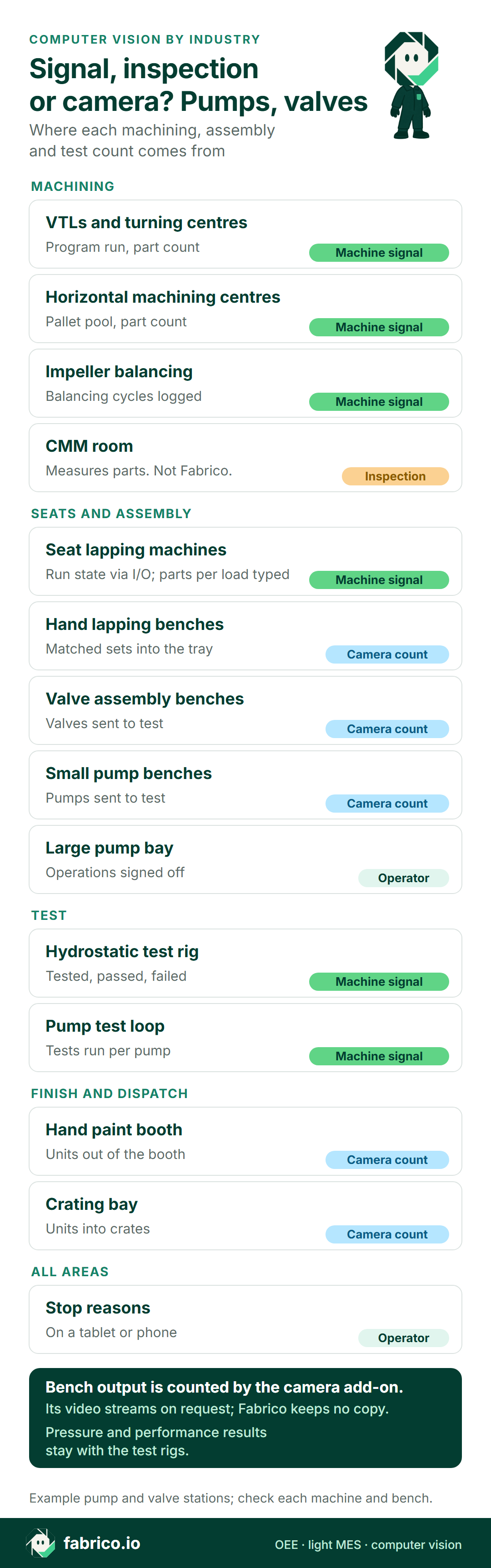
Text version of this infographic
- Machining: VTLs and turning centres: machine signal, program run, part count
- Machining: horizontal machining centres: machine signal, pallet pool and part count
- Machining: impeller balancing: machine signal, balancing cycles logged
- Machining: CMM room: inspection, measures parts, not Fabrico
- Seats and assembly: seat lapping machines: machine signal, run state via I/O, parts per load typed
- Seats and assembly: hand lapping benches: camera count, matched sets into the tray
- Seats and assembly: valve assembly benches: camera count, valves sent to test
- Seats and assembly: small pump benches: camera count, pumps sent to test
- Seats and assembly: large pump bay: operator, operations signed off
- Test: hydrostatic test rig: machine signal, tested, passed, failed
- Test: pump test loop: machine signal, tests run per pump
- Finish and dispatch: hand paint booth: camera count, units out of the booth
- Finish and dispatch: crating bay: camera count, units into crates
- All areas: stop reasons: operator, on a tablet or phone
- Footer: bench output is counted by the camera add-on; its video streams on request and Fabrico keeps no copy
- Pressure and performance results stay with the test rigs
Explainer presented by Iris, Fabrico's AI-generated presenter: how an add-on camera counts output where a machine has no signal. Book a demo.
Plays from YouTube. Google may set cookies when you press play. Privacy policy.
The pilot plan in six stages
No stage has a date. The plant sets its own pace; the record in the third column decides.
| Stage | Bench task | Proof comes from | Ends once |
|---|---|---|---|
| 1. Pick the bench | One valve assembly bench and one catalogue family | ERP order confirmations | The order book holds that family in two sizes or more |
| 2. Hand-count | Tally each valve onto the cart, with its serial | Rig test log, routing cards | Tally, log and cards agree, or each gap has a name |
| 3. Mount | One camera add-on over the hand-off cart | The fitters' agreement, light, grit | The counting zone shows the cart top and no faces |
| 4. Rules | Write rules for sizes, re-laps, ETO valves, holds | Routing cards | Each case on the card has a rule |
| 5. Score | Camera, tally and rig log, row by row | Rig test log | Misses and false counts are explained through a size change and a re-lap loop |
| 6. Price | One measured shift in standard minutes and money | ERP orders waiting | The plant has a loss figure it trusts |
Stage 1: pick one valve bench that feeds the hydrostatic rig
Three stations qualify: finished units leave each one by hand, and a record downstream can check the count.
| Candidate station | Verdict for a first pilot |
|---|---|
| Valve assembly bench before test | First choice: valves leave with only a card stamp, and the rig log per serial sits right behind it |
| Small pump bench before the test loop | Later: pump families vary more per bench, so start once the valve method holds |
| Pack-out after shell and seat test | Later: the count lines up with passes, but shows output, not why the rig ran short |
Pick a catalogue family: DN50 and DN80 metal-seated ball valves built to stock or to repeat orders, not an engineered-to-order (ETO) gate valve with a special trim; make to order versus engineer to order explains the split. An ETO valve can occupy a fitter for several shifts, so a count per hour says nothing about it. Record those through operation sign-offs against standard hours, as in tracking OEE on manual and hybrid assembly lines.
Leave machining out: lathes, machining centres and impeller balancers already report run state and part count through their controls. Then read the ERP order confirmations for the chosen family. The stage closes when they show the bench will build at least two sizes, and so make at least one size change, while the pilot runs.
Stage 2: hand-count the bench against the rig log and routing cards
Before any camera goes up, a person tallies each valve as it is set on the hand-off cart and writes down its serial. That tally is the OEE baseline measurement the camera will be judged against. Three records then line up: the tally, the routing card stamp at the assembly operation, and the rig's test log.
The rig log is the reference because valve production testing has its own rules. In Europe, the purpose of EN 12266-1, as DIN, the German standards body, describes the valve pressure test standard, is “to establish certain basic requirements for production pressure testing of industrial valves in order to ensure uniform tests and test procedures”, and where a valve's own product or performance standard differs, that standard applies. Pressure testing of metallic valves is also covered by ISO 5208, which BSI publishes as BS ISO 5208:2015. Whichever standard an order names, the rig records shell and seat results by serial, and those results stay with the rig and the quality system. The pilot only reads which serials arrived.
That check works only where valves carry serials rather than batch numbers; lot versus serial tracking explains the difference.
Tallied minus tested equals valves in the queue or on hold. If the tally says 40, the rig log has 37 serials and three valves stand in front of the rig, the records agree. If one is missing, find it before Stage 3: pulled for inspection, sent back to lapping without its card, or tallied twice.
For pumps the reference is the test loop. ISO 9906, as the Swedish Institute for Standards lists it, specifies hydraulic performance tests for customers’ acceptance of rotodynamic pumps, at three acceptance grades running from tighter tolerance (grades 1B, 1E and 1U) to even broader tolerance (grade 3B). The loop's log per serial already says which test each pump got, so a later pump pilot reconciles against it the same way; the acceptance side is covered in factory versus site acceptance tests.
Stage 3: mount one camera add-on over the hand-off cart
Mount the camera add-on above the cart where finished valves wait for the rig, aimed at the cart top, not at the fitter. One camera, one counting zone.
A peer-reviewed study of a camera counting hand-assembled pieces shows what goes wrong here. Pierleoni and colleagues (Journal of Imaging, 2020) set upper and lower size limits for what their counter would accept, “in order to avoid considering image noise or table wear as objects to be counted.” A valve cell has both: lapping compound and grit drifting from the seat benches, and a cart top scarred by steel bodies. Keep the zone clean, house the camera away from the lapping plates, and mask anything outside the cart, as in privacy masking for production line cameras.
The study is one prototype at one Italian assembly table, counting small steel lighting devices, not valves, and not Fabrico's software: it names failure modes, not an accuracy to expect.
Stage 4: write the counting rules for sizes, re-laps and ETO valves
The camera counts what lands in its zone; the rules, taken from the routing card, decide what that count means.
- One valve, one count, at the cart. Count valves, not parts. Lapped seat sets are a lapping count, not this one.
- Each size earns its own standard. Here an example 4.0 cell minutes per DN50 valve and 6.0 per DN80, credited when the valve passes the seat test.
- A re-lapped valve counts once, as rework. After a seat fail it goes back to lapping and returns to the cart. The camera add-on cannot see a second trip; the rig log can, because the serial appears twice. Keep it out of first-pass good; rework versus repair sets out the terms.
- Held and pulled valves are not output. A body that weeps through the casting wall is booked against the casting lot; a valve pulled for inspection counts when it returns.
- ETO valves sit outside the camera count, scored apart through sign-offs.
Why standard minutes and not units: Europump, the European pump makers' association, puts the value of pumps produced in EU member countries above EUR 10 billion in 2016, and World Bank trade data for 2023 has the EU exporting 18.8 million centrifugal pumps worth USD 3.65 billion, against 167 million from China worth USD 4.59 billion. Dividing value by count gives about USD 194 a pump against USD 27: European exports are fewer, higher-value units, where a plain count per hour misleads.
Rig changeovers get their own codes. Moving the rig from DN50 to DN80 means new test adaptors and blind flanges, and the UK HSE's guidance note GS4 calls pressure testing a high-risk activity and says test connectors take cyclic loading, so fatigue must be addressed when they are inspected. Adaptor changes and fixture seal swaps go under their own stop codes, never inside slow running.
Stage 5: score the camera count serial by serial
Proof is a sheet with one row per valve: the serial from the rig log, a tick if the tally saw it, a tick if the camera add-on counted it. The same study scored its counter on four outcomes, two of them errors: it could “wrongly count when a piece has not been added on the table” or “wrongly do not count when an assembled piece has been placed on the table”.
| Row on the sheet | Likely cause at a valve cart | Fix |
|---|---|---|
| Missed: serial logged, no camera tick | Two valves set down together, an arm across the zone | Zone, framing, one valve at a time |
| False count: camera tick, no serial | A valve lifted and set back, a fixture parked on the cart | Zone, a lift-and-reset rule |
| Second trip: serial twice on the log | A valve re-lapped after a seat fail | The counting rule, not the camera |
| Not yet tested: ticks, no serial yet | The valve is in the queue | None; this is the queue |
Illustrative arithmetic, not a measured or Fabrico figure: if the rig log holds 75 serials and the camera counted 74 of them plus one false count, its total of 75 matches the log while hiding two errors. That is why the sheet is scored row by row, never by totals.
Write the pass mark down before scoring starts and hold to it; when the camera and the operator log disagree covers settling the gaps. Score through events, not a date: at least one DN50 to DN80 change, one re-lap loop back from the rig and one rig adaptor change.
Stage 6: price one measured shift in standard minutes
Example numbers, no real plant. Four hand lapping benches and three assembly benches feed one hydrostatic rig with DN50 and DN80 metal-seated ball valves. The early shift is 06:00 to 14:00 with a half-hour break, so 450 minutes are planned, read at the rig. The rig's PLC reports tests, passes and fails; the camera add-on at the cart counts valves sent to test; the team lead types in stop reasons.
Availability. The rig stood for 75 minutes: 35 with no valves, because the assembly benches waited for lapped DN50 sets; 25 changing test adaptors, blind flanges and bench fixtures from DN50 to DN80; and 15 replacing a worn seal in the rig's clamping fixture. It ran 375 of 450 minutes: 83.3%.
Performance. The rig tested 55 DN50 valves, worth 220 standard minutes, and 20 DN80 valves, worth 120. That is 340 earned minutes in 375 minutes of running: 90.7%, with 35 minutes of slow running.
Quality. Three DN50 valves and one DN80 valve failed the seat test and passed only after re-lapping: 3 x 4.0 + 1 x 6.0 = 18 standard minutes leave the good figure. 322 of 340: 94.7%.
OEE. 83.3% x 90.7% x 94.7% = 71.6%. The quick check: 322 good standard minutes in 450 planned minutes is 71.6%.
What the cart count adds. No valves reached the cart between 07:10 and 07:50 while the fitters waited for DN50 seat sets; the lappers were re-doing sets from the night shift's seat test fails. The quality loss and the starved rig share one cause. Without a count at the cart, the rig carries both.
In money. Price stops and slow running only where they cost sales, so check the ERP order confirmations first. If confirmed orders were waiting for these valves, the 110 minutes of stops and slow running are valves never made. At an example contribution margin of EUR 30 per standard minute (EUR 120 per DN50 valve, EUR 180 per DN80), that is EUR 3,300, of which EUR 1,050 comes from the late seat sets alone. If no order was waiting, the same minutes are spare capacity, not lost cash; output value per SKU explains the difference.
The four re-lapped valves still ship, so they are priced at crew time, not margin: an example 30 crew minutes each to re-lap and retest at an example EUR 48 an hour is 120 crew minutes, or EUR 96, spread across the lapping benches and the rig. The shift's bill is EUR 3,396 while orders wait. Fabrico prices losses from the plant's own SKU price or margin; replace every example input here.
Book a demo to see valve benches, the hand-off cart and the hydrostatic rig counted on one timeline.
What ends, widens or resets the pilot
Events set these rules, not dates. Write them down at Stage 1.
Stop
- The camera and the rig log still disagree after a re-mount, though the rules cover each case on the card.
- The bench's order book turns to ETO one-offs; switch to operation sign-offs.
- The fitters or the works council have not agreed the framing.
Widen
Widen once the camera count has matched the tally and the rig log through each DN size on order, a seat fail loop and a rig adaptor change. Next, in order: the lapping benches, whose count explains a starved rig; the pack-out after test; then a small pump bench before the test loop. Each new station repeats Stages 2 to 5, as in scaling a computer vision pilot to the plant.
Change, then re-run Stage 2
When a new size, pressure class or trim enters the bench; when the cart, the layout or the light moves; when the rig gets a new adaptor set or test sequence; or when an ETO order starts sharing the bench.
Fitters, the works council and the vendor questions
A camera over an assembly bench sees people. Before anything is mounted, settle with the fitters, and the works council if the site has one, what the count will be used for, and write down who may open bench video. German plants have a legal reason to start there: under section 87 of the Works Constitution Act, a works council co-determines the introduction of technical devices designed to monitor employee behaviour or performance. Aim at the cart, not the fitter, and report per bench and shift, never per person.
Ask every vendor the same questions:
| Question | Accept only |
|---|---|
| How does your count line up with the rig log? | Timestamped counts the plant can match to rig serials. |
| How is a valve re-lapped after a seat fail counted? | Once, as rework. |
| How do DN50 and DN80 valves earn different minutes? | A standard per family, credited at the seat test pass. |
| What does the zone do with lapping grit and a worn cart? | Size limits and a set zone, tested on the plant's cart. |
| How are rig adaptor changes booked? | Their own stop codes, apart from waits for valves. |
| How are ETO valves recorded? | Operation sign-offs against standard hours. |
| Who can open bench video, and is any kept? | Named roles, with the storage answer in writing. |
| How do counts reach the ERP? | A named interface or export, not retyping. |
What Fabrico does in a valve bench pilot
Fabrico is a cloud OEE platform with light MES functions; in this pilot it covers three jobs:
- The hand-off cart: the camera add-on counts valves sent to test. Where the camera add-on covers the station, the video for the minute of a stop can be opened from the shift timeline, streamed on request and not stored in Fabrico.
- The hydrostatic rig: tests, passes and fails are read from the PLC or counter, against the standard minutes the plant sets per size and pressure class.
- Stop reasons: the fitters and the team lead type them on a tablet or phone where they work.
Losses are priced in money per cell and shift from the plant's own SKU price or margin. Fabrico works in the browser and in iOS and Android apps, and figures go to the ERP through a REST API, webhooks or Excel and CSV exports. When the pilot reaches the machine shop, counts come from the lathe and machining centre controls; routings there are covered in MES for metal fabrication.
Roadmap: idle-bench and growing-queue alerts from the camera add-on without anyone asking, with a proposed stop reason the fitter confirms or changes.
Test results, certificates, dimensional checks and heat number traceability stay with the rig and the quality system; their fail counts feed the quality figure.
See Fabrico computer vision for OEE, how camera add-on counts become OEE with computer vision and the OEE software buying guide.
Questions pump and valve plants ask about a first pilot
Which station should a valve plant pilot first?
A valve assembly bench that feeds the hydrostatic rig. Valves leave it with only a routing card stamp, and the rig's test log per serial can check the count.
Will the camera add-on spot a leaking seat or a porous body?
No. A leaking seat shows up in the seat test on the hydrostatic rig, porosity in the shell test or the foundry's own checks, and dimensions on the CMM. Their fail counts still feed the OEE quality figure.
How is a valve that passes only after re-lapping counted?
Once, as rework. It leaves the first-pass good figure, and the rig log shows its serial twice, which is how the pilot tells a second trip from a new valve.
Can engineered-to-order valves go into the same pilot?
Record them, but score them apart. An ETO valve can take a fitter several shifts, so it earns standard hours through operation sign-offs, not a camera count.
When does the pilot end?
When its checks hold, not on a date: the camera count has matched the rig log through a size change, a re-lap loop and a rig adaptor change. If it never does, the plant stops it.
Want to see a valve bench count scored against a hydrostatic test log? Book a demo to see lapping, assembly and the rig counted on one timeline.






Latest from our blog





Real Fabrico tiles, sample data.