


 Login
 Blog

Computer Vision for Drone Manufacturing: A Five-Gate Pilot That Prices the Build Bench

In short: Computer vision in drone manufacturing counts airframes at hand build benches and kit pack-out, where no machine logs them; flash benches and test stands count.
- Start at one bench: the airframe build bench, where arms, motors, ESCs, harness and flight controller go together by hand.
- Referee the camera add-on count with unique serials from the flash bench, not log lines; a re-flash writes the same serial twice.
- Five gates and no calendar: each gate opens on an event, such as an agreed mount or three matching batches.
- In the example, bench B2 runs at 71.4% OEE and loses EUR 8,220 a shift, but only while orders wait.
- Calibration results, motor tests and class labels stay with their benches and the quality team.
Counting is not inspection: the camera add-on counts finished airframes crossing a line at the tray, while calibration, motor run-up and conformity checks stay with the benches and people that own them.
The setting is a plant building small multirotor drones in low to mid volume, with many variants, for commercial and defence buyers. Most value is added by hand at benches, and the software that flashes each airframe already writes a record per serial. Below is one pilot the plant runs itself at one station, with example numbers. The plant sets its own pace: each gate opens on an event, not a date, and nothing here is a Fabrico delivery schedule.
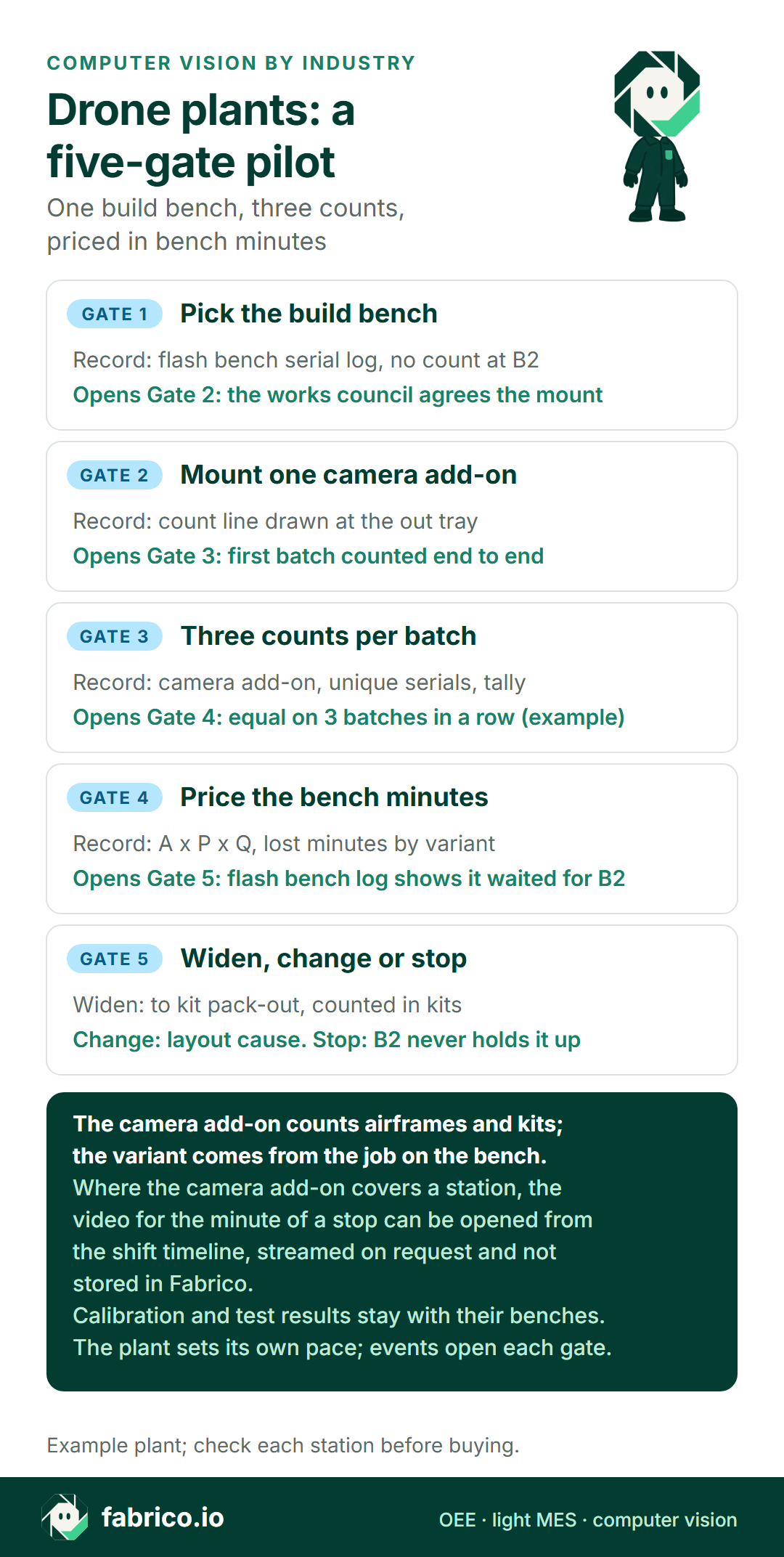
Text version of this infographic
- Computer vision by industry. Drone plants: a five-gate pilot. One build bench, three counts, priced in bench minutes.
- Gate 1, pick the build bench. Record: the flash bench serial log, and no count at B2. Opens Gate 2: the works council agrees the mount.
- Gate 2, mount one camera add-on. Record: the count line drawn at the out tray. Opens Gate 3: the first batch counted end to end.
- Gate 3, three counts per batch. Record: camera add-on, unique serials, tally. Opens Gate 4: counts equal on 3 batches in a row (example rule).
- Gate 4, price the bench minutes. Record: A x P x Q and lost minutes by variant. Opens Gate 5: the flash bench log shows it waited for B2.
- Gate 5, widen, change or stop. Widen: to kit pack-out, counted in kits. Change: a layout cause, fix and recount. Stop: B2 never holds up the flash bench.
- The camera add-on counts airframes and kits. The variant comes from the job on the bench.
- Where the camera add-on covers a station, the video for the minute of a stop can be opened from the shift timeline, streamed on request and not stored in Fabrico.
- Calibration and test results stay with their benches. The plant sets its own pace; events open each gate.
- Example plant; check each station before buying.
Where a drone plant already counts, and where nobody does
Ask one question per station: what records that a unit passed? Some stations log a record per airframe, some have a readout, and some are hand benches where the only count is a tick on a sheet. A camera pilot belongs at the third kind, next to a station of the first kind that can referee it.
| Station | What already counts | Unit | Camera add-on |
|---|---|---|---|
| Kitting | Pick list or kit cart scan | Parts kits | No |
| Harness prep | Crimp machine counter, board tally | Looms | No |
| Airframe build bench | A tally sheet, if any | Airframes | Pilot here |
| Flash and calibrate bench | Serial log on the bench PC | Serials | No, referee |
| Motor run-up cage | Test stand log | Serials | No |
| Weigh and class label | Scale readout, label printer | Airframes | No |
| Battery charge rack | Charger readout | Packs | No |
| Kit pack-out | Packing list | Kits | Later |
| All stations | Stop reason from the operator | Minutes | No |
The flash and calibrate bench is the natural referee because it touches each airframe once, by serial. The PX4 autopilot guide states that "The accelerometer must be calibrated on first use or if the flight controller orientation is changed", and the technician must "hold the vehicle still (rather than rotate it) in each orientation". The software record is the count; the hand time is the bench cycle. A flight controller fitted rotated at the build bench shows up here, as a failed calibration and an airframe sent back.
The unit changes along the way: kits of parts at kitting, looms at harness prep (OEE for wire harness assembly covers that area), airframes at the build bench, serials at the flash bench and run-up cage, packs at the charge rack and kits at pack-out. The pilot keeps one unit per station.
Explainer presented by Iris, Fabrico's AI-generated presenter: how an add-on camera counts output where a machine has no signal. Book a demo.
Plays from YouTube. Google may set cookies when you press play. Privacy policy.
Gate 1: choose the build bench, because the flash bench already logs serials
Bench B2 in the example builds two variants on one frame. M, a mapping quad, takes an ideal 15 bench minutes; P, a payload quad with a gimbal mount and a second loom, takes 22. Two assemblers fit arms, motors, ESCs, loom and flight controller, and nothing on the bench has a signal. The losses people complain about are here: short kits, a fixture change between frames, a soldering tip that fails mid-batch.
What makes B2 a good first station is the bench after it, because the rules make the serial unique. The Consumer Technology Association, publisher of ANSI/CTA-2063-A, says "Each serial number is unique to a specific drone and can also be used to identify the drone’s manufacturer." In the EU, Regulation (EU) 2019/945 requires a class C1 drone to "have a unique physical serial number compliant with standard ANSI/CTA-2063". In the US, 14 CFR 89.505 bars production of a standard Remote ID drone "unless the producer assigns to the unmanned aircraft or remote identification broadcast module a serial number that complies with ANSI/CTA-2063-A." The flash bench binds that serial to the flight controller, so its log holds one line per airframe, plus one per re-flash.
Gate 1 closes with a short record: the bench, both variants with their ideal minutes, the referee (unique serials from the flash bench log) and a written mount request to the works council or staff representatives. Gate 2 opens when they agree.
Gate 2: one camera add-on over the out tray, and a count line the airframe must cross
Mount the camera add-on above the out tray, aimed at the tray and not at the assemblers, and draw the count line where a finished airframe is set down. Two details decide whether the count holds. In the IKEA ASM study of people assembling furniture on camera, researchers at the Australian National University found that "white parts might be missed due to poor contrast against the white work surfaces." A drone bench has the dark version: black carbon arms on a black ESD mat. Pick a tray colour that stands out from the frame, and keep the light even.
The second detail is hands. The same study notes that "the tracker may lose an occluded object for a reasonably long time, it may assign new IDs after occlusion". An airframe lifted, turned and set down again under two hands can look like a new one, so put the count line where the hands leave, not where they work. These are limits of the setting, not a figure for any product; the pilot measures the count at this bench.
The camera add-on counts units only. The assembler selects the job on the bench tablet when a batch starts, and each count belongs to that job; computer vision OEE at manual assembly stations sets out the general pattern. Gate 2 closes with a photo of the mount, the line and the job rule. Gate 3 opens when the first batch is counted end to end without a reset.
Gate 3: three counts per batch, and the serial logged double
For each batch, set three numbers side by side: the camera add-on count, the unique serials the flash bench logged for B2 airframes, and the assemblers' tally sheet.
| Batch | Camera add-on | Unique serials | Tally sheet |
|---|---|---|---|
| M, mapping quad | 14 | 14 (15 log lines) | 14 |
| P, payload quad | 6 | 7 (7 log lines) | 8 |
| Shift | 20 | 21 (22 log lines) | 22 |
Each miss has a cause on the floor. The P airframe that needed its loom rerouted was handed over the back edge of the bench to the harness technician, so it never crossed the count line. The tally reached 22 because one P frame was ticked when its kit was opened, parked while flight controllers were held, and ticked again when finished. The flash log has 22 lines for 21 serials because the returned M was flashed twice. Count serials, never lines.
The fix for the camera add-on count is a layout rule, not a setting: every airframe built on B2 leaves through the out tray, even when it goes to the harness technician next, and returns are reworked at a table beside the bench, away from the line. The acceptance rule is the plant's to set; the example uses camera add-on count equal to unique serials on three batches in a row after the last layout change. That is an example rule, not an accuracy claim. Gate 4 opens when it is met.
Gate 4: the shift in OEE, then in money
The example shift runs 06:00 to 14:30, less 40 minutes of breaks and a 12 minute ESD and FOD check, so planned time is 458 minutes. In the M batch a soldering tip change stops the bench for 12 minutes and the airframes run 12 minutes slow. The fixture change to P takes 16. Then the P kits arrive without flight controllers: the lot is held at goods-in for its origin paperwork, and the bench waits 34 minutes. Routing the second loom costs 20 slow minutes.
Stops are 12 + 16 + 34 = 62 minutes, so run time is 396 and Availability is 396 / 458 = 86.5%. B2 built 14 M at 15 minutes and 7 P at 22, earning 210 + 154 = 364 minutes: Performance is 364 / 396 = 91.9%, and the slow loss is 32. Two airframes came back: an M with its flight controller fitted rotated, and a P with two motor leads swapped, found at the run-up cage. First-pass good is 13 M and 6 P, 195 + 132 = 327 minutes, so Quality is 327 / 364 = 89.8%. OEE is 86.5% x 91.9% x 89.8% = 71.4%, the same as 327 / 458.
Money needs a margin. No drone maker's price list is used: makers that publish prices also sell fleet software or apps, so prices here are example inputs. The example sells M at EUR 7,500 and P at EUR 12,375 with a 16% contribution, EUR 1,200 and EUR 1,980 an airframe. That 16% sits between the pre-tax operating margin of 8.65% and the gross margin of 17.48% for US Aerospace/Defense firms in NYU Stern's margin data as of January 2026. Per ideal minute, M is worth EUR 80 and P EUR 90. The plant replaces all of this with its SKU price or margin.
| Variant | Lost bench min | Value per ideal min | While orders wait |
|---|---|---|---|
| M, mapping quad | 24: tip 12, slow 12 | EUR 80 | EUR 1,920 |
| P, payload quad | 70: FC hold 34, fixture 16, slow 20 | EUR 90 | EUR 6,300 |
| Shift total | 94 | EUR 8,220 | |
| Wrong view | 131, adding 37 quality min | EUR 11,400 |
The 94 lost bench minutes are worth EUR 8,220 a shift, but only while orders wait and B2 is what keeps the flash bench short. The largest part, EUR 3,060, is the held flight controller lot, a loss that starts at goods-in. The wrong view also prices the 37 quality minutes as margin and reaches EUR 11,400, overstating by EUR 3,180: the returned airframes ship after rework, so they cost crew time, 60 minutes or EUR 40 at an example EUR 40 an hour. If orders are not waiting, lost minutes are crew time only: 94 x 2 assemblers = 188 crew minutes, about EUR 125. Per-variant ideals matter here; theoretical versus actual cycle time explains why.
Book a demo to see build bench stops, reasons and lost minutes per drone variant on one shift timeline: book a demo.
Gate 5: the three exits from the pilot and what triggers them
Gate 5 has no date either. An event on the floor picks one of three exits.
- Widen to kit pack-out. When the acceptance rule is met and the flash bench log shows it sat waiting for B2 airframes during B2's stops, so the bench minutes were real. Pack-out counts kits: one closed case is one kit.
- Change the mount. When a batch misses and the cause is the layout: an airframe leaving off the tray, glare, a new fixture in view. Fix it and restart the batch count at zero.
- Stop at B2. When the flash bench never runs short during B2's stops, or a miss repeats with no layout cause, such as look-alike frames stacked in one tray. In the first case B2 is not the constraint; bottleneck analysis with real-time OEE finds the station that is.
Pack-out brings its own rule. The FAA lithium battery shipping guide says that for lithium ion batteries over 100 Wh packed with equipment, "Lithium-ion cells and batteries must be offered for transport at a state of charge not exceeding 30% of their rated capacity", and the number allowed is the "Minimum required to power equipment plus 2 spare sets per package". Packs for air shipment wait on a charge rack, airframes queue for them, and pack contents vary by shipping mode. So the camera add-on counts closed cases and the packing list says what is inside; measuring manual packing and scaling a computer vision pilot to the plant cover the next steps.
Serials, class marks and component origin: what the rules add to the count
None of these rules is a job for the camera add-on, but each changes how the count is read.
| Rule | Region | What it adds to the count |
|---|---|---|
| Regulation (EU) 2019/945 | EU | A unique physical serial per class C1 drone; the class label on the drone and its packaging; class set by MTOM including payload |
| 14 CFR Part 89 | US | The producer assigns an ANSI/CTA-2063-A serial; a Remote ID label permanently affixed |
| Public Law 116-92, Sec. 848 | US, DoD buying | Origin of flight controllers, radios, data links, cameras and gimbals per order |
| FAA lithium battery guide | Air shipment | Packs packed with equipment at no more than 30% charge; a cap on spare sets per package |
In the EU, the class mark depends on mass. Regulation (EU) 2019/945 requires a C0 drone to "have an MTOM of less than 250 g, including payload" and lets a C1 drone, "as an alternative, shall have an MTOM of less than 900 g, including payload". "The UA class identification label shall be affixed visibly, legibly and indelibly to the UA and its packaging and shall be at least 5 mm high." A heavier gimbal can move a payload variant into another class, so class belongs to the variant, and label work sits at weigh and label and again at pack-out.
In the US, Part 89 adds a Remote ID label: "The label must be in English and be legible, prominent, and permanently affixed to the unmanned aircraft." For defence orders, Section 848 of Public Law 116-92, as enacted in 2019, bars the Department of Defense from buying a drone that "uses flight controllers, radios, data transmission devices, cameras, or gimbals manufactured in a covered foreign country or by an entity domiciled in a covered foreign country". That is the text as enacted; the plant checks the current version. This is why a flight controller lot can be held at goods-in, and why the example books that wait as its own stop reason. Serials, labels and origin records stay with the quality team; the pilot only borrows the serial log.
Where Fabrico fits on a drone line
Fabrico is OEE software and light MES in the cloud. Where a station has a usable signal, from a PLC, a sensor or a counter, stops and counts come from it, and the operator adds the stop reason on a tablet or phone. At a hand bench like B2, the camera add-on counts finished airframes and the variant comes from the job on the bench; see computer vision OEE software and OEE with computer vision. Where the camera add-on covers a station, the video for the minute of a stop can be opened from the shift timeline, streamed on request and not stored in Fabrico.
OEE, stops and losses show by bench and shift, priced from the plant's SKU price or margin. Reports export to Excel, and Fabrico also has a REST API and webhooks; integrating MES and OEE with ERP and quality systems covers the boundaries. Calibration results stay with the flash bench, motor test results with the run-up cage, and conformity checks and class labels with the quality team. Build plans sit in the ERP, APS or a spreadsheet; Fabrico provides the counts and rates those plans read. On Fabrico's roadmap, not live today: the camera add-on noticing an idle bench and suggesting a stop reason for the assembler to confirm.
Plants that also build avionics boards meet the same split on SMT lines, in computer vision for electronics manufacturing; for the plant-wide view, see OEE for aerospace manufacturing, and for one set of definitions across sites, OEE governance across plants.
Eight questions for any vendor before Gate 2
Test the answers against the three-count table.
| Question for the vendor | Why it matters on a drone line |
|---|---|
| Can the count line sit at a tray where black carbon arms lie on a black ESD mat? | Low contrast hides parts. |
| How is the variant tied to a count when two quads look alike from above? | A camera counts units, not models. |
| Can counts be compared, batch by batch, with unique serials from the flash bench log? | A re-flash writes a serial twice. |
| Can a held flight controller lot be booked apart from late motors? | Paperwork and supplier stops have different owners. |
| Can ideal bench minutes be set per variant? | 15 and 22 minute airframes share one bench. |
| Can lost minutes be priced per variant, and only while orders wait? | Bench time is margin only if the airframe would sell. |
| Through which interfaces does data leave? | Serial logs and orders sit in other systems. |
| What does the works council see before the mount? | Bench data on two people can point to one. |
Assemblers, the camera add-on and the works council
On a two-person bench, bench data can point to a person, so order matters. The mount request goes to the works council or staff representatives at Gate 1, and the camera add-on goes up at Gate 2 only after they agree. The frame shows the out tray, not faces, and reports are per bench and shift, never per assembler. The assemblers see the three-count table first: they know why an airframe left over the back edge. For the EU legal side, see GDPR rules for production line cameras.
What drone plant teams ask next
Can the camera add-on tell a mapping quad from a payload quad?
No. It counts airframes crossing the line at the out tray. The variant comes from the job selected on the bench tablet, so ideal minutes are set per variant.
Which count referees a drone pilot?
Unique serials from the flash and calibrate bench. Each airframe gets one serial, so a second log line for the same serial is a re-flash, not a second drone. A tally sheet is a third opinion, not the referee.
Do Remote ID serials or EU class labels have to go into the pilot?
No. The pilot needs the serial log as a referee and nothing more. Serial assignment, labels and conformity records stay with the quality team and the systems that already hold them.
How are kits counted when spare batteries wait on a charge rack?
At pack-out, one closed case is one kit. What goes inside comes from the packing list, because packs for air shipment are charged to no more than 30% and the number of spare sets per package is capped.
What if the flash bench, not the build bench, is the constraint?
Then the build bench minutes are crew time, not lost airframes, and the pilot stops at B2. Move the camera add-on, or the attention, to the station that keeps the flash bench waiting.
Want to see bench stops, reasons and lost minutes per drone variant in one place? Book a demo.
Related articles





Latest from our blog







Real Fabrico tiles, sample data.