


 Login
 Blog

GlobalReader vs Plex: Which Fits a Plant That Wants OEE Tracked

Short answer: GlobalReader and Plex do different jobs. GlobalReader is a plug-in OEE tracker: a sensor box per machine and live OEE for a monthly fee (from EUR 125 per machine). Plex is a cloud ERP and MES suite from Rockwell Automation, with production monitoring inside (Plex ERP page). Choose GlobalReader to measure machines while the current ERP stays; choose Plex to run the plant on one system; look at neither first for a fully continuous process, since GlobalReader names discrete work and Plex discrete, hybrid and regulated industries (GlobalReader, Plex).
- Makers, from their own pages on 19.11.2026: GlobalReader OÜ of Tartu, Estonia; Plex, whose site footer reads Rockwell Automation, Inc.
- Prices: GlobalReader lists EUR 125 a machine monthly and a EUR 137 set-up charge per device. Plex: no public price; quote on request (checked 19.11.2026).
- Sample die-casting cell: 69.0% OEE on one night shift; two fixes before the first shot are worth about EUR 143 a shift.
Most people asking "GlobalReader vs Plex" want to know how each tracks OEE. One product is built around that question; the other answers it with one module of a much larger system.
Key takeaways
- Name the job first: measuring machines, or replacing the ERP and MES the plant runs on.
- GlobalReader fits next to an existing ERP; its integrations page lists partner links to Dynamics 365, Directo, Monitor G5 and NOOM.
- Plex puts finance, purchasing, MES, quality and inventory in one cloud system, so the project is an ERP change.
- Only GlobalReader publishes a price list; ask Plex for a written quote that names every module.
Two different products, checked on their own pages
GlobalReader. The footer of globalreader.eu names the company as GlobalReader OÜ at Spektri 6, Tartu, Estonia, 50411, and its page title addresses European SMEs. The homepage promises "SME-friendly price and deployment" and says the product "works with any discrete manufacturing operation". Its Scoutbox page adds a target size: "Built for factories with 10+ machines and 2+ shifts" (all read 19.11.2026). Before a contract, look up the registry code in the Estonian business register and check it against the order form.
Plex. plex.com now forwards to the Plex Smart Manufacturing Platform site, whose footer reads "© 2026 Rockwell Automation, Inc." Rockwell's own press release of 1 September 2021 announced it had completed the acquisition of Plex Systems, said Plex had "over 700 customers", and placed it in Rockwell's Software and Control segment; the same text sits in the Plex newsroom. The Plex ERP page calls it "a cloud-based enterprise resource planning system designed for manufacturers" that combines ERP with MES, and the Plex MES page lists "operator control panels, error-proofed workflows, closed-loop quality control, inventory tracking, and finite scheduling" (read 19.11.2026).
Under the EU SME definition, a medium-sized firm has fewer than 250 employees and either up to EUR 50 million in turnover or a balance-sheet total up to EUR 43 million (accessed 19.11.2026). A firm that size can add a monitoring subscription beside its accounts package; moving finance, purchasing and the shop floor into one new suite is a company-wide project.
GlobalReader and Plex side by side
Each cell cites its vendor page, read 19.11.2026; shared ground follows the table.
| Question | GlobalReader | Plex |
|---|---|---|
| What it is | OEE and production monitoring with a sensor box per machine (Scoutbox page) | Cloud ERP plus MES, quality, supply chain and more on one platform (Plex homepage) |
| How a machine is read | Photo-eye, inductive, current or relay sensors; OPC UA or MQTT where the machine shares data | Production monitoring "Powered by Kepware®", with "seamless connectivity to and from machines" (production monitoring page) |
| Hardware in the price | "Hardware included in price" (pricing) | Ask which hardware a quote includes |
| Where it runs | Servers in Europe, "Or the whole system on your own server, running without internet." | Multi-tenant SaaS; an edge layer, FactoryTalk ResilientEdge, "extends cloud-based manufacturing execution to the edge" (ResilientEdge page) |
| Orders and the ERP | Smart Factory add-on: "Two-way integration connects your shop floor directly to your ERP"; partner builds listed (integrations page) | The ERP is Plex itself; top-floor plan changes are dispatched to the plant floor scheduler (MES page) |
| Quality and traceability | Quality Control add-on: "Operators confirm specs before production continues. All logged for audit." | "Closed-loop quality control", inventory with "end-to-end traceability" (MES page) |
| Uptime and security stated | Readings buffered on the box until delivered | "99.9% Service Level Agreement uptime", ISO/IEC 27001:2013 and externally audited SOC reports (cloud and security page) |
| Price | From EUR 125 per machine a month, EUR 137 per device once | No public price; quote on request (checked 19.11.2026) |
Both show live OEE in a browser and push alerts: GlobalReader texts or e-mails the team when a machine halts without warning (homepage), and Plex Mobile "provides instant alerts and notifications" on phones and scanners (Plex Mobile page). Both list a planning tool: GlobalReader a Planner feature, Plex a finite scheduler. Those are matched strengths and do not decide the choice.
What it costs to start: one published price list, one quote
GlobalReader's pricing page sets the Monitoring Core plan at "Starting from €125 /machine /month", Scoutbox hardware and support included, billed monthly "no lock-in", with "SAVE 5% with annual plan". A footnote adds "one-time deployment fee (€137/device)". Features such as Operator, which collects downtime causes and the products in production, start at EUR 26 per machine a month; add-ons such as Quality Control start at EUR 13 per machine a month each. Plex shows no figure on the pages read and routes buyers to a contact form: no public price; quote on request (checked 19.11.2026). Its cloud page does promise "Unlimited users, devices, and machines", worth holding against the quote. The table prices a six-machine hall on GlobalReader list figures, without VAT.
| Six machines, list figures | GlobalReader | Plex |
|---|---|---|
| Once, at the start | 6 x EUR 137 = EUR 822 deployment | Quote on request |
| Each month | 6 x (EUR 125 + EUR 26 Operator) = EUR 906 | Quote on request |
| First 12 months | EUR 822 + 12 x EUR 906 = EUR 11,694 | Quote on request |
| With Quality Control on all six | Plus 6 x EUR 13 = EUR 78 a month | Quality is part of the MES scope listed |
Compare like with like. A GlobalReader figure buys machine monitoring next to the ERP the plant already pays for. A Plex quote may replace that ERP as well, so set it against today's ERP licence, hosting and support bills, the trade-off laid out in light MES vs full MES. The table assumes reason entry needs Operator; GlobalReader can confirm.
How a shot on the machine becomes a number on the screen
GlobalReader starts at the machine. Its Scoutbox page describes one box per machine with three sensor inputs and a controller port; an inductive sensor "Counts cycles", a photo-eye counts pieces and metres, and a relay or current signal tells it when the machine runs. The box sends over LAN, WiFi or LTE and holds readings in a buffer until they get through, which suits an older die-casting machine whose controller nobody wants to open. Plex starts at the business record. Its production monitoring page describes "automatically capturing machine data, downtime and production performance" through connectivity powered by Kepware, and the MES page adds that "For every action on the plant floor, there is a transaction in Plex." Ask Plex which machines without a readable controller it can count, and with what hardware.
Cell 4 at night, in GlobalReader and in Plex
Invented example: the plant, the cell and all figures are made up, and screens from either vendor are not reproduced. A foundry with 140 staff casts aluminium pump housings for car makers' suppliers. Cell 4 is a cold-chamber high-pressure die-casting machine with a two-cavity die, ladle robot, spray robot and trim press. Ideal cycle: 75 seconds a shot, 1.6 housings a minute. The night shift runs 22:00 to 06:00 with 40 minutes of breaks: 440 planned minutes, 704 housings possible.
| Time and event | GlobalReader | Plex |
|---|---|---|
| 22:00 part number PH-220 starts on cell 4 | Operator feature records the product in production (pricing page), or the order arrives from a listed ERP | The job comes from the Plex plan, dispatched to the plant floor scheduler (MES page) |
| 22:00 shots counted | An inductive sensor counts cycles; ask how the two-cavity multiplier is set | Machine data captured through the Kepware-powered link (production monitoring) |
| 22:00 to 22:18 die warm-up, first shots scrapped | Warm-up reason chosen on the machine-side touchscreen (homepage) | Downtime captured automatically; operators work from the paperless operator Control Panel (MES page) |
| 23:30 spray nozzle clog, 16 min | Text or e-mail goes to the night supervisor | Alert on Plex Mobile (mobile page) |
| 01:10 holding furnace low, 14 min waiting for metal; 03:20 ladle robot fault, 12 min; 04:45 trim press jam, 9 min | Reasons logged at the machine; Call for Help add-on can page the right person | Ask Plex to show how a reason is attached to the job |
| Through the night, 54 housings fail porosity and cold-shut checks | Quality Control pop-ups; scrap totals can flow back to the ERP | Quality procedures kept from the control plan; inventory tracked with "end-to-end traceability" |
| 06:00 shift report | "See patterns across shifts, machines, and operators" (homepage) | "Easily customized dashboards" (production monitoring) |
Two rows call for a separate pilot check. A shot can be fired and never trimmed, so match the shot count to the trim press counter for a whole shift. And decide whether warm-up is a stop, a setup or scrap, because each choice moves a different OEE factor.
The night shift in OEE and euros
| Sample shift, cell 4 | Minutes or housings |
|---|---|
| Planned time, 22:00 to 06:00 less breaks | 440 min |
| Die warm-up after the break | 18 min |
| Spray nozzle clog | 16 min |
| Waiting for metal | 14 min |
| Ladle robot fault | 12 min |
| Trim press jam | 9 min |
| Stopped time | 69 min |
| Housings cast, 270 shots x 2 | 540 |
| Rejected for porosity or cold shut | 54 |
- Availability. 440 minus 69 leaves 371 running minutes: 371 / 440 = 84.3%.
- Performance. 371 minutes at 1.6 housings a minute allow 593.6; the cell cast 540: 540 / 593.6 = 91.0%.
- Quality. 540 minus 54 leaves 486 good housings: 486 / 540 = 90.0%.
- OEE. 84.3% x 91.0% x 90.0% = 69.0%, the same as 486 good housings out of 704 possible.
What the pilot aims at. Two losses can be fixed before the first shot. Running the die heater through the break cuts warm-up from 18 to 6 minutes, and a nozzle clean at shift start cuts clogs from 16 to 4. That frees 24 minutes. At 1.6 housings a minute, 91.0% performance and 90.0% quality, each running minute yields about 1.31 good housings, so 24 minutes add about 31 good housings: 517 in all and an OEE of about 73.5%, up 4.5 points.
Which margin to use. Take a sample selling price of EUR 38 a housing and value each lost housing at 12% of that, EUR 4.56. The industry margin dataset that Aswath Damodaran maintains at NYU Stern, data as of January 2026, shows 35 US Auto Parts firms at a 5.67% pre-tax unadjusted operating margin and a 15.84% gross margin (accessed 19.11.2026); 12% sits inside that range. The gain is about 31.45 x EUR 4.56 = EUR 143 a shift. At three shifts a day, five days a week, for 48 weeks, 720 shifts, that is about EUR 103,300 a year, roughly EUR 8,600 a month. The 69 stopped minutes on this one night cost about 90 good housings, about EUR 412.
Beside that, GlobalReader's EUR 151 a month for this cell with Operator is small; a Plex quote must be judged on the whole ERP and MES scope. More on this process in OEE for high pressure die casting, and the formula itself in the OEE calculation guide.
Decision matrix: GlobalReader or Plex for your plant
Rows where both vendors answer alike were removed. Each row left names a test that settles it.
| If this is you | Look first at | Why (vendor page) | Prove it in the pilot by |
|---|---|---|---|
| OEE on a handful of machines, and the ERP stays as it is | GlobalReader | Partner ERP integrations listed by name | One order in from the ERP and its good count back out |
| The ERP is due for replacement and MES should sit in the same system | Plex | Cloud ERP combined with MES | A reference visit to a plant of similar size on Plex |
| The budget needs a published price per machine | GlobalReader | Monthly fee per machine with the Scoutbox in it | A written first-year total with every add-on in use |
| Customers audit lot traceability from receipt to shipment | Plex | Inventory with end-to-end traceability | One lot traced from the furnace charge to the shipped box |
| Old machines with no controller anyone will open | GlobalReader | Photo-eye, inductive, relay or current sensors | A week of counts within a few parts of the trim press counter |
| Several plants on one standard, with an uptime figure in the contract | Plex | 99.9% uptime service level, ISO 27001 | The uptime figure and its credits written into the contract |
| Machine data may not leave the site at all | GlobalReader on the plant's own server | Own server, running without internet | IT signing off the network drawing before anything is fitted |
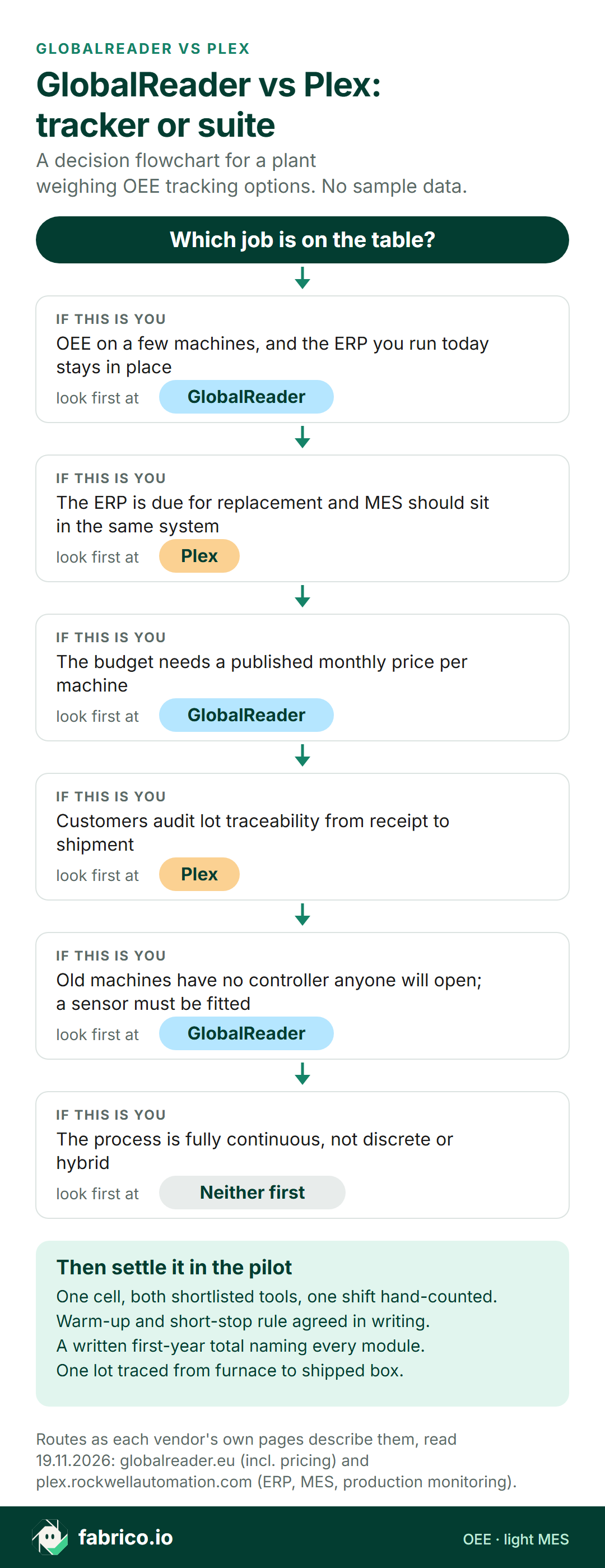
Text version of this flowchart
- OEE on a few machines, and the ERP you run today stays in place: look first at GlobalReader.
- The ERP is due for replacement and MES should sit in the same system: look first at Plex.
- The budget needs a published monthly price per machine: look first at GlobalReader.
- Customers audit lot traceability from receipt to shipment: look first at Plex.
- Old machines have no controller anyone will open; a sensor must be fitted: look first at GlobalReader.
- The process is fully continuous, not discrete or hybrid: look at neither first.
- Then settle it in the pilot: one cell, both shortlisted tools, one shift hand-counted; warm-up and short-stop rule agreed in writing; a written first-year total naming every module; one lot traced from furnace to shipped box.
Where Fabrico fits
Fabrico combines OEE software and light MES in one cloud service, with its scope on the MES and OEE solution overview page. Machine PLCs, sensors or counters feed it run, stop and count. Operators add the reason on a tablet or phone and tag it with the product on the machine, and Fabrico puts a euro figure on each loss per line and shift, like the die-casting sums above. Machines with no usable signal can be counted by the camera add-on; where the camera covers the line, the video for the minute of a stop can be opened from the shift timeline, streamed on request and not stored in Fabrico. Fabrico supplies measured rates per line; the plan itself is made in the ERP, APS or planning spreadsheet. EU customers are hosted on AWS in Frankfurt. Book a Fabrico demo to see a sample shift costed loss by loss.
Where Fabrico is not the right pick. Companies whose real project is a new ERP, with finance, purchasing, quality and the shop floor in one suite, belong with a suite such as Plex. A plant that wants one supplier to fit the sensors and charge a single fee per machine is shopping for GlobalReader's model. A site that must keep every reading inside the building with no internet link needs software installed on its own server; Fabrico is delivered as a cloud service.
Questions to send both vendors before a quote
- On warm-up and short stops: where do warm-up shots and stops under two minutes land out of the box, and can the plant change the rule itself?
- For GlobalReader: which sensors and fitting hours does the EUR 137 per device cover, is Operator required for reason entry, and which fees does the annual 5% reduce?
- For Plex: which modules does the quote include, what hardware reads a machine with no network port, and what does a plant this size pay a year for licences and services?
- For both: in what format does the data leave, and what becomes of it when the contract stops?
For OEE tracking inside Plex specifically, there is a separate review of OEE tracking in Plex smart manufacturing.
What to do this week
- Write down the job in one line: measure machines, or replace the ERP and MES.
- List the machines with their controllers, and mark which ones nobody will open.
- Price today's systems: ERP licence, hosting and support a year, so a suite quote has something to sit against.
- Agree the warm-up and short-stop rule, then mail it to each vendor along with the questions above.
- Hand-count a full shift on the pilot cell and price it with a margin from a published range.
Questions people ask about GlobalReader and Plex
How does GlobalReader compare with Plex for tracking OEE?
GlobalReader is made for OEE tracking: a Scoutbox on each machine feeds counts and run time to live dashboards, priced per machine from EUR 125 a month. Plex covers OEE with a production monitoring module inside a cloud ERP and MES suite owned by Rockwell Automation, with no public price.
What do GlobalReader and Plex cost?
On 19.11.2026 GlobalReader's price list started at EUR 125 a machine per month including the Scoutbox, with a one-off EUR 137 per device for deployment; Operator and other features start at EUR 26 a machine per month. Plex: no public price; quote on request (checked 19.11.2026).
Who makes GlobalReader and who owns Plex?
GlobalReader's site names GlobalReader OÜ, Spektri 6, Tartu, Estonia. Plex's site footer reads Rockwell Automation, Inc., and Rockwell announced on 1 September 2021 that it had completed the acquisition of Plex Systems.
Can GlobalReader work with an ERP instead of replacing it?
Yes. Its Smart Factory add-on offers two-way ERP integration, and its integrations page lists partner builds for Dynamics 365, Directo, Monitor G5, NOOM and other systems.
Can Fabrico run beside GlobalReader or Plex?
Yes, where a plant wants its stop reasons costed in euros in OEE and light MES software that runs in the cloud. Fabrico takes its run, stop and count data from a machine signal, or counts with the camera add-on; test each hand-off between systems during a pilot.
Want a die-casting night laid out loss by loss in euros, next to OEE per line and shift? Book a demo.
Related articles




Latest from our blog



Real Fabrico tiles, sample data.