


 Login
 Blog

Computer Vision for Dental Products Manufacturing: Audit the Implant Pack Count

In short: In a dental products plant, computer vision counts finished packs at manual cleanroom benches where no machine signal equals one shippable unit.
- Lathe counters, sealer cycles and label printers each count something real, but none of them counts a good, labelled pack.
- The costly miscounts are kits counted twice, resealed or relabelled packs counted again, and one lot booked by two shifts.
- A sterilisation batch changes stock status, not output: count the pack once at the bench and release it in the ERP.
- On one example early shift the sheet says 81.6% and the audit says 73.1%, with EUR 768 of loss unseen.
- Inspection stays with the quality team; the camera add-on counts packs and nothing else.
Computer vision in dental manufacturing earns its place at hand-packing benches, where implants and abutments become labelled packs and no machine reports a finished unit.
Checking threads, surfaces and seals is inspection, a job for the quality team and its measuring equipment; counting the packs that leave the bench is a separate job, and the subject here.
A dental plant rarely lacks numbers. Lathes report parts, the pouch sealer reports cycles, the label printer reports labels and the ERP reports released stock. These four almost never agree, and the shift sheet takes whichever is easiest to read. The audit below uses an example implant and abutment plant; every station figure is an example input.
The dental miscount table: what inflates the number, the fix, who keeps it
Nine places account for most of the gap between the shift sheet and the packs that can actually ship. Each row gives the place, what the sheet does, the fix, and who holds the number afterwards.
| Where | What the sheet does | Fix | Who keeps the number |
|---|---|---|---|
| Sliding-head lathes | Counter total booked as good, setup and first-off parts included | Counter = parts made; good comes later | Lathe controller, as total |
| Blasting, etching, cleaning | One basket booked as one unit, or pieces guessed by weight | A basket is a batch, not a count point | No count kept here |
| Fixture and cover screw | Implant and screw counted as two units | Count the labelled pack | Packing bench |
| Pouch sealer | Seal cycles booked as packs; a reseal counts twice | Cycles are a stop signal, not packs | Sealer for stops, bench for packs |
| Label printer | Reprints and test labels booked as packs | Labels printed are not packs made | Printer for stops, bench for packs |
| Lot split over two shifts | Both shifts book the whole lot | Count by shift time; the lot is for traceability | Packing bench, time stamped |
| Release samples | Packs pulled for seal tests left in output | Count them made; QA logs the samples | Quality team |
| Sterilisation batch | Packs counted at packing and again at release | One count at the bench; release is a stock status | ERP |
| Laser-marked drills | Re-marks after an unreadable code booked as drills | Count drills into the kit tray | Kit bench |
The rules on labelling decide what one unit is. In the US, the UDI subpart of 21 CFR 801 is plain (section 801.20): "Every device package shall bear a UDI". In the EU, the Medical Device Regulation 2017/745 puts UDI carriers on the label of the device and on all higher levels of packaging, and adds that higher levels of packaging do not include shipping containers. So the count unit is the labelled pack. A shipping carton is not a unit of output, however tempting it is to count cartons at the dispatch door.
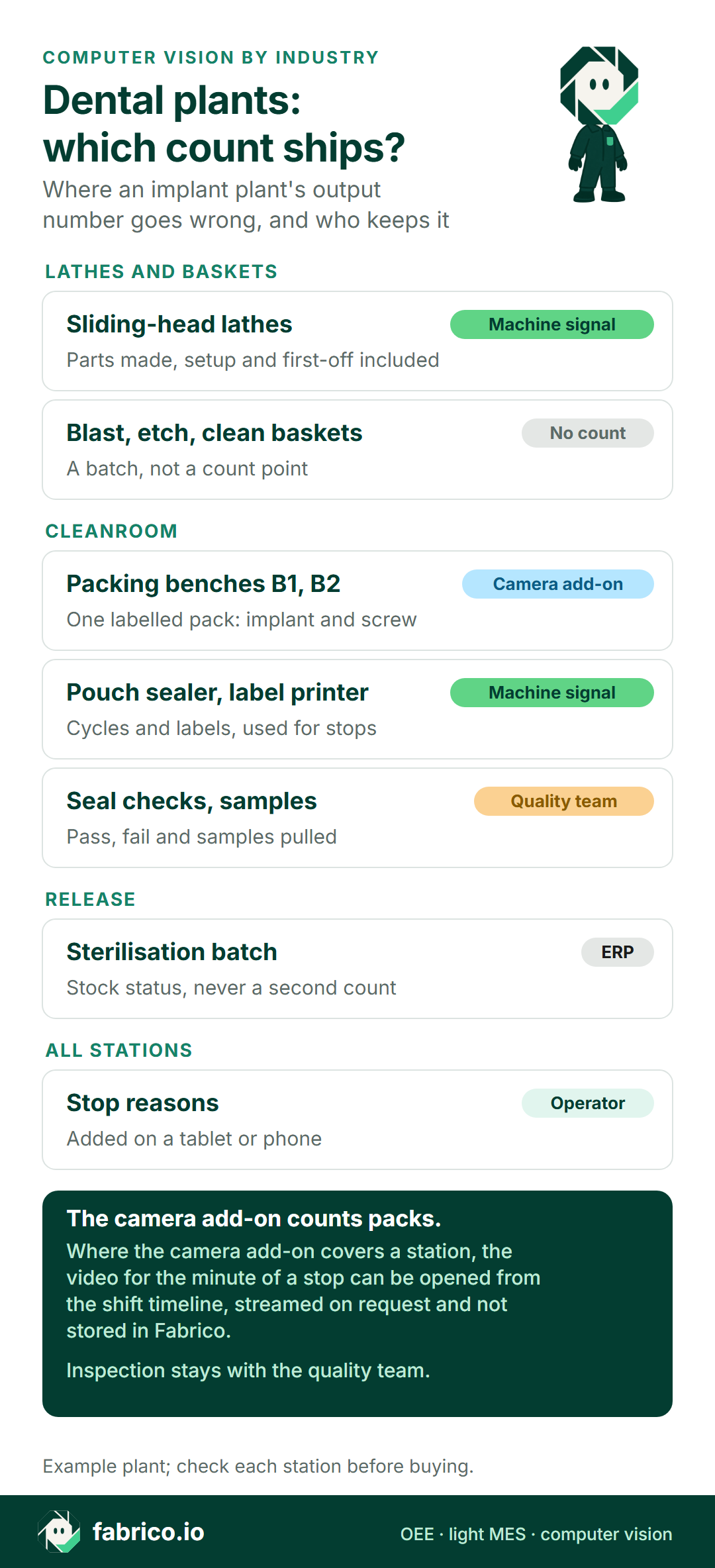
Text version of this infographic
- Computer vision by industry. Dental plants: which count ships? Where an implant plant's output number goes wrong, and who keeps it.
- Lathes and baskets. Sliding-head lathes: parts made, setup and first-off included. Machine signal.
- Blast, etch, clean baskets: a batch, not a count point. No count.
- Cleanroom. Packing benches B1, B2: one labelled pack, implant and screw. Camera add-on.
- Pouch sealer, label printer: cycles and labels, used for stops. Machine signal.
- Seal checks, samples: pass, fail and samples pulled. Quality team.
- Release. Sterilisation batch: stock status, never a second count. ERP.
- All stations. Stop reasons: added on a tablet or phone. Operator.
- The camera add-on counts packs. Where the camera add-on covers a station, the video for the minute of a stop can be opened from the shift timeline, streamed on request and not stored in Fabrico. Inspection stays with the quality team.
- Example plant; check each station before buying.
Explainer presented by Iris, Fabrico's AI-generated presenter: how an add-on camera counts output where a machine has no signal. Book a demo.
Plays from YouTube. Google may set cookies when you press play. Privacy policy.
Implant, abutment and drill variants: why one plant rate fails
An implant plant turns fixtures, abutments, cover screws and healing caps from titanium bar, and often surgical drills too. Each family has its own bench time, label and way of going wrong.
The US rule for endosseous dental implants, 21 CFR 872.3640 places a root-form implant in class II and lists four geometrically distinct types: basket, screw, solid cylinder and hollow cylinder. In the EU, Rule 8 of Annex VIII of the MDR classes implantable devices as class IIb, except devices intended to be placed in the teeth, which are class IIa. A site packing both keeps two device classes on the same benches.
Surgical drills follow another rule. Under 21 CFR 801.45, a device used more than once and reprocessed before each use must carry a permanent UDI marking on the device itself. So drills pass a laser marking station that implants never see, and the laser's mark count is not a drill count: a mark the verifier cannot read is marked again.
The Federation of the European Dental Industry (FIDE) represents more than 550 dental manufacturers; its regulatory affairs page states that more than 80% of companies in the dental industry use the HIBC barcode. A barcode on every pack makes traceability strong. It does not make the output number right: a reprinted label carries the same code as the one it replaced. Catheter and pouching lines are covered in computer vision for medical device manufacturing.
Plant layout: from sliding-head lathes to sterile release
The example plant has three sliding-head lathes turning titanium bar. Two run fixtures and abutments; the third alternates between abutments and surgical drills. Each lathe controller has a part counter and a run signal, so lathe stops and part totals come from the machine. Setup and first-off parts after a bar or program change are in that total; they are a start-up loss of the lathe, never output.
Parts then travel in baskets through blasting, acid etching, cleaning and passivation. A basket of several hundred parts goes in and comes out together, so counting there books one basket as one unit or guesses pieces from weight. Treat the basket line as a batch step with its own availability, not a count point; pieces are counted once, later.
The queue of cleaned baskets in front of the cleanroom decides the shift. When it is empty, both benches wait; when it is full, the benches set the pace, the usual sign of a constraint (see how to identify manufacturing bottlenecks). A first-in, first-out lane for baskets keeps lots in order (see FIFO lane vs supermarket). So benches B1 and B2 are where output is counted. A packer places the fixture and its cover screw in a vial, the vial in a blister, and passes it to the pouch sealer and label printer. Nothing on the bench reports a finished pack, and a camera add-on over each out tote closes that gap. It is worth timing the bench by hand first, as in measure manual packing before automating.
After labelling, packs leave in a sterilisation batch and come back for QA release; neither adds a unit. Drills are counted into the kit tray, not at the laser.
Labels, lots and UDI: the counting rules the regulation sets
In the words of the EU MDR, the UDI production identifier (UDI-PI) "identifies the unit of device production and if applicable the packaged devices": in practice the lot or serial number, plus dates where they apply. A lot is a unit of traceability; output is a count of packs in a time window. When a lot of 600 fixtures is packed over two shifts, both shifts see the same lot number, and a sheet that books output by lot books it twice. Time stamp each pack at the bench and leave the lot to the label and the device record (see lot vs serial tracking).
The same logic covers the kit. A fixture with its cover screw in one vial is one labelled pack and one UDI; counting implant and screw separately doubles the bench's output. Write down the count unit per product family before counting starts: fixture pack, abutment pack, drill kit.
Clear aligner plants should read one more line of the MDR: devices "mass-produced by means of industrial manufacturing processes in accordance with the written prescriptions of any authorised person shall not be considered to be custom-made devices". So the aligner plant picks one output unit, the aligner or the case, and never mixes them.
Sterilisation batches and release holds: a stock status, not output
Implants and abutments are sold sterile, so every pack passes a sterilisation batch after the bench. The FDA page on medical device sterilization lists methods including moist heat, dry heat, radiation and ethylene oxide gas, notes that about fifty percent of all sterile medical devices in the US are sterilized with ethylene oxide, and says the FDA inspects the industrial facilities that sterilize devices. In the example plant, batches go to a validated outside steriliser.
So the packs leave and come back. Counting at the bench and again on release reports them twice; waiting for release shows a bench that made nothing all shift and hides its stops.
Count first-pass good packs at the bench, in the shift they were made, and keep sterilisation and release as stock status in the ERP: packed, at steriliser, quarantined, released. Release samples follow the same split: the bench made them, the quality team logs them, and they leave shippable stock, not the bench's output. See quality holds and OEE.
What a camera can and cannot count at a packing bench
At a cleanroom bench a camera is well placed: packs leave one at a time into one tote, and the camera add-on only has to count them. A photo eye on a chute would count anything that breaks the beam, a glove included. The camera has its own limits.
The main one is occlusion. In a review of occlusion handling in object detection, Saleh, Szénási and Vámossy of Óbuda University write: "Since occlusion can happen in various locations, scale, and ratio, it is very difficult to handle." At a dental bench, occlusion is a gloved hand over the tote, a pack laid on another, or a tray of vials whose lower row hides behind the upper one. Glossy blister foil adds glare. All of it can be designed around before the first count.
- Mount the camera over the out tote, not over the work.
- Keep the tote a single layer, or use a short chute, so no pack hides another.
- Test lighting with the real foil and pouch on a normal shift.
- Run the camera count next to a hand tally for a few lots and agree the gap per lot.
No count accuracy figure is claimed here; the comparison at the bench is the proof. The camera add-on does not judge seals, threads or labels. Those stay with the quality team's checks and its validated equipment.
Cleanroom bench B1 on an early shift, audited
One example shift on bench B1, every number an example input. The shift runs 06:00 to 14:00, less 30 minutes of breaks and 15 minutes of gowning at the start, so 435 minutes are planned. The bench packs two families, each with its own ideal time: 1.5 minutes for a fixture pack (vial, blister, seal, label) and 1.0 minute for an abutment pack (theoretical, not actual, cycle times).
Stops took 61 minutes: two lot changes with line clearance at 14 minutes each (28, a start-up loss worth cutting with MES and OEE), a cleaned basket that came late from passivation (24), and a label printer ribbon change (9). That leaves 374 run minutes.
The camera add-on over the out tote counted 146 fixture packs and 112 abutment packs. At the ideal times they earn 146 x 1.5 = 219 minutes plus 112 x 1.0 = 112 minutes, so 331 minutes. The 43 minutes between run and earned are slow packing: blister cavities that stuck on a new tray lot (31) and the packer helping at the label printer (12). The quality team's seal check failed 6 fixture packs for open seals and the label check rejected 4 abutment packs, worth 9 + 4 = 13 minutes. Good output is 140 fixture packs and 108 abutment packs, 210 + 108 = 318 minutes.
Availability is 374 / 435 = 85.98%. Performance is 331 / 374 = 88.50%. Quality is 318 / 331 = 96.07%. OEE is 85.98% x 88.50% x 96.07% = 73.1%, which matches 318 / 435. QA also pulled 4 fixture packs from each lot as release samples, 8 in all. They stay in the bench's good count and leave the 140 fixture packs that go on to release as 132.
Now the shift sheet. It booked the whole fixture lot as made today, including 14 packs the night shift had already packed, took the 3 reprinted abutment labels as 3 more packs, and called all rejects good.
| Item | Shift sheet | Audit | Why |
|---|---|---|---|
| Fixture packs | 160 | 146 made, 140 good | 14 belong to the night shift |
| Abutment packs | 115 | 112 made, 108 good | 3 reprints are not packs |
| Earned minutes | 355, all good | 331, 318 good | Rejects called good |
| Lost minutes seen | 80 | 104 stops and slow | 24 min hidden |
| OEE | 81.6% | 73.1% | 8.5 points apart |
Put the audited figure, not the sheet, on the board at the morning standup.
The machine counts agree with neither. The pouch sealer logged 262 cycles, because 4 packs were resealed after a wrinkle; the label printer logged 263 labels, with 3 reprints and 2 test labels. Each is a good signal for its own stops, and neither is the number of packs.
What the lost bench minutes cost
No dental maker's margin is used here; the money starts from a public band. The NYU Stern margins by sector (US, data as of January 2026) give Healthcare Products, 204 firms, a gross margin of 54.00% and a pre-tax unadjusted operating margin of 15.34%. Take an example ex-works price of EUR 120 for a fixture pack and an example contribution of 40%, EUR 48 a pack. That sits between the two NYU figures and is an example input the plant replaces with its own.
A fixture pack is worth 1.5 ideal bench minutes, so one minute of bench B1 is worth EUR 48 / 1.5 = EUR 32 while fixture orders wait. The shift lost 61 minutes to stops and 43 to slow packing, 104 minutes in all, which is EUR 3,328 of contribution a shift. Over 21 early shifts that is EUR 69,888. The shift sheet sees only 80 lost minutes, EUR 2,560 a shift, so EUR 768 a shift and EUR 16,128 over 21 shifts never show up anywhere.
Two parts are priced differently on purpose. The 10 rejected packs are not lost sales: the implants go back through the quality team's review and are packed again later, so they cost crew time (see quality losses inside OEE). Six repacks at 4 minutes and four relabels at 2 minutes make 32 minutes, EUR 20.37 at the Eurostat 2025 hourly labour cost of EUR 38.2 in the euro area. And the contribution figure only applies while fixture orders wait. When stock is full, a lost bench minute costs the two packers' time instead: 2 x 104 = 208 minutes, EUR 132.43 a shift. Which of the two applies is the core of any capacity release business case, and of the question whether overtime or weekend shifts are needed at all.
Fabrico prices losses from each SKU's price or margin entered by the plant, while OEE stays by station and shift; that is why the figures go in per product family, and why a rejected pack is never multiplied by its full margin.
Where Fabrico sits next to the QMS, the ERP and the quality team
Fabrico is OEE software and a light MES. In the plant above it reads run, stop and count from the lathe controllers, sealer and label printer, and pack counts from the camera add-on at benches B1 and B2. The operator adds the stop reason on a tablet or phone at the bench. OEE shows by station and shift, and losses are priced from each SKU's price or margin.
Where the camera add-on covers a station, the video for the minute of a stop can be opened from the shift timeline, streamed on request and not stored in Fabrico. On Fabrico's roadmap, not live today: the camera add-on detecting stops at the bench and suggesting a stop reason. For how cameras and machine signals combine in practice, see computer vision OEE software and the guide to OEE with computer vision.
Device history records, batch release and the QMS under ISO 13485 stay with the quality system. Lots, sterilisation status and released stock stay in the ERP. Inspection stays with the quality team and its validated equipment. Reports export to Excel, and Fabrico also has a REST API and webhooks. If the plant is still deciding between kinds of tool, the overview of OEE software categories sets out the options.
A camera over a cleanroom bench films gowned people even when it points at a tote, so in Europe the works council or staff representatives should see the purpose, the mounting point and who can open what before it goes up. Point it at the out tote and the bench edge, not at faces, and write down that the camera add-on counts packs and is not used to rate people.
Book a demo to see lathe stops, sealer cycles and cleanroom pack counts on one shift timeline.
Questions for any vendor before a dental pilot
The first six only make sense in a dental or medical device plant; put the same list to every vendor.
- Count unit per family. Can the unit be set per family (fixture pack, abutment pack, drill kit)?
- Shift, not lot. Is each pack time stamped, so a lot over two shifts is never booked twice?
- Machine counts as signals. Are sealer cycles and labels used for stops only, apart from the pack count?
- Sterilisation and release. Is the bench count left alone when a sterilisation batch is released?
- Samples and rejects. Can rejects and release samples be booked without editing the bench count?
- Cleanroom fit. Can the camera add-on be mounted and cleaned under the cleanroom rules?
- Change control. Which records change when counting is added at a validated station?
- Data out. Who owns the link from counts to the ERP and QMS reports?
A vendor that answers the first five clearly has understood that the hard part of counting in a dental plant is the definition of a unit, not the camera.
What dental plant teams ask next
Where does computer vision help most in dental manufacturing?
At the manual cleanroom packing benches. Lathes, sealers and label printers give machine signals; the bench is where no machine counts a finished pack.
Can the lathe counter be used as output?
Only as parts made, setup and first-off parts included. Parts are still lost or held in cleaning, inspection and packing, so it is not a count of good packs.
Is a fixture with its cover screw one unit or two?
One. The labelled pack carries one UDI, so the pack is the unit. Counting the implant and the screw separately doubles the output of the bench and inflates its performance.
When should packs be counted: at the bench or after sterile release?
At the bench, once, in the shift they were made. Sterilisation and release are ERP stock status; counting again reports the packs twice.
Does the camera add-on check seals or labels?
No. Seal, label and dimensional checks are inspection, done by the quality team with validated equipment. The camera add-on counts packs leaving the bench.
Want to see cleanroom pack counts and lathe stops on one shift timeline? Book a demo.
Related articles




Latest from our blog







Real Fabrico tiles, sample data.