


 Login
 Blog

Computer Vision for Bearing Manufacturing: Prove a Camera Count at One Packing Table

In short: pilot computer vision at one bearing packing table and check its count against the noise tester until every gap has a cause.
A counting camera says how many boxed bearings left a station and when; gauges, surface checks and the noise tester do the inspecting.
- The plant runs the pilot itself, at its own pace, at one table that boxes 6310 to 6316 bearings by hand.
- Baseline first: a hand tally and one priced late shift show what the table loses today.
- The referee is the noise tester's pass count, corrected for bearings waiting between the tester and the table.
- Proof is a written tolerance and a named cause for each gap; stop when either fails or the money sits elsewhere.
- The Fabrico camera add-on counts boxes leaving the table; packers add stop reasons, and gauges and testers keep their results.
Grinding lines, furnaces and assembly lines report through their controls. The packing table, where medium bearings are boxed by hand, usually reports nothing.
This plan takes one table through eight steps. Each step ends when its check is met, not on a date, so the plant sets its own pace. All plant figures are example numbers, not a report from a real plant.
Computer vision in a bearing plant: which stations already report a count
Start where no machine counts, which rules out the ring route. In a 2022 study of 6308-2z ring production in the journal Materials, rings were forged from tube, turned, heat treated and ground, and the races were then superfinished. Each step runs on a machine with a control: presses count strokes, lathes count cycles and the grinding line PLC counts rings in and out. The furnace reports trays or kilograms per hour, a booking question covered in OEE for heat treatment, not a camera job.
The assembly line matches rings and balls to a clearance group, then fits, washes, greases and seals each bearing and spins it on a noise and vibration tester; the line PLC and the tester both count.
Small sizes keep that machine count to the end. World Bank trade data for 2023 lists China exporting 5.3 billion ball bearings worth USD 3.24 billion, and Japan 640 million worth USD 1.56 billion. Dividing value by count gives about USD 0.61 a bearing against USD 2.44; averages like these mix every size, but they show a trade in very large numbers of low-value pieces. Those go to automatic packers that count their own cycles.
Medium and large sizes, mixed customer orders and export packs go to people: packing tables, re-sort benches and large-bearing benches. Of the three, the packing table is the easiest to prove, because a machine count sits just upstream.
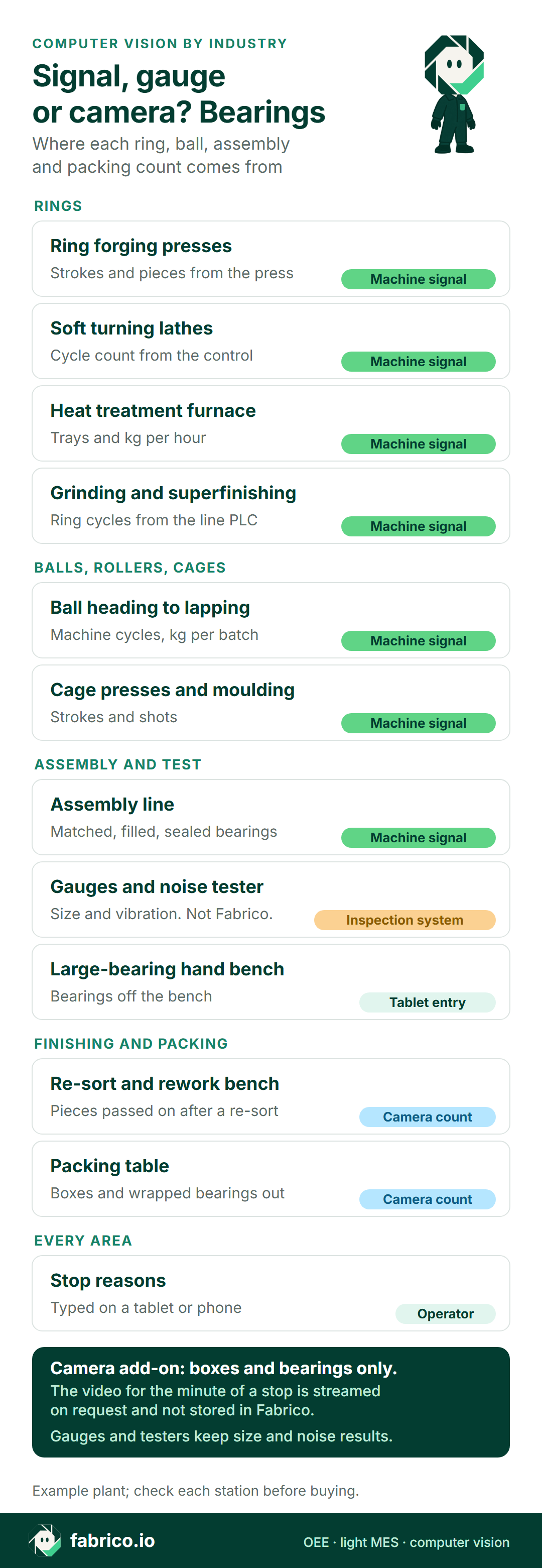
Text version of this infographic
- Rings: ring forging presses: machine signal, strokes and pieces from the press
- Rings: soft turning lathes: machine signal, cycle count from the control
- Rings: heat treatment furnace: machine signal, trays and kg per hour
- Rings: grinding and superfinishing: machine signal, ring cycles from the line PLC
- Balls, rollers, cages: ball heading to lapping: machine signal, machine cycles and kg per batch
- Balls, rollers, cages: cage presses and moulding: machine signal, strokes and shots
- Assembly and test: assembly line: machine signal, matched, filled and sealed bearings
- Assembly and test: gauges and noise tester: inspection system, size and vibration, not Fabrico
- Assembly and test: large-bearing hand bench: tablet entry, bearings off the bench
- Finishing and packing: re-sort and rework bench: camera count, pieces passed on after a re-sort
- Finishing and packing: packing table: camera count, boxes and wrapped bearings out
- Every area: the stop reason is typed by the operator on a tablet or phone
- Camera add-on: counts boxes and bearings only; the video for the minute of a stop is streamed on request and not stored in Fabrico
- Gauges and testers keep size and noise results
Explainer presented by Iris, Fabrico's AI-generated presenter: how an add-on camera counts output where a machine has no signal. Book a demo.
Plays from YouTube. Google may set cookies when you press play. Privacy policy.
Step 1: pick one table that boxes 6310 to 6316 bearings
Pick a table that boxes one family of sizes from one assembly line, so every bearing reaching it has passed one noise tester. Here that is packing table 2, fed by line 2 with deep groove bearings from 6310 to 6316, each boxed singly with a customer label. Most orders go out in single boxes; export orders are wrapped in VCI paper first.
Write down the counting unit: one boxed bearing leaving the table with its label. A carton of 20 is a shipping unit, not the counting unit. Write down the variants too. Clearance comes in groups, and ISO 5753-1 specifies values of radial internal clearance for radial contact groove ball bearings and five other bearing types. A C3 lot and a CN lot of one size are different SKUs with different labels, so the table boxes them apart and the count keeps them apart.
Then rule out the wrong stations for a first pilot:
- Line 1's small sizes go through an automatic packer that already counts its cycles.
- The large-bearing bench builds a few slewing rings a shift; a tap on a tablet counts those.
- The re-sort bench is a good second station, but its input is a held lot, so it has no clean referee yet.
If the long-term plan is a packing machine, the same baseline serves that decision too: measure manual packing before automating it.
Step 2: count one late shift by hand and price it
Before any bracket goes up, find out what the table loses today. For one late shift the team lead tallies boxes leaving the table each hour and notes when and why it stood; packers note boxes set aside. Step 6 shows how a tally drifts, but a tally is enough to price the problem.
Example numbers, no real plant. The late shift runs 14:00 to 22:00; without the half-hour break, 450 minutes remain planned. The best rate a crew has held on single boxes is 2 bearings a minute, an ideal of 30 seconds each.
Availability. The noise tester on line 2 stood for 35 minutes after a gauge alarm, and no bearings reached the table. A changeover between two customers' labels and boxes took 20 minutes. Run time was 395 of 450 minutes: 87.8%.
Performance. In 395 minutes the table could box 790 bearings at the ideal rate. It handled 710: 700 boxed and shipped, and 10 set aside. 710 of 790 is 89.9%.
Quality. The 10 set aside carried a CN label on a C3 lot and were caught at the carton check. 700 of 710 is 98.6%.
OEE. 87.8% x 89.9% x 98.6% = 77.8%. The quick check: 700 good bearings of the 900 that 450 minutes allow at 2 a minute is 77.8%.
In money. HTS Construction Plant Spares lists a 6310 2RS bearing at GBP 18.20 ex VAT for one piece: 50 mm bore, 110 mm outside diameter, 27 mm wide. A maker sells below a one-piece shop price, so this example takes a contribution margin of EUR 5 per boxed bearing across 6310 to 6316, which the plant replaces with its own SKU margin. For a margin band, NYU Stern's January 2026 margin data (accessed 16.11.2026) lists 105 US machinery firms at a gross margin of 37.47% and a pre-tax operating margin of 15.86%; at those margins, EUR 5 fits a bearing selling for about EUR 13 to EUR 32.
Price lost output only while orders wait. If the order book for these sizes is longer than the table can ship, the 190 bearings lost to stops and slow packing are EUR 950 of margin this shift: 70 from the tester wait (EUR 350), 40 from the changeover (EUR 200) and 80 from slow packing (EUR 400). If the table runs ahead of shipping, those minutes are spare capacity and the margin lost is zero. The cost of downtime per minute and throughput accounting follow the same rule.
Rework at crew time. The 10 mislabelled boxes are relabelled and ship with the next order, so they are not lost margin. At about 1.5 minutes a box, that is 15 crew minutes. Eurostat puts average hourly labour costs at EUR 34.90 in the EU in 2025, from EUR 12.00 in Bulgaria to EUR 56.80 in Luxembourg; at an example EUR 35 an hour, the relabel costs about EUR 8.75.
So the table is worth a pilot: EUR 950 a shift while orders wait, of which EUR 350 belongs to line 2, not to the packers.
Book a demo to see a packing table and the noise tester that feeds it counted on one shift timeline.
Step 3: agree the lens position with the packers and the works council
A camera over a packing table sees hands and faces as well as boxes. Tell the packers what the count is for before a bracket goes up, and agree it with the works council where one exists. In Germany, section 87 of the Works Constitution Act gives the works council co-determination over technical devices designed to monitor employee behaviour or performance, so that agreement comes first; elsewhere, check the local rule.
Put three things in writing: the lens looks at the outfeed edge, not at people; figures show by table and shift, never by name; and the shift record is used to fix losses, not to rate packers. Privacy masking on line cameras shows how to keep people out of the picture.
Step 4: mount the camera add-on over the outfeed, not the bearings
Mount the camera add-on above the edge where finished boxes slide onto the roller conveyor to cartoning. Count boxes, not bearings: a bare ring throws reflections, a bearing being wrapped sits in a packer's hands, and the box is the unit the shipping list counts.
Peer-reviewed work names the limits that matter; one co-author of the review below runs a machine-vision firm. A 2026 systematic review of industrial object counting in the journal Sensors finds: "In stacked workpiece boxes or crowded conveyor belts, severe inter-object occlusion or temporary occlusion caused by rapid movement leads to feature loss, making detectors identify multiple overlapping targets as a single one or miss detection completely." It adds that "illumination and dust at production sites are complex and changeable". It does not test a bearing table, so read it as a list of what to design out:
- Stacked boxes. Two small boxes leaving on top of each other can count as one. A guide rail keeps them in single file.
- Hands in view. Set the counting line past the point where packers square and label the boxes.
- Changing light. Windows, lamps switched at shift change and oil mist from the grinding hall change the picture; fix the light and clean the lens each shift.
- Side passes. A box handed over the side into a mixed-order carton never crosses the line. Make every box leave by the outfeed.
Mark the bracket position, so a knock during cleaning shows. Camera placement and lighting on a production line covers height and light in depth.
Step 5: take the referee count from the noise tester
A pilot needs a count that neither the camera nor the tally produced. At table 2 that is the noise tester on line 2, whose method is standardised: BSI publishes ISO 15242-1, the fundamentals of measuring vibration on rolling bearings, as BS ISO 15242-1:2015. The test result does not matter here; what matters is that every bearing passes the tester once and the tester or line PLC keeps a pass count.
Bearings wait on the buffer track between the tester and the table, so at each handover the team lead counts the track and the table tray, one more line in the OEE shift handover. The referee for a shift is then:
Referee = tester passes in the shift, plus bearings waiting at the start, minus bearings waiting at the end.
The same flow shows where the 35 tester minutes in Step 2 came from: a gauge alarm stopped the tester, the buffer ran empty and the table had nothing to box. The table books those minutes as starved, and the fix sits at the tester; starvation and blocking explains why. The tester's rejects stay out of the pilot: they reach the OEE of line 2 through its reject count.
Step 6: reconcile three counts and count each box once
With the camera add-on mounted and the referee set, run a shift with all three counts side by side. Example numbers: the tester passed 702 bearings, 18 waited at 14:00 and 26 at 22:00, so 694 boxes should have left the table.
| Count | Where it is taken | Boxes | Gap to referee | Named cause |
|---|---|---|---|---|
| Referee | Tester passes 702, plus 18 waiting at 14:00, minus 26 waiting at 22:00 | 694 | 0 | The yardstick |
| Camera add-on | Counting line at the outfeed edge | 686 | minus 8 | 5 pairs of boxes left stacked; 3 boxes went over the side |
| Hand tally | Team lead's hourly sheet | 706 | plus 12 | 12 relabelled boxes tallied a second time |
| Shipping list | ERP at shift end | 694 | 0 | Matches, so the referee is sound |
- The camera add-on was 8 short. Five times two boxes left stacked, and three went over the side into a mixed-order carton. A guide rail and filling mixed cartons at the outfeed end close both.
- The tally was 12 high. Twelve C3 boxes with a CN label were relabelled at the hold shelf and tallied again on their way into the carton. A relabelled box counts once, is not good first time and never returns as new output; quality holds and OEE covers holds and releases.
Compare by hour as well as by shift, so that gaps which cancel out over a shift still show. When the camera count and the operator log disagree covers which record wins. These are example numbers. This page quotes no accuracy figure for any camera system; the comparison gives the plant its own.
Step 7: give each size and pack variant its own ideal rate
The 40 slow minutes in the baseline were not a slow crew. From 19:00 the table boxed an export order wrapped in VCI paper, with no ideal rate of its own, so against 2 a minute the wrap read as slow packing.
Set the ideal per size and pack variant from the best rate a crew has held: a 6316 is heavier to box than a 6310, and a VCI wrap adds a step. Give the customer changeover its own loss code too, as a size change has on a grinder. The variant comes from the order or the packer's tablet, because a wrapped bearing in a box looks the same from above as a plain one. Then re-read the baseline: the slow minutes move from the crew to the missing rate, as the cycle time deficit explains for machines.
Step 8: what counts as proof, and when to stop
Write the proof rule before the first comparison shift, not after the numbers arrive. It has four parts:
- A tolerance between the camera add-on count and the referee, set by the plant, for example the gap it already accepts between lot cards and the shipping list.
- A named cause in the shift record for each gap above that tolerance.
- A sample that covers every size from 6310 to 6316, both clearance groups and both pack types, with at least 4,000 boxes in all.
- The team lead accepting the count, with stop times on the timeline matching the team lead's notes.
How accurate a camera part count is explains why the sample must include the busiest part of the shift. Write the stop rules just as early:
| What the comparison shows | What the plant does next |
|---|---|
| Gaps within tolerance, each with a named cause | Passed: run the table on the camera add-on count. |
| A gap with no named cause | Stop counting, find the cause, then restart the sample. |
| The camera add-on was knocked or re-aimed | Restart the sample from the new position. |
| Boxes cannot be made to leave in single file | Stop here; a photo eye on a single-file chute may count better. |
| Packers cannot be kept out of the view | Stop and agree the view again with packers and works council. |
| Orders never wait for this table | Stop. The money sits at line 2 or elsewhere, and a tally is enough here. |
After a pass, the re-sort bench is the natural next station: it loses hours no machine records, and the referee method carries over once the held quantity sits on the lot card. The large-bearing bench usually stays on a tablet entry, and where boxes already run in single file, counting output with photo eyes may be the cheaper option.
Questions for a camera or OEE vendor before the pilot
Ask every vendor on the shortlist the same seven questions, and check each answer against the first comparison shift.
| Question | What a good answer shows |
|---|---|
| How is the noise tester's pass count read? | Through the line PLC or the tester's interface, named, with its reset at shift change. |
| Can the count split by size, clearance group and pack? | 6310 to 6316, CN and C3, single box and VCI wrap as separate SKUs with their own ideal rates. |
| What exactly does the camera count at a packing table? | Boxes crossing one line at the outfeed, not hands and not bare rings. |
| How do stacked boxes and side passes show up? | As gaps against the referee in the comparison, never smoothed away. |
| How does a relabelled box count? | Once in the total, as a quality loss, and never again as new output. |
| Who sees the camera view, and from where? | A data flow on paper that the works council and IT can review. |
| Can the shift record leave the system? | An export to the ERP or a spreadsheet, to compare with the shipping list. |
A vendor who will not compare its count with the plant's own referee is asking for trust instead of proof.
What the Fabrico camera add-on does in this pilot
Fabrico is cloud OEE software with light MES functions on top. In this pilot it does four jobs:
- At packing table 2 the camera add-on counts boxes leaving the outfeed and puts them on the shift timeline, so the hour the table stood shows as that hour.
- On line 2 Fabrico takes run state and counts from the line PLC, including the tester's pass count where the line provides it, so the referee sits on the same timeline.
- Per size and pack variant the plant sets the ideal rate, and Fabrico prices each loss from the plant's own SKU price or margin.
- At the table the packers or the team lead add the stop reason on a tablet or phone. Where the camera add-on covers the table, the video for the minute of a stop can be opened from the shift timeline, streamed on request and not stored in Fabrico.
Reports export to Excel, and Fabrico also has a REST API and webhooks.
On Fabrico's roadmap, not live today: a camera add-on that offers a probable cause when a packing table stands.
Outside Fabrico: Grinder gauging, surface and burn checks, the noise and vibration result, hardness testing, laser marking and lot traceability stay with their own systems and the ERP.
For the product itself, see computer vision for OEE. OEE with computer vision walks through turning a camera add-on count into OEE, and the OEE software guide covers the wider choice.
Bearing pilot questions from plant managers
Why start a bearing pilot at the packing table and not at a grinder?
Grinders, furnaces and assembly lines already report through their controls, so a camera adds nothing there. The packing table boxes medium bearings by hand with no count, and the noise tester just upstream gives it a referee.
Can a counting camera check raceways, shields or bearing noise?
No. Size is held by gauges on and after the grinders, raceway surfaces by surface inspection and noise by the vibration tester. A counting camera only says how many boxes left the table and when.
What if the camera add-on count and the noise tester count disagree?
Check the buffer count first, then look for stacked boxes, boxes passed over the side and boxes counted twice. A gap with no named cause stops the pilot until it is found.
How big should the comparison sample be?
Big enough to cover every size, clearance group and pack type the table handles. This plan asks for at least 4,000 boxes, compared by hour as well as by shift.
Does a relabelled box count as good output?
No. It counts once in the total and as a quality loss, the relabel is priced at crew time, and it never returns as new output when it ships.
Want to see a bearing packing table and the noise tester that feeds it on one shift timeline? Book a demo.
Related articles













Real Fabrico tiles, sample data.