


 Login
 Blog

Computer Vision Sporting Goods Manufacturing: Find Which Fitness Model Slows the Cell

In short: In a fitness equipment plant, a computer vision camera add-on counts units at assembly cells, powder line stations and packing, where no machine signal exists.
Key takeaways
- Each variant lands on its own station: frame colour at the powder booth, pad colour at upholstery, model and class at the assembly cell.
- A cell building three strength machines needs three ideal times; one 40 minute standard made the leg press look slow in the example shift.
- Benders, weld robots and the cure oven give a machine signal; manual weld bays, assembly cells and crating need a camera add-on count.
- Weld checks, final checks and ISO 20957 type tests stay with the quality team and the test lab.
- In the example, 59% of the lost money sat on one gym chain order, over half of it waiting for chain-colour frames.
Weld quality, stack travel and ISO 20957 type tests are checked by the quality team and the test lab; the camera only counts.
Sporting goods is a wide trade; the segment here is strength training equipment: selectorised machines with weight stacks, plate-loaded machines and benches, built in EU or North American plants for gyms and homes, under the ISO 20957 safety standards. Per Standards Norway's page for NS-EN ISO 20957-1:2024, classes S and I cover equipment for "training areas of organizations such as sport associations, educational establishments, hotels, sport halls, clubs, rehabilitation centres and studios", while class H is "equipment for domestic use". A plant can build a home chest press in the morning and a leg press for a gym chain in the afternoon, in the same cell.
The variant-by-station matrix for a strength equipment plant
Start with where each variant lands, and with who places the orders. EuropeActive's release on its 2026 European market report finds that "The number of fitness clubs increased by 3 % to 67.515 primarily driven by the club expansion of European chain operators." A chain fit-out can mean dozens of stations in one frame and pad colour, next to home orders in stock colours. Each variant lands on one or two stations.
| What changes | Station that absorbs it | What changes there | Count from |
|---|---|---|---|
| Model and frame | Tube benders, robot weld cells | Program and weld fixture | Machine signal |
| Short runs and frame repairs | Manual weld bays | Fixture swap per frame | Camera add-on |
| Frame colour: chain or stock | Powder booth | Colour change between runs | Camera add-on at unload |
| Pad colour | Upholstery benches | Vinyl and thread per order | Camera add-on |
| Model and stack size | Assembly cells | Ideal time per station | Camera add-on |
| Class S or class H | Assembly cell, final check | Parts, labels, check plan | Quality records |
| Accuracy class A, B or C | Treadmill test | Test plan per class | Test rig or quality records |
Class is the row a costing sheet forgets. ISO 20957-2:2024, as listed by the Estonian Centre for Standardisation and Accreditation, applies to "stationary strength training equipment with stacked weight resistance or alternative means of resistance" in classes H, S and I, and adds: "Accuracy classes are not applicable to this type of stationary training equipment as accuracy classes do not affect the safety of this equipment." Treadmills differ: ISO 20957-6:2021 covers treadmills "with the classes S, H and I and classes A, B and C regarding accuracy". Where class S and class H versions of one machine differ in parts, labels or check plan, the class belongs in the model code, not in a comment field.
Colour is the row that hurts. The frame colour is decided at the powder booth, and the assembly cell feels it when painted frames arrive late. In a Products Finishing column on colour change time in a powder booth, a coater with a cartridge reclaim booth reports 30 to 45 minutes to get from one reclaim colour to another, and the consultant Rodger Talbert answers that a booth, guns and feed centre built for it allow "you to go from reclaim to reclaim in less than 15 minutes". Either way, a chain colour slotted into a day of stock black costs booth minutes twice, in and out.
Pad colour lands on the upholstery benches, which have no machine signal: the same count gap as seat covers on the computer vision for furniture manufacturing page.
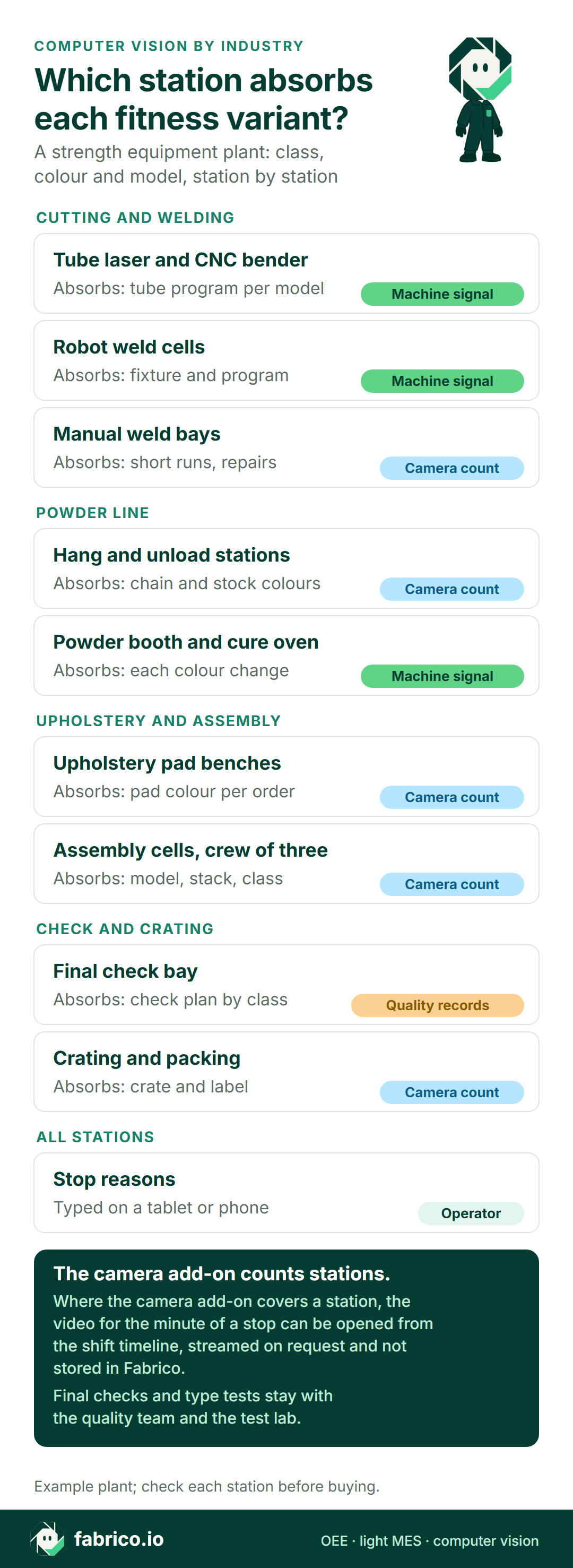
Text version of this infographic
- Tube laser and CNC bender: absorbs the tube program per model. Count: machine signal.
- Robot weld cells: absorbs the fixture and program per frame. Count: machine signal.
- Manual weld bays: absorbs short runs and repairs. Count: camera add-on.
- Powder line hang and unload: absorbs chain and stock colours. Count: camera add-on.
- Powder booth and cure oven: absorbs each colour change. Count: machine signal.
- Upholstery pad benches: absorbs pad colour per order. Count: camera add-on.
- Assembly cells, crew of three: absorbs model, stack and class S or H. Count: camera add-on.
- Final check bay: absorbs the check plan by class. Count: quality records.
- Crating and packing: absorbs crate and label per order. Count: camera add-on.
- All stations: stop reasons typed by the operator on a tablet or phone.
- The camera add-on counts stations. Where the camera add-on covers a station, the video for the minute of a stop can be opened from the shift timeline, streamed on request and not stored in Fabrico.
- Final checks and type tests stay with the quality team and the test lab.
- Example plant; check each station before buying.
Explainer presented by Iris, Fabrico's AI-generated presenter: how an add-on camera counts output where a machine has no signal. Book a demo.
Plays from YouTube. Google may set cookies when you press play. Privacy policy.
Leg press, chest press, home press: one assembly cell, three ideal times
Take assembly cell A2, a crew of three, and three models: CH, a class H chest press for home use with a 70 kg stack; CP, a class S chest press in a gym chain's frame and pad colours with a 90 kg stack; and LP, a class S leg press with a 110 kg stack. Example ideal times are 30, 40 and 50 cell minutes a station; a plant sets them from its best demonstrated runs, as the guide on ideal cycle time for OEE explains.
The cell ran 414 minutes and the camera add-on counted 10 finished stations rolling out to the final check bay: 4 CH, 4 CP and 2 LP. One CP came back from final check, so 9 were good. The same shift, scored four ways:
| Ideal time used | Cell OEE | CH run reads | LP run reads |
|---|---|---|---|
| Per model: 30, 40, 50 min | 70.8% | 92.3% | 92.6% |
| One 40 min standard | 75.0% | 123.1% | 74.1% |
| One 30 min home rate | 56.3% | 92.3% | 55.6% |
| One 50 min leg press rate | 93.8% | 153.8% | 92.6% |
The cell total moves more than 37 points with the costing sheet, but the run columns matter more. Under the 40 minute standard the home press run reads 123.1% and the leg press run 74.1%, so the team lead goes to look at leg presses. Per model the two runs are level, 92.3% and 92.6%. A run reading above 100% means the standard is wrong, not that the cell found a shortcut.
Only per-model ideals put slow minutes on the model that lost them. A single standard is often a demand rate from the order book, not an ideal. The pages on heijunka versus mixed-model production and high-mix, low-volume manufacturing cover sequencing.
Which stations give a machine signal, and which need a camera add-on count
| Station | Count from | Unit counted |
|---|---|---|
| Tube laser cutter | Machine controller | Cut tubes |
| CNC tube bender | Machine controller | Bend programs run |
| Robot weld cells | Robot controller | Weld cycles per fixture |
| Manual weld bays | Camera add-on | Frames off the fixture |
| Powder line hang and unload | Camera add-on | Frames on and off the hooks |
| Booth and cure oven | Line or oven controller | Conveyor run time |
| Upholstery benches | Camera add-on | Pads onto the rack |
| Assembly cells | Camera add-on | Stations to final check |
| Final check bay | Quality records | Passed and returned |
| Crating | Camera add-on | Crates closed |
Robot cells are the easy case: the controller knows each cycle, as the page on OEE for robotic welding cells shows, though a weld cycle is a frame only once cycles per frame are written down for each fixture. On the powder line a hanger carries one large frame or several small brackets, so the unload count needs a parts-per-hanger figure for each model. The conveyor knows it ran, not what hung on it.
The assembly cell has no PLC. Three people build a station from a painted frame, a pad set, a stack kit and a cable kit, and the count lives on a tally sheet. Here the camera add-on counts the finished station as it rolls onto the final check bay. The model comes from the order the team lead starts on the tablet. The camera add-on for OEE and MES page shows the set-up, and the same frame, paint and assembly chain runs through the computer vision for bicycle and motorcycle manufacturing page.
One early shift on assembly cell A2, priced per model
The shift runs 06:00 to 14:30 with two 15 minute breaks, so 480 minutes are planned. Four stops took 66 minutes: a cable kit short during the CH run (8), the change from CH to CP fixtures and hardware (12), painted CP frames late from the powder line, which was still on stock black (30), and the change to LP (16). That leaves 414 run minutes: 130 on CH, 176 on CP and 108 on LP.
The 10 counted stations earn 4 x 30 + 4 x 40 + 2 x 50 = 120 + 160 + 100 = 380 ideal minutes, so 34 minutes were slow (10 on CH, 16 on CP, 8 on LP). At final check one CP went back for a cable routed outside its pulley guard, 40 minutes of quality loss, leaving 9 good stations worth 340 ideal minutes.
Availability is 414 / 480 = 86.25%, performance 380 / 414 = 91.79%, quality 340 / 380 = 89.47%. OEE is 86.25% x 91.79% x 89.47% = 70.83%, the same as 340 / 480. The bars below add up: 340 + 66 + 34 + 40 = 480.
Now the money. Maker price lists are not used as sources, so the prices are example inputs: ex-works EUR 1,440 for CH, EUR 3,200 for CP and EUR 5,000 for LP, each at a 25% contribution before fixed costs. That sits between the two margins in NYU Stern's margin table for US Recreation companies, 39.79% gross and 9.69% pre-tax operating ("Data used is as of January 2026"). That is EUR 360, 800 and 1,250 a station, or EUR 12, 20 and 25 per ideal cell minute.
| Model | Stop + slow min | EUR per ideal min | Lost while orders wait |
|---|---|---|---|
| CH home press, class H | 8 + 10 = 18 | 12 | EUR 216 |
| CP chest press, chain colours | 42 + 16 = 58 | 20 | EUR 1,160 |
| LP leg press, class S | 16 + 8 = 24 | 25 | EUR 600 |
| Cell A2 | 100 | EUR 1,976 |
The chain chest press carries EUR 1,160 of the EUR 1,976 (59%), and EUR 600 of it came from the colour itself: 30 minutes waiting for frames while the booth was still on stock black. The powder line absorbed the variant; the cell paid for it.
These minutes cost margin only while orders wait. With a short order book they are crew time: at Eurostat's 2025 estimate of hourly labour costs, EUR 34.9 an hour across the EU, 100 cell minutes for a crew of three are 5 hours, or EUR 174.50.
The returned chest press is rework. It is re-routed next shift and ships, so it costs crew time, not margin: three people for 20 minutes, 1 hour or EUR 34.90.
If the cell looked like this on an example 21 early shifts a month in which orders wait, that is 21 x EUR 1,976 = EUR 41,496: an example, not a forecast. Fabrico prices losses from each SKU's price or margin, the idea behind pricing lost output by SKU value.
Want to see an assembly cell scored by model, with losses priced per station? Book a demo.
Counting rules that keep the colour cost on the powder line
The money table points upstream. Five counting rules keep the colour cost visible:
- Book a colour change as a stop on the booth, with both colours named, so a chain colour has a cost.
- Book the cell's frame wait as its own reason, frames late from powder, with the order named. A short booth change can still cost the cell 30 minutes when frames queue behind it.
- Count frames at unload, not at hang. A frame stripped and sent back through the line counts once, at its last unload.
- Write a parts-per-hanger figure for each model, so 40 hangers of small brackets are not read as 40 frames.
- Treat crating as the shipping truth. Cell good minus crated equals stations at final check, in rework or waiting for a crate. If it does not close, a count is wrong.
Sequencing is the cure: group chain colours into blocks, as SKU changeover sequence optimization explains, and shorten the change with a changeover checklist. Before buying a fast colour-change booth, Talbert advises doing the payback maths; the priced wait minutes at the cell are its production-time side. For what a tally sheet misses, see manual versus automatic downtime tracking.
Ball plants: the same variant matrix on other stations
The matrix carries over to footballs on other stations. Per FIFA's plant visit report on how footballs are made, "Around half of the manufacturers of FIFA certified footballs are based in Sialkot, Pakistan." Atkin and co-authors' study of Sialkot ball producers describes match, training and promotional grades, with brand, team or advertiser logos. Size sits on the cutting dies and bonding moulds, colourway on the screen printing tables, and build route on stitching or bonding: FIFA lists hand, machine and hybrid stitching and thermal bonding, where panels "are placed inside a mould that is heated by a machine to press and glue the panels together."
Two rules change the count. Pakistan's Trade Development Authority, in its sports goods market report, describes a hold before packing in which "the balls are inflated for 24 hours for quality check", so a leak found on Wednesday belongs to Tuesday's production and every tray needs line, shift and model on it. And certification is per model: FIFA's football testing manual requires that "Identical samples of the model to be tested shall be sent to the test institute." There the camera add-on suits shared print and packing tables, counting balls into the carton.
What a camera finds hard in a three-person cell
Vision research on counting repeated human work names the problems. Hu and co-authors at ShanghaiTech University built a dataset for counting repetitive actions in video (CVPR 2022) because earlier tests lacked "more realistic situations where action interruption or action inconsistencies occur in the video." In their own failure cases, one result went wrong "because there is more than one person moving in the video."
A three-person cell has all three: people walk around the frame, stop mid-build to fetch a cable kit, and the work changes by model. So the count is the finished station crossing a line onto the final check bay, not the assembly motions. Frame the outfeed, keep the next cell out of view, and test the angle under the hall lights, since gloss powder coat and chrome guide rods reflect. How accurate camera OEE counts are covers what to compare a camera count against. No accuracy figure is claimed here; the plant proves it against final check and crating counts.
Inspection and type testing stay with quality and the test lab
A station can be counted and still fail. Weld checks belong to the weld inspector and the quality team, cable routing, stack travel and labels to the final check bay, and ISO 20957 type testing to the test lab the plant uses. Their reject counts, entered against the cell and shift, feed the quality part of OEE. A returned station is rework rather than scrap, the split that scrap versus rework explains. The camera add-on counts stations; it does not judge them.
Five steps for a strength equipment plant this quarter
- Write an ideal time per model per cell, class S and class H apart, from the best demonstrated runs.
- Pick one assembly cell and the powder line unload that feeds it.
- Write a parts-per-hanger figure for each model and count frames at unload.
- Book colour changes as booth stops and frame waits as cell stops, with the colour and the order named, for one full chain order.
- Price lost minutes per model, at margin only while orders wait and at crew time otherwise. Then block chain colours on the booth plan.
Questions for any vendor, and the works council point
- Can each cell hold a different ideal time per model, so CH, CP and LP are scored apart?
- Can class S and class H versions of one machine carry separate model codes, ideal times and counts?
- How does the camera count a finished station at the outfeed when three people move around it?
- Can powder line counts be turned into frames with a parts-per-hanger figure for each model?
- Can a colour change be booked on the booth and the resulting frame wait on the cell, both with the order named?
- Is a station returned from final check recorded as rework against the cell and shift that built it, not as a second unit?
- Can losses be priced from each model's price or margin, and switched to crew time when orders do not wait?
- How do counts reach the ERP, and in which formats?
Before a camera goes up, the works council or crew representatives should hear what is counted (finished stations crossing the outfeed line), who sees the counts and how disputes are settled. The camera add-on counts output at a station, never a person: aim it at the outfeed, not at the crew. GDPR and production line cameras covers the data side.
Where Fabrico fits in a strength equipment plant
Fabrico is cloud OEE and light MES software. It reads the bender, weld robot and cure oven signals, and the camera add-on counts output at the manual stations, from weld bays to crating. Stop reasons come from the team lead's tablet or phone. OEE, downtime and losses sit by station and shift, with an ideal time per model and losses priced from each SKU's price or margin. The OEE with computer vision guide explains the counting method.
Where the camera add-on covers a station, the video for the minute of a stop can be opened from the shift timeline, streamed on request and not stored in Fabrico.
On Fabrico's roadmap, not live today: the camera add-on finding a stop by itself and proposing a reason.
Inspection stays with the quality team and the test lab. The colour and order sequence lives in the ERP, APS or spreadsheet; Fabrico supplies the per-model rates and counts it needs (see integrating MES and OEE with ERP). Reports export to Excel, and Fabrico also has a REST API and webhooks. Plants weighing a lighter system can read the light MES overview and the OEE and MES solution overview.
What fitness equipment makers ask next
Can a camera tell a club chest press from a home one?
It does not need to. The camera add-on counts finished stations at the cell outfeed; the model and class come from the order started on the tablet.
How are frames counted on a powder line that hangs several parts on one hanger?
At the unload station, with a parts-per-hanger figure for each model. A frame sent back through the line counts once, at its last unload.
Does the camera add-on check welds, cable routing or stack travel?
No. Weld checks stay with the weld inspector and the quality team, cable routing, stack travel and labels with the final check bay, and ISO 20957 type tests with the test lab the plant uses.
Do treadmills fit the same matrix?
Yes, with one more row: ISO 20957-6 gives treadmills accuracy classes A, B and C on top of classes S, H and I, so the test plan becomes a variant.
What changes when a gym chain order backs up?
Lost cell minutes then cost margin instead of crew time, and per-model ideals matter more: in the example, a club leg press minute is worth about twice a home press minute.
Want the powder line and the assembly cells it feeds on one OEE view? Book a demo.
Related articles














Real Fabrico tiles, sample data.