


 Login
 Blog
Computer Vision for BBQ Grill Manufacturing: See Which Model Slows Boxing

In short:
- Gas, pellet and wood stove models share the metal lines, then load different hand benches that count nothing.
- Give each model its own ideal time at each station; one figure per line hides losses whenever the model mix changes.
- The Fabrico camera add-on counts grills, stoves and cartons by model where no machine keeps a count.
- Leak, ignition and emissions tests stay with rigs and labs, welds and finish with inspection: Fabrico does no inspection.
Computer vision in BBQ grill manufacturing counts grills and stoves by model at hand stations, so each model is judged against its own ideal time.
Counting is not inspection: weld, finish, leak and emissions checks stay with inspectors, test rigs and accredited labs.
In scope: gas, charcoal and pellet grills, smokers, wood and pellet stoves, and fireplace inserts, followed through one example plant. Indoor cookers sit in computer vision for appliance manufacturing, grate and stove castings in computer vision for foundries, and general laser and weld bays in computer vision for metal fabrication.
Grill and stove variants by station: where each model change lands
The matrix sets the example plant's models against its stations, with example minutes per unit at the hand stations. The metal lines count by program; the benches count nothing unless someone writes it down.
| Model | Sheet metal and weld | Burner and valve bench | Leak check | Pellet or stove bench | Boxing or crating |
|---|---|---|---|---|---|
| Three-burner LP gas grill | Base program | 3 valves: 9 min | LP fixture | None | 4 min, regulator bag |
| Four-burner LP grill, side burner | Wider firebox | 5 valves: 14 min | LP fixture | None | 5 min |
| Four-burner natural gas grill | As four-burner LP | 4 valves: 12 min | Natural gas fixture | None | 5 min, own print |
| Pellet grill | Hopper, chamber | None | None | Auger, controller: 16 min | 7.5 min |
| Wood stove A, non-catalytic | Plate body | None | None | Brick set A, baffle, glass: 40 min | 8 min crate, label |
| Wood stove B, catalytic | Catalyst housing | None | None | Catalyst, brick set B: 55 min | 8 min crate, label |
Read it down a column. The valve bench sees 9 to 14 minutes a grill, the stove bench 40 to 55 a stove and boxing 4 to 8 a unit. The leak check absorbs the fuel, the stove bench the certified model and boxing the market; none has one natural pace. So count where the model's work at a station ends, by model: the running model is set at each change, and each unit counted is measured against that model's ideal time.
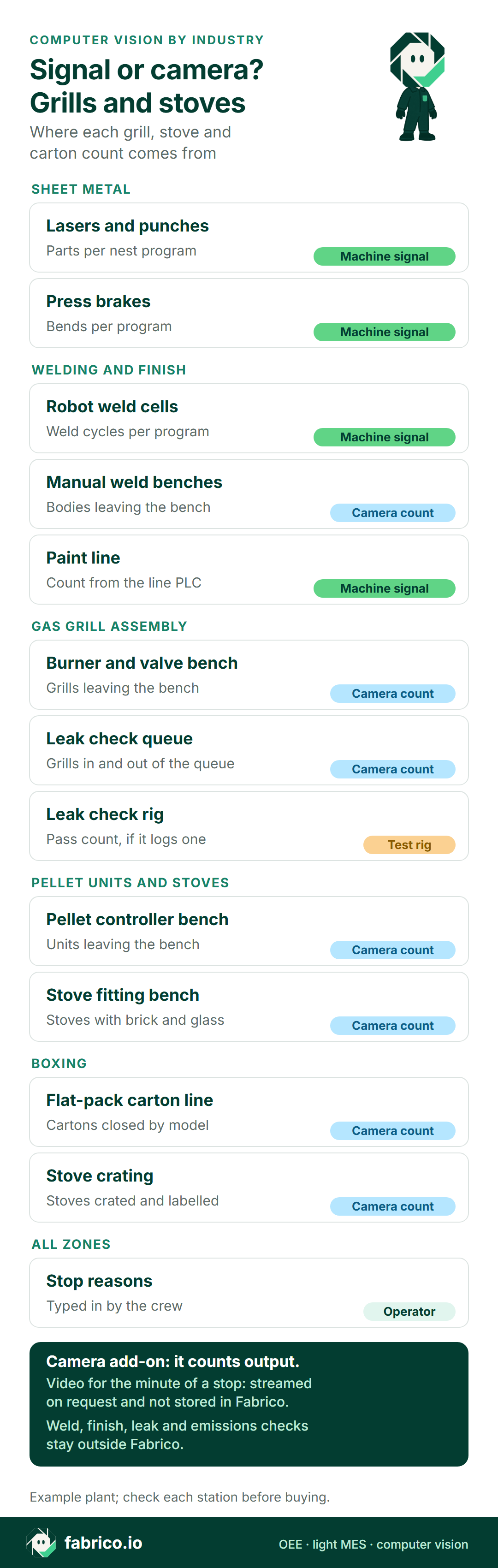
Text version of this infographic
- Sheet metal: Lasers and punches: machine signal, Parts per nest program
- Sheet metal: Press brakes: machine signal, Bends per program
- Welding and finish: Robot weld cells: machine signal, Weld cycles per program
- Welding and finish: Manual weld benches: camera count, Bodies leaving the bench
- Welding and finish: Paint line: machine signal, Count from the line PLC
- Gas grill assembly: Burner and valve bench: camera count, Grills leaving the bench
- Gas grill assembly: Leak check queue: camera count, Grills in and out of the queue
- Gas grill assembly: Leak check rig: test rig, Pass count, if it logs one
- Pellet units and stoves: Pellet controller bench: camera count, Units leaving the bench
- Pellet units and stoves: Stove fitting bench: camera count, Stoves with brick and glass
- Boxing: Flat-pack carton line: camera count, Cartons closed by model
- Boxing: Stove crating: camera count, Stoves crated and labelled
- All zones: Stop reasons: operator, Typed in by the crew
- Camera add-on: it counts output.
- Video for the minute of a stop: streamed on request and not stored in Fabrico.
- Weld, finish, leak and emissions checks stay outside Fabrico.
Explainer presented by Iris, Fabrico's AI-generated presenter: how an add-on camera counts output where a machine has no signal. Book a demo.
Plays from YouTube. Google may set cookies when you press play. Privacy policy.
One flat boxing ideal time makes bigger grill cartons look slow
Suppose the plant set its boxing ideal at 4 minutes a carton when the line boxed mostly three-burner grills, so the peak plan expects 85 cartons from 340 earned minutes a shift. In these example shifts the packers earn those 340 minutes at each model's real ideal: 4 minutes for a three-burner carton, 7.5 for a pellet grill, 5 for a four-burner with side burner.
| Example shift | Three-burner | Pellet | Four-burner with side burner | Earned minutes | Cartons | Short of the plan of 85 |
|---|---|---|---|---|---|---|
| February | 60 | 0 | 20 | 240 + 0 + 100 = 340 | 80 | 5 |
| April | 40 | 8 | 24 | 160 + 60 + 120 = 340 | 72 | 13 |
| May | 25 | 16 | 24 | 100 + 120 + 120 = 340 | 65 | 20 |
Nobody packed slower in May; the cartons got bigger. With the flat 4 minutes, the May shift reports 65 x 4 = 260 earned minutes in 380 running minutes, a performance of 68.4%, and 120 slow minutes to explain. At the real ideal times performance is 340 / 380 = 89.5%, and the slow loss is 40 minutes with a cause the crew can name.
The planning error costs more: five late shifts a week, each 20 cartons short, are 100 grills a week the plan counted on. HPBA's 2023 State of the Barbecue Industry names the Saturday before Memorial Day as one of the busiest days of the year for buying new grills, so stock for US stores must be boxed before late May. A gap found in May can only be bought back with extra shifts; overtime and weekend shifts as a capacity diagnostic and nameplate capacity versus real capacity show how to size it.
Set the ideal per model at each station where the work differs, check it at the bench, and re-check it before each season; ideal cycle time explains why one blanket value distorts the whole OEE figure.
Burners, valves and side burners: the gas grill bench
Fitters drop burner tubes into the firebox, bolt the valve manifold behind the control panel, seat each valve in its burner, wire the igniter and add the knobs. A fourth burner and side burner add two valves, a gas line and a shelf: 9 minutes becomes 14.
No controller counts this work; see measuring OEE on manual and hybrid assembly lines. A camera add-on at the bench exit counts grills leaving, and the model set for the bench gives each its 9, 12 or 14 minutes. Without the model, a morning of side-burner grills reads as a slow bench.
Pellet grills go to their own bench for the hopper, auger, hot rod igniter, fan and controller, then a function check. If the check logs a result per unit, read it; if not, the camera add-on counts units leaving.
Natural gas or LP: fuel changes at the leak rig, and no double count
A natural gas grill and an LP grill of one size share fireboxes and carts, then part ways on gas parts, the leak check and the carton. Under the US and Canadian outdoor grill standard, ANSI Z21.58/CSA 1.6, an LP unit for a cylinder supply must be marked "CAUTION: Use only the gas pressure regulator supplied with this appliance", according to Intertek's update notice on the 2015 edition. The natural gas version takes a different hose kit and no cylinder regulator, so the bag station holds two kits that look alike.
The carton changes too. In Great Britain, the assimilated text of the Gas Appliances Regulation (EU) 2016/426 says "The warning notices on the appliance and its packaging shall clearly state the type of gas to be used, the gas supply pressure, the appliance category" and any restrictions on use. A grill boxed for another gas or market is a different product at boxing.
Before boxing, the gas circuit is checked on a pressure decay rig with a fixture per model, or with a soap test that logs nothing. When the order book switches fuel, the rig changes fixture, and boxing feels that changeover as a wait. A camera add-on aimed at the queue lane counts grills into and out of the queue, by model. If 18 LP fireboxes sit there at 19:10 while the rig runs a natural gas batch, the boxing stop reason names the leak check, not the packers. SKU changeover sequence optimization shows how to run fuels in longer blocks, and kanban versus CONWIP how to cap the fireboxes waiting at the rig.
Book a fuel mix-up once: a carton the audit finds holding a natural gas hose kit instead of the LP regulator leaves the good count at boxing, where the mistake was made, not also at the rig.
Wood stoves are certified model by model, so the fitting bench counts by model
The EPA's economic analysis of the US wood heater rule describes stove production plainly: "Generally, the manufacturing process entails the assembly of several prefabricated metal components", with cast iron, heat-proof glass and refractory brick among the major inputs.
In the US, the model is the unit of certification. 40 CFR 60.531 defines a model line as "all wood heaters offered for sale by a single manufacturer that are similar in all material respects that would affect emissions". Under 60.533, a change of more than a quarter inch (0.64 cm) in any linear dimension of the firebox, baffles, refractory, catalyst, flue exit or door gaskets "is presumed to affect particulate matter and carbon monoxide emissions and efficiency", and a refractory or gasket material change is presumed to affect particulates. For pellet stoves the list adds the feed rate, the auger motor and "the angle of the auger to the firebox".
So brick sets A and B are not spares for each other: when model B's refractory runs short, the bench waits, with its own reason, and the count stays by model.
Each certified model line runs a quality assurance plan with "regular (at least annual) unannounced audits" by a third-party certifier, and each stove carries a permanent label that shows, under 60.536, the "Month and year of manufacture of the individual unit" and a serial number. A reprinted label makes a printer's count drift, so the camera add-on counts stoves at the bench exit and the label stays the traceability record; see lot versus serial tracking.
Heaters made or sold for use in the US from May 15, 2020 must not exceed particulate emissions of "a weighted average of 2.0 g/hr", or 2.5 g/hr under the cord wood test option, shown by certification tests. In the EU, solid fuel stoves fall under ecodesign Regulation (EU) 2015/1185 and the energy label under 2015/1186; the European Commission's overview of local space heater rules says the ecodesign requirements are "mandatory from 1 January 2022 for solid fuel local space heaters". In the example plant, a stove sold in both markets is set up as two products, each with its own label and counts.
Sheet metal, welding and enamel already count every variant
Lasers, punches and press brakes know their program and part count, so connect run state and counter and book a program change as setup. First-part approval after a brake tool change is a planned check, as in OEE for press brakes and first-off approval after a changeover.
Steel stove bodies are welded from plate into the firebox itself, with secondary air channels, a flue collar and a door frame that must sit flat on its gasket. Robot cells count weld cycles per program; see OEE for robotic welding cells. A manual weld bench counts nothing, so a camera add-on at its exit counts bodies by model. High-heat paint, powder coat on cart panels and porcelain enamel on grates and kettle bowls run on finishing lines whose PLCs keep their own counts.
What the camera counts by model, and what stays with inspection
Research on vision in assembly is frank about unseen variants. Büsch and colleagues at Hamburg University of Technology trained a camera to recognise hand tools; on new instances of known tools, the wrench class "yielded a significantly worse sensitivity (56%)", with other tools detected in its place. Their study (Sensors, 2023; no conflict of interest declared) recognises tools and steps, not finished units, and gives no counting accuracy for a plant like this one.
So this page keeps the camera to a narrower job than reading a half-built grill: finished units crossing a fixed exit, with the model taken from the order running there, not from the image. Glare from enamel and forklifts at the boxing exit still call for a careful mount, and the plant should check the count by hand against its own cartons before trusting it.
Gas tightness stays with the leak rig, burner lighting with the ignition check, welds and finish with inspection, and stove emissions with an accredited lab; inspection versus testing explains the split.
Agency packers hired only for the peak get the camera briefing at their first-day induction. Where a works council exists, settle what is counted before any camera is mounted. Aim at the unit as it leaves, never at a fitter's hands, and report by line and shift; see production line cameras without surveillance. The camera add-on counts grills, stoves and cartons, not people.
Worked example: one May late shift with three models, priced by model
Example numbers, no real plant. Three packers box three models on the late shift, 14:00 to 22:00 less a 30-minute break at 18:30: 450 planned minutes. A camera add-on counts closed cartons, and the team lead types stop reasons on a tablet. From 14:00 to 15:40 they pack 25 three-burner cartons at 4 minutes; a 15-minute change leads to 16 pellet cartons at 7.5 minutes until 17:55; a 10-minute change leads to 24 four-burner cartons at 5 minutes, with a 45-minute wait from 19:10 for LP fireboxes held at the leak check.
Availability. Model changes took 25 minutes and the leak check wait 45, leaving 380 running minutes: 380 / 450 = 84.4%.
Performance. The 65 counted cartons earned 25 x 4 + 16 x 7.5 + 24 x 5 = 340 minutes: 340 / 380 = 89.5%. The 40 slow minutes sit in the four-burner block, where packers counted side-burner bolts from bulk bins.
Quality. The outgoing audit opened 4 four-burner cartons holding a natural gas hose kit, left at the bag station from the day shift's order, instead of the LP regulator. Good cartons: 61 of 65, worth 320 of 340 earned minutes, or 94.1%. An audit packer swapped the kits, 15 minutes each, before the shift ended; they return to stock as rework, not new output.
OEE. 0.844 x 0.895 x 0.941 gives 71.1%. Check: 320 good minutes of 450 planned is 71.1%, and the bars add up: 320 + 45 + 40 + 25 + 20 = 450.
What the shift cost, model by model
Example inputs, to be replaced with the plant's own: contribution margins of EUR 45 for a three-burner grill, EUR 90 for a pellet grill and EUR 70 for a four-burner grill with side burner (this page found no public margin per grill model), and a loaded labour rate of EUR 40 an hour. On the rate, Eurostat's hourly labour cost data for 2025 put hourly labour costs between EUR 12.0 and EUR 56.8 across EU countries, and euro area industry at EUR 40.3. Lost minutes convert at the ideal time of the model running, or about to run.
| Loss this shift | Minutes | Model and ideal | Grills | Money, example |
|---|---|---|---|---|
| Wait for LP fireboxes at the leak check | 45 | Four-burner, 5 min | 9 not boxed | EUR 630 margin |
| Side-burner bolt kit short | 40 | Four-burner, 5 min | 8 not boxed | EUR 560 margin |
| Change to pellet grills | 15 | Pellet, 7.5 min | 2 not boxed | EUR 180 margin |
| Change to four-burner grills | 10 | Four-burner, 5 min | 2 not boxed | EUR 140 margin |
| Reopened at audit, wrong gas kit | 20 | Four-burner, 5 min | 4 reworked | EUR 80 crew time |
| Total | 130 | 21 not boxed, 4 reworked | EUR 1,590 |
The four reopened cartons go back to stock, so they are priced at crew time, not margin: the three packers spent 20 minutes each (60 crew minutes) packing cartons that failed the audit and the audit packer 60 minutes on the swaps: 120 crew minutes, or 2 hours at EUR 40, which is EUR 80.
In the May peak, with orders waiting and no spare shift, the 21 grills are EUR 1,510 of margin gone: EUR 7,550 over five late shifts, and EUR 75,500 over a ten-week peak with the same pattern. The crew was also paid through the 110 lost minutes: 5.5 hours, another EUR 220. Fabrico builds this table from the counts, using the margin or price entered for each product; the capacity release business case turns recovered minutes into a funding case.
The four-burner block carries EUR 1,330 of the EUR 1,510, so the fixes start there: let the leak check finish boxing's LP model before it changes fixture, and put a kanban card on the side-burner bolt kit.
Three steps for this week
- Write the matrix for your own plant: models down the side, stations across, minutes per unit where the work differs.
- Recompute one peak shift's boxing performance with an ideal time per model and compare it with what the line reported.
- Put the leak rig's pass count and the boxing cartons on one sheet for a week, split by fuel, and note the hours boxing waited.
Book a demo to see three grill models and two fuels counted on one boxing timeline.
Vendor questions for a mixed grill and stove plant
| Question | A sound answer |
|---|---|
| Can each grill and stove model have its own ideal time at each station? | Yes, per model and station, so a side-burner grill or a catalytic stove does not read as slow. |
| How is the running model set when a bench or the boxing line changes? | From the order or a tap at the change, with the change booked as a changeover. |
| How does the leak check queue show up by fuel? | As counts into and out of the queue, by model, and a named wait on the boxing line. |
| How does a carton reopened at the audit count? | Out of the good count once, at boxing, with a reason, and back to stock as rework. |
| Can a stove sold in two markets be two products? | Yes, each with its own ideal time, label and counts. |
| Where do counts go, and who sees them? | A written data flow; reports by line and shift, never by packer. |
Start with three camera add-on positions: the boxing exit, the leak check queue lane and the stove bench exit.
Where Fabrico fits in a grill and wood stove plant
Fabrico is cloud OEE software with light MES features. For a mixed grill and stove plant it covers three things today:
- Machines: lasers, press brakes, robot cells and finishing lines send run state and counts, and the crew names the reason for each down period.
- Hand stations: the camera add-on counts grills off the valve and pellet benches, units through the leak check queue, stoves off fitting benches and closed cartons. Where a camera add-on covers the station, the video for the minute of a stop can be opened from the shift timeline, streamed on request and not stored in Fabrico.
- Model pace: an ideal time per model at each station, so each counted grill or stove meets its own pace, and losses are priced from the margin or price set for each product.
The crew books reasons from a phone or tablet, and losses show in money per station, model and shift on web, iOS and Android; see the OEE and MES solution overview.
Roadmap: a camera add-on that notices a boxing line falling behind its model's ideal time and proposes a likely cause for the team lead to confirm or change; not available today.
Not in Fabrico: weld and finish inspection, leak, ignition, emissions and efficiency tests, certification files, labels and serial records.
How a camera count becomes an OEE figure: OEE with computer vision. The camera feature itself: computer vision for OEE.
Grill and stove model mix: questions plant managers ask
How many ideal times does a grill plant need?
One per model at each station where the model's work differs. In the example plant, boxing alone has four: 4, 5, 7.5 and 8 minutes.
Which station gets the first camera in a mixed grill plant?
The boxing line exit, where closed cartons leave by model with a pallet label as their only record. The leak check queue lane comes next, because it shows when the fuel mix starves boxing.
Can a counting camera catch a bad weld, a gas leak or the wrong firebrick?
No. Welds and finish go to inspection, gas circuits to the leak check and stove builds to the quality plan. A unit those checks send back is booked to quality, so OEE carries it.
Want three grill models, two fuels and the stove benches on one timeline? Book a demo and see a May shift counted model by model, from the leak check to the pallet.
Related articles











Real Fabrico tiles, sample data.