


 Login
 Blog

Computer Vision for Forklift Manufacturing: Find Where the Final Line Waits for Masts

In short (key takeaways): Computer vision for forklift manufacturing counts masts, chassis and trucks in and out of the racks between stations, showing which station holds output back. Load tests, weld checks and paint checks stay with the test bays and the quality team; the camera add-on only counts units.
- Count three racks for one shift: painted chassis, assembled masts and built trucks.
- The rack that runs empty sits right after the constraint; the rack that grows sits in front of a station that is not.
- On a paced final line, the late station shows in the line controller, not in a camera add-on at a station exit.
- Price the trucks the final line did not build, not all the minutes the slow station lost.
The queue test: count three racks before mounting anything
A forklift plant has one question before any camera add-on goes up: which station holds output back? The answer sits in the racks between stations. Wherever two branches of the plant meet, units wait. Count each of those racks for one shift and the constraint names itself.
The test needs four numbers per rack: how many units sat there at the start of the shift, how many went in, how many came out, and how many sat there at the end. A fifth number does the real work: the minutes the rack stood empty while the station after it wanted a unit.
| Queue | Start, end | In, out | Verdict |
|---|---|---|---|
| Rack A: painted chassis | 3, 5 | 12, 10 | Grows: paint is ahead of the line |
| Rack B: assembled masts | 1, 1 | 10, 10 | Empty 80 min: the line waited for masts |
| Rack C: built trucks | 2, 2 | 10, 10 | Steady: the test bays keep up |
Example readings from one early shift on an example plant that plans 12 electric counterbalance trucks a shift. Rack B ended where it started, yet it stood empty for 80 minutes. That is the reading that matters.
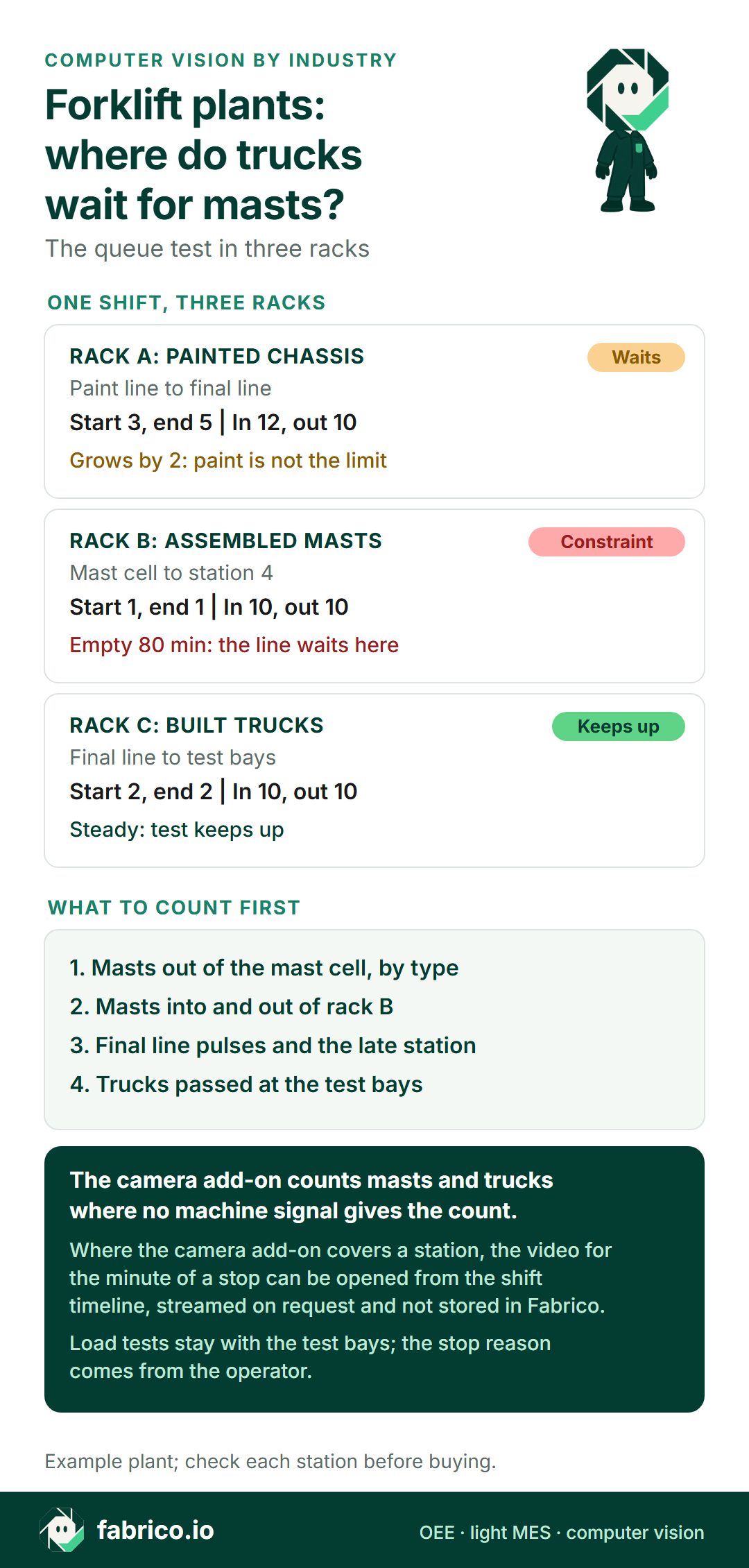
Text version of this infographic
- Forklift plants: where do trucks wait for masts? The queue test in three racks.
- Rack A, painted chassis, paint line to final line: start 3, end 5, in 12, out 10. Grows by 2: paint is not the limit. Waits.
- Rack B, assembled masts, mast cell to station 4: start 1, end 1, in 10, out 10. Empty 80 min: the line waits here. Constraint.
- Rack C, built trucks, final line to test bays: start 2, end 2, in 10, out 10. Steady: test keeps up. Keeps up.
- What to count first: 1. Masts out of the mast cell, by type. 2. Masts into and out of rack B. 3. Final line pulses and the late station. 4. Trucks passed at the test bays.
- The camera add-on counts masts and trucks where no machine signal gives the count.
- Where the camera add-on covers a station, the video for the minute of a stop can be opened from the shift timeline, streamed on request and not stored in Fabrico.
- Load tests stay with the test bays; the stop reason comes from the operator.
- Example plant; check each station before buying.
Explainer presented by Iris, Fabrico's AI-generated presenter: how an add-on camera counts output where a machine has no signal. Book a demo.
Plays from YouTube. Google may set cookies when you press play. Privacy policy.
Reading the racks on a lift truck line
A rack that grows sits in front of a station that is not keeping up with what arrives, or that is being fed faster than the plan needs. A rack that runs empty sits right after a station that cannot keep up. In the example, rack A grew because the final line was held back. Rack B ran empty because the mast cell upstream of it did not deliver ten plus two masts. Rack C stayed level, so the test bays are not the limit on this shift.
Two traps catch plants reading racks for the first time. The first is to blame the station in front of the full rack: rack A was full because station 4 had no mast to mount. The second is the start and end count. Rack B looks healthy on an end-of-shift sheet; only the empty minutes show the two lost pulses. The theory of constraints calls this a buffer that protects the constraint; here the buffer protected nothing, because the constraint sat behind it. A drum-buffer-rope set-up would size rack B to cover the mast cell's worst hour, not its average one.
Plants that build several truck families run counterbalance and warehouse trucks on different lines, each with separate racks. FEM's World Industrial Truck Statistics sheet for Q4 2025 shows why: in each of the three yearly tables it carries, Class 1 electric counterbalanced rider trucks are about 18% of world shipments (434,173 of 2,381,417 in the largest year), while the warehouse classes 2, 31 and 32 together make up more than half. A queue test is run per line, never across two lines that share a paint shop.
On a paced final line, a camera add-on cannot see the late station
Many forklift final lines are paced. The line indexes when the last station is ready, and all trucks move one position at once. A camera add-on at the exit of station 4 sees one truck leave per pulse, and so does a camera add-on at the exit of station 7. On a synchronous line, all stations show the same exit count and the same gaps, so no station-exit count can say which station finished last.
Plants see the late station in three other ways. The line controller logs a station-ready signal per station per pulse; the last ready signal before each index is the holdup. Where stations have andon buttons, the andon log shows who called and for how long. Where neither exists, the team leader logs the stop reason on a tablet when the line waits, for example "station 4, no mast". Fabrico reads the index and the stop from the line controller, and the operator adds that reason. The gap between takt and pulse, in the sense of cycle time, takt time and lead time, is the minutes the late station cost.
The stations around the constraint, and the variants they absorb
The example plant builds electric counterbalance trucks in a low to mid volume, with many options per order: duplex or triplex masts, several lift heights, side-shift, fork lengths, cab or open overhead guard, lead-acid or lithium-ion batteries. Two branches feed one final line.
- Chassis branch. Frame welding in robot cells, then the paint line on an overhead conveyor, then rack A. Robot cells and the paint conveyor already give a count from their controllers; see OEE for robotic welding cells.
- Mast branch. Mast channel welding and machining, the same paint line, then the mast cell. A crew of three nests the channels, shims the rollers, fits the lift cylinders, chains, hoses and the carriage, and runs a hold test before the mast goes on a cart to rack B. Nothing in that cell gives a count.
- Bought-in parts. Counterweight castings are craned in at station 3; batteries from the battery room fit at station 6.
- Final line and test. Eight paced stations, rack C, two test bays for the static and dynamic tests, then the load plate.
Heavier machinery plants follow the same logic with different racks; computer vision for agricultural and construction machinery reads a tractor line by model, and computer vision for railway rolling stock reads a bogie line by bogie type. Indexed lines with a slow manual station appear in computer vision for lawn mower and garden equipment, and body builds on bought-in chassis in computer vision for truck body and trailer manufacturing.
Where the count comes from at each forklift station
A camera add-on is worth its mount only where nothing else gives the count.
| Station | Where the count comes from | Camera add-on |
|---|---|---|
| Frame and mast welding cells | Robot controller cycle count | Not needed |
| Channel machining | CNC program and part count | Not needed |
| Paint line | Conveyor hanger count | Not needed |
| Mast cell | Nothing today | Masts out on the cart lane |
| Rack B to station 4 | Line index, one mast a pulse | Not needed |
| Battery fitting, station 6 | Line index plus battery serial scan | Not needed |
| Test bays | Test bench pass and fail | Not needed |
| Rework bay | Nothing today | Trucks in and out |
Two stations in eight need a camera add-on, and both sit off the paced line. The rework bay matters because a truck that leaves the test bays for rework and returns is easy to count twice.
Inspection, tests and the rules that decide when a truck is finished
The rules differ by market, and they move the point where a truck counts as good. None of them is a job for the camera add-on: the result comes from the test bay, the plate from the configuration, the serial from a scan.
EU, testing. The EU Machinery Regulation (EU) 2023/1230 says "The static and dynamic tests referred to in section 4.1.2.3 shall be performed on all lifting machinery or related products ready to be put into service." Directive 2006/42/EC carries the same duty until the Regulation applies on 14 January 2027, when the Directive is repealed. So a truck is not good output when it leaves the final line; it is good when it passes the test bay. The good count belongs to the test bay, and the line count is only "built".
EU, load plates. The same annex says that where the maximum working load depends on the configuration, each operating position gets "a load plate indicating, preferably in diagrammatic form or by means of tables, the working load permitted for each configuration." Mast height, mast type and attachments change the plate, so the configuration belongs to each truck record, not to the line.
US, design standard. Under OSHA 29 CFR 1910.178, a US employer rule, "All new powered industrial trucks acquired and used by an employer shall meet the design and construction requirements" of ANSI B56.1, and approved trucks "shall bear a label or some other identifying mark indicating approval by the testing laboratory." The B56 committee is run by the Industrial Truck Standards Development Foundation. In Europe and elsewhere, the ISO 3691 series is the reference standard for industrial truck safety.
EU, batteries. The EU Batteries Regulation (EU) 2023/1542 requires that "From 18 February 2027 each LMT battery, each industrial battery with a capacity greater than 2 kWh and each electric vehicle battery placed on the market or put into service shall have an electronic record". A traction battery built for a lift truck reads as an industrial battery under the Regulation's definition, so the plant's compliance team will want the battery serial tied to the truck serial at station 6. See lot versus serial tracking for how the two kinds of record differ.
A mast cell shift, priced in trucks the line did not build
The example is the mast cell on the early shift, 06:00 to 14:30 less two 15 minute breaks: 480 planned minutes for a crew of three. All figures are example inputs; a plant replaces them with plant figures.
- Ideal times, cell minutes. Duplex mast 30, triplex mast 45.
- Plan. 12 trucks: 8 duplex and 4 triplex, which needs 420 cell minutes. The cell has 60 minutes of slack.
- Stops, 68 minutes. Hose kits short from kitting 34, painted channel set late from the paint line 22, chain fixture change 12.
- Run time. 480 minus 68 = 412 minutes.
- Counted by the camera add-on at the cart lane. 8 duplex and 3 triplex: 8 x 30 + 3 x 45 = 375 earned minutes, so slow cycles cost 412 minus 375 = 37 minutes.
- Quality, 30 minutes. One duplex mast failed the hold test at a hose fitting. The fail comes from the hold test, not the camera add-on.
- Good. 7 duplex and 3 triplex: 345 minutes.
Availability 412 / 480 = 85.8%. Performance 375 / 412 = 91.0%. Quality 345 / 375 = 92.0%. OEE 85.8% x 91.0% x 92.0% = 71.9%, the same as 345 / 480. The cell lost 135 minutes. The slack absorbed 60, and the other 75 are exactly one duplex and one triplex mast. Rack B stood empty for 80 minutes because the line loses whole 40 minute pulses: two pulses, two trucks short, 10 built against a plan of 12.
The money, only while orders wait. No vetted public price list is used: the large truck makers sell connected fleet products, so they are not sources here. The example takes an ex-works price of EUR 24,000 for a duplex truck and EUR 36,000 for a triplex truck, with 25% contribution: EUR 6,000 and EUR 9,000. That 25% sits between the 15.86% pre-tax operating margin and the 37.47% gross margin for US Machinery companies in NYU Stern's January 2026 margin table, which is scale only. Both work out at EUR 200 per ideal cell minute.
The two trucks the line did not build cost EUR 6,000 + EUR 9,000 = EUR 15,000 a shift, or EUR 315,000 over 21 early shifts, but only while orders wait for trucks. Pricing all 135 lost cell minutes at EUR 200 gives EUR 27,000 and overstates the loss by EUR 12,000, because 60 of those minutes were slack that cost no truck. When orders do not wait, the loss is crew time: eight people on the final line waited 80 minutes, 10.67 hours at the 2025 euro area average of EUR 38.2 an hour from Eurostat's labour cost estimate, about EUR 407 a shift. The failed mast is reworked by two fitters in 45 minutes, 1.5 hours or EUR 57.30 at crew time, and goes to rack B next shift; it is not lost margin.
The decision is which loss to fix first, the core of a capacity release business case. With the plan's mix, the cell needs losses of 60 minutes or less to deliver 12 masts.
| Fix | Losses left | Masts a shift | Contribution won |
|---|---|---|---|
| Today | 135 min | 10 | Baseline |
| Hose kits on time | 101 min | 11 | EUR 6,000 |
| Plus painted channels on time | 79 min | 11 | EUR 6,000 |
| Plus no fixture change | 67 min | 11 | EUR 6,000 |
| Plus slow cycles cut by 20 min | 47 min | 12 | EUR 15,000 |
Clearing all three stops still leaves the line one truck short. The cell also has to run closer to its ideal times, which only a count by mast type shows. That capacity versus throughput gap is invisible on a sheet that records only stops.
First steps: what to count, in this order
- Masts out of the mast cell, by type. A camera add-on over the cart lane counts each mast as it leaves; the type comes from the order the cell is building. Start here, because it is the one feeder with no count today.
- Masts into and out of rack B. In is the cell count; out is the line index at station 4. The difference, minute by minute, is the empty time that cost the pulses.
- Final line pulses and the late station. From the line controller's ready signals, or the stop reason the team leader logs.
- Trucks passed at the test bays. From the test bench. This is the good count, so it decides the quality figure.
- Trucks in and out of the rework bay. A second camera add-on, only if retests get counted twice.
Count whole units the camera add-on can see. Dumery and colleagues at EPFL (ICCV 2025) note that existing counting methods "struggle to handle the challenge of stacked 3D objects in which most objects are hidden by those above them", and that object localizations "are often erroneous when objects are stacked together". A mast on a cart, one per lane, fits a camera add-on. Rollers in a bin, chains on a reel or forks stacked on a pallet do not; those come from the kit list. Glare and people standing between the lens and the cart also hide a unit, so the lane is chosen first. Picking the pilot line follows the same rule: the station with the clearest view and the biggest gap first.
Where Fabrico fits on a lift truck line
Fabrico is cloud OEE software and light MES. Stops and counts come from the machine signal: the robot cells, the paint conveyor, the final line controller. The operator adds the stop reason at the station on a tablet or phone. OEE is shown by station and shift, and losses are priced from each SKU's price or margin, so a lost triplex truck carries its own value.
The camera add-on counts output where no machine gives a signal: the mast cell cart lane, the rework bay. Where the camera add-on covers a station, the video for the minute of a stop can be opened from the shift timeline, streamed on request and not stored in Fabrico. See computer vision for OEE and MES and OEE with computer vision for the camera add-on in detail.
On Fabrico's roadmap, not live today: the camera add-on suggesting a stop reason from the video. Today the reason comes from the operator.
Load tests stay with the test bays, weld checks with the welding inspectors and paint checks with the quality team (see inspection versus testing); the test bench pass and fail signal feeds the quality figure. The build plan lives in the ERP or the planning spreadsheet; Fabrico supplies the counts and rates. Reports export to Excel, and Fabrico also has a REST API and webhooks.
Want to see a mast cell and a paced final line counted side by side? Book a demo.
Questions for any vendor before a forklift plant pilot
- The mast type comes from the order, not the image. How does the system take it from the ERP or the operator?
- How does it read station-ready signals and the index from the final line controller?
- Can one rack have its in count from a camera add-on and its out count from the line, on one timeline?
- How is a truck that fails the static or dynamic test, is reworked and passes on a retest booked: built once, good once?
- Are losses priced from each SKU's price or margin, so a triplex minute and a duplex minute carry their own value?
- Can test bay results be exported with the truck serial for the battery and load plate records the plant keeps?
- What happens to the count when masts arrive in rack B from a second shift or a supplier?
- Who can open the camera add-on view, and how is that agreed with the works council?
Agree in writing what the pilot must show on the floor, as in a factory acceptance test versus site acceptance test.
Cameras and the people who build masts
A camera add-on at the cart lane is aimed at masts, not at fitters. In plants with a works council, agree the view, who can open the minute of a stop and for what purpose before mounting it. Counts by station and shift say nothing about one person. GDPR and production line cameras covers the EU side of a camera add-on.
Forklift plant questions, answered
Does a camera add-on work on a paced forklift final line?
For counting units, yes; for finding the late station, no. On an indexed line all trucks move together, so a station-exit count looks the same at all eight stations. The late station comes from the line controller or the team leader's stop reason.
Can the camera add-on tell a duplex mast from a triplex mast?
The camera add-on counts masts. The mast type comes from the order the cell is building, from the ERP or selected by the operator on the tablet.
How is a truck that fails the load test counted?
Built once at the final line, then a quality loss at the test bay until it passes a retest. Rework is priced at crew time, because the truck still ships.
Do lithium-ion batteries change what the plant has to count?
They add a serial at the battery fitting station. In the EU, industrial batteries above 2 kWh need a battery passport from 18 February 2027, so the truck serial and the battery serial belong together.
How many shifts does the queue test need?
One shift at three racks shows a direction. The plant repeats it on another shift and another model mix before it moves people or buys a camera add-on, and it sets that pace itself.
Want to see a forklift line's racks, mast cell and test bays counted on one timeline? Book a demo.
Related articles






Latest from our blog







Real Fabrico tiles, sample data.