


 Login
 Blog

Computer Vision for Modular Housing: Audit the Module Count Before It Ships

In short: Computer vision in modular housing means a camera add-on that counts finished modules where no machine signal exists, so OEE rests on modules accepted, not pulses moved.
Inspection stays with the QA team and any third-party agency; the camera add-on counts units, it never judges a module.
Key takeaways
- Count each module once, at the acceptance bay exit. A house is complete only when all its modules pass.
- A repaired module that crosses the exit again is rework, not new output.
- Pods, stairs and wall panels are feed. Count them where they are made or received.
- In the example shift the sheet reads 94.5% while the audited OEE is 73.5%: one module of contribution a day goes unseen.
Miscount audit: where a modular plant's module number drifts
A volumetric or panelised home factory reports one number upward: modules or houses built. It feeds the build plan, the site delivery dates and the OEE of the line, and it drifts for reasons of this industry: houses of two or three modules, a snagging loop, bought-in sub-assemblies and counts taken at the wrong station. The table lists eight drifts on a pulse line, the fix, and who keeps the corrected count.
| Miscount | What the sheet shows | Fix | Kept by |
|---|---|---|---|
| House booked as one unit | 4 houses when one has a module still in snagging | Count modules; mark a house complete when its last module passes | Acceptance bay |
| Counted at the floor set | Modules started at S1, not finished | Count at the acceptance bay exit | Acceptance bay exit |
| Repaired module counted again | Yesterday's snagged module as new output | One module ID, one count; repair time to quality | Snagging bay |
| Rejected module called good | Quality 100% | Good only after QA or the agency accepts | QA team |
| Pods and stairs as output | Feeder parts in the module total | Count feed at receiving or its cell | Goods in, joinery |
| Wall panels as modules | Panel line output in module units | Panel line keeps its own machine count | Panel line controller |
| Handover module counted twice | Both shifts book the module at S5 | Count at the exit; note the pulse position | Line leader |
| Late pod booked as planned | Availability looks fine | A stop with the reason pod late | S3 crew lead |
The repaired module counted again and the rejected module called good move OEE most, because each raises output and quality at once.
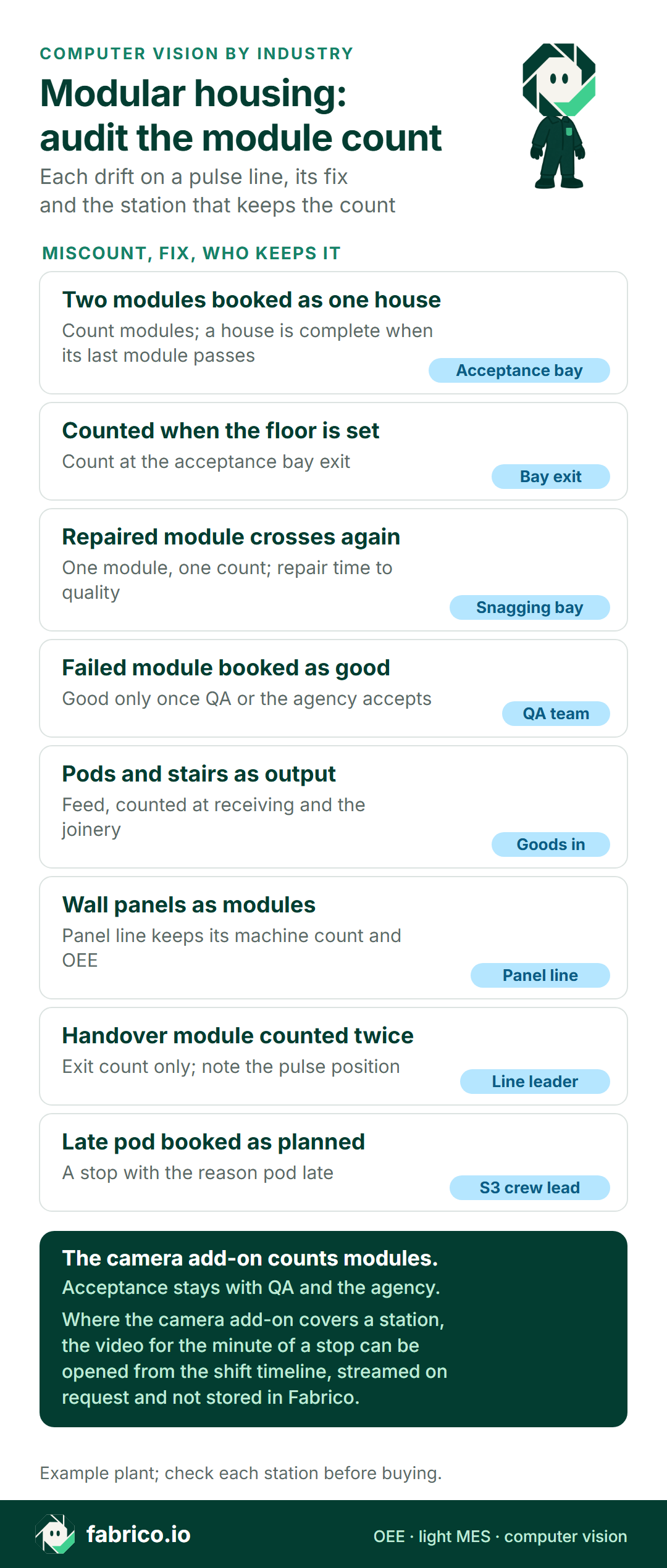
Text version of this infographic
- Computer vision by industry. Modular housing: audit the module count. Each drift on a pulse line, its fix and the station that keeps the count.
- Two modules booked as one house. Count modules; a house is complete when its last module passes. Acceptance bay.
- Counted when the floor is set. Count at the acceptance bay exit. Bay exit.
- Repaired module crosses again. One module, one count; repair time to quality. Snagging bay.
- Failed module booked as good. Good only once QA or the agency accepts. QA team.
- Pods and stairs as output. Feed, counted at receiving and the joinery. Goods in.
- Wall panels as modules. Panel line keeps its machine count and OEE. Panel line.
- Handover module counted twice. Exit count only; note the pulse position. Line leader.
- Late pod booked as planned. A stop with the reason pod late. S3 crew lead.
- The camera add-on counts modules. Acceptance stays with QA and the agency. Where the camera add-on covers a station, the video for the minute of a stop can be opened from the shift timeline, streamed on request and not stored in Fabrico.
- Example plant; check each station before buying.
Explainer presented by Iris, Fabrico's AI-generated presenter: how an add-on camera counts output where a machine has no signal. Book a demo.
Plays from YouTube. Google may set cookies when you press play. Privacy policy.
Module, house or section: what one unit means on a module line
The unit is the first decision, and the rules of each market already make it. In the UK the government's MMC definition framework sorts factory building into seven categories. Category 1 is pre-manufacturing of 3D primary structural systems, which is volumetric modules. Category 2 is 2D primary structural systems, which is panels and cassettes. Category 5 is non-structural assemblies and sub-assemblies, where most bathroom pods sit. A plant running Category 1 and Category 2 under one roof has two units; adding them makes both meaningless.
In the United States the HUD Code makes the unit plain for manufactured homes. Under 24 CFR 3280.11, a permanent label is fixed to each transportable section of each home. A double-section home carries two labels and is two units of factory output, even though the buyer sees one house. Modular homes built to a state programme follow the same logic: in Maryland, the state insignia is applied to the industrialized building unit by the third-party agency once it passes an assembly line inspection, and a location report goes to the state three days before shipment for each unit.
The label or insignia is the cleanest good count a module plant has, because an outside party issues it. It is also late. For OEE by station and shift, the plant still needs the moment each module leaves the line and the moment it comes back from snagging.
A plant study of a US factory building sectional homes shows how section and house blur on the floor. In the Jordan Journal of Mechanical and Industrial Engineering simulation study, the two sections of a double-bay house are matched at the exterior wall and roofing stations, processed together, then split before the finishing stations, and time data were taken against the floor number on the tag on each chassis. A count at a matched station sees one house; after the split it sees two sections.
Computer vision for modular housing: which stations already have a machine signal
A modular plant is mostly hand work. First list what the machines already report.
- Panel lines. Framing tables, nailing bridges and sheathing stations run on a controller with a cycle count. Fabrico reads that signal for the panel line's OEE.
- Joinery and CNC cutting. Program runs and parts cut: parts, not modules.
- Module transfer. The transfer car or pulse drive PLC knows a move happened, not whether the module went on to acceptance or across to the snagging bay.
- Acceptance and test. Electrical and pipework pressure tests and the QA walk-round give a pass or fail per module, kept by the QA team and any agency.
The gaps are the manual pulse stations and the two doors where the count matters most: the acceptance bay exit and the snagging bay. There the camera add-on counts modules crossing a marked line. It does not count studs or screws, and it does not decide whether a module passed.
| Station | Count source | Unit | Who picks it |
|---|---|---|---|
| Panel line | Machine controller | Panels, cassettes | Production engineer |
| S1 to S6 pulse moves | Transfer car or pulse drive PLC | Pulses | Line leader |
| Acceptance bay exit | Camera add-on | Modules out | Plant manager |
| Snagging bay door | Camera add-on | Modules in and out | QA lead |
| Pod and stair receiving | Goods in scan | Feed parts | Logistics |
| Stop reasons | Operator on a tablet or phone | Minutes, reason | Each crew lead |
Pulse moves are a poor proxy for output. The study above reports a factory making 10 sections a day where comparable factories made 7, each section taking about two days from chassis to clean-up. Over a two-day cycle, a pulse count and a finished count can sit a day of output apart.
Snagging, red tags and the module that crosses the exit twice
Snagging is normal in a module plant. A wet room fails its water test, a circuit fails the electrical test, or a finish is damaged in transfer. The module goes to the snagging bay, is fixed and returns to acceptance, crossing the exit once on the day it was built and again on the day it was repaired.
US rules treat a failed home as not yet good. Under 24 CFR 3282.362, the in-plant primary inspection agency can withhold the label and red tag a home that does not conform, and only the agency may remove the red tag. The same section requires the agency to keep records of red-tagged homes and the status of each. That record is the quality count; the production sheet should agree with it, not with the crew's tally.
The fix is a rule, then a count. The rule: one module ID, one good count, booked on the day it is accepted, and its repair time counted as quality loss of the shift that built it. The count: the camera add-on at the snagging bay door counts modules in and out, and the module ID comes from the job record, so a second exit is matched to the first. See lot versus serial tracking for keeping the ID across stations, rework and the good count in OEE for why a repaired unit must not re-enter good output, and quality holds and rework tracked inside OEE for holds in the same report.
In the UK, BOPAS accreditation audits the designers, manufacturers and constructors of offsite systems; it was set up with mortgage lenders so that the durability of offsite systems would exceed 60 years or two mortgage terms. The QA records are already audited, so the shift report should take its quality number from them, not from a separate tally.
Pods, stairs and wall panels: feed, not output
A module line pulls from feeders: the wall panel line, floor and roof cassette jigs, a stair cell in the joinery, and pods made in a pod cell or bought in. Each is output for its cell and feed for the line. Two rules keep the module total clean:
- Each feeder has its own count and OEE. The panel line counts panels, the pod cell counts pods; neither is added to modules.
- A late feeder is a stop on the line. When S3 waits for a pod truck, the held pulse is availability loss with the reason "pod late", logged by the crew lead on a tablet or phone.
Waiting time booked as planned time removes itself from availability. Logged as a stop, it sits in the shift report next to the supplier who caused it, and the buyer has a number to take to the pod supplier. The panel side of the flow, saws, routers and the waits between them, is covered in MES for woodworking.
Example layout: a two-module bungalow on a six-station pulse line
The example plant builds timber-framed volumetric modules for two-module bungalows in the EU: six stations, crews of four to six at each, one module a pulse, feeders from the side, acceptance and snagging bays at the end.
Two cameras cover the counts that decide OEE. Everything upstream is a machine count (the panel line), a pulse move (the PLC) or a stop reason from the crew. In a module plant the number of camera positions is the number of doors a module can leave by, not the number of stations.
One day shift audited: the sheet against the exit count
Example inputs, not a real plant. Day shift 06:00 to 14:45, less two 15 minute breaks: 495 planned minutes. The example ideal pulse at the line exit is 52 minutes a module, set from the work content of the slowest station rather than from the takt time the order book asks for.
- Stops, 46 minutes. S3 held 28 minutes for a bathroom pod delivery; the transfer car faulted for 18 minutes. Run time 449 minutes.
- Slow, 33 minutes. Wall panels reached S2 out of sequence, so several pulses ran long. Eight modules crossed the exit for the first time: 8 x 52 = 416 earned minutes.
- Quality, 52 minutes. One module failed the wet room water test and went to snagging. Seven modules were accepted: 364 good minutes.
Availability 449 / 495 = 90.7%. Performance 416 / 449 = 92.7%. Quality 364 / 416 = 87.5%. OEE = 90.7% x 92.7% x 87.5% = 73.5%, the same as 364 / 495.
| Line on the report | Shift sheet | Audited | Why |
|---|---|---|---|
| Modules | 9 | 8 built, 7 good | Yesterday's repaired module crossed again |
| Rejected | 0 | 1 | Water test fail called good |
| Houses complete | 4 | 3 | One bungalow waits for its second module |
| Stops booked | 18 min | 46 min | Pod wait booked as planned |
| OEE | 94.5% | 73.5% | 468 vs 364 good minutes |
The sheet is not lying on purpose. Each entry is true where it was written: the exit crew saw nine modules go out, the S3 lead saw a planned wait, the planner saw four bungalows started. The audit moves each count to the station that keeps it. The study above adds a warning from a quota floor: crews that finished their 6 to 7 sections left, while lagging crews stayed to finish. On a floor like that, a crew tally is the number most likely to drift, which is the gap between a production counter and OEE software.
What the unseen module costs a shift
No vetted public margin for a single module exists, so the price is an example input: EUR 52,000 ex works a module at a 20% contribution, EUR 10,400. For scale, US homebuilders in the NYU Stern margin data for January 2026 run a 22.70% gross and a 12.57% pre-tax operating margin; 20% sits between them, and since homebuilders also carry land, the band is only a sanity check. EUR 10,400 over a 52 minute ideal pulse is EUR 200 per ideal line minute.
| Item | Minutes | EUR a shift | Priced as |
|---|---|---|---|
| Stops (pod late 28, transfer car 18) | 46 | 9,200 | Contribution, only while orders wait |
| Slow pulses | 33 | 6,600 | Contribution, only while orders wait |
| Snagged module | 52 | 302.25 | Crew time: it ships after repair |
| Audited total | 131 | 16,102.25 | Stops and slow plus repair |
| Shift sheet view | 27 | 5,400 | Misses one module a shift |
Stops and slow cost 79 minutes, EUR 15,800 a shift, but only while house orders wait for a factory slot. If the order book is short, the lost minutes cost crew time instead: a line crew of 30 for 79 minutes is 39.5 hours at the euro area industry rate of EUR 40.3 an hour (Eurostat, 2025), EUR 1,591.85. The snagged module is not lost margin, because it ships after repair: three finishers for two and a half hours is 7.5 hours, EUR 302.25.
The sheet sees 27 lost minutes, EUR 5,400. The gap, EUR 10,400 a shift, is one module of contribution: EUR 218,400 over 21 day shifts while orders wait. Fabrico prices losses from each SKU's price or margin, with each module type set up as an SKU, so the plant replaces these example inputs with its figures.
Want to see a module line counted at the acceptance bay? Book a demo.
Questions for any vendor before a camera goes up in a module plant
- Is the unit a module, a section or a house, and can a two-module house be marked complete only when both modules pass?
- How is a repaired module that crosses the exit again matched to its first exit, and where does its repair time go?
- Can the QA team's accept or reject, or the agency label, set the quality count without a second tally?
- Are panel line, pod cell and module line counted as separate units with separate OEE?
- Can a held pulse at S3 be logged as a stop with the reason pod late, by the crew lead, on a tablet or phone?
- Where exactly does the camera sit at the acceptance bay door, and what happens when a forklift, a crane load or scaffolding blocks the view?
- How is the ideal pulse time set per module type, and who changes it when the house mix changes?
- What does the system offer the ERP and the site delivery plan: exports, an API, webhooks?
Question 6 matters more than it looks. Vision models lose accuracy when objects overlap or the light is poor: in a 2025 study of timber log detection in industrial sheds, the authors saw some degradation in accuracy with overlapping logs or poor lighting, and reached a mAP@0.5 of 0.640 on their test set. A module crossing a marked line at a bay door is a large single object, the easy case; studs in a stack are the hard case, and a module plant does not need to count them. For the detail of camera accuracy, see when the camera and the operator log disagree.
Where Fabrico sits between the pulse line and factory acceptance
Fabrico is a cloud OEE software and light MES platform. In a module plant that means:
- Counts and stops from the machine signal where one exists: the panel line controller, the pulse drive or the transfer car PLC.
- The camera add-on counting modules at the acceptance bay exit and the snagging bay door, where no signal exists.
- Stop reasons added by the crew lead on a tablet or phone; OEE, stops and losses by station and shift.
- Losses priced from each SKU's price or margin.
Where the camera add-on covers a station, the video for the minute of a stop can be opened from the shift timeline, streamed on request and not stored in Fabrico. Acceptance stays with the QA team and the third-party agency: their accept or reject result becomes the quality count. The plan stays in the ERP or the planning spreadsheet; Fabrico supplies the counts and rates it runs on. Reports export to Excel, and Fabrico also has a REST API and webhooks.
On Fabrico's roadmap, not live today: the camera add-on detecting a held pulse and suggesting a stop reason. Today the crew lead adds the reason, and the shift lead reviews the losses hour by hour in a short interval control meeting. For the wider method behind camera counts and OEE, see computer vision for OEE, and for a neighbouring building products plant, computer vision for window and door manufacturing.
Crews, cameras and the works council
A camera at the acceptance bay door frames the module and the floor marking, not the crews inside the line. Keep the field of view on the doorway, agree it with the works council or employee representatives before mounting, write down who can open the video and why, and mask what lies outside the doorway.
The count is per module and per station, never per person. Where the line runs on a quota, an exit count also takes pressure off the crews: nobody has to defend a number written down at the end of the day. For first pass against rolled yield across the snagging loop, see first pass yield versus rolled throughput yield; for how a pulse line is balanced, line balancing. Plants that also cast precast or blocks can compare computer vision for building materials.
What plant managers ask about counting modules
How is a two-module house counted on the line?
Count modules, not houses. Each module is one unit at the acceptance bay exit, and the house is complete when its last module passes, so one failed module of a pair does not hide behind the other.
Does a module that comes back from snagging count again?
No. A repaired module that crosses the exit a second time is the same unit. Its repair time sits in the quality loss of the shift that built it, and the module ID already has an exit, so the second crossing is booked as rework.
Can a camera count wall panels and cassettes as well?
Rarely needed. Framing tables and nailing bridges have a controller with a cycle and part count, and Fabrico reads that signal. The camera add-on earns its place where no signal exists, such as the acceptance bay door.
Who decides that a module is good?
The QA team does, and in US plants under the HUD Code or a state programme the third-party agency has the last word on the label or insignia. Fabrico takes their accept or reject result as the quality count; the camera add-on only counts the module.
Where does the module ID come from if the camera add-on only counts units?
From the plant's own job record: the serial or module number on the chassis tag, the label or the traveller. The camera add-on counts that a module crossed; the ID and the house type come from the job running at that station.
Do bathroom pods count as output?
Not for the module line. A pod bought in or built in a feeder cell is feed. Count it at goods in or at the pod cell, and count the module that contains it at the acceptance bay.
Want to see modules, snags and pod waits on one shift timeline? Book a demo.
Related articles





Latest from our blog







Real Fabrico tiles, sample data.